Who Deserves Credit for the Armenia–Azerbaijan Peace Deal?
Conflicts end because of patience, persistence, and luck—not one man’s showmanship.

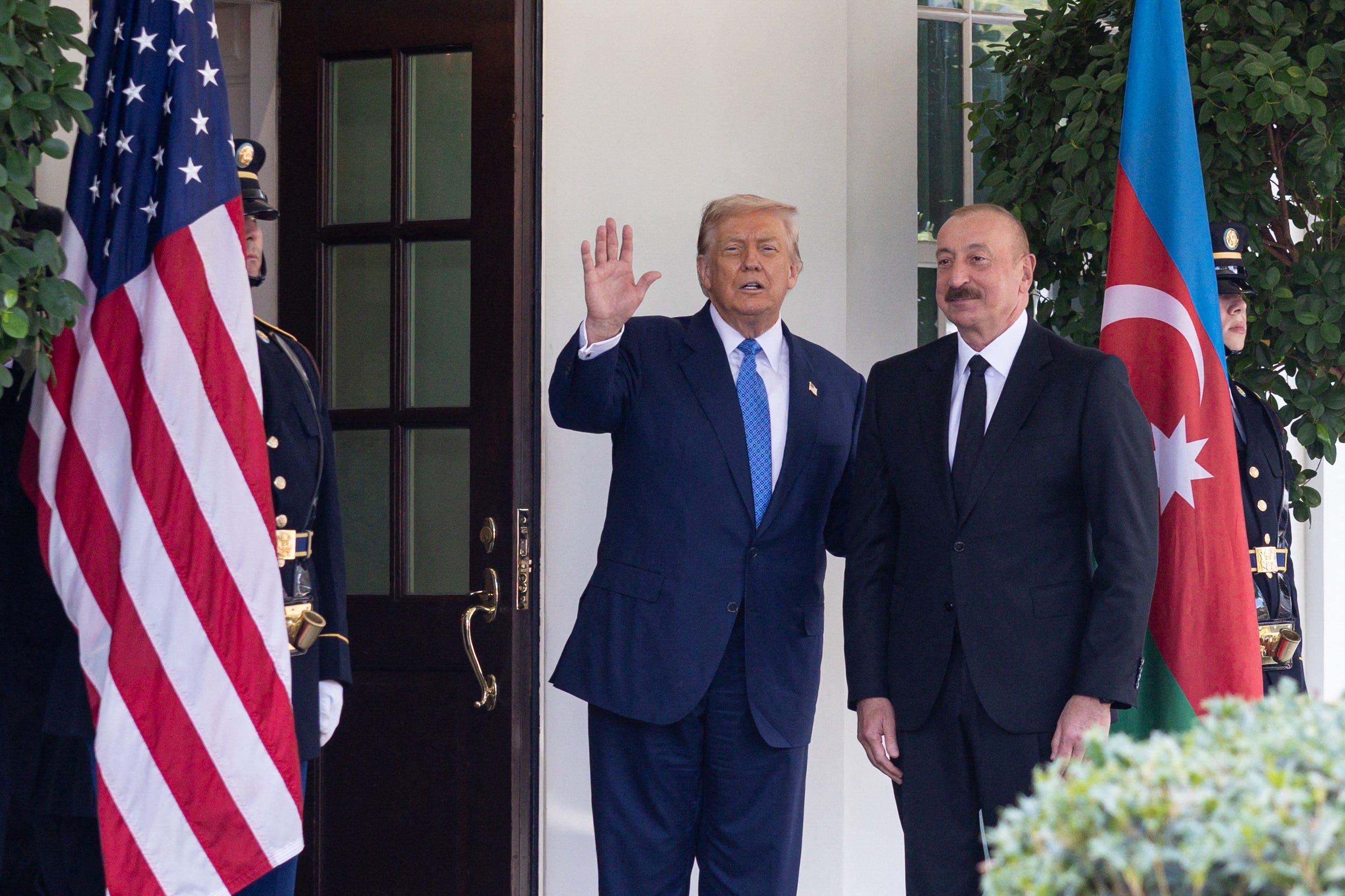
PRESIDENT DONALD TRUMP HOSTED Armenian President Nikol Pashinyan and Azerbaijani President Ilham Aliyev at the White House on Friday to sign a peace agreement that could be a major step toward normalizing relations between the hostile neighbors. Trump was quick to take credit, especially since the highlight of the deal is a 27-mile transit route linking Azerbaijan to its exclave via Armenia’s border with Iran. It’s a “great honor for me,” Trump said, implying he alone has caused this to happen.
But the story of how this agreement came to be is less about the heroic intervention of one American president than the payoff of patient, multi-decade diplomacy and the associated unpredictability of other countries in the region.
The Caucasus—wedged between Turkey, Iran, and Russia—has long been a combustible fault line in Europe and Asia. When Armenia and Azerbaijan emerged as independent states from the collapse of the Soviet Union in the early 1990s, they inherited an unresolved territorial dispute over a strip of land called Nagorno-Karabakh, deep-seated ethnic and religious animosities, and borders drawn without regard for security realities.
The result was a war that killed tens of thousands and displaced hundreds of thousands. A fragile ceasefire in 1994—mediated by the “Minsk Group” of France, Russia, and the United States—gave way to periodic clashes over the following three decades. The “frozen conflict” was relatively calm when I was commander of U.S. Army Europe from 2011 to 2013, but even then we tracked hostilities daily.
When I visited these countries multiple times in 2012, ethnic and territorial disputes simmered just below the surface. Both sides fired artillery rounds at each other as I watched through binoculars from a nearby hilltop. Military leaders from both countries confidently—and unrealistically—told me they would “settle it” on the battlefield.
The human dynamics I observed several times in the negotiating rooms were telling. Younger Armenian and Azerbaijani political officials often showed a willingness to explore solutions. But seated beside them were older, Soviet-trained generals—men shaped by rigid doctrine, zero-sum thinking, and decades of enmity—who were the immovable objects in the room. At one dinner in Baku, a policy discussion with Azerbaijan’s uniformed chief of defense nearly degenerated into a fistfight, which scared the hell out of my security team, enough so that they had their hands on their weapons beneath their sport coats. It was a reminder that personalities, as much as politics, often block progress, and those same personalities can often be the impetus for violence.
And yet, there were reasons for optimism. Georgia, Armenia, and Azerbaijan were sending professional, NATO-trained units to missions in Afghanistan and Kosovo. Young officers, educated in the West, and young soldiers who had trained with NATO forces were replacing that older generation of generals. Professional noncommissioned officer corps were taking shape in both countries. U.S. and NATO training programs and exercises were instilling the concept of the profession of arms and building trust through engagement and interaction. The idea that Armenia and Azerbaijan could field professional, nonaligned peacekeeping units—working shoulder to shoulder in the same global coalitions while locked in dispute at home—was remarkable.
But the realities of domestic politics didn’t change. Politicians on both sides used the dispute over Nagorno-Karabakh to distract from their failures to promote economic growth, political freedom, and honest government. Eventually, in a brief but bloody war in 2020, Azerbaijan retook a large chunk of Nagorno-Karabakh with drone swarms and tank battles. As in 1994, the war ended with a ceasefire, this time policed by Russian forces. Three years later, with Moscow distracted by its military disaster in Ukraine, Azerbaijan attacked again, seizing the whole of Nagorno-Karabakh and forcing 100,000 ethnic Armenians behind Armenia’s undisputed borders.
Throughout the decades of war and skirmishes, the United States tried to mediate, often with little to show for it. Those efforts were painstaking and often frustrating—and they spanned both Republican and Democratic administrations. While President Trump has claimed personal credit for this week’s breakthrough, the truth is that the United States has had remarkably little influence, but a great deal of luck, in resolving this ongoing conflict.
The United States has been trying to broker this kind of breakthrough for decades, often with Russia sitting at the same table. Now, Moscow is not only distracted by its devastating war in Ukraine, but its influence in the Caucasus is greatly diminished. Iran, another traditional major power in the region, is at the lowest ebb of its power in generations. The United States deserves some of the credit, but most of it goes to Israel, which radically diminished Iran’s most important proxy networks, decapitated its military leadership, destroyed its air defenses and many of its long-range missiles, thoroughly infiltrated its government and scientific bureaucracy, and even forced its supreme leader into hiding. Turkey, the third major power in the region and a de jure American ally, stands to benefit from this new deal, which encourages east-west trade routes (i.e. from the natural resource–rich Caspian Basin toward Turkey) rather than the currently prevalent north-south ones.
What made this agreement possible, though, was Azerbaijan’s dominant victory in 2023. It was brutal and opportunistic, but it did remove the major sticking point from Armenian–Azerbaijani relations and enable both countries to move forward. With that change in paradigm, and with a lack of other neutral powers, decades of American diplomacy under presidents of both parties could finally bear fruit.
The new agreement focuses on the long-contentious Zangezur Corridor, the narrow strip of Armenian territory linking Azerbaijan to its Nakhichevan exclave. Under the deal, Armenia also pledged to grant the U.S. exclusive development rights for 99 years, enabling rail, energy, and digital connections. Both countries will sign bilateral agreements with Washington, expand economic ties, and formally depart the OSCE Minsk Group, a tacit and strong acknowledgment that Russia’s role in the region has evaporated.
The deal is far from perfect. Many Armenian Americans and human rights advocates are concerned the agreement fails to address displacement from Nagorno-Karabakh or the fate of prisoners of war. And the official handshake will not erase decades of mistrust. As one U.S. official put it, “Tomorrow is the handshake in writing the check, and we still have to ink the contract and cash the check.”
If this agreement holds, it will be more than just a U.S. diplomatic win; it will be proof that even in one of the most intractable post-Soviet conflicts, sustained diplomatic engagement, trust-building, and professional military reform just might have an eventual capability to create conditions for peace.
This is not the end of the story, but it just may be the start of a new chapter. It’s mostly a reminder: Diplomacy conducted over years and across administrations can pay off. Especially when the forces of stability outlast the ambitions of those who thrive on instability.
 | A guest post by
|