Why Are Democrats Teasing Homophobia in New Attacks on MAGA?
The strategy demeans an important constituency of the party without providing an obvious political gain.

“WHEN YOU SAY ‘THAT’S SO GAY,’ do you realize what you say? Knock it off,” declared Hilary Duff in her now-iconic 2008 anti-bullying PSA. It’s arguably the most famous example of a wave of anti-bullying messaging campaigns that crested in the late 2000s; anyone old enough to have had a MySpace account will remember the emergence of NOH8 posters and It Gets Better videos. The latter initiative was a direct response to a spike in teen suicides across the country; for a time, national attention fixated on how kids were being shaped by not just overt attitudes like bullying, but also by the insidiously hostile language of classrooms, hallways, and locker rooms. It was a time of realizing what you say, and knocking it off.
Obama-esque smarm seemed to become part of the Democrats’ DNA during his early tenure, as the widespread adoption of smartphones and social media shifted our public square online. Public reproach of politicians and public figures from regular citizens escaped the containment of the local paper’s letters-to-the-editor page and became an ongoing, real-time concern, with the possibility of online criticism rapidly snowballing into a full-on PR crisis becoming a new kind of political threat vector. For some people, this focus on the unintended implications of certain words awakened in them a new social self-awareness. For others, though, PSAs like Duff’s marked the start of a malign era of “woke policing,” which conservatives worked tirelessly and effectively to weaponize against Democrats in the years that followed.
This is why it’s a bit surprising to find that in 2025, the Democratic party—a collection of “schoolmarms” and “scolds,” as your average right-winger might tell you; “the internet’s HR department,” as the Atlantic put it last year—is apparently trying to recast itself as snarky, bawdy, and a little angry. A full-blown rebrand is underway: Potential 2028 contenders, official party accounts, and swaths of the recently cautious base are pushing the boundaries they used to impose on others and adopting the cavalier persona of a Barstool Sports guy. Perhaps unsurprisingly, this has resulted in a lot of posting with an unmistakably homophobic angle.
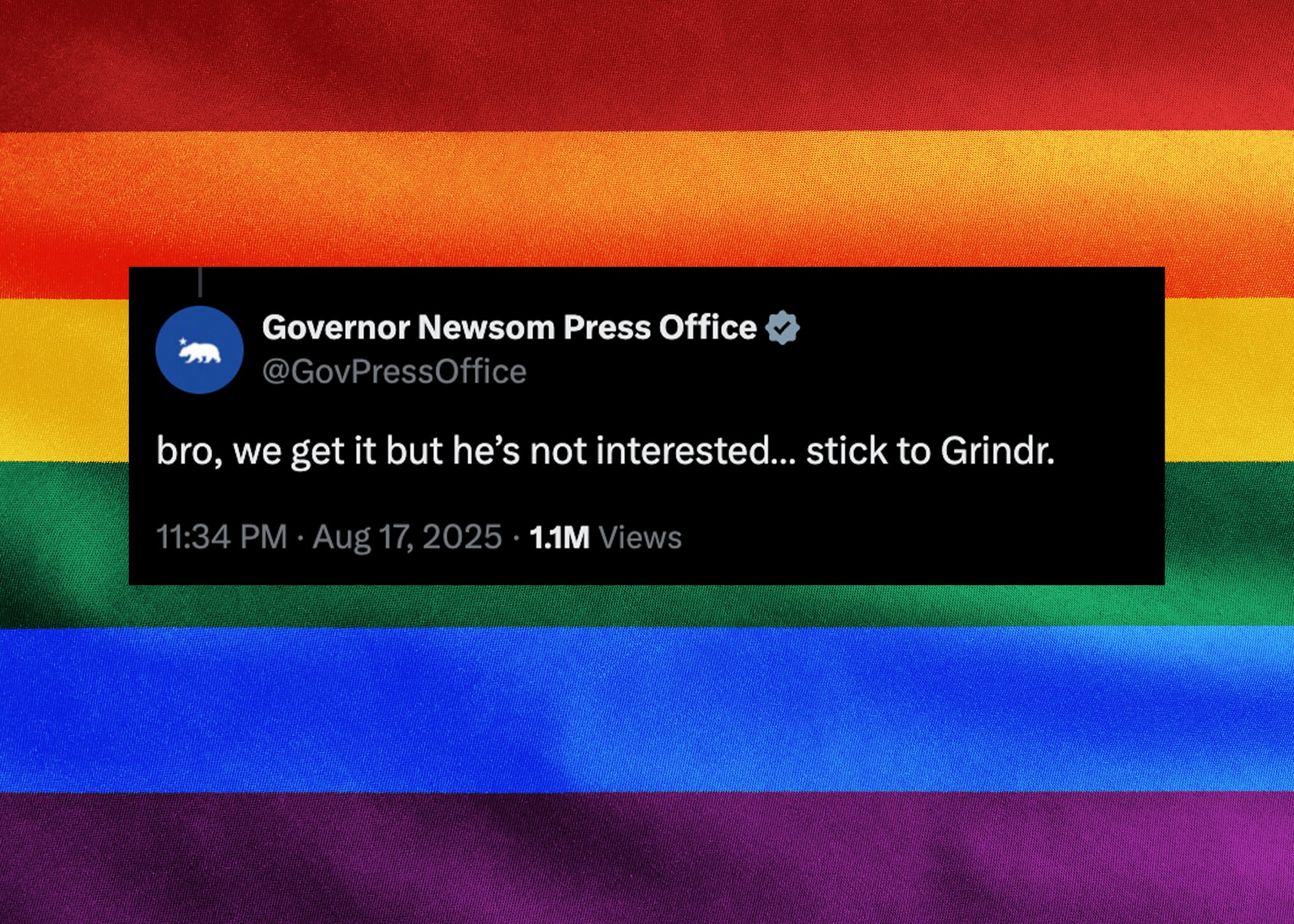
Examples of the new direction are plentiful. “Bro, we get it but he’s not interested . . . stick to Grindr,” reads a late-summer post from the popular ‘Governor Newsom Press Office’ satirical social account. (The post was a reply to a MAGA influencer’s rap video relating Newsom to Satan.) Breakout progressive media star Jennifer Welch recently went viral with a riff declaring JD Vance a “failed drag queen” who went to “Peter Thiel’s gay boot camp in Silicon Valley” to become “a sociopathic queer-eyed freak show.” She added, “You know, he’d be so much cooler if he’d just come out.” Don Lemon, during an episode of his podcast last month, said Megyn Kelly “looks trans.” No qualifications. He just flat-out said it. (In a blithe followup clip, he said, “perhaps I should, I should apologize to the trans community, because no one wants to look like Megyn Kelly.”)
Even more recently, Democrats have capitalized on a salacious, unsupported rumor that Donald Trump once gave former President Bill Clinton a blowjob. Potential 2028 presidential contender Ruben Gallego quote-tweeted a post containing a gif of a man doing a pantomime of giving simultaneous blowjobs, adding the caption, “Is that the Trump Dance?” And the official X account of the Democratic National Committee reposted an infamous clip of Trump doing a bit where he adjusts a podium mic in a way that clearly resembles—you guessed it—giving a blowjob. “Wtf is he doing,” the account helpfully added. There’s some evidence the new tone is working—to gain followers for Democratic accounts, if nothing else.
To be clear, this isn’t a complete break with the party’s messaging approach in the recent past. We’re not that far from some of the strange and amusingly crass shots the party took at the ticket in last fall’s election. (Who can forget the completely made-up “JD Vance had sex with a couch” story, which went from typical online shitpost to vice-presidential candidate shit-talk in the space of weeks? Senate minority leader Chuck Schumer made a joke about it just last month.) But the difference between that and the latest round of Democratic aggro-posting is that today, mainstream Dems seem more comfortable hitting marginalized groups with collateral damage if doing so makes it possible for them to land more effective blows against their Republican opponents.
So far, the party has largely seemed to accept the tradeoff and has held back on the sort of self-censoring for which it used to be known. Still, pragmatic self-justifications aside, something feels off.
At best, this is a controlled demolition of the “too woke” brand that some believe cost the party the 2024 election. If we can just land a real punch or two below the belts of our enemies, the thinking seems to go, perhaps we can get voters to hear us out on our pro-family policies, our economic vision, and our plans for housing and healthcare. What’s the harm in a few crude jokes if it helps pry MAGA out of office? Worn-out Democrats seem eager to make that sort of Faustian bargain, despite not knowing for sure what they would actually get out of it.
Other, less circumspect observers may experience the tone shift as pure catharsis—a welcome opportunity to give MAGA’s bullies a taste of their own medicine. Some Democrats almost certainly feel some level of satisfaction in turning Trump and his goons’ schoolyard hazing tactics against them. (Perhaps, they might think, it could even be the way to get macho influencers like Joe Rogan on board to help save the young male vote. Who knows?) But homophobia-teasing Democrats would do well to consider that when it comes to setting up a bigger political tent, humiliation is not as effective as persuasion.
Aside from the damage to the party’s coalition that may result from one of its longstanding constituencies being made the butt of hostile jokes, the Democratic shitposters are incurring big political risks by going for this sort of performative edginess. What happens when AOC asks what Newsom’s team meant with that Grindr joke on a 2028 primary debate stage? Will the governor’s posts play the way they did this year?
Still, the biggest concern is that a party that embraces a middle school–throwback form of performing hyperbolic straight masculinity—paying homage to the bleak ideals of “locker-room talk”—may come across as one that is still in the dark about how to make a substantive appeal to straight men. Because straight men aren’t looking for Democrats to cosplay as their drinking buddies: They’re looking for leaders who can speak plainly about the pressures and problems men face today and offer solutions that don’t sound like a hodgepodge of so many white papers, phone polls, and committee meetings. They don’t want to be prejudged (who does?), and they don’t want to feel so policed when they try to speak that silence comes to seem like the better option.
In short, they want normal, competent leaders who advocate for their interests, and their desire for such leadership is only going to grow as the consequences of Trump 2.0 become clearer over the remaining years of this administration.
If Democrats want to reset their reputation and position themselves to meet this need, they don’t have to mimic the class bully. They just need to grow more comfortable in their own skin. The question isn’t whether Democrats can make edgier jokes, but whether they can tell a more compelling story about who they are and what they’re fighting for—without setting their values on fire along the way. Is that really so much to ask?
 | A guest post by
|