Why Tech Titans Love Trump and Hate ‘Introspection’
Silicon Valley’s “builders” love the president who’s destroying everything.

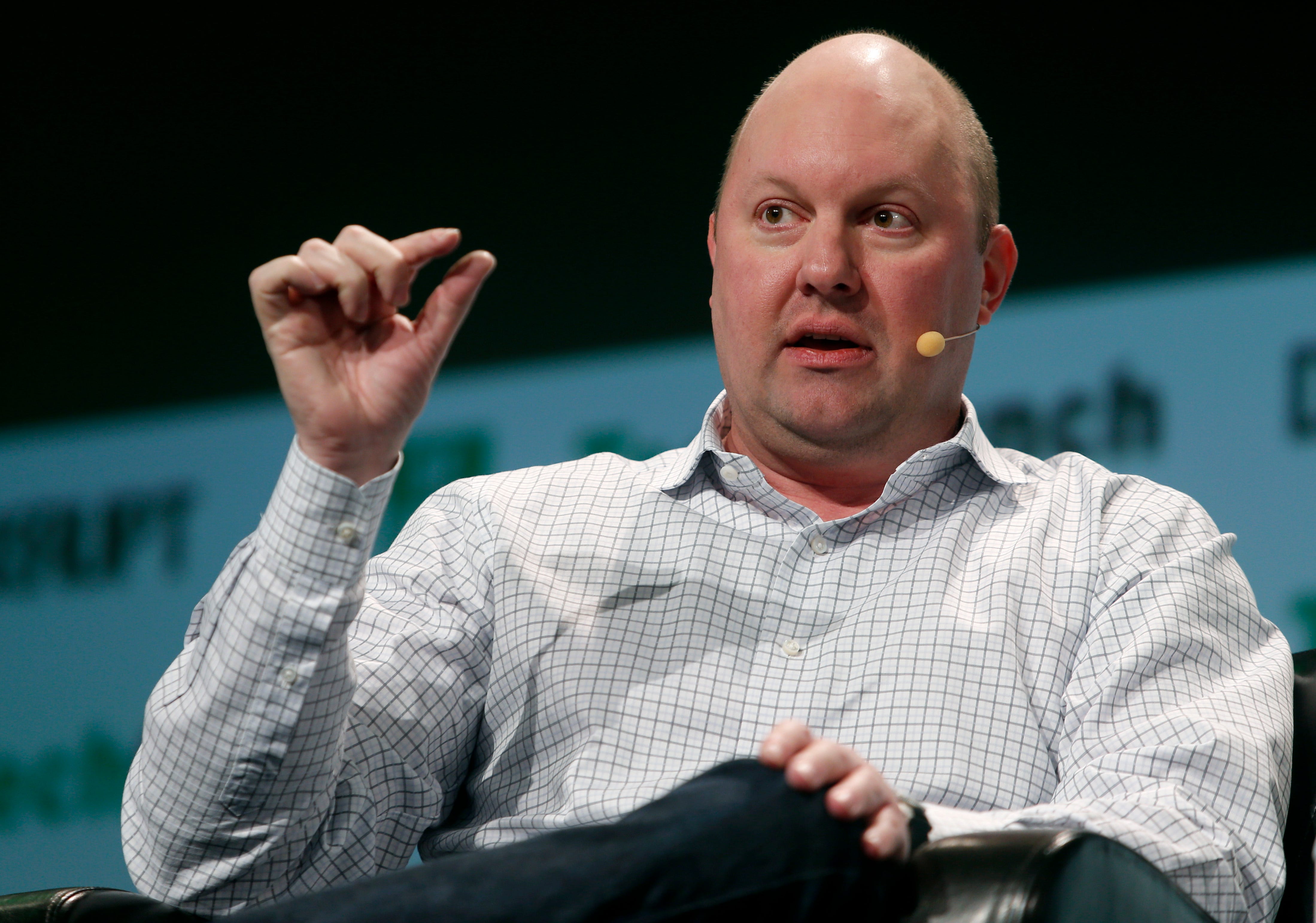
THE BILLIONAIRE TECH FOUNDER and venture capital investor Marc Andreessen thinks introspection is for suckers and losers. A podcaster recently asked Andreessen: “You don’t have any levels of introspection?” He replied: “Yes, zero, as little as possible.”1 When asked why, he said he preferred to “move forward.” What followed was a bizarre potted history of introspection as Andreessen understands it, which he believes was invented by psychoanalysts like Sigmund Freud in the early twentieth century. “Great men of history didn’t sit around doing this stuff,” Andreessen declared. He later cited Marcus Aurelius’s advice to “stop talking about what the good man is like, and just be one” to support his case, apparently indifferent to the fact that this line comes from Aurelius’s Meditations, which is nonstop introspection from cover to cover.
Andreessen, an early pioneer in web browsers in the 1990s and the cofounder of the major venture capital firm Andreessen Horowitz is a public and pugnacious advocate of unconstrained technocapitalism. He frequently comments on issues ranging from the wrongheadedness of AI doomerism to government regulation. In 2023, he published “The Techno-Optimist Manifesto,” which contains sentences like this: “Deaths that were preventable by the AI that was prevented from existing is a form of murder.” He closes his manifesto with his favorite catchphrase: “It’s time to build.”
Andreessen, no doubt unintentionally, illuminated a pervasive attitude in the Trump era. The cultures of Silicon Valley and MAGA often diverge—but parts of Trump’s second inaugural address would have been right at home in “The Techno-Optimist Manifesto,” such as his declaration that “we will pursue our manifest destiny into the stars, launching American astronauts to plant the Stars and Stripes on the planet Mars. . . . Americans are explorers, builders, innovators, entrepreneurs, and pioneers. The spirit of the frontier is written into our hearts.” With all this exploring, building, and pioneering to do, there’s little time for introspection. This is why it’s no surprise that several prominent Silicon Valley types are attracted to the self-described “builder” Donald Trump—a man who isn’t known for deep reflection and self-awareness.
Compare Trump’s words quoted above with Andreessen’s from his manifesto: “We believe that while the physical frontier, at least here on Earth, is closed, the technological frontier is wide open. We believe in exploring and claiming the technological frontier. We believe in the romance of technology, of industry. The eros of the train, the car, the electric light, the skyscraper. And the microchip, the neural network, the rocket, the split atom.”
Andreessen isn’t the only powerful investor and founder with a list of quotes about building stuff and American greatness and colonizing space as long as your arm who’s attracted to MAGA. White House AI adviser David Sacks has hailed cryptocurrency as a potential “new world currency,” adding that “Money is being made programmable. That’s a fundamental change with implications we can still barely see. . . . In math we trust.”
The administration’s most famous tech-billionaire frenemy, Elon Musk, is slightly more inclined toward introspection than Andreessen—especially when the process is chemically augmented. “We need to expand the scope and scale of consciousness so that we’re better able to understand the nature of the universe and understand the meaning of life,” he once said. The cosmic flavor of Trump’s second inaugural address was probably a nod to the Musk wing of MAGA. As Musk explains: “We are not shooting for the moon. We are shooting for Mars. A maniacal sense of urgency is our operating principle.” But maniacal ambition is often accompanied by other manias: “If the rules are such that you can’t make progress, then you have to fight the rules,” Musk believes. He also fervently and indignantly believes in . . . himself: “When I ask for something, you fucking give it to me.”
This gives us some idea of why Silicon Valley’s most prominent billionaires are so Trumpian.
THE MANTRA “YOU CAN JUST DO THINGS” has become popular among Trump’s supporters. It’s an ethos that the titans of Silicon Valley find attractive—they don’t have much patience for process or the slow grind of institutional change. If Elon Musk wants to make humanity an interplanetary species, who’s the Securities and Exchange Commission to stop him? He’s a builder and it’s time to build.
Trump is a uniquely disinhibited president. Trump sees himself as the architect of a new version of America, and a little corruption along the way is no obstacle to his vision. He has bottomless contempt for constraints on his freedom of action, which is why he has worked diligently to sideline Congress, flout the rule of law, turn the Department of Justice into his personal law firm, and so on. It’s why he wages war on Iran without bothering to consult with Congress or even make his case to the American people. It’s why his corruption is so brazen. He recently told New York Times reporters that the only constraints on his global power are “My own morality. My own mind. It’s the only thing that can stop me.”
But if MAGA Silicon Valley would take a moment to reflect on the long-term consequences of empowering an authoritarian to just do things, it would see that many of Trump’s achievements are a dangerous mirage.
ONE MAJOR ATTRACTION OF TRUMP to Musk and Sacks was his promise to stay out of wars. Trump has spent most of his political career bitterly denouncing “stupid” regime-change wars. He could take a moment to recall the rage he felt over those earlier wars, which had a tendency to spiral out of control, create devastating unintended consequences, and cost far more than their planners assumed. So much for that. Now, thanks to Trump’s Middle Eastern regime-change war of choice, oil prices are up over 70 percent since the start of the year—which some fear will cause the AI bubble to pop—and Trump is now pleading with allies and enemies to help reopen the Strait of Hormuz.
An introspective leader would have considered the way his relentless attacks on allies—such as the arbitrary imposition of massive tariffs and threats of invasion—have made it less likely that those allies will help in a time of need. A little introspection would have helped Trump realize that gratuitous insults don’t forge closer relationships with America’s friends. When Britain considered sending the aircraft carrier HMS Prince of Wales to the Persian Gulf, Trump said, “We don’t need people that join Wars after we’ve already won!”
But Trump, like Andreessen, doesn’t believe the great men of history—himself included—should bother with such beta habits as introspection and self-doubt. Trump once declared: “My gut tells me more sometimes than anybody else’s brain can ever tell me.” One thing Trump’s gut tells him is that he can break every promise he ever made to his base and get away with it. “MAGA loves it,” he said after the operation to capture Venezuelan dictator Nicolás Maduro. “MAGA is me. MAGA loves everything I do, and I love everything I do, too.” When immense power is concentrated in the hands of a leader who is incapable of introspection—particularly when that leader has encased himself in a thick personal filter bubble with cringing sycophants endlessly clamoring for his attention and affection—colossal miscalculations will be the result. Instead of learning from those miscalculations and changing course, Trump blames everyone but himself and maintains full confidence in his own judgment.
Trump has generally been able to offload responsibility for his mistakes, but his plummeting approval rating suggests that Americans are increasingly blaming him for an ever-lengthening list of self-inflicted disasters. His net approval rating is 18 points underwater, and approval of the war in Iran is even lower. The longer the war drags on, the worse it will get. Even if Trump ends the war, this is no guarantee that he will reconsider his new fixation on military interventionism. Trump recently said “I do believe I’ll have the honor of taking Cuba” and declared: “I can do anything I want with it.” He has also threatened Colombia and Panama. He considers Venezuela an American possession, and he remains obsessed with Greenland. If Trump were capable of introspection, the eruption of multiple global crises caused by the war in Iran—as well as the deepening rift within NATO—would give him pause on his increasingly bellicose foreign policy. Trump promised Americans that he would be the “peace president,” but he seems intent on starting wars in every corner of the globe. This sort of cognitive dissonance doesn’t keep Trump up at night, so he assumes it shouldn’t bother anyone else.
After fourteen months of failed negotiations with Moscow over the war in Ukraine, some introspection may suggest that Trump’s theory of the case on the war—that Vladimir Putin was desperately searching for a way out and eager to strike a deal—was deeply flawed. But yet again, Trump is sticking with his original set of assumptions. At a time when high oil prices are powering Putin’s war machine, Trump even lifted sanctions on Russia.
Silicon Valley investors who moonlight as foreign policy experts like Sacks and Musk constantly complained about the cost of supporting Ukraine. Musk described it as “insane.” Trump, too, was furious about how much the United States spent on support for Kyiv, but the Pentagon’s latest request for Iran exceeds the total spent by the United States over four years of the Ukraine war.
Trump was elected to make life more affordable for Americans, but his policies have had the opposite effect. Beyond the war in Iran, Trump’s protectionism is driving up prices and creating global economic instability. Even after the Supreme Court nullified Trump’s “liberation day” tariffs, the administration used a different legal justification to re-enact them, and the effective tariff rate remains at its highest point in more than eighty years. Despite sputtering job growth and Trump’s cratering economic approval rating, his gut still tells him to stick with the tariffs. We can only imagine the howls of indignation from MAGA Silicon Valley if Biden adopted such self-destructive economic policies—or if he authorized the sale of advanced AI chips to China, took a 10 percent stake in Intel, and adopted any number of Trump’s statist policies. Don’t expect any soul-searching among the techno optimists about this enormous misjudgment.
Immigration is another issue on which Trump has zero introspection. Americans have rapidly lost their patience with Trump’s brutal mass deportation campaign. Just 38 percent of Americans say they approve of Trump’s handling of immigration. An objective assessment of the consequences of mass deportation would take into account the economic consequences of deporting vital parts of the labor force (in industries like construction and agriculture) at a time when inflation remains stubborn. It would note the disconnect between Trump’s oft-repeated claim that he’s going after the “worst of the worst” and the reality that 73 percent of those detained by ICE have no criminal convictions. But Trump’s personal paramilitary continues to patrol American neighborhoods and the deportations continue apace.
In “The Techno-Optimist Manifesto,” Andreessen declared that “Our enemy is deceleration, de-growth, [and] depopulation.” Thanks to Trump’s cruel and capricious immigration policies, the United States had one of its lowest years of population growth on record in 2025. If Andreessen is willing to give introspection a try, he could consider why he supported a president who has enacted growth-killing tariffs, a population-draining immigration crackdown, and a war in Iran that has fomented a global economic crisis.
IN THE SHORT TERM, JUST DOING THINGS excites supporters because it creates the illusion of rapid and effective action. But in the long run, this unconstrained form of governance leads to policies that are built upon a foundation of weak popular and institutional support. Many of the Trump administration’s most cherished policies have not been enshrined in law: The tariffs can be removed, the war in Iran had no congressional approval, and the vast majority of the administration’s policymaking has been done through executive orders. His only major legislative achievement was a bill that yanked millions of Americans off Medicaid in exchange for a massive tax break for the wealthy. Trump has always been more focused on means than ends—as long as he has the power to do something, he doesn’t really care about outcomes. But this is why his legacy won’t be the inauguration of a new “golden age” for America—it will be a set of hollow accomplishments that can be easily overturned by future executive actions.
More fundamentally, the Trump era will serve as a historic warning. This is what happens when the awesome power of the presidency is given to a self-obsessed authoritarian who believes he should be able to just do things without the legal and institutional constraints that have always been at the heart of American democracy. We’re overdue for some national introspection.
While Andreessen is wrong that introspection is a modern invention, it’s certainly true that the “great man” he endorsed for president doesn’t bother with self-reflection, doubt, or humility. But Trump’s second term has been a test case for the theory that greatness is synonymous with hubris. Trump has squandered the first year of his second term and created the conditions for a major political backlash in the midterms. If he loses Congress, his remaining political capital will dwindle and he will likely seek to compensate with even more ambitious unilateral crusades like the war in Iran, even more corruption, and even more attacks on democratic institutions. But don’t expect any contrition from Andreessen or the rest of MAGA Silicon Valley. They’ll move forward without a moment’s hesitation or an ounce of self-criticism. They’ll tell their critics to stop wallowing in the past. They’ll say it’s time to (re)build.
How did he arrive at this self-knowledge then?
 | A guest post by
|