Why Tuesday’s Georgia Primary Has MASSIVE 2028 Implications
Bottoms fallout for Peach State Dems.

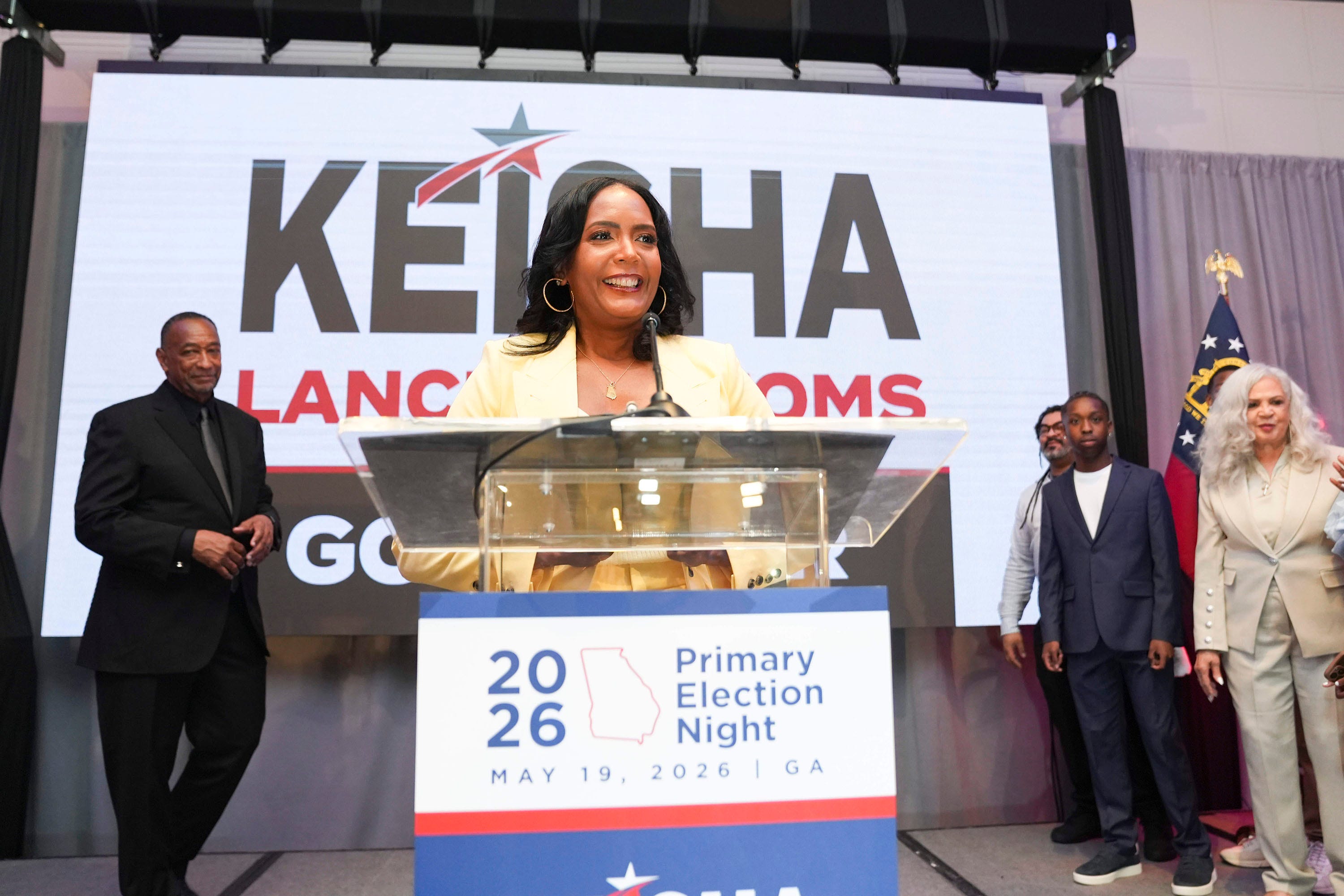
AS THE GEORGIA PRIMARY ELECTION RESULTS trickled in last night, some Democratic officials began to feel uneasy. Many had been convinced that none of the Democratic candidates for governor would secure more than 50 percent of the primary vote, meaning that the nomination would be decided in a June runoff.
Instead, Keisha Lance Bottoms—the former Atlanta mayor and senior adviser to President Joe Biden—destroyed the primary field, earning a shocking 56 percent of the vote. Jason Esteves, a former state senator, came in a distant second place with 18.7 percent of the vote. Geoff Duncan, the former Republican lieutenant governor who switched parties, didn’t even crack 10 percent.
While Bottoms’s victory was publicly celebrated by the national party—DNC Chair Ken Martin, for example, called her a “battle-tested leader” who could flip the seat blue—it left some Democrats worried about the general election challenge ahead of them. For months, local officials had privately been agonizing over Bottoms’s candidacy, fearing that her tenure as mayor of Atlanta from 2018 to 2022—during which she oversaw the city’s sometimes-controversial response to COVID and struggled to cope with a massive spike in crime—could damage her in the general election. But local officials I spoke with following last night’s results lamented that little was done to recruit another candidate who could compete with Bottoms’s name recognition. As one dejected Democratic state representative put it to me: “It’s like we were all sleepwalking to this nomination.”
“The strongest primary candidate is not necessarily the strongest general candidate,” lamented state Rep. Michelle Au, who supported Duncan, the former Republican, in the primary.
On the surface, the governor’s race might seem like less of a national story than one of interest chiefly to Georgians. But the reality is that this election will have dramatic ripple effects at the national level.
Two of the Democratic party’s most promising presidential prospects come from Georgia: Sens. Jon Ossoff and Raphael Warnock. But their cases for running for president—or even their odds of being selected as vice president—would be dramatically weakened if Democrats don’t control the governorship. That’s because, if either left the Senate, it would be up to the next governor to appoint a replacement.
Further complicating matters, Republicans could end up nominating Lt. Gov. Burt Jones, who is headed to a runoff next month against billionaire Rick Jackson. Jones acted as a fake elector for Donald Trump in 2020 and pushed for a special session of the state legislature to overturn Trump’s loss.1 And the thought of Jones being in charge during a presidential year—when Georgia is likely to once again be a key swing state—is enough to give Democratic officials nightmares.
“If there is a Republican—especially if there is an election-denying Republican governor of Georgia—I think that shuts down their presidential talk,” said Democratic strategist and Georgia native Tré Easton. “The risk is not worth that reward.”
This dynamic underscores just how much political fortunes can be shaped by seemingly unrelated races. And given the national importance, there’s a feeling among local and national Democratic officials that the party did not approach this race with the seriousness it deserves; that it failed to nominate a top-tier candidate, instead settling for an ineffective mayor vulnerable because of her ties to the Biden White House and record from the COVID era.
“It is the most important governor’s race in the country,” said Democratic pollster Adam Carlson, arguing that there was an early opening to launch a serious challenge against Bottoms last summer, but no candidate emerged. Now, Carlson said, Democrats will be left trying to get a “very flawed Democratic nominee” through the general.
Liberal democracy cannot function without a vibrant, independent, free press. Sign up for Bulwark+ today to support our work and join our growing community.
Democratic strategists said that they kept expecting national party leaders to wade into the race and endorse an alternative to Bottoms, as sometimes happens when a candidate deemed too risky for a statewide race surges (as when national party leaders threw their support behind Amy McGrath instead of Charles Booker in Kentucky’s Senate race in 2020,2 or behind Henry Cuellar instead of Jessica Cisneros in a Texas House rematch in 2022). If the race had gone to a June runoff, there would have been an extended opportunity to put forward an alternative to Bottoms.
But national intervention never came. Georgia operatives who opposed Bottoms in the primary told me that none of the other primary candidates felt like they could go negative on Bottoms and bring up her shaky record as mayor, worrying that it would be a bad look to criticize the only black woman running. The race stayed largely quiet and uneventful, as party officials privately fretted that they were backing themselves into a corner—but did very little to stop it. The only major national endorsement came from Joe Biden, who threw his support behind Bottoms in the final few weeks of the race.
Bottoms’s allies argue that the concerns about her being a weak general election candidate are largely coming from a small minority of hyper-online politicos and aren’t grounded in reality. Her resounding primary win is evidence, they say, that she can energize voters, especially black women—who are the base of the Democratic party, especially in Georgia. And they note that Bottoms is running in a very favorable environment for Democrats. Plus, Democrats believe that Georgia Gov. Brian Kemp’s recent call to redistrict ahead of the 2028 cycle will only further energize the party’s base to turnout for Bottoms.
“Political insiders have underestimated Keisha her entire career—and she’s constantly proven them wrong, just like she did last night,” said TaNisha Cameron, a spokesperson for the Bottoms campaign, in a statement. “Voters know that Keisha was a strong leader for Atlanta and will be a strong leader as Georgia’s next governor fighting for Georgia families.”
Even Bottoms’s critics who worked on opposing primary campaigns acknowledged that her ability to energize black women was impressive—a sentiment shared by national observers as well.
“There is something still very powerful in the Democratic party about identity, especially in the wake of Kamala Harris losing,” said Easton. “In Georgia, especially, I think they see Keisha as the next stand, and there’s a sense of ‘We’re not gonna let them do to her what they did to Kamala.’”
Anita Howard, the district attorney for the region around Macon, similarly told me that “the electorate in Georgia wants a black female governor.”
“The politicos and elected officials, the small percentage of naysayers, have got to come to grips with it. We’ve got to give the electorate what they want.”
🫏 Donkey Business:
— A few other notes from last night’s primaries: Despite the fact that more Democratic voters turned out in Georgia than Republicans, the party wasn’t able to unseat two conservative state Supreme Court justices. When I was talking with Dem officials on the ground today, this was seen as a huge missed opportunity and a clear sign that the party didn’t invest enough resources in informing their voters whom to support. Other operatives also said it helped explain why Bottoms had such a resounding win; Tuesday’s electorate consisted of fairly low-information voters who were relying on name recognition in their voting decision. Given the redistricting battles ahead—and whatever mayhem comes in the 2028 election—the lack of investment in these judicial races is likely to follow around the state party for a long time.
— Pennsylvania also held its primary elections yesterday, in which Bob Brooks, a retired firefighter and union leader, won a closely watched race to take on GOP Rep. Ryan Mackenzie in a Lehigh Valley district. Brooks is one of the buzzier candidates running this cycle, getting attention for his gruff working-class persona—the kind of thing that Democrats are desperate to embrace. (See also Platner, Graham.) Ahead of the primary, he also secured endorsements from leaders across the party’s ideological spectrum, including the Democratic Congressional Campaign Committee, Vermont Sen. Bernie Sanders, and Gov. Josh Shapiro. And the “Squad” is likely to get another member next year after state Rep. Chris Rabb won the nomination for a safe Philadelphia-area district, shutting out the more establishment candidates by embracing his progressive credentials.
My open tabs:
— Democrats are racing to one region ahead of the 2028 presidential primaries
— He Was Jailed Over a Charlie Kirk Post. The Sheriff Now Owes Him $835,000.
— My Son’s Hockey Team and the Crisis of American Resentment
Jones and Jackson clocked in with 38 percent and 33 percent in last night’s Republican gubernatorial primary, respectively—trouncing Brad Raffensperger, the Georgia secretary of state, who had just 15 percent. The fact that Jones, who was a fake elector for Trump, clobbered Raffensperger, arguably the state official who showed the most backbone in standing up to Trump’s attempt to steal the 2020 election, says a lot about the Republican party of 2026.
Funny. Republicans elect criminals, rapists, pedophiles and crooks and laugh at suckering so many people into voting for them because they can just say they hate trans people and win. Dems fret about a slight breeze messing up a hairdo, or hairpiece. Fight like GOP and kick their butts. Stop with the pearl clutching, and worrying about every word spoken and every deed done. No wonder dems lose. It becomes nauseating. All dems have to do is say, kiss my ass, and I do not support pedophiles as my opponent does. Take it to the rim and stop dribbling!
I’m a GA Democrat. Keisha Lance Bottoms & Geoff Duncan were the only two Democratic candidates for governor with name recognition. Statewide office is dominated by Republicans. It is practically a miracle that we have two Democratic senators. Every statewide race is an uphill battle for Democrats. That would be true no matter who won the nomination. I did not vote for Lance Bottoms, but I will do everything I can to support her now.