Withdrawing from Europe Would Be a Strategic Blunder
Yet it’s one even some experts seem intent on making.

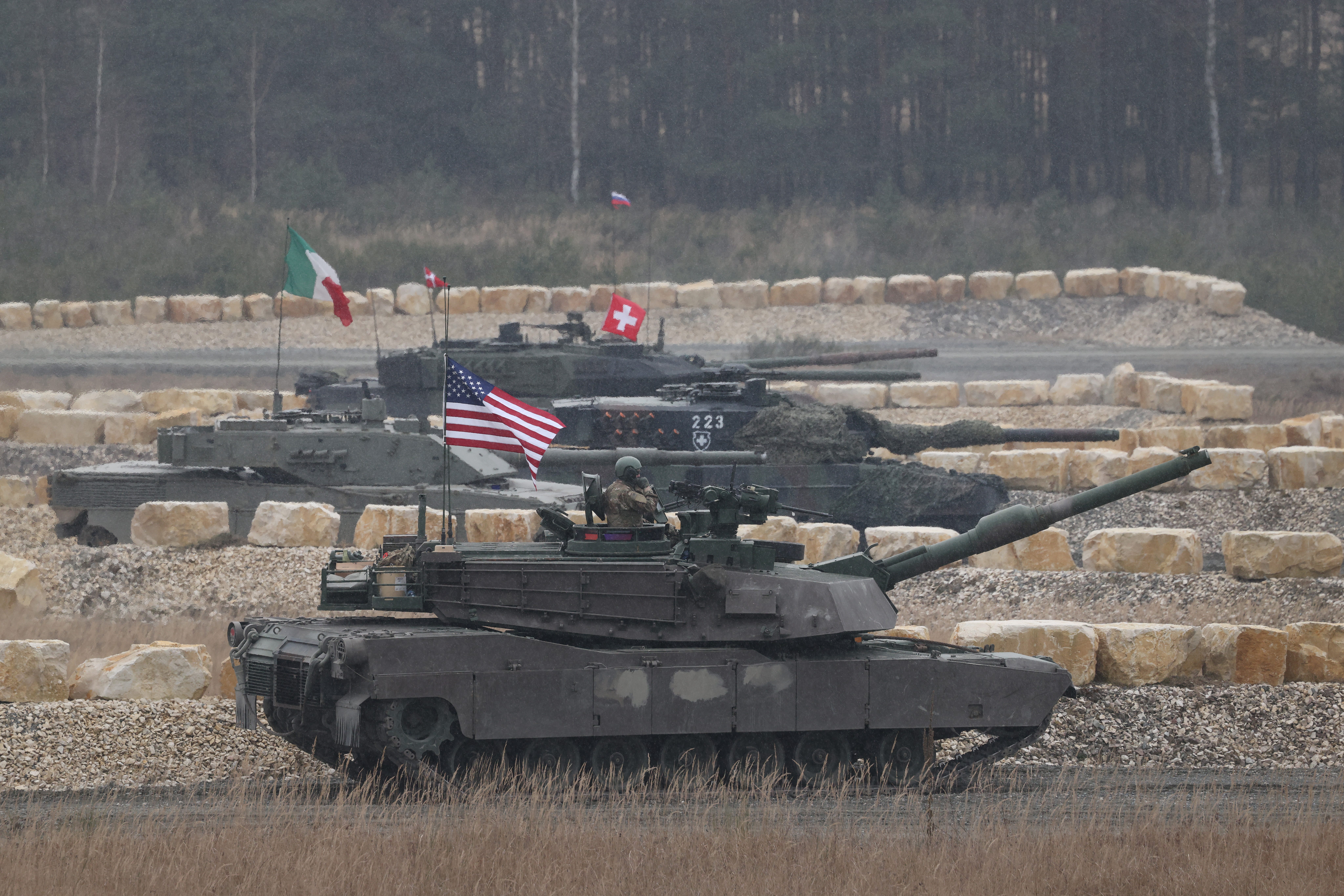
IN A RECENT FOREIGN AFFAIRS ARTICLE titled “How U.S. Forces Should Leave Europe,” Christopher Chivvis, a rightfully respected scholar of international relations at the Carnegie Endowment for International Peace, argues for drawing down the U.S. military footprint on the continent:
The best window for Europe to take on a greater share of the burden for its defense is now—not in five or ten years when political will may have faded or an emergency elsewhere forces a sudden U.S. withdrawal. The reasons for making the change are not going away. Competition with China and the emergence of other global powers have altered the United States’ strategic reality. Washington can no longer maintain the global military primacy it enjoyed after the end of the Cold War. To avoid overstretching, the United States must allocate its assets prudently—which means withdrawing from or downsizing in some parts of the world.
He frames the current force structure as outdated and narrowly focused on countering Russia, advocating for repositioning forces to the Indo-Pacific in line with the administration’s strategic emphasis on China. But his argument is built on oversights and mistaken assumptions that make his conclusions and recommendations strategically shallow and operationally dangerous.
U.S. troops in Europe are not a Cold War vestige. They anchor transatlantic cooperation, respond to crises on three continents, enable cyber and missile defense, and reinforce the strategic trust that underpins every alliance and coalition we participate in. To reduce their presence now would not only weaken deterrence in Europe but also harm our broader global responsiveness. And critically, it would reflect a recurring American error: the belief that we can predict the next war and optimize for it in advance. We rarely get it right.
BEFORE THE BERLIN WALL CAME DOWN and the Cold War ended, U.S. troop levels in Europe exceeded 350,000. That was in the 1980s. By 2004, that figure had already fallen to about 111,000. I served as the chief of operations on the U.S. Army Europe staff during the planning phase in 2004, when Secretary of Defense Donald Rumsfeld directed us to reduce that number even further to approximate 30,000. Later, as the commanding general of U.S. Army Europe from 2010 to 2013, I led the final stages of that transformation, overseeing the final return of soldiers and families to the United States, the closure of bases, the consolidation into five key base hubs, and the significant investment in modern infrastructure, much of it shared by our German and Italian allies where the majority of our soldiers were stationed.
Today, just over 30,000 troops (and their families) are permanently stationed in Europe, supplemented by 10,000–25,000 rotational forces (troops without their families) when necessary. It’s a lean, purpose-built force that reflects years of troop-to-task analysis and careful base closings and coordination with our allies. Contrary to Chivvis’s characterization, there is not a bloated or excessive footprint in Europe. There is a strategically positioned set of enablers and rapid-response units capable of supporting operations across Europe, Africa, and the Middle East.
When the United States surged rotational forces to Europe following Russia’s 2022 invasion of Ukraine, it was not an accident—it was the result of sound planning. Chivvis casually suggests that, at some point after his proposed drawdowns are completed, “if changing security conditions make it necessary,” the United States could “send some forces back.” But our ability to deploy emergency forces to the continent efficiently is a function of our current presence there. Without the forward infrastructure, interoperability, and host-nation access agreements we put in place as part of contingency planning, the United States and NATO would have been slower to respond and far less effective in supporting Ukraine’s initial defense against the Russian invasion.
Chivvis argues that U.S. forces currently in Europe should be moved to the Indo-Pacific region to support the pivot toward competition with China. But this logic fails on both strategic and practical grounds.
First, there aren’t that many troops in Europe to begin with. The idea that pulling a few units and associated small headquarters from Germany or Italy would substantially bolster our Indo-Pacific posture is illusory. The distances, basing challenges, and logistical hurdles in the Pacific require a fundamentally different approach—one that cannot be addressed by simply reshuffling forces from one theater to another.
Chivvis predicts that “Supporters of the U.S. Army will also likely argue that because the army is not needed in Asia, it might as well remain in Europe,” but explains that “a large number of . . . Army units . . . could be either redeployed to other theaters or deactivated on their return to the United States, saving the country money.” It may be wise for the United States to maintain a smaller Army and a larger Air Force and Navy, but Chivvis commits the part-whole fallacy by assuming that a smaller Army overall necessitates a smaller Army in Europe—one of the few places in the world where American ground forces are required, at least for now, to fulfill American treaty commitments, and where they remain useful.
Second, China is not our only threat. The international security environment is increasingly characterized by multi-theater, multi-domain challenges. Fixating on one region or adversary while ignoring potential hot spots is strategic myopia. Recent history teaches us that our ability to forecast future conflicts is abysmal. In 2000, few predicted that the United States would be deeply engaged in Afghanistan in 2002 or Iraq in 2003, or that Libya would require NATO intervention in 2011, or that Russia would annex Crimea in 2014 or invade Ukraine in 2022. We didn’t predict the war in Gaza, the destabilization of the Sahel, or the renewed need for Red Sea naval operations. The next flashpoint may come from a frozen conflict in the Balkans, the Caucasus, the Black Sea, or a yet-unseen crisis in Africa.
Chivvis claims that “U.S. troop deployments in Europe are larger than necessary to defend core U.S. interests on the continent,” but he ignored the strategic depth and flexibility American forces in Europe provide for unpredictable scenarios not only in Europe but in Africa and the Middle East, too. Withdrawing from Europe in favor of a “China first” approach risks leaving us flat-footed when—not if—the next unanticipated crisis erupts elsewhere.
And even in the European context strictly defined, Chivvis misunderstands the interrelation of the challenges the United States and our allies face. “Concentrating U.S. resources on nuclear, cyber, and gray-zone defense while leaving land defense largely to European allies,” he writes, “will be a more sustainable division of responsibilities as Washington pares down its commitments.” But conventional and gray-zone threats aren’t mutually exclusive. Many European nations have experienced cyber-attacks. We’ve seen ransomware operations against hospitals, critical infrastructure, and public agencies. The lessons we learned from Estonia—especially after the 2007 cyber-attack that nearly crippled the country’s digital infrastructure—have shaped U.S. and NATO cyber strategy. But we must continue learning. Cyber defense requires persistent cooperation, integration of command structures, and rapid information-sharing—all made possible by forward presence, intelligence sharing, and secure communications networks established with our allies.
Moreover, Russia isn’t the only threat on the continent. The situation in the Western Balkans remains fragile, with Bosnia and Kosovo vulnerable to destabilization. In the South Caucasus, tensions between Armenia and Azerbaijan threaten broader regional escalation. The breakaway Transnistria statelet in Moldova threatens stability on Ukraine’s border. Russia continues to exploit these and other fault lines through disinformation, paramilitary forces, and economic coercion.
These aren’t hypotheticals. They are clear and present dangers, and they are some of the contingencies that U.S. forces in Europe face. And they cannot be managed from Fort Bragg or Camp Pendleton.
U.S. troops in Europe are not tethered to the continent. They are regionally aligned, globally employed, and strategically indispensable. Grafenwöhr and Vicenza, for example, are not only premier multinational training and deployment facilities—they are also home to U.S. soldiers and families, embedded in supportive host-nation communities and co-located with critical infrastructure. Vicenza is also the headquarters for U.S. Army Africa, with deep partnerships across 54 nations on that continent.
Kaiserslautern serves as a logistics and transportation hub for U.S. European Command, Africa Command, and Central Command. It also houses a military intelligence brigade and an intelligence center that delivers critical intelligence to U.S. diplomats and combatant commanders across three continents. Chivvis maintains that any U.S. force in Europe should be designed for “supporting the country’s world-class collection of intelligence”—as well as “protecting the U.S. East Coast” and “maintaining nuclear deterrence”—but doesn’t describe how those missions would be accomplished by a force cut “roughly in half.”
In just the past few years, U.S. troops based in Europe have supported operations and contingency missions in Ukraine, Syria, Israel, Iraq, Libya, Sudan, Niger, Gaza, Lebanon, and the Red Sea. They’ve also enabled security cooperation, civil affairs, and humanitarian assistance across Eastern Europe, the Caucasus, North Africa, and the Baltics. Our National Guard State Partnership Program engages dozens of countries through long-term defense relationships—all of them rooted in and enabled by our presence in Europe.
These troops are all integrated with U.S. Cyber Command, Transportation Command, Special Operations Command, and even Space Command for layered global operations. Europe is the backbone of that network. The commander of U.S. Army Europe supports five different other commands with forces from Europe.
ONE OF THE GREAT ADVANTAGES of the current European posture is that it exists, now. It works. And it has been paid for. During the 2004–2012 transformation, we partnered with host nations—particularly Germany and Italy—to invest in modernized, consolidated installations. Billions were spent to upgrade barracks, headquarters, family housing, and command infrastructure, sized to a reduced footprint that was designed for the twenty-first century. The result is a set of world-class facilities that provide security, stability, and speed of response. A cost analysis of leaving those bases—most built less than a decade ago—would show the capriciousness of leaving, especially given the likelihood that, as Chivvis concedes, we might have to come back.
But perhaps the most important reason to maintain U.S. forces in Europe is also the hardest to quantify: trust. Chivvis insists that “U.S. withdrawals must preserve the trust, norms, and processes that give strength to the United States’ relations with Europe,” that the United States must “avoid unnecessarily irking allies,” and that “the United States can allay European fears of U.S. abandonment and retain influence with its allies.” But the drawdowns he recommends makes those goals impossible to accomplish.
During my tenure as commander of U.S. Army Europe, I built close working relationships with the chiefs of defense and land component commanders and their respective governments of all 49 European countries within our footprint. Our subordinate command in Vicenza builds similar bonds with military leaders and governments across the 54 countries of Africa. These relationships aren’t ceremonial—they are vital to intelligence sharing, crisis response, and the credibility of American leadership. While he didn’t get the modern uniform right, an American ambassador once told me military forces were his “diplomats in khaki.”
In some ways, though, it’s not the relationships among the brass that matter, but the relationships among troops from allied nations at the enlisted level. We saw a true, heartbreaking example of this trust when multiple NATO allies came together to recover the bodies of four Americans killed in a training accident in Lithuania. Trust is earned through time, presence, and shared relationships. In any coalition, trust is what allows you to lead. It is the difference between allies showing up or staying home. And it cannot be recreated from 5,000 miles away.
Chivvis joins a long list of analysts who believe the United States can predict the next conflict, optimize force structure by moving units around, and position the military where we think they may be used. That’s a dangerous illusion.
Yes, we must address the rise of China. But that doesn’t mean abandoning the rest of the world. Our global responsibilities are not sequential—they are simultaneous. And our global presence must be layered, flexible, and forward.
The force stationed in Europe today is about 1.5 percent of the total uniformed U.S. military. It is the result of careful planning, sound investment, and hard-earned lessons from decades of operations. It deters Russia and others who might start a conflict. It reassures allies and partners who still look to the United States for leadership. It would be silly to suggest that the U.S. military should stop constantly reevaluating its structure and posture, in Europe and elsewhere. And as both the geopolitical situation and the character of warfare change, it may make sense to revise the American presence in Europe—perhaps even to include some of the redeployments of specific assets that Chivvis recommends. But, out of a panic about China, to radically diminish our footprint in Europe, which has been carefully designed and streamlined to provide crucial capabilities and enablers for ourselves and our allies across three continents, would not only be shortsighted. It would be self-defeating.
 | A guest post by
|