Withdrawing Troops from Germany Is an Own Goal
American forces in Europe are there to defend American interests.


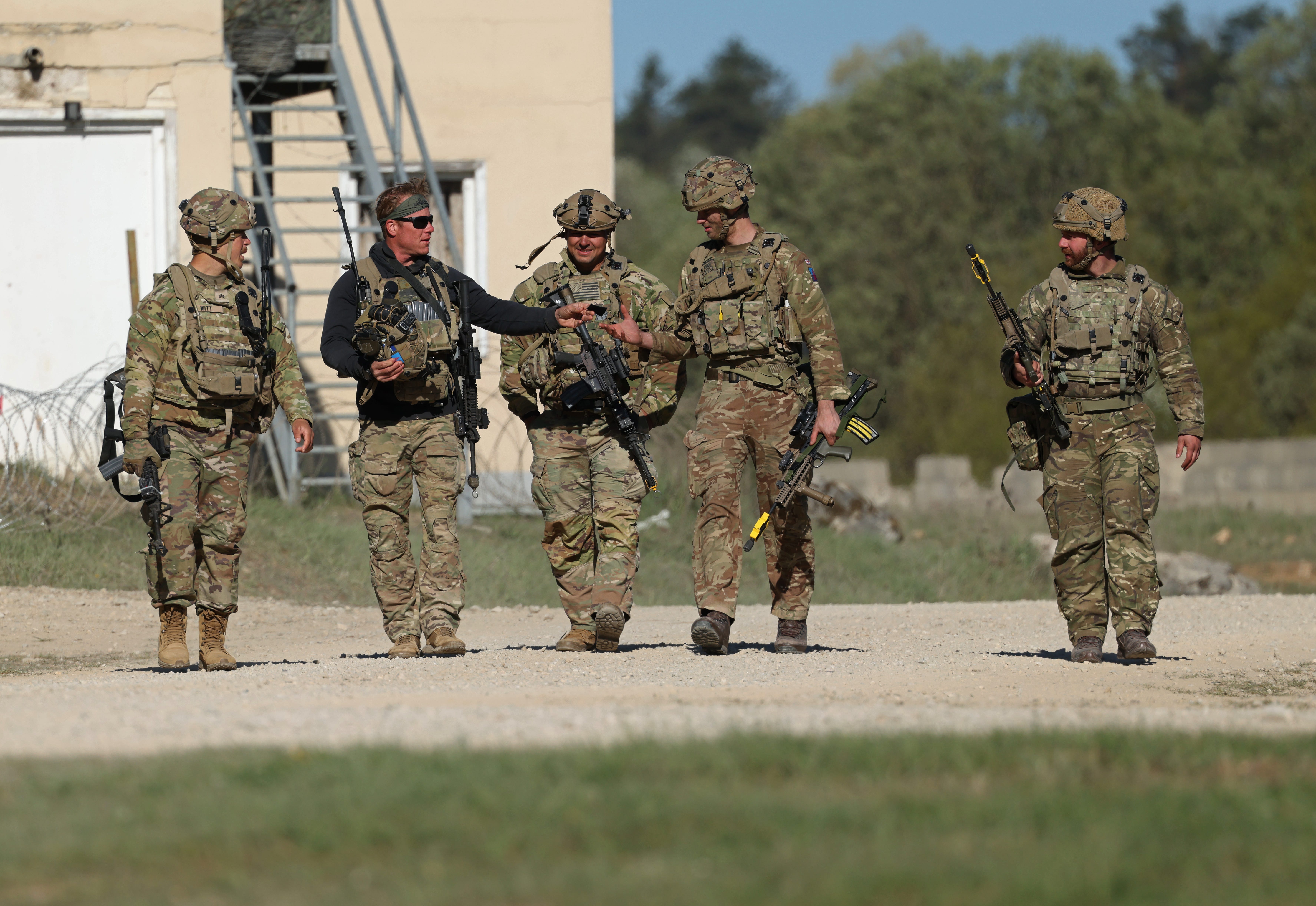
PRESIDENT TRUMP, ONCE AGAIN PIQUED at an ally, has ordered 5,000 American troops withdrawn from Germany. Defense Department officials were not shy about linking the move to Chancellor Friedrich Merz’s criticism of what passes for American strategy for ending the war with Iran.
Further drawdowns from Germany and elsewhere in Europe may be coming. Angered at recent criticism by Italian Prime Minister Giorgia Meloni, one of the most MAGA-adjacent European national leaders, and chagrinned by Madrid’s decision not to engage in the war about which NATO was never consulted, Trump also has threatened to close U.S. bases in Italy and Spain. Someone needs to advise President Trump that our forces stationed on allied soil are in fact critical U.S. military enablers, not trading cards or transactional toys, with host nations to be rewarded for good behavior or threatened with base closure as punishment. In medical parlance, such moves would be best described as “self-harm”; in the geo-political world, they would be characterized as “diplomatic malpractice.”
Let’s review the facts. Following the end of the Cold War, residual U.S. forces in Europe were based where they were best positioned to fulfill two roles: first, to enable U.S. military and power-projection operations in Eurasia; and second, to contribute to NATO’s defense against potential Russian revanchism. While individual NATO allies refused to become combatants in the war with Iran because they were not—as the North Atlantic Treaty requires—consulted prior to hostilities, U.S. bases throughout Europe have played and continue to play critical roles throughout the conflict in facilitating the movement of troops, equipment, and supplies to those American units engaged in the fight. Allied airbases, logistics hubs, and ports were and still are critical to supporting American kinetic operations against Tehran and to maintaining the blockade in the Strait of Hormuz. Should Putin’s frequent threats to attack NATO ever materialize, those same facilities would play an irreplaceable role receiving reinforcements from the United States and organizing and supporting their movement to the front. And in such a war, those American forces would be joined by tens of thousands of allied airmen, sailors, soldiers, and marines, who are trained to defend their homelands and who are able to operate easily with their American counterparts. Withdrawing U.S. forces in a tantrum of spite and anger, on the other hand, would threaten American success at both power projection and active defense.
TAKING A MORE GRANULAR LOOK at Germany, the United States currently deploys about 35,000 troops there, including five Army garrisons, the headquarters of European Command and of Africa Command, and the training sites at Vilseck, Hohenfels, and Grafenwöhr (which are the finest and largest ground force training sites outside of the United States). Additionally, the Army’s Landstuhl medical center is the largest and most sophisticated U.S. military medical center outside the United States and serves both the European and Central Command theaters of operations. The Air Force has a major transportation hub at Ramstein, which also supports European and Central Command operations. If these facilities hadn’t already existed at the beginning of the Iran war, we would have had to invent them. Downsizing or eliminating them would degrade or even cripple military operations we now take for granted.
But the strategic blunders don’t end there. Inexplicably, Trump just canceled the pending deployment of the Army’s long-range hypersonic Dark Eagle missile system to Germany, where it was going to offset Russia’s in-place Oreshnik and Iskander missiles. This was a gift to Vladimir Putin, with whom Trump spoke just days ago.
In addition to the military loss represented by the troop drawdown, the financial cost of such foolishness—even if those forces are relocated to other NATO states whose leaders the president calls “friends”—would likely run at a minimum in the hundreds of millions of dollars, a total waste of money at a time the Department of Defense is calling for increased defense spending to rebuild America’s defense establishment. Every dollar spent moving troops and supplies around Europe is one that can’t be spent reconstituting the military’s drastically depleting stockpile of critical munitions.
The U.S. force posture in Spain is smaller than that in Germany, but includes the naval base at Rota, home to four missile defense destroyers strategically placed to protect allies in the Alliance’s southwest—as well as to keep eyes on the Strait of Gibraltar connecting the Mediterranean Sea with the Atlantic Ocean. The Air Force has a significant presence in western Spain, at Morón, from which it facilitates logistic and expeditionary operations. Again, as with Germany, the two locations are perfectly placed to support and sustain U.S. global power projection.
Withdrawing U.S. forces from their Italian bases would create a huge gap in our forward posture. The U.S. presence in Italy includes a fighter wing at Aviano, a quick reaction airborne brigade at Vincenza, an Air Force security squadron essential to supporting the Italian Air Force’s participation in NATO’s nuclear dual-capable aircraft force, a key naval air station in Sicily absolutely central to allied anti-submarine warfare efforts in the Mediterranean, the headquarters of the Sixth Fleet, and a large naval support activity. Removing these forces from Italy would gut America’s ability to dominate the Eastern Mediterranean, which would be welcome news to Russia and China but much less so Israel and America’s other Middle Eastern security partners, not to mention our NATO allies in Southeast Europe.
THE WORST OF THESE OUTCOMES has not yet been ordered, but the fact that President Trump has ordered one in seven U.S. troops in Germany to leave suggests he is serious about a military drawdown in Europe. All in all, the fit of spite he is considering would not only diminish U.S. power-projection capabilities, but also reduce NATO’s deterrence and defense posture by a huge degree.
Perhaps that is the president’s intention. His continued failure to comprehend the alliance’s value to the United States and his long-held animus against NATO have repeatedly led to musings about leaving the alliance. Current legislation prevents him from departing the alliance without congressional approval, which he is unlikely to obtain, judging by the standing ovation King Charles III received when he praised the alliance during his recent speech to a joint session of Congress.
Withdrawing forces could be a backdoor approach to reducing NATO. If that is Trump’s game, let’s have that debate in the open. A majority of Americans support NATO and the American role in it. If Trump wants to change policy, first he should change their minds.
 | A guest post by
|
 | A guest post by
|