Zelensky’s Kickass Two Weeks
And his broader achievement (so far).

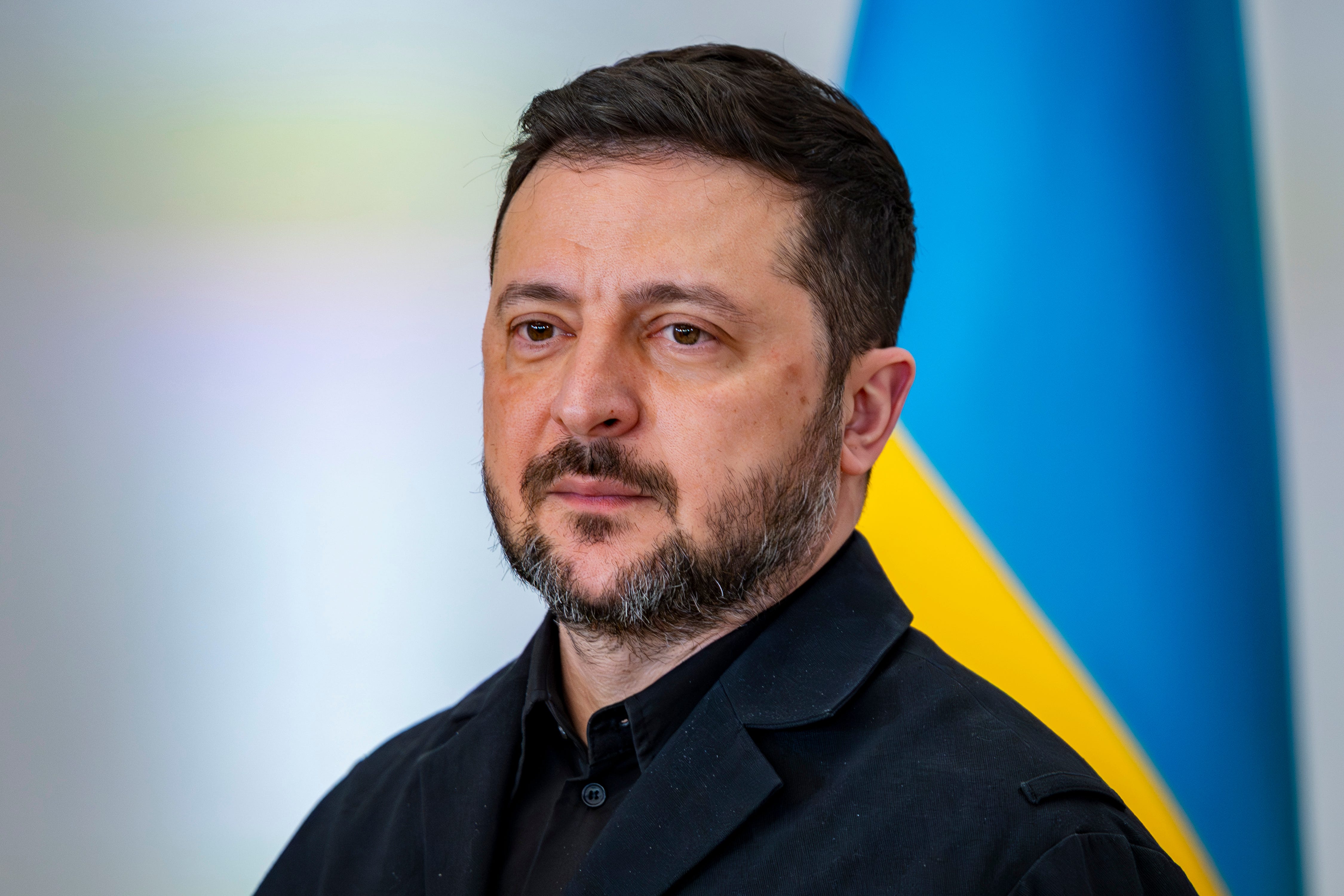
FOR UKRAINIAN PRESIDENT VOLODYMYR ZELENSKY, the last two weeks have been a remarkable moment in the spotlight. There was his Middle East visit to promote Ukrainian drone defense technologies and finalize new security partnerships with Gulf nations. He has pitched interceptor drones to Israel, where Benjamin Netanyahu maintains a wary distance. He has kept the focus on Russia’s intelligence-sharing support to Iran, producing evidence that Russian intel probably facilitated the Iranian strike on the Prince Sultan Air Base in Saudi Arabia that that wounded more than a dozen U.S. troops, damaged several refueling planes, and destroyed a vital aircraft. And he has continued to walk the tightrope required to maintain a functional relationship with the United States under Donald Trump.
The latest developments have prompted British academic historian and broadcaster Peter Caddick-Adams to argue that, contrary to conventional wisdom—which points to Vladimir Putin gaining from higher oil prices and to Ukraine receding into the background on the world stage—Ukraine may be more of a winner from this war than Russia. In Caddick-Adams’s words:
Led by its courageous and astute president, Kyiv’s government has played a weak hand of cards extraordinarily well, turning an existential crisis to its own advantage. Now its expertise is helping to realign the geopolitical pack, cementing stronger relations with countries that have hitherto been ambivalent towards Ukraine’s existential struggle with Putin.
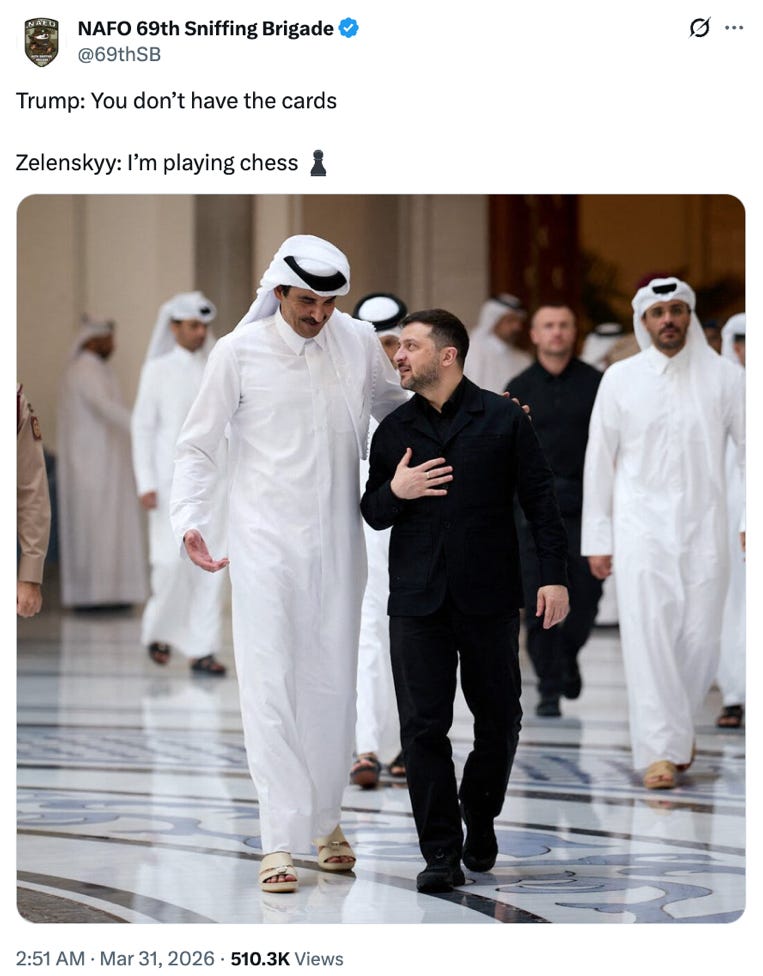
Or, as a meme by pro-Ukraine online activists put it more succinctly: Zelensky may not “have any cards,” as Trump infamously told him last year—but maybe he’s playing chess.
AS THE IRANIAN REGIME ESCALATED ITS STRIKES in response to U.S. and Israeli attacks, Ukrainian know-how became uniquely useful: Iranian Shahed drones made up the bulk of Russia’s drone arsenal in 2022–23, until Russia began large-scale domestic production of its own modified versions, and Ukraine had both low-cost interceptors to stop them and specialists trained in operating these defenses. On March 9, Zelensky told the New York Times that the United States had asked for help and that Ukrainian interceptor drones and a team of experts were already on the way to U.S. military bases in Jordan. The White House neither confirmed nor denied this information. However, in a Fox News interview a few days later, Trump appeared to both contradict and snub Zelensky: “We don’t need their help in drone defense,” he said (adding a Trumpian “we have the best drones in the world” flourish). He also slammed Zelensky yet again for supposedly stalling the Ukraine peace talks, telling NBC News that he was “far more difficult to make a deal with” than Putin.
But Zelensky was pursuing other options, with a trip to the Gulf states to negotiate ten-year agreements on exchange of technology and expertise with Saudi Arabia, Qatar, and the United Arab Emirates. (Ukrainian drone experts have also visited Kuwait and Jordan.) It’s a brilliant move that not only expands Ukraine’s alliances and partnerships beyond the United States and Europe, but also lifts Kyiv from seeker to provider of military assistance, from victim to partner. On a practical level, funds from the Gulf state deals may help offset the delay in a €90 billion loan in European Union funding, currently blocked by Viktor Orbán’s Hungary.
Meanwhile, Zelensky has continued his public relations offensive to counter the narrative that Ukraine is losing on the battlefield and to address the charge—once made by Trump, and constantly bandied about by Kremlin propagandists—that he is a “dictator without elections.” (He has consistently said, as before, that elections will be held as soon as there is a complete ceasefire and that he is prepared to step down from his post.) But the media blitz got him into a new verbal skirmish with the American side. In a March 25 interview with Reuters, Zelensky said that the Trump administration was leaning on Kyiv to withdraw its troops from the Ukraine-controlled, heavily fortified portions of the Donbas region, offering U.S. security guarantees only if Ukraine hands over that territory.
Zelensky’s widely reported claim drew an unusually testy rejoinder from Secretary of State Marco Rubio, who called the statement “a lie” and reiterated twice that it was “not true.” The U.S. position, Rubio said, that was “security guarantees will not take effect until the war is over”—with no demands for Ukrainian land concessions as a precondition. In his own response, Zelensky offered some de-escalation, stressing that he had never claimed U.S. officials were directly pressuring Ukraine to cede the remaining part of the Donbas as a condition for security guarantees. Rather, he said, the linkage was implied: Russia refuses to end hostilities unless Ukraine surrenders the Donbas territories, and the U.S. agrees to provide security guarantees only after hostilities end.
Was the spat a Zelensky blunder? Maybe not: One of its effects is that Rubio has officially disavowed a U.S. demand for Ukraine to give up urban territory which is not only inhabited by nearly 200,000 Ukrainian citizens but is viewed by many military experts as vital to the country’s defense. At the same time, Zelensky has applied some pressure of his own, stressing Russia’s role as an ally to America’s enemy in the new Gulf war—the intelligence-sharing with Iran—in an NBC interview of out of Qatar. “Do they help Iranians? Of course,” he declared. “One hundred percent.”
Having learned from experience last year, Zelensky is clearly determined not to rise to the Trump administration’s bait. In his interviews, he has continued to thank Trump for the deliveries of weapons financed by Europe, stressed the legitimacy of a political shift that prioritizes America’s own needs, and voiced cautious regret, not criticism, about Trump’s choice to put more pressure on Ukraine than on Russia. It is also notable that while Zelensky was working on his Gulf state alliances, his wife, Ukrainian First Lady Olena Zelenska, was in the United States meeting with Melania Trump over the issue of returning abducted Ukrainian children home from Russia and sitting for an interview on Fox News to thank Melania for her efforts and advocacy.
OF COURSE, ZELENSKY’S SUCCESSES in diplomacy and partnership-building are owed in no small part to the talent, ingenuity, and hard work of ordinary Ukrainians who, faced with a brutal war in which their country was outmanned and outgunned by an invading power, put it on the cutting edge of military drone technology. Those successes would also mean little without the successes of the Ukrainian armed forces on the frontlines—and not only on the frontlines. In recent days, for instance, Ukrainian drone strikes on Russian ports have nearly halved Russia’s oil export capacity (according to calculations by Reuters), throwing a huge wrench into the Kremlin’s plans to repair its budget problems with a windfall from the spike in energy prices caused by the war in Iran. There has been much wailing and gnashing of teeth from the war-hawk bloggers who worry that Russia may not be able to “dictate its own terms” to Ukraine at the negotiating table.
But Zelensky’s own achievement should not be underestimated. Consider just a broad outline of what he has done since the February 24, 2022 Russian invasion—starting with his refusal of a U.S. offer to be evacuated. (“I need ammunition, not a taxi” deserves a place in the annals of heroic battles for freedom on a par with Winston Churchill’s epic “We shall fight on the beaches” peroration.) His charismatic leadership helped rally the world to his country’s cause. Then, after three years of dealing with American and European allies who were willing to give Ukraine enough aid to stave off defeat but not enough to achieve victory, he found himself facing the prospect, and then the reality, of a White House “partner” not only unreliable but often frankly hostile.
During the 2024 campaign, Zelensky pulled off a near-perfect balancing act between a Democratic incumbent and party that had given Ukraine imperfect support, and a Republican candidate and party that had at times blocked aid, blamed him for the war, and depicted him as a grifter. (It still wasn’t enough for MAGA fanatics who howled “election interference” at Zelensky’s September 2024 visit to a munitions factory in Scranton, Pennsylvania with Pennsylvania Gov. Josh Shapiro, ignoring his visit to Utah and meeting with Republican Gov. Spencer Cox in July of that year.) Early in Trump’s second term, he carried himself with dignity and grace during that disgraceful Oval Office ambush by Trump and JD Vance on February 28, 2025, intended not only to humiliate and browbeat him into a de facto capitulation that would have given Trump his peace deal in Ukraine. Pressured to apologize for his own bristly tone, he managed to express regret and call for “constructive” communication without bending the knee. In the months that followed, Zelensky mastered, out of painful necessity, the art of stroking Trump’s ego—and he managed to do it without groveling.
The war in Iran seemed to put Zelensky into another impossible situation—yet he may have found a way to turn it to his advantage.
He has also managed to speak in support of U.S. action in Iran—a dicey proposition, given how badly waged and unpopular the war has been—in a way that conveys a fundamental American principle: the value of freedom and human rights. Right now, the Ukrainian president seems to be able to articulate those values far better than the American administration, perhaps because he actually believes in them.

Zelensky may be a long shot for the Nobel Peace Prize for which he has been nominated (along with the Ukrainian people). But someday, there should be a Winston Churchill Defender of the Free World award, and Zelensky should be its first winner—with an extra bonus for incredible grace under pressure.