A Government Shutdown Is Looming So Hard Right Now
Negotiations have completely fallen apart with hours left on the clock.

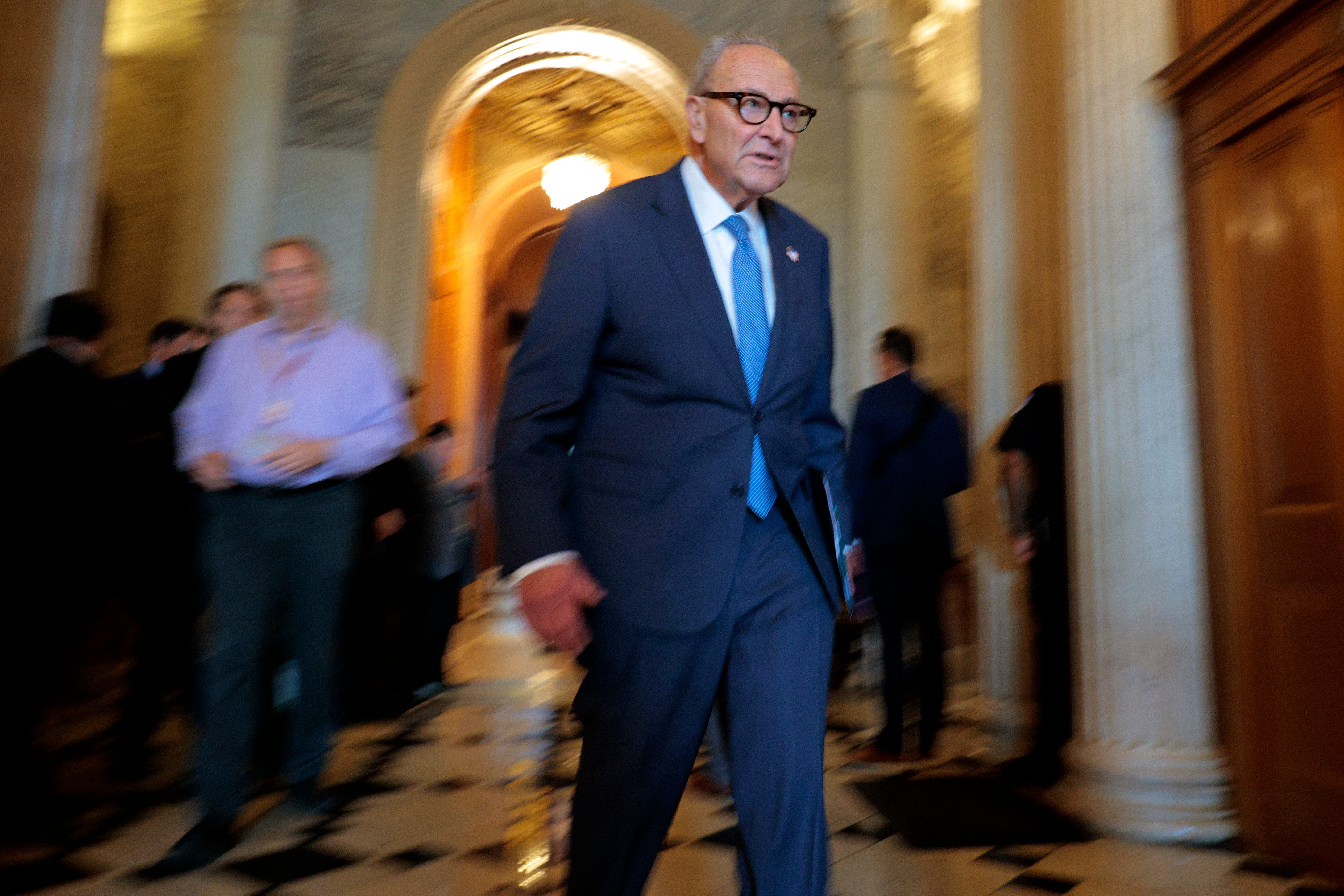
Eastbound and shutdown
Deals to prevent government shutdowns often appear suddenly, late at night, when no one knows to expect them, save the people working on them. An even later-at-night vote will then move the government funding deadline a few weeks or months into the future, and America wakes up to the opportunity to enjoy a few more months of important services.
This time, things are different. Interparty trust in the Senate, which made so many late-night deals possible in the past, has all but evaporated. The Republican majority is immovable on policy and scheming to steal back any concessions they might offer their Democratic colleagues to get a spending bill finished. And the Democrats are struggling, under pressure from their base, to get their priorities addressed at all.
Whatever hopes politicians and reporters placed in the prospect of a last-minute deal to fund the government—those hopes are fading by the hour. Federal funding expires tonight at midnight, and while many effects of a shutdown could take days to materialize, some happen immediately.
Democratic leaders in both chambers have mishandled the delicate negotiation process from the moment they tried to start it. Both Sen. Chuck Schumer and Rep. Hakeem Jeffries begged the White House for a meeting instead of letting the White House come to them. They did this despite knowing Republicans would need their support in the Senate in order to pass a funding bill.
This gave President Donald Trump an opportunity to initially accept and then abruptly cancel the meeting with Democrats, making them look like fools afraid to follow through with their threats.
When it comes to concessions, Dems have had one overriding priority. Ask any senator from either side and they will tell you that the core of the issue is the extension of Affordable Care Act subsidies. But the Democrats also have a toxic brand and have earned a reputation for folding in the face of a creepingly authoritarian administration, complicating their posture in this shutdown fight.
To be sure, the party has achieved some recent victories on tertiary political issues, like forcing a subpoena on documents from Jeffery Epstein’s estate, as well as a handful of judicial victories in the lower courts. But when Congress was faced with its biggest and most unavoidable problem—how to keep the government running—congressional Democrats have not been able to use their leverage to extract any concessions. If the shutdown is “successful”—that is to say, if it is as short lived as possible, and if the party is able to use it to secure at least some policy victory on health care costs—it would show that Democrats do have at least some ability to constrain the administration.
While Trump did initially rebuff a meeting request from the Democrats, the sides did come together Monday. But before heading there, rumors of alternate proposals and deals began leaking out of Schumer’s office, including an alleged proposal for a weeklong CR that would open up a window for health care talks, which Republicans would agree to enter into in good faith.
This directly undercut House Democrats, who insisted a handshake deal was a nonstarter. In addition, Senate Democrats beneath the top rungs of leadership don’t feel they can afford to place much trust in their Republican colleagues, no matter what negotiation-curious overtures they make.
Sen. Ron Wyden (D-Ore.), the ranking Democrat on the Senate Finance Committee, told me, “The premium increases that people are gonna see in a few days came about because, essentially, the tax incentives, the administration, frankly, has not been willing to go along with. . . . And I think absent our proposal, Americans are gonna feel like they’ve been hit by a health care wrecking ball with these rate hikes.”
When I asked Wyden whether he would trust Republicans or the Trump administration on some kind of handshake agreement to negotiate the health care subsidies in exchange for keeping the government funded for any additional length of time, he said, “You’re asking me to speculate, and I’m not gonna speculate.” I noted it was not a question of speculation, but whether he feels he can trust his fellow lawmakers that they would adhere to an agreement of some sort, given the preceding nine months of broken promises and unilateral action on the part of the administration.
“Certainly the track record of keeping their word is something to be questioned,” Wyden answered.
Ezra Levin, cofounder of Indivisible, a Democratic organizing group, also dismissed Schumer’s stopgap plan as foolish.
“This isn’t hardball. It’s kid pitch. You don’t start negotiating with yourself on the day of the meeting with the White House,” he said. “Hope it’s not real.”
After Schumer departed a White House meeting Monday, he said a seven-to-ten–day CR was off the table. After that, he offered reporters a verbal postcard from his own distant alternate reality: “I think for the first time, the president heard our objections and heard why we needed a bipartisan bill.” Trump has subsequently given off no such impression.
Instead, Congress remains at an impasse. Republicans have been unwilling to negotiate, and Democrats’ attempts to force them to come to the table have failed.
Even in the unlikely event that a deal might be reached by midnight—or sometime in the wee hours of Wednesday—there will likely be a shutdown on the record books. This is because House Speaker Mike Johnson has refused to bring the House back into session. House Republicans have maintained that they have already done their job in passing the “clean” continuing resolution. Unless Senate Democrats suddenly decide to pass just that, Johnson would have to summon back his colleagues for travel time and the routine process of getting a newly formed deal to the floor—not to mention convince his members to support any such deal. Doing that could potentially take days. That would just be such a bother, you know?
However, House Democrats are in town, and they’re demanding to come back into session. Gathering on the Capitol’s east steps Tuesday morning, Jeffries tried to hype up his colleagues and give medical professionals and patients who rely on the ACA subsidies a chance to speak. The event felt more like a pep rally than a press conference.
Immediately after Jeffries and co. concluded the presser without taking questions, lawmakers turned to their staffers for help composing short social-media videos. They took photos before the group scurried back up the steps and into the Capitol building.
I did catch Rep. Greg Landsman (D-Ohio), a member of the bipartisan Problem Solvers Caucus, who told me both sides needed to get together and hammer out a deal. Trump, he insisted, had been checked out of the process.
I think about it as like, if I were president, this would be the easiest negotiation ever. You’ve got the votes. You have the votes in the House and the Senate to keep the government open and extend [the Affordable Care Act tax credits]. You do. And if [Trump] wants to be responsible for fifteen million people who in the next couple of months are going to realize that their premiums are gonna go up, then it’s gonna be because they did not work to extend the tax credits, then sure. But my sense is that he was realizing for the first time that this was happening yesterday.
What actually matters
It’s easy to view government shutdowns as political theater; they lend themselves to dramatic narratives and sensational coverage. But shutdowns cause very serious problems for Americans outside of Washington.
Furloughed federal employees might receive back pay after a shutdown ends. But those living with limited financial resources can be devastated by a single missed paycheck. And Americans outside of government can run into serious issues, too: The loss of important government services can disrupt parts of everyday life. This doesn’t even touch on all the private businesses that rely on federal workers to help them, whether with government services or in the form of paying customers (think of the restaurants near federal buildings).
Ultimately, no matter how the politics plays out, there are never winners in a government funding lapse; there are only losers and survivors. And the survivors often start out on much stronger financial footing than the average American. In many cases, they are members of Congress, who, despite bloviating about not wanting to receive a paycheck during a shutdown, are mandated by the Constitution to receive income.
That’s something to consider as this unfolds.
Seat’s taken
Adelita Grijalva handily won her special election last week to fill the vacancy in Arizona’s 7th Congressional District left by her father, who died in March. Upon being seated, Grijalva would immediately hand Reps. Ro Khanna (D-Calif.) and Thomas Massie (R-Ky.) the 218th and final signature to their discharge petition to force a vote on obtaining the Jeffrey Epstein files. But Grijalva hasn’t been seated.
She is expected to be sworn in when Congress returns to session, making October 7 the earliest possible date unless House Speaker Mike Johnson calls the chamber back before then.
But Johnson continues to keep Congress in recess, justifying his refusal to reconvene the chamber by claiming that their work has concluded until the government is fully funded through November 21. (Most House Democrats are physically present in Washington this week—I saw many of them at yesterday’s presser on the Capitol steps—but Republicans are staying away.) As a result, Khanna and Massie’s discharge petition remains in legislative limbo.
Discharge petitions that fail to garner enough signatures to force a vote disappear at the end of the year. They can also only be voted on under certain privileged business. Grijalva’s prolonged (and forced) absence pushes a potential Epstein vote into the murky future.
Rep. Katherine Clark (D-Mass.), the House minority whip, has pleaded with Johnson to swear in Grijalva. In a letter to Johnson on Monday, Clark wrote:
Common practice in the House of Representatives requires that Representatives-elect in special elections in which results are not in doubt be sworn in at the earliest opportunity. In a directly analogous example, Representatives Randy Fine and Jimmy Patronis were sworn in less than 24 hours after their election, during a pro forma session, when previously scheduled voting days were canceled.
The people of Arizona’s 7th district have been without representation since the untimely death of Representative-elect Grijalva’s father. Any delay in swearing in Representative-elect Grijalva unnecessarily deprives her constituents of representation and calls into question if the motive behind the delay is to further avoid the release of the Epstein files.
It’s hard to view the delay as anything other than what Rep. Clark suggests it is: an attempt to keep the 218th signature off the petition. But Johnson is also gambling on his dereliction not registering with voters if there is a prolonged shutdown.
it's impressive how despite all the evidence to the contrary, chuck schumer continues to talk as if the ancien regime still had any meaning; i suppose it's something about old dogs and new tricks, but these completely pro forma empty statements about bipartisanship, once a staple of political dialogue, just sound insane in the age of trump.
I was against a shutdown because I know the Democrats will take the blame. On the other hand, maybe having Republican voters feel the pain on the ACA subsidies will cause a few to reevaluate their priorities. At this point, I'm all in on a shutdown.