Review: ‘Playworld,’ Adam Ross’s Novel of Painful Discovery
A coming-of-age tale that asks what freedom we can hope for if we lack the words to describe our lives.

Playworld
by Adam Ross
Knopf, 528 pp., $29
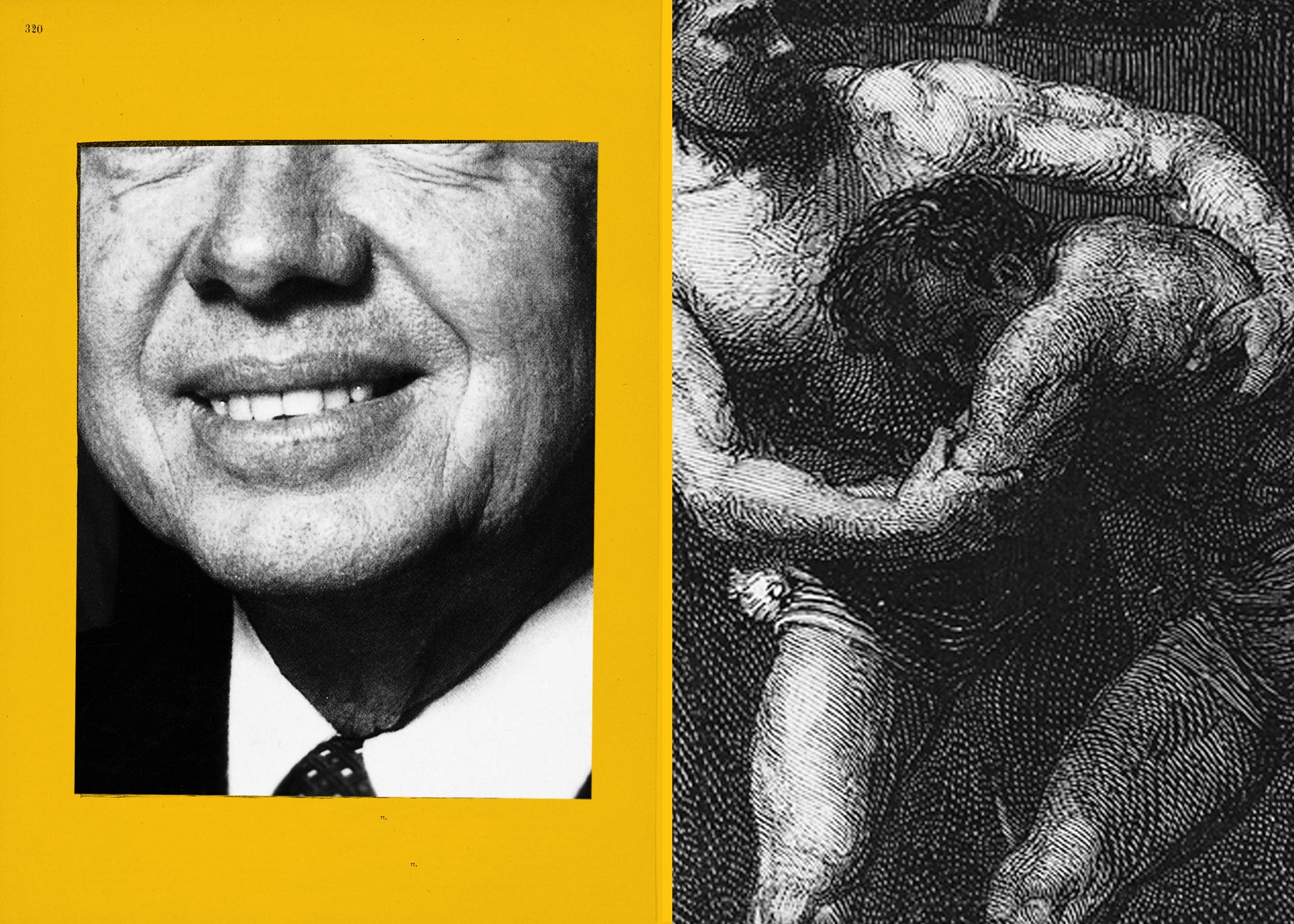
THE PROTAGONIST OF PLAYWORLD, Adam Ross’s acclaimed novel and buzzy book of the summer, is Griffin Hurt, a 14-year-old child actor living in New York City in the early 1980s. But the book’s hero may well be former President Jimmy Carter.
Carter scarcely plays a role in this coming-of-age novel that follows Griffin as he navigates trauma, love, and the general ailments of growing up Gen X. The 1980 election plays out in the background as he goes through his first year in an elite private school and faces troubles small and large. On the smaller side, his father, a struggling actor, requires Griffin to act in a television show to help pay the bills, which Griffin hates. His therapist doesn’t listen to him and falls asleep during their sessions.
These are typical, almost comical indignities for a young man on the make. The larger problems cannot be described in that way. Griffin’s wrestling coach sexually abuses him, and so does a friend of his parents. The latter occasions the arresting opening lines of the novel:
In the fall of 1980, when I was fourteen, a friend of my parents named Naomi Shah fell in love with me. She was thirty-six, a mother of two, and married to a wealthy man. Like so many things that happened to me that year, it didn’t seem strange at the time.
These disparate acts are all born out of their perpetrators’ uninhibited self-seeking—what Tom Wolfe labeled “The Me Decade” was only just starting to recede as an even more openly selfish era loomed—and Ross subtly uses Carter, the former peanut farmer turned president, as both an explanation of and rebuttal to their behavior.
Part two of Playworld opens with a quote from Jimmy Carter’s 1979 “Crisis of Confidence” speech. It is the key to understanding both Playworld and the cultural changes our country went through in the 1970s and ’80s that continue to shape American society.
We are at a turning point in our history. There are two paths to choose. One is a path I’ve warned about tonight, the path that leads to fragmentation and self-interest. Down that road lies a mistaken idea of freedom, the right to grasp for ourselves some advantage over others. That path would be one of constant conflict between narrow interests ending in chaos and immobility. It is a certain route to failure.1
Of course, the path to fragmentation and self-interest is the one we’re still on today, and the consequences of the mistaken idea of freedom Carter warned about permeate Ross’s book. Sometimes it’s obvious, as with the sexual abuse Griffin suffers. Other examples are more commonplace—Griffin’s father cheats on his mother—and even less obvious, as when a young child Griffin accidentally starts a house fire and abandons his younger brother while trying to escape it. You can’t really blame a young child for fleeing in such a scenario, but it becomes clear that Griffin’s brother internalized the abandonment in a way that continues to haunt him.
One of the effects of this scene and others like it is to convey the sense that self-interested behavior, even the most sympathetic kind, can and does harm others—a damning rebuttal to the therapy-speak crowd out there that holds dogmatically to a generalized notion of the need to “put your own oxygen mask on before helping others.” They have mastered step one—the art of putting their oxygen mask on—but in many cases appear to have failed to reach step two, the mandate to help others.
ROSS SKILLFULLY BRINGS OUT THESE ISSUES from relationships and situations between his characters, whom he develops with empathy and insight across the book’s five hundred pages. That figure may seem daunting, especially for a summer read—the book could easily hold open a heavy door; it should easily anchor a towel on a windy beach—but Ross’s lively writing keeps the story moving at a good pace, and the expansive plot never gets complicated enough to slow things down. For instance, this vivid passage offers a glimpse of what Griffin puts himself through to lose weight ahead of wrestling matches: “I swigged a mouthful of water from the hallway’s fountain, which I swished around my tacky mouth, allowing my tongue, dry as a dandelion’s corona, to be mercifully submerged. Then I spit in a dribbling stream.” The intensity of Griffin’s sheer physical self-control here in the face of pure animal need—of his resistance to one of the most elemental desires a person can have—suggests that deeper and darker psychological needs are being expressed than Griffin’s friends and teammates might assume are motivating him.
Ross the writer knows how to use words, but he also knows how they fail us—and how devastating those failures can be. The power that can be accessed, bound up, or released through putting language to things is another major theme in the book, with Griffin’s struggles to understand what’s going on in his life resulting in part from his lack of words to describe it. Words don’t just describe life, of course: They give it shape, and they can change or even destroy it.
After Griffin shares his feelings about the inadequacy of his vocabulary, his therapist, Elliot, offers a response that creates one of the book’s most poignant moments: “Back in the office you said you felt like you were speechless. That you had things you saw but struggled to communicate. Those are the two most heartfelt things you’ve ever shared with me. So maybe that’s what you’ve been put on the earth for. To come up with a language for your life.”
It’s an important concept for any time, but the world-creating power of language has a particular salience now, as American civil society pulls more violently apart. There’s a reason authoritarians prefer to keep their countries illiterate, targeting education systems and restricting books: Doing so helps prevent their subjects from imagining other ways of living, let alone better ways. It’s notable that Ross chooses to end Playworld with Griffin giving up acting and deciding to pursue a career as a writer.
Ross’s conceit is that the book itself is the fruit of this decision: Narrated by a now-adult Griffin, it represents an adult’s look back on his earlier life, which he colors in with understandings that evaded him at the time. Part of this means he has found the words to describe the abuses he experienced back then—to be able to see in retrospect what was really happening to him even though it “didn’t seem strange at the time.” And the unsettling implication of Griffin’s narration is that some never find the words to perform this redescription of their own experiences, and because their experiences are never made to seem strange to them, they never develop a desire to change the conditions that enabled their abuse. But to consider questions like this for too long is to step out of Playworld and into the real world, which is still undergoing the political consequences of the era in which the book is set.
By the story’s end, Griffin has expanded his view of life, made it more capacious and interesting. The book’s final encouragement is for the reader to do the same, but it doesn’t stop there. As Griffin tells us on the penultimate page, “I rode and did not look back.”
One imagines Ross, a former wrestler whose high-school athletic career provided a real-life basis for his writing about Griffin’s wrestling in the book, must also appreciate the language of “grasp[ing] for ourselves some advantage over others.”
 | A guest post by
|