
Hey guys: If you missed Jasmine’s Triad last week, go back and give it a read. It’s so good.
Her thesis is that while “woke” eventually grew into an amorphous oppressive blob—if you like Thanksgiving or don’t like bike lanes, then you are read out of the movement!—the original ideas behind “staying woke” are pretty valuable. And also turned out to be . . . right. Here’s Jasmine:
Maybe at this point you’re thinking I’m making a True Woke has never been tried! argument. Not quite. My point is that “wokeness”—in an idealized form—is an argument for guardrails against unrestrained domination by the most powerful forces in society. It was in the calls for an end to extrajudicial police killings. It was in the demands for accountability when influential figures parroted harmful racist remarks. It was in the warnings of how easily civil protections for vulnerable groups—trans people or noncitizen immigrants or pregnant women—could be trampled upon.
The best Triads make you think about the world a little differently. This is one of them. If you missed it, read Jasmine here.
1. The Polls
For all the carping about polls, they’re usually correct. Even in the big surprise elections, like 2016, the polling was mostly accurate: Trump’s results were within the margin of error in almost every state.1
But sometimes there are misses. It’s useful to look at the polling in Wisconsin to understand what happened last night because while the topline result is shocking, the numbers . . . aren’t really?
This isn’t the story of a polling miss so much as voter sentiment moving so fast that the polls were a few days behind it.
Let’s look at the most recent polls heading into the election:


And what did we get when the actual votes were counted?

So let’s start with Francesca Hong. She underperformed her polling, but not by that much. The average of the last three polls had her at 42.7 percent. She finished with 39.37 percent. Three points is awfully close to the margin of error.
What happened to Hong’s number? She had been sitting at 40 percent since the middle of July. Then there was a little boomlet as Wisconsin Democrats took a closer look at her, so she gained a few points. And then, over the last week or so, she cooled off and settled back to her baseline. This isn’t a collapse. The polls just didn’t capture her reversion during the last week.
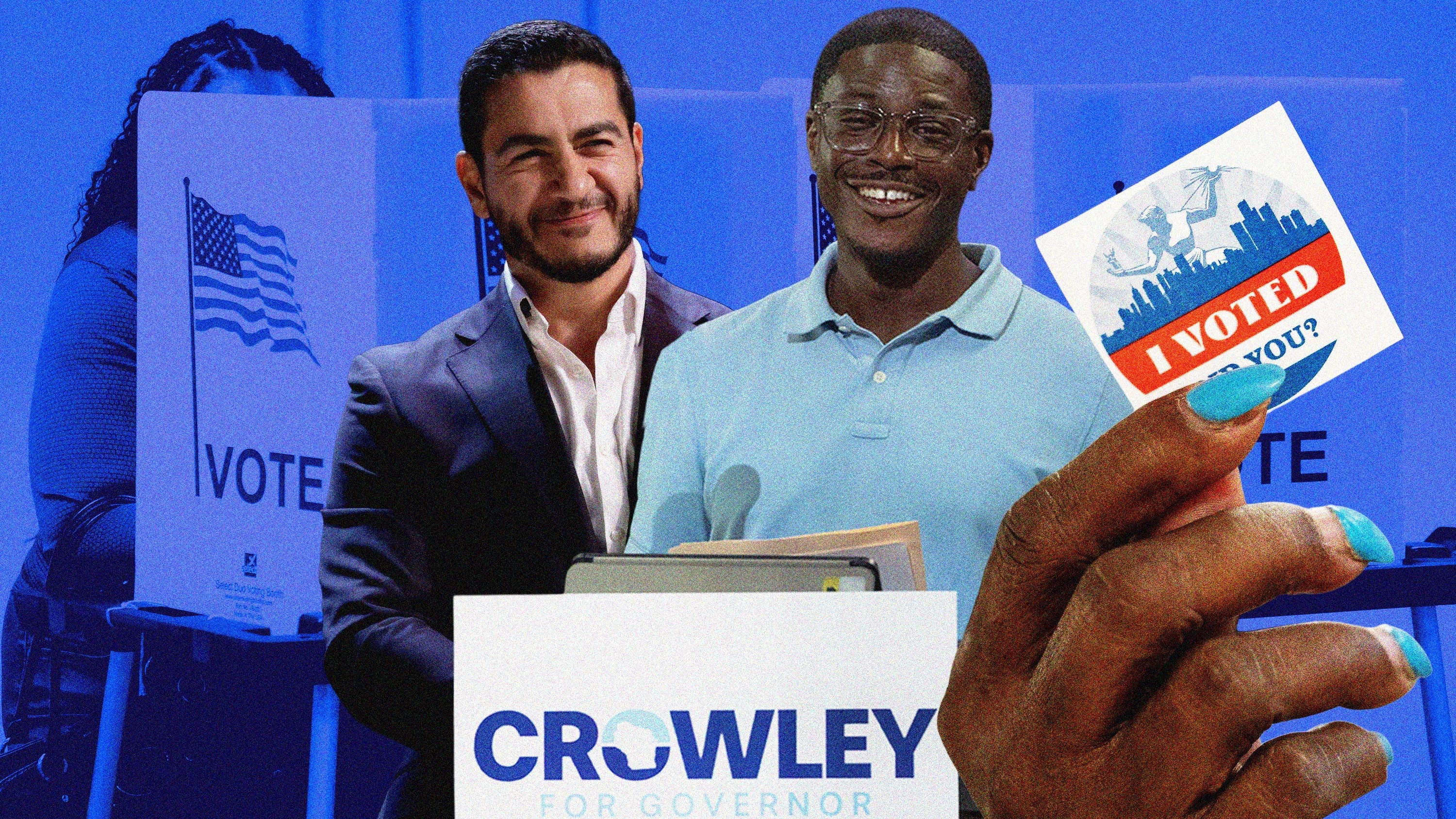
The big shock is David Crowley’s 39.78 percent.
That number is a surprise, but there were signs that something was happening. In early July Crowley didn’t even register because he’d dropped out of the race. Last week, after rejoining, he was at 22 percent. Voters were finding their way to him. Mandela Barnes had been sitting on something like 20 percent and he dropped out just two weeks ago. His voters had to go somewhere. It turns out they flowed to Crowley.
The polls captured the beginning of that flow, but polling doesn’t work in real time. There’s latency.
The polls in Wisconsin weren’t wrong so much as a week behind. The environment was more fluid than some of us realized and the movement that we saw in the polls toward Crowley was happening faster than surveys could capture.
Today’s Triad is free because I wanted to make sure it was as widely read as possible. You can read our locked newsletters—and join the conversation—with a Bulwark+ membership:
The reason I’m picking apart the polling is because between Hong in Wisconsin and El-Sayed in Michigan, we’re going to get a narrative about how DSA-branded Democrats always underperform.
And the reality is more complicated than that.
El-Sayed isn’t actually a DSA Democrat. He’s a normal Democrat who, for various reasons, codes as DSA-adjacent. Yet he underperformed much more than Hong. El-Sayed’s polling average had him up by 13; he won by a point.
Francesca Hong is a real-deal DSA-er and she finished within the margin of error of where the polls had her.
So at the broadest possible level, a narrative saying DSA Dems underperform their polls isn’t right.
But there is a lesson in here and it seems important.
Haley Stevens did well with African-American voters. Abdul El-Sayed did not. Francesca Hong did best in Wisconsin’s college towns. In densely urban Milwaukee she ran behind Crowley, who has been county executive there since 2020.

The eternal lesson is that African-American voters are the backbone of the Democratic coalition. And African-American voters seem to be less interested in DSA-forward candidates than most other parts of the coalition.
Maybe that will change!2 But until it does, we should keep in mind that to succeed in Democratic primaries, candidates need to do well with African-American voters.
Black voters represent the dead-center of the party.
And by the way: Thank God. Maybe Hong could have won the general election, but the matchup polls for her with Tom Tiffany were tough. I like Crowley’s chances against a weak Republican in a wave year.
I am not a Democratic strategist, but if I were, I would tell prospective Dems to lean into the African-American vote. Find ways to appeal to black voters and your chances of winning general elections improve because black voters aren’t just the center of the Democratic party—they’re close to the center of our broader political culture.
Find where black voters are, go there, and win.
2. Between Two Pillows
After stepping down as CEO of MyPillow, Mike Lindell’s quest to be the governor of Minnesota blew up last night.
The results were humiliating. So let’s luxuriate in them.
Lindell is one of the most famous men in all of MAGA. A captain of industry. A patriot outsider. He was endorsed by Trump. He was running against Lisa Demuth, a state legislator (and speaker of the Minnesota House) who was propped up by a single establishment Republican megadonor, Richard Uihlein.
And Lindell got schlonged.

Even in the reddest of red counties—the Trumpiest places in the Land of 10,000 Lakes—Lindell couldn’t break 50 percent.
How could this have happened?
Well, as of this writing, neither @realMikeLindell nor @RealLindellTV have tweeted about the result. The tears, they are delicious.
3. Alarmism
Gene Weingarten read Ross Douthat’s farewell column so I didn’t have to:
Douthat is forever defining “populism” as a noble political stance instead of what it is and has always been: the politics of trawling for eyes and ears and hearts and minds by milking resentment over invented hobgoblins that come and go with the times — Chinese laborers, foreigners, feminists, brown people, the intelligentsia, the rich, the poor, whatever is currently unpopular with the masses.
Here’s Douthat’s whole column, but I’ll save you the ordeal. I have distilled it down into two bullets.
Douthat says he hates Trump, but always manages to somehow express his distaste with a tepid qualifier. He complains that Trump is bad, but was made that way by idiot liberal policies to which he was reacting. In this piece, Douthat actually says this: “But as Trumpism has flailed and failed, it hasn’t consolidated the kind of authoritarian power anticipated by its most alarmed opponents.” (It hasn’t? Really? Let’s just let this particular opinion air out a little in the backyard until it is bearable to approach.)
But here’s the big one: Douthat wrote the following: “I lived with the blue-state governance that doctrinaire progressivism encouraged, and it yielded civic and educational collapse.” Aaaand: “I lived through the years of peak woke, and it was a McCarthyite experience.”
I love this trick of Douthat’s. He says that we aren’t at full-blown authoritarianism—not yet—and the fact that we have only had an attempted coup and a handful of dissidents executed by the masked secret police discredits all of the “alarmists” who warned that Trump was an aspiring autocrat.
But also: “blue-state governance” has yielded “civic and educational collapse.”
Excuse me? Collapse? Who’s the alarmist now, Mr. Potato Head?
Blue-state socioeconomic markers for income far outpace those of red states and on the question of education, well, would you rather your kids go to a school in NY/NJ/CT or WV/MO/AL?
If it is truly civic and educational collapse, how can Douthat raise his family in a blue state? Why hasn’t he struck out for Wyoming or Kentucky?
But then, that’s what this clown does, and always has done. He’s not a public intellectual. He’s a grifter whose marks happen to be elite media executives.
Except, ironically, Wisconsin.
Hong didn’t get blown out in urban counties. She ran respectably. But it wasn’t enough.
See, JVL, you have to understand that when Renee Good and Alex Pretti are shot in the street for filming the secret police, that’s something that Ross Douthat knows will never, ever happen to him.
But when someone asks Ross Douthat to maybe not say that gay people are at fault for the sexual abuse crisis in the Catholic Church, that’s something that directly affects him.
Collapse is when I cut my finger. Failed authoritarian consolidation is when you get shot ten times by masked ICE agents and die.
Oh, what will Ross Douthat’s first feature for 60 Minutes be? A long interview (“with limited commercial interruption, brought to you by”… okay, I should stop there) with the newest rising star of American journalism, Bari Weiss?
A hard-hitting exposé with dramatic shot-from-the-back darkened studio interviews with the brave whistleblowers at the Pentagon who have been blocked from proving how our ammunition’s actually getting absconded into the void by chthonic demons?
Or will he resurrect the Andy Rooney closer, with his first topic being: “Didja ever notice that we’ve been decadent for fifty years, and nobody’s said anything? Why *is* that?”