Amy Acton’s Prescription for Ohio
The Democratic candidate for governor explains why voters are exhausted by the rancor of politics—and shares her vision for renewal.

Cincinnati, Ohio
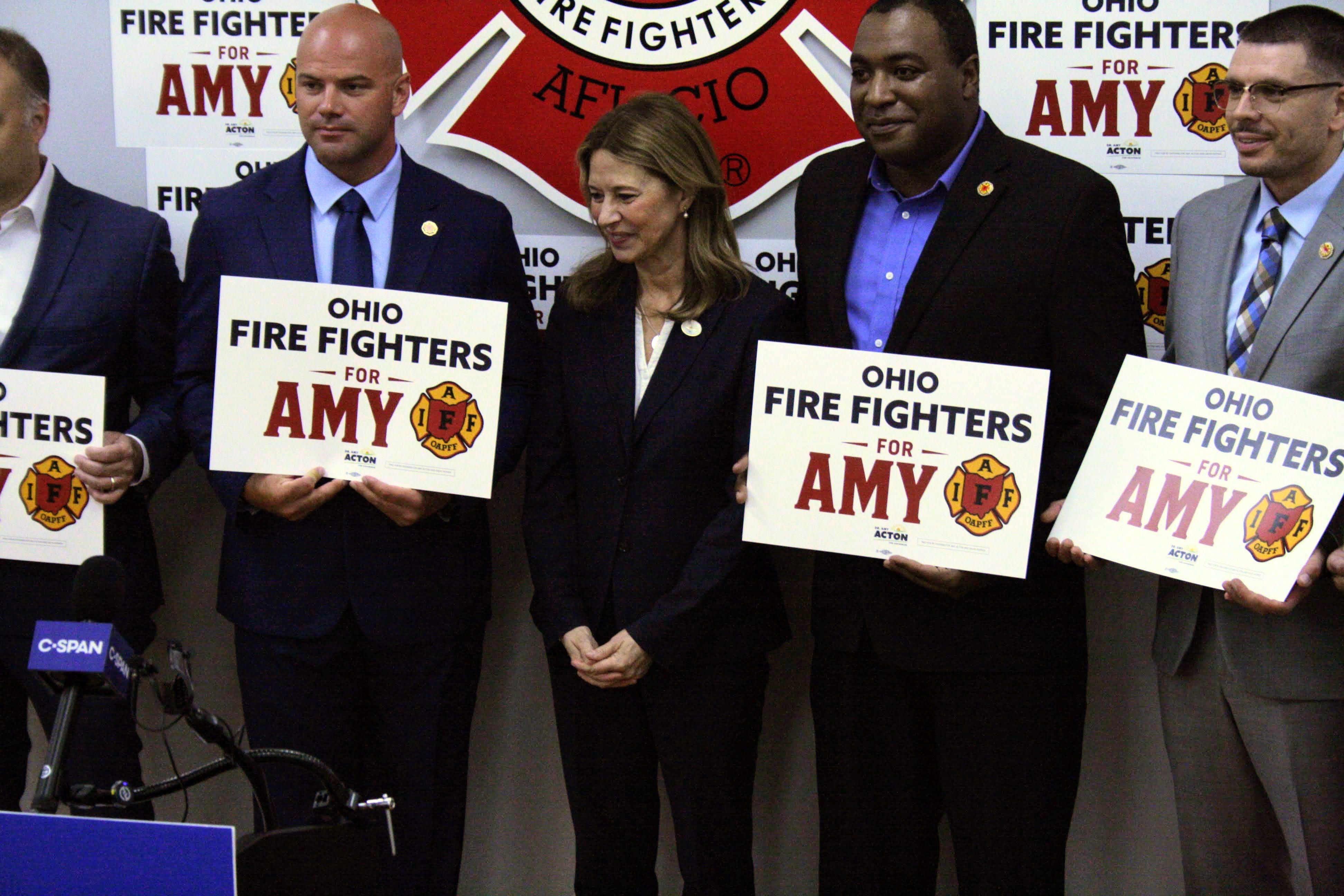
AMY ACTON PICKED UP A BIG ENDORSEMENT Monday in a union hall on the city’s west side. In a room decorated with historical mementos honoring Cincinnati’s fire department, the oldest professionalized municipal fire department in the country, Acton was surrounded by a dozen or so union leaders as the Ohio branch of the International Association of Fire Fighters threw its support behind her gubernatorial bid.
This year, the cops-and-firefighters split is stark in Ohio. The state’s Fraternal Order of Police gave Republican Vivek Ramaswamy its endorsement, which it also extended to every other Republican running statewide. And while the firefighters have in the past gone in for both Republicans and Democrats, for most of the last decade and a half—ever since then-Gov. John Kasich in 2011 pushed for and signed a law (later repealed) sharply curtailing public employees’ collective-bargaining rights—they’ve placed their bets pretty firmly with Democrats. This fall they are all-in on Acton.
On this hot summer day I’ve come to the Fire Fighters Union Local 48 hall to see Acton in action and grab her for a chat after. The event, closed to the public but open to some members of the press, will be the first chance I’ve gotten to observe the candidate up close.
The first thing to grab my attention is a reminder from the president of Columbus’s Local 67, Steve Stein, of how Acton, a physician who was director of Ohio’s Department of Public Health from 2019 to 2020, responded to the pandemic. For Republicans, seething over COVID public health interventions has become de rigueur. There was some freshness, then, in hearing words of praise for a public servant who did battle with a deadly virus against which we were initially almost defenseless:
We weren’t sure if we were going to lose half of our workforce responding to this [COVID]. And every single one of our members said, “We’ll see you tomorrow.” And it was leadership—proven leadership—[from] people like Dr. Acton, Gov. DeWine and the team, and the hard work of our firefighters, EMTs, and paramedics, that responded to every single Ohioan, no matter where they lived. . . . Those decisions weren’t partisan. They were decisions about safety. They were decisions about serving other people.
Stein wouldn’t be offering this praise if Acton didn’t welcome it, which suggests the candidate is going to respond to Republicans’ COVID-related attacks by refusing to cede the ground of science and memory to them. A preference for the truth shouldn’t be extraordinary in mainstream political candidates, but in 2026, it’s a promising opener for anyone who would prefer not to be gaslit about that recent episode of extraordinary suffering and death.
When Acton gets up to speak, she makes clear she is less interested in relitigating the pandemic than in talking about the Ohio she wants to build. But as she gives her values-forward stump speech, it’s tempting to let your mind wander backwards, to a time before the pandemic and before MAGA. In some ways, the future Ohio envisioned by Acton sounds an awful lot like the one she knew during childhood.
“When I was growing up in Youngstown, we didn’t know what party you were in,” she says. “We knew what union you were in.”
Fearless reporting.
Sharp analysis.
And commentary that helps you see around corners.
Make sure you miss nothing—join Bulwark+.
In the Youngstown of Acton’s memory, partisan affiliation was an abstract feature of a person’s identity. The concrete things about you had to do with the institutions down the street: unions, yes, but also churches, neighborhoods, and civic organizations, and underneath all that, the general expectation that you and your neighbors would look out for one another. It’s the spirit of small-town Ohio—a pretty faithful impression, even if the warts have been removed.
Life in such a setting can be far from idyllic, of course. Acton and her brother experienced a childhood marked by abuse and neglect—the subject of her first campaign ad. For a time, they lived in a tent during a Youngstown winter. This morning, she emphasizes that it was often first responders and neighbors who intervened to make sure the pair of kids were okay. Some would even invite them onto their front porch for an impromptu breakfast “just because we were hungry.”
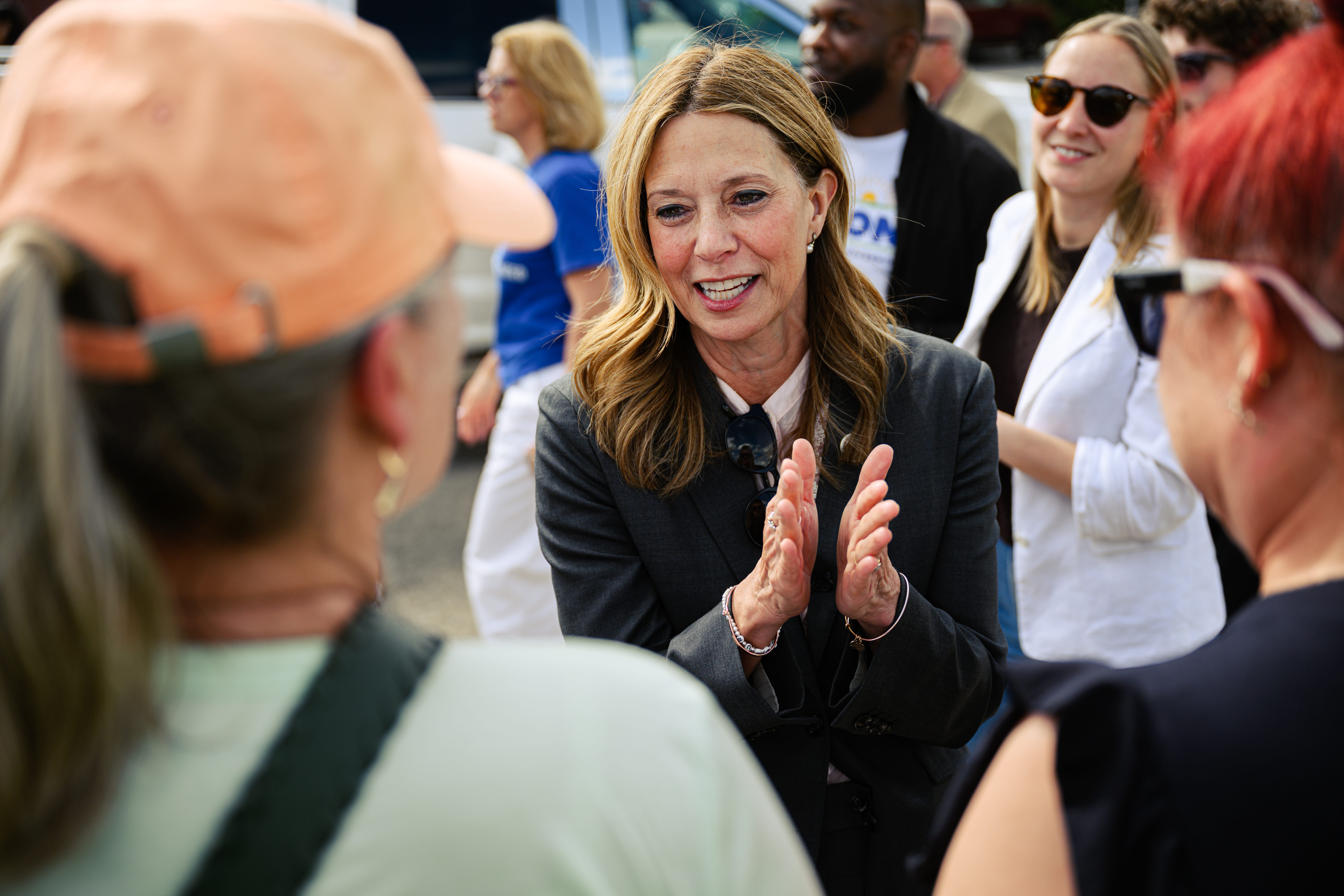
It might be because of this hardscrabble background, but Acton’s empathy doesn’t feel like an act in the way it so often does with other candidates out on the campaign trail. “I’m a doctor. I’m not much of a politician,” she says, adding, “I’m becoming one right in front of your eyes.” Watching Acton, it seems to me that she doesn’t work a room so much as observe it, and in a way that reminds me of the moment a physician looks you over before starting the conversation during an exam. In response to questions, she sometimes pauses to take in the questioners for so long that it’s almost physically discomfiting. Call it retail bedside manner.
The doctor’s diagnosis is that the state has an acute infection of political acrimony that needs to be addressed in order to treat a deeper underlying condition: economic malaise. “Everywhere we go, people are longing for public servants again, and they’re longing for this hate and chaos and vitriol and purposeful pitting against one another to end,” she says. “The issues they talk about—95 percent of them—no one would disagree on: It’s the cost of living, housing, educational costs, childcare, property taxes.”
She cites a Clermont County family with premature twins who had accumulated $300,000 in medical debt from a neonatal intensive care stay. They had done everything right, she says, yet still found themselves financially overwhelmed. Anecdotes like this frame Acton’s defense of her medical debt–relief policy, which Ramaswamy recently seized on as proof that she is a socialist of some kind.
It’s a stark contrast to Ramaswamy—who recently was booed by an audience of conservatives for claiming his generation is “going to be fine” and has “already made it.”1
“For pennies on the dollar, we’re renegotiating that debt,” Acton says—noting that “Illinois spent $10 million of state funding, and they alleviated a billion dollars of people’s debt.”
After this, Acton moves through a cavalcade of pocketbook-focused policies, concluding with her proposal for a “circuit breaker” rebate for middle-income homeowners facing steep tax increases. After that, a moment of vintage Americana.
“This endorsement means everything to me,” she tells the firefighters. “You’ve been my heroes, and I promise that I’ll be fighting so that no one in this state is ever unseen.”
SITTING DOWN WITH ME after her speech, Acton reiterates that she isn’t a natural politician. “My last office I ran for was in high school,” she tells me. “The instincts of being a 60-year-old doctor and doing public health and preventive medicine—it’s always about going to ground. It’s always about the community as your patient. That was my instinct all along, and I started going around listening even before I filed my paperwork to make the decision to run.” In her Toledo-built Jeep Wrangler, she says, “I’ve been to every county in Ohio. . . . I wanted to meet people where they are.”
Meet them she did. At a recent Democratic dinner in Fulton County that normally draws a few dozen people, more than three hundred attendees turned out. Many, she recalls, introduced themselves not as Democrats but as lifelong Republicans. Acton believes some of her draw, and some of the willingness of those guests to put aside partisan loyalties, traces back to the pandemic.
“It’s a deep bond that formed around going through such a very hard time. It’s very unique. I don’t think a politician could intentionally create this kind of connection,” she reflects.
That experience of collective suffering—and Acton’s presence in communal memories of it—also helps explain why, she says, “I’ve never been in a room in two and a half years where someone doesn’t cry.”
Every campaign has its unique rhythms and quirks; regular weeping from eventgoers is far from the strangest I’ve encountered over my years of following national politics. But it provides a curious point of contrast with the aversive reaction associated with Ramaswamy’s campaign.
“My opponent was just out last week with the whole, ‘victors not victims, you’re whiny and complaining’ stuff,” she tells me. I point out that, during his humiliating performance at YALCon, there were quite a few whiners in the crowd.
She laughs. “He’s the biggest whiner I’ve met.”
FOR ALL THE ATTENTION PAID to Acton’s public health role during Ohio’s experience of the pandemic, it is easy to forget that it represents only a small chapter in her career. She has worked with five governors—Republicans and Democrats—and her experiences have given her a zest for (reasonable) bipartisanship.
If elected, she says, she will appoint Republicans to her cabinet, because Ohioans should expect their governor to work with anyone willing to solve everyday problems.
One former Republican governor in particular genuinely excites her: Bob Taft.2 Acton and her running mate, lieutenant governor candidate David Pepper, recently met Taft for lunch. The former governor arrived carrying a crumpled, coffee-stained sheet of paper on which he’d listed everything he’d hoped to accomplish when he became governor in 1999.
Together, Acton tells me, the three of them walked through the list. The Taft of yesteryear had set his sights on constructive, reasonable goals: new parks, initiatives to encourage economic development, and other long-term projects of the sort that rarely dominate campaign speeches but can shape a state for decades.
Acton explains that she didn’t see this as an exercise in nostalgia. Rather, she takes it as a reminder that governors once measured success by what they built. In a time of endless, unproductive scrapping, that seems like a useful thing to recall.
But in addition to the economic and material considerations informing Acton’s policy offer and her own desire for building up Ohio, she has a priority issue in the area of cultural politics. The question: Why are we all so bummed out? Acton’s answer: because we are so damn lonely.3
Ohioans are “absolutely exhausted of hate, chaos, and vitriol, and being pitted against one another,” she tells me. “We are hardwired for human connection.” As an exhausted and angry Ohioan, I am inclined to agree.
She invokes Bowling Alone, sociologist Robert Putnam’s landmark study of America’s fraying civic life and declining social capital that has been helping people see those problems more clearly for over a quarter century. Putnam’s book is “about the fabric of our civic society. I was talking earlier about [how] people didn’t know what party you were in; they knew what union you were in,” she tells me. “They also knew what hat you wore, if you were an Elk or a Moose or whatever. There’s so much pride, and people wanna have pride again in Ohio.”
As an Elk (and a fan of Putnam, who has been a Bulwark Daily guest), I heard Acton speaking to me in my own born-again Ohioan’s language. Our state’s politics, culture, and even our sports teams are subject to derision and often made the butt of hostile jokes. People still laugh about the Cuyahoga River catching on fire. But damn it, I still love Ohio. I moved back here, after all. It’s clear that Acton does, too.
“I always say when I’m going around the country, it’s the United States of Ohio,” she says. “We’re the test market. We represent the whole United States.” That’s part of what being the “Heart of It All” is all about. But the heart is deceitful above all things, and it’s got reasons that reason does not know—all of which is to say, it’s going to be another three months of weeping and whining before we know the road ahead for Ohio, and for the United States thereof.
It’s certainly understandable that Ramaswamy would have a loose grasp of on-the-ground issues for Ohioans, given that he appears to have spent almost half his time during this campaign outside the state.
Full disclosure: I campaigned for Taft in high school and still have the t-shirt.
Connecticut’s Sen. Chris Murphy, who agrees, wrote a piece about this for The Bulwark.
You can tell a lot about someone when they tell you they’re ok with bullying children and using government to police sports.