‘Animal Farm’ Never Gets Old
Orwell’s classic turns 80.

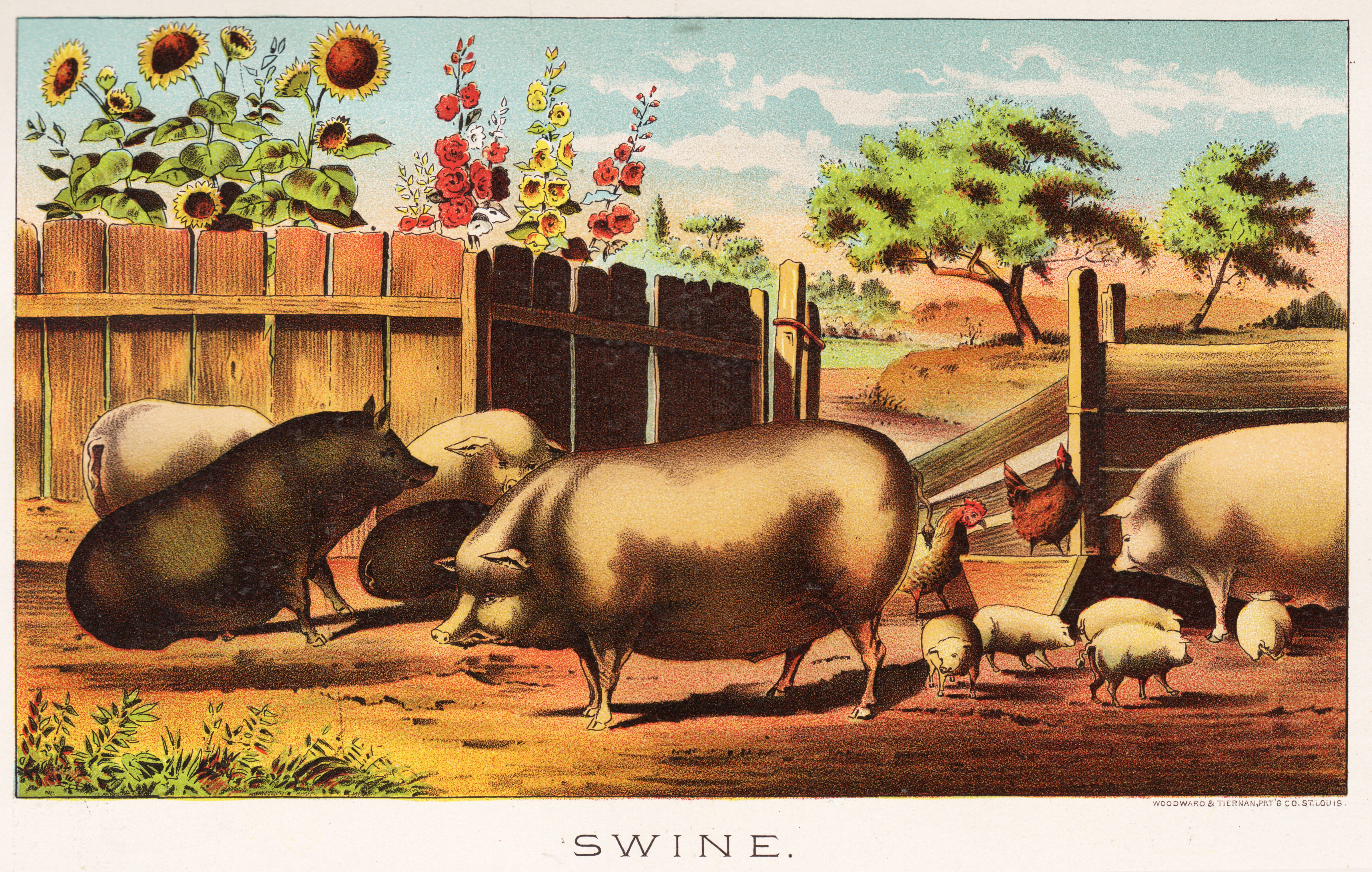
GEORGE ORWELL’S SATIRICAL FABLE Animal Farm, which marked its eightieth birthday in August, has endured as one of the most-read and most-loved books in the English language. Yet this short novel about a revolution whose promise of liberation is perverted into a new tyranny almost didn’t get published: When Orwell started shopping his manuscript to British publishers in early 1944, the story was easily recognized as a satire of Soviet Russia, and there was a profound reluctance to publish anything anti-Soviet—not only because of progressive sympathies, but because the Soviet Union was a key wartime ally. (Soviet infiltration of British political and cultural institutions evidently played a role, too; plus ça change.) Five publishing houses rejected the book; a small press accepted it in July 1944 but waited more than a year to print it.
Orwell later wrote that Animal Farm was inspired by harrowing personal experiences in the Spanish Civil War. He and his wife Eileen O’Shaughnessy Blair (a poet and editor who, according to their son Richard Blair, played a significant role in shaping the book) went to Spain, shortly after marrying in 1936, to join the fight against Francisco Franco’s right-wing nationalists. In 1937, they had to flee for their lives—not from Franco’s Falangists, but from the Stalinists who had gained partial control of the left-wing Republican government; many of their friends were killed, imprisoned, or disappeared in anti-Trotskyist purges. On their return to England, Orwell wrote that “it was of the utmost importance to me that people in western Europe should see the Soviet regime for what it really was.” Eventually, he got the idea of “exposing the Soviet myth” via an allegorical “fairy-tale” about animal liberation gone wrong.
The Soviet parallels in the novel, in which animals on a farm run by the drunk and abusive Mr. Jones band together to drive out their two-legged oppressors and set out to build a haven of freedom and equality for all beasts, are very explicit—right down to specific characters, events, and symbols. Napoleon, the crafty boar who eventually becomes Animal Farm’s totalitarian dictator with a personality cult, clearly represents Stalin; his rival Snowball, who co-leads the revolution but gets outmaneuvered, forced into exile, and branded a traitor—and blamed for everything that goes wrong on the farm—is Trotsky with trotters. (Early on, there’s also a Marx-Lenin mashup: Old Major, the wise boar who inspires the revolt before dying and has his skull reverentially displayed on a post, much like Lenin’s mummified body in the mausoleum in Red Square.) The farm’s flag—a white hoof and horn on a green field—echoes the red flag with the hammer and sickle. Like the early Soviet revolutionaries, the animals throw themselves into enthusiastic labor to make their experiment work, and normal practices turn into political projects: “the Egg Production Committee for the hens,” “the Clean Tails League for the cows,” and “the Whiter Wool Movement for the sheep.”
Soon, the resemblances turn much darker. In an episode that clearly echoes the Holodomor, the mostly man-made famine Stalin used to break the back of peasant resistance to collectivization (and crush Ukrainian nationalism), hens who resist orders to surrender their eggs for trading are starved into submission. Later, the purges and show trials begin. As the assembled animals watch in horror, four pigs who had criticized Napoleon earlier are dragged before him by his pack of trained hounds, confess to treasonous collaboration with Snowball, and are at once dispatched by the same dogs. Napoleon demands more confessions, and they are quick to follow:
The three hens who had been the ringleaders in the attempted rebellion over the eggs now came forward and stated that Snowball had appeared to them in a dream and incited them to disobey Napoleon’s orders. They, too, were slaughtered. Then a goose came forward and confessed to having secreted six ears of corn during the last year’s harvest and eaten them in the night. Then a sheep confessed to having urinated in the drinking pool—urged to do this, so she said, by Snowball—and two other sheep confessed to having murdered an old ram, an especially devoted follower of Napoleon, by chasing him round and round a bonfire when he was suffering from a cough. They were all slain on the spot.
In time, the animals’ lives grow more and more dismal. There is more work and less food, but Napoleon’s chief propagandist Squealer keeps giving upbeat reports, and the weekly “Spontaneous Demonstrations” with cheery songs in praise of Comrade Napoleon continue. The “Seven Commandments” of the revolution’s philosophy of “Animalism,” painted on the wall of the barn, keep getting altered until they are finally erased except for the last one, “All animals are equal”—with a famous key addendum: “But some animals are more equal than others.”
Orwell’s novel ends with a development that, at the time, had no parallels in Soviet reality: The pigs adopt human ways, from sleeping in beds to drinking alcohol and finally wearing clothes and walking upright. (The sheep, who provide the farm’s slogan-chanting chorus, are promptly taught to bleat, “Four legs good, two legs better” in place of the old “Four legs good, two legs bad.”) In the book’s famous final scene, when a delegation of human farmers arrives to restore good relations with the pigs, the baffled animals huddled outside the window listen as Napoleon repudiates the remainder of the farm’s revolutionary traditions—such as the appellation “Comrade,” the hoof-and-horn flag, and even the name “Animal Farm,” now reverting to the old-time “Manor Farm”—and the pigs seem to morph into something more and more human.
Orwell, a democratic socialist, thus seems to be envisioning a scenario in which the Soviet regime evolves into a state capitalist oligarchy and drops its Communist trappings. That never came true—or did it? Not quite in the way it happens in Animal Farm; but, after the fall of the Soviet Union and a brief democratic interlude, that’s pretty much where things have ended up. Russia has shed its Soviet name, the hammer and sickle and the Communist forms of address; it is ruled by a crony capitalist oligarchy that flaunts its palatial homes and villas, its yachts and luxury cars, its designer suits and high-priced watches; and today, it is also a Stalinist-lite (and sometimes not so lite) dictatorship in which dissent is ruthlessly squashed and the worship of the “national leader” reaches Comrade Napoleon–like proportions.
AFTER ITS PUBLICATION, Animal Farm “took the world by storm,” as Russian-born Orwell scholar and translator Masha Karp wrote in a recent article for the Orwell Society website. Karp notes that it excited a particular interest in Eastern Europe, among people for whom Stalinism was not a theoretical threat. Its first translation, into Czech (Farma zvířat), was published in late 1946 in Czechoslovakia—then already in the Soviet orbit but not yet fully Communist-controlled. A Polish translation appeared around the same time, this one published in London by the League of Poles Abroad; the first Russian translation was serialized in the West Germany-based émigré magazine Posev in 1949 and then published as a book with a plan for it to be smuggled it into the Soviet Union. Orwell, eager to support the project, not only declined royalties but made a donation toward the printing costs.
But perhaps the most remarkable story—and the one with the most resonance today—is that of the Ukrainian translation, Kolgosp Tvaryn, published in September 1947 for Ukrainian refugees in “displaced person” camps in Germany; the translator, 24-year-old Polish-born Ukrainian Ihor Ševčenko, pointedly “Sovietized” the title by turning “farm” into kolgosp or “collective farm.” Ševčenko, later a philology professor at Harvard, had written to Orwell to tell him that he had read the novel aloud to groups of refugees, sight-translating it into Ukrainian, and that his listeners—many of whom felt that nobody in the West grasped the truth about the Soviet regime—were deeply impressed. Once again, Orwell was enthusiastic and gladly waived royalties; he also agreed, despite a “frightfully busy” schedule, to contribute a preface which, according to Karp, offers the most complete explanation of how and why he came to write the book. (The existing English version of this preface is a back-translation from Ukrainian; regrettably, Orwell’s original text is lost, along with several lines that Ševčenko cut, with Orwell’s permission, because he thought they would be unsuitable for Western Ukrainians who had been Polish, not Soviet citizens before the start of World War II.)
The story of that first publication of Kolgosp Tvaryn is both inspiring and depressing. Shortly after the book was printed, Orwell wrote to Arthur Koestler that the American authorities in Munich had seized 1,500 copies and turned them over to the Soviet officials in charge of (nearly always forcible) repatriations of prisoners of war and refugees. It was, Christopher Hitchens wrote in a foreword to a 2010 edition of Animal Farm, a striking example of “the alliance between the farmers and the pigs, so hauntingly described in the final pages of the novel.” Karp notes that this shameful decision may have been the result of a foolhardy attempt by Ukrainian dissidents to circulate the book among Ukrainian-speaking Soviet soldiers stationed in Germany—or it may have simply reflected “an incredible naiveté on the part of the American authorities.” Either way, it feels especially shameful today amid another, much more comprehensive American betrayal of Ukrainians, when “incredible naiveté” is the most charitable explanation. (At publication time, President Trump seems to have shifted in a more Ukraine-friendly direction, at least on the rhetorical level—though, as always, it’s hard to say exactly what’s going on or how long it will last.)
Luckily, before the seizure, some 2,000 copies of Kolgosp Tvaryn had already been distributed in the “displaced persons” camps—and even became part of the curriculum in the schools set up by the refugees. Many of those refugees’ descendants, such as Ukrainian-American filmmaker and journalist Andrea Chalupa, are still keeping those well-worn books as precious family relics.
ANIMAL FARM HAS BEEN a global phenomenon, with translations into more than 70 languages; but it has been a particularly big hit in the United States. It helped that the American edition came out in 1946, just as the wartime alliance with the Soviet Union was deteriorating and the Cold War was setting in. (Speaking of which: Orwell is credited with being the first to use the term “cold war” in reference to Soviet relations with the U.S. and England in early 1946.) Orwell’s novel was named a Book-of-the-Month Club main selection in September 1946; it also got a rave review in the New Yorker from prominent critic Edmund Wilson, who praised the book’s “simplicity,” “wit,” and plain, spare prose. It has remained a staple of school curricula; in 2019, it was the seventh most-assigned high school title. And it will likely get a new boost from an upcoming Andy Serkis animated film that will feature Seth Rogen voicing Napoleon (though an early review and a clip suggest that the adaptation suffers from what Variety describes as “cutesy” antics and potty humor).1
The novel certainly deserves its status as a classic. Political relevance aside, it is a brilliant work of literature. Wilson deservedly compared Orwell to Voltaire and Swift; but Orwell’s satire is warmer and more humane. The put-upon animals through whose eyes we see the story are treated with genuine affection. The fate of the loyal workhorse Boxer, who responds to every problem with “Napoleon is always right” and “I will work harder” until he collapses—and ends up getting sold to a horse slaughterer under the guise of a trip to an animal clinic—is not only grimly ironic but heartbreakingly poignant.
But in 2025, Americans may be reading this novel with somewhat different eyes than in times gone by, when strongman rule, cult-like worship of leaders, and reality-denying propaganda were things that happened somewhere else. Today, it’s hard to read Orwell’s mordant description of the extravagant panegyrics to Napoleon (“two cows, enjoying a drink at the pool, would exclaim, ‘Thanks to the leadership of Comrade Napoleon, how excellent this water tastes!’”) and not think of the examples we are witnessing daily—from the downright idolatrous sensibility common among Trump’s base to administration officials falling all over each other to heap praise on Trump at a cabinet meeting, or a member of Congress telling reporters Trump is “never wrong,” or press secretary Karoline Leavitt gushing, “Cracker Barrel is a great American company, and they made a great decision to Trust in Trump!” Likewise, when Orwell wryly notes that the animals “had nothing to go upon except Squealer’s lists of figures, which invariably demonstrated that everything was getting better and better,” one can’t help thinking of Trump firing the Bureau of Labor Statistics commissioner who wouldn’t deliver that message.
The rewriting of slogans, the insidious conspiracies invoked to explain anything that goes wrong, the propaganda chief convincing the other animals that things they saw with their own eyes didn’t happen or happened very differently: The parallels are all over the place. You could even point out that, like Orwell’s animal revolution, Trumpian populism purports to champion the downtrodden and the scorned. And Trump’s cozy huddle with Vladimir Putin last month evokes the novel’s haunting last line in which the animals “looked from pig to man, and from man to pig, and from pig to man again; but already it was impossible to say which was which.”
This is not to say that we’re trapped on Animal Farm, of course. Unlike its denizens, we have other sources of information, and buying what MAGA’s Squealers are selling is a choice. So far, this administration’s actions are more of a chaotic and incompetence-riddled power grab than authoritarian rule; in lieu of Napoleon’s fearsome dogs mauling dissenters at his signal, we have National Guards bagging trash around Washington, D.C. But if Animal Farm isn’t our own story (yet), it is certainly a useful warning. And not just for Trump’s enemies: The devoted Boxer, sold to the glue factory so that the pigs can buy themselves a few cases of beer, can be seen as a stand-in not only for the Soviet working class but for all the MAGA faithful getting screwed by Trump’s policies.
Modern American parallels are certainly not the only reason to reread Animal Farm. But they are a good reminder that Orwell’s fable was never just about the Soviet Union.
An earlier animated film, made in 1954 and co-sponsored by the CIA, is excellent and quite faithful to the novel—except for an altered ending in which the animals rebel, storm the farmhouse, and kill their porcine rulers. (Amusingly, investors concerned about a backlash from the agriculture industry also insisted on adding material to show that not all farmers are bad and that the animals on other farms are not oppressed.) A 1999 live-action TV movie, also with a happy-ish ending, featured animatronic critters and an impressive voice cast including Patrick Stewart, Ian Holm, and Julia Louis-Dreyfus; it’s worth seeing if only for the Animal Farm propaganda reels that cleverly mimic Soviet propaganda visuals. It also occasioned a brilliant review headline in the Washington Post: “This Little Piggy Went Marxist.”
Cathy Young, I appreciate this excellent review and all your good writing on the Russia situation. And thank goodness for George Orwell.
Over the last several decades, to me as a very pro-Israel Jew, Roger Waters has become a very disturbing person to me and I don't agree with anything he says, nor do his former bandmates.
That caveat aside, I highly recommend to you Cathy, and to all Bulwark readers, the 1977 album by Pink Floyd called "Animals". It's not only influenced by, but is directly referencing the Orwell novel.
While I highly recommend it, I will warn readers and music fans it is not a "fun romp" or whimsical. The album cover features a huge pig, flying over a brooding factory. It's a cover that indicates it is indeed a very dark album. It captures the absolute scary reality of what Animal Farm is about. It's also a group at their "progressive rock" height. Which is a way to say it features 3 very long pieces, bookmarked by 2 short ones.
Pigs on the Wing pt.1
Dogs
Pigs(3 different ones)
Sheep
Pigs on the Wing pt.2
When one pours through the lyrics, you see all the allusions to the Orwell story, with very few references to 1970s era British politicians like Mary Whitehouse sprinkled in. The lyrics take a few steps away from Orwell, but never stray far. The Pigs are at war with and eventually overtake the Dogs. While the Sheep in the middle get slaughtered by both. But at what cost? The last of the longer songs, Sheep, features a twisted animal version of Psalm 23.
I don't just suggest this album because of the Orwell tie, but the fact that this music, this dark and dense music, really captures what now feels like. To me it does. For all the "hippie dippy" pot smoking allusions their 1972 Dark Side of the Moon bring to mind. 1977s Animals is a different trip, a different story, and unfortunately fits the darkness of our modern Trump Farm, full of Pigs.
Have a great weekend Cathy,& Bulwark readers. I really adore your work, Cathy. You are such a wonderful and strong addition to the Bulwark contributors.