A Backlash Is Brewing Against Companies Helping ICE
Activists are targeting the reputations of Home Depot, AT&T, and other businesses.

THERE ARE SIGNS that Donald Trump’s power is starting to wane.
First there was his party’s catastrophic showing in the off-year elections a few weeks ago. A couple weeks later, he hosted New York City’s mayor-elect, Zohran Mamdani, at the White House, but instead of castigating the young democratic socialist, Trump treated him obsequiously, posting a large photoset to Truth Social afterwards in the manner of a fan who’d gotten to meet a rock star backstage. Then there were rumblings of coming House GOP retirements, then a stalled health care initiative, and then open anger with his Ukraine peace plan.
And now here’s another sign.
Companies that have collaborated with immigration enforcement agencies in various ways to aid Trump’s mass deportation initiative—whether through allowing ICE to raid their parking lots, taking on contracts with DHS, or a variety of other actions—are starting to feel the rumblings of a consumer revolt.
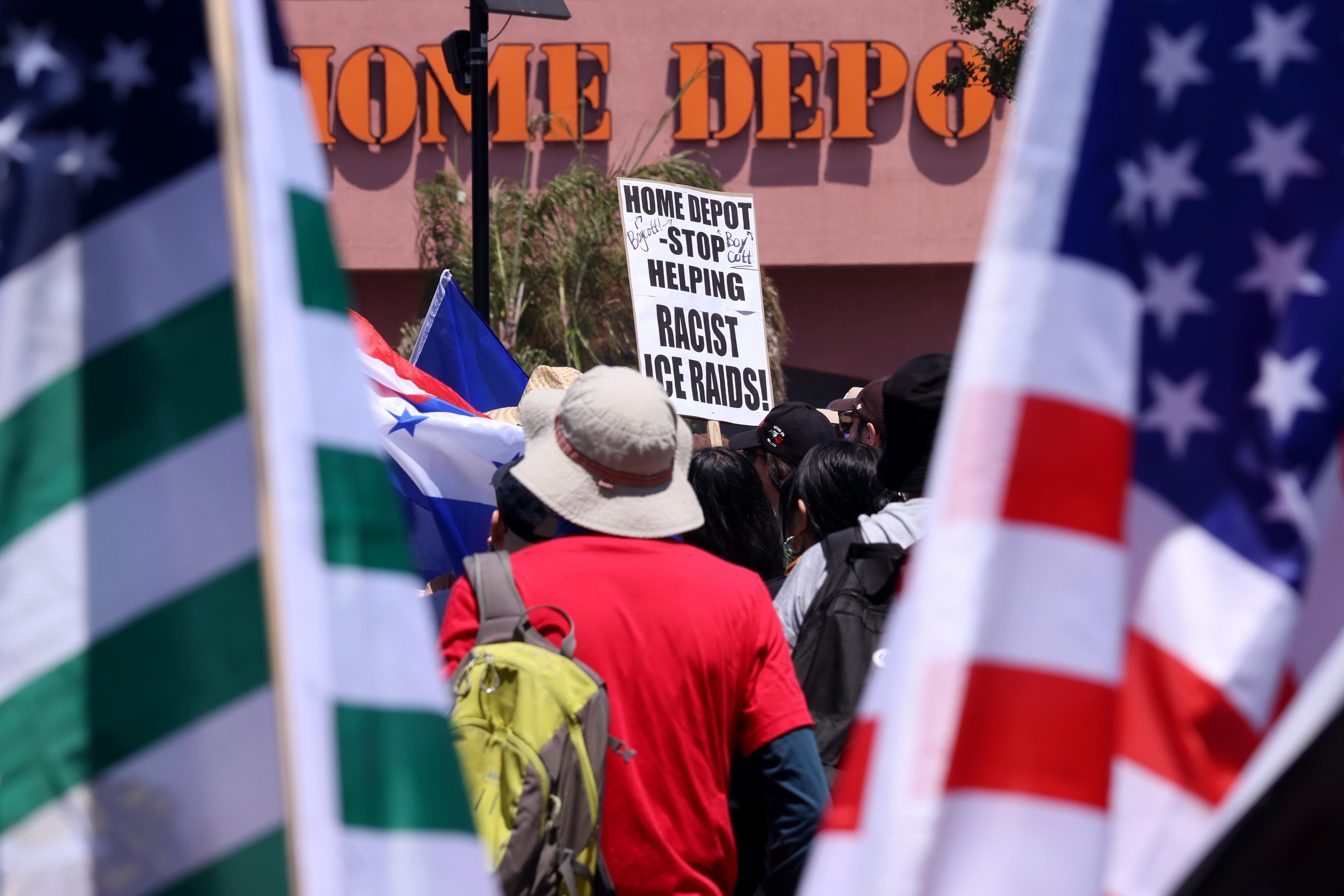
Home Depot is possibly the most visible case after the company’s parking lots became a familiar setting for shocking viral clips and local news segments depicting federal agents’ aggressive attempts to apprehend unsuspecting day laborers. The home-improvement chain now faces the prospect of a national boycott. But that’s not the end of their troubles: Bold and unpredictable protests are beginning to disrupt retail operations across the country.
A particularly headline-grabbing protest was staged last weekend at the Home Depot in Monrovia, California, a location picked because it’s where Roberto Carlos Montoya Valdés, 52, from Guatemala died on the freeway after being hit by an SUV while running from an ICE raid. Last weekend, protesters walked into the store en masse, picked up $0.17 ice scrapers (get it?), bought them one by one, then queued up again to return each purchased tool. This was all perfectly legal, but it created retail chaos: enormous, slow-moving lines. The checkout-clogging action ultimately forced the location to temporarily close. All this was done in the name of protesting the company for its refusal to object to the masked federal agents who have used its stores and parking lots as staging grounds to ambush day laborers looking to help Americans with landscaping and house work.
There is a rich history of progressive-minded groups using boycotts and targeted campaigns against businesses in hopes of changing their behavior and political decisions in general. There have even been some successes in the current Trump term, as Disney and Jimmy Kimmel will attest.
That’s because companies care, more than anything, about their bottom lines. And they hate extended periods of bad press, which is precisely the result of actions like this. This latest protest came after I reported last month that Home Depot executives met with Los Angeles Mayor Karen Bass and activists to discuss the company’s role in Trump’s immigration operations. The company has said its hands are tied. Attendees at the meeting described it as unproductive.
Coverage of the ice scraper protest has blanketed local news in L.A., but it also gained national attention with a segment on Rachel Maddow’s show for MS NOW. The National Day Laborer Organizing Network (NDLON), which organized the protest and provided the orange and white “ICE OUT OF THE HOME DEPOT” signs protesters brought into the store, said companies that cooperate or work with ICE can expect to see Americans respond with the power of their wallets.
“People are becoming more emboldened to cross Trump as his power wanes,” Chris Newman, the general counsel of NDLON, told The Bulwark. “The shared goal of the corporate overlords and ICE is to make people feel powerless, and these actions are a way of resisting that sense of powerlessness.”

FOR MONTHS NOW Home Depot has been singled out for its role as a staging ground in the Trump deportation regime. What’s different now is that it is far from the only company starting to catch heat for its association with the administration. This month also saw the beginning of a new campaign against AT&T from groups associated with People’s Action, a coalition of forty organizations across twenty-nine states whose constituent groups have been organizing initiatives of this kind for half a century. The group protested outside around twenty AT&T stores in the greater Chicago area, encouraging customers to refrain from getting upgrades, new contracts, or doing extra holiday spending on AT&T products.
The reason: AT&T has major contracts with federal agencies carrying out Trump’s mass deportation program. The company received a $146 million, ten-year contract with DHS last fall to “provide mission-critical communications services” that are “dedicated to support the national security and emergency preparedness mission for the foreseeable future.” That deal was signed when Biden was still president—but then, as the American Prospect reported, ICE awarded AT&T an $11 million contract for data analytics and support services this summer, and the company also received a $14 million contract from CBP for network-related services in the late spring; DHS’s new direction was already more than clear by the time those deals were finalized. A petition from the group against AT&T has more than 12,000 signatures.
There’s also speculation that AT&T data could have been used by DHS to target people during the shocking raid at the 7500 South Shore Drive residential building raid in Chicago. That raid featured multiple agencies coming from different directions at 1 a.m., including agents rappelling down from a Black Hawk helicopter like it was a Michael Bay movie. I asked AT&T spokespeople if they could confirm or deny the use of the company’s technology and services in the 7500 South Shore Drive raid and they did not respond to multiple requests for comment. No criminal charges resulted from the raid—it was just an embarrassing, made-for-TV spectacle.
People’s Action is also targeting Amazon and its affiliated stores (like Whole Foods) over the company’s ties to ICE. This follows a #NoTechforICE report from immigration groups that called out Amazon and Palantir for providing the “collection, storage, and management of the vast amount of information required by ICE to increase its reach to the levels promised by the Trump administration” and enabling “DHS to apply new technologies and expand its data-sharing capabilities to undermine and get around any local protections that were hard-fought and won by immigrant rights groups.” Amazon’s cloud storage space, the report said, helps DHS maintain a “database for immigration case management systems and biometric data for 230 million unique identities—mostly fingerprint records, alongside 36.5 million face records and 2.8 million irises.”
In addition to Home Depot and Amazon, Hendrick Motorsports is also in the crosshairs after ICE approved a $2.2 million no-bid contract for twenty-five Chevrolet Tahoe SUVs with the company this summer. The Charlotte Observer, following earlier reporting from Zeteo, noted that critics are now calling for a boycott of the company. And Democratic Reps. Bennie Thompson (D-Miss.) and Shri Thanedar (D-Mich.) wrote a letter to the government agency in which they questioned if Hendrick caught that sweet deal thanks to owner Joseph “Rick” Hendrick III being a prominent GOP donor.
“I don’t know if we’ve reached a turning point around fear of Trump,” Unai Montes-Irueste, with People’s Action, told me, “but it’s a good sign we’re starting to pick fights instead of reacting to things that just happened.”
Three cheers for a backlash!
thank you for giiving us this vital info that I do not see anywhere else. Keep it up