

A Baker, a Pastor, and Charlotte’s Stand Against ICE
How everyday people are reminding the nation what it means to be American.

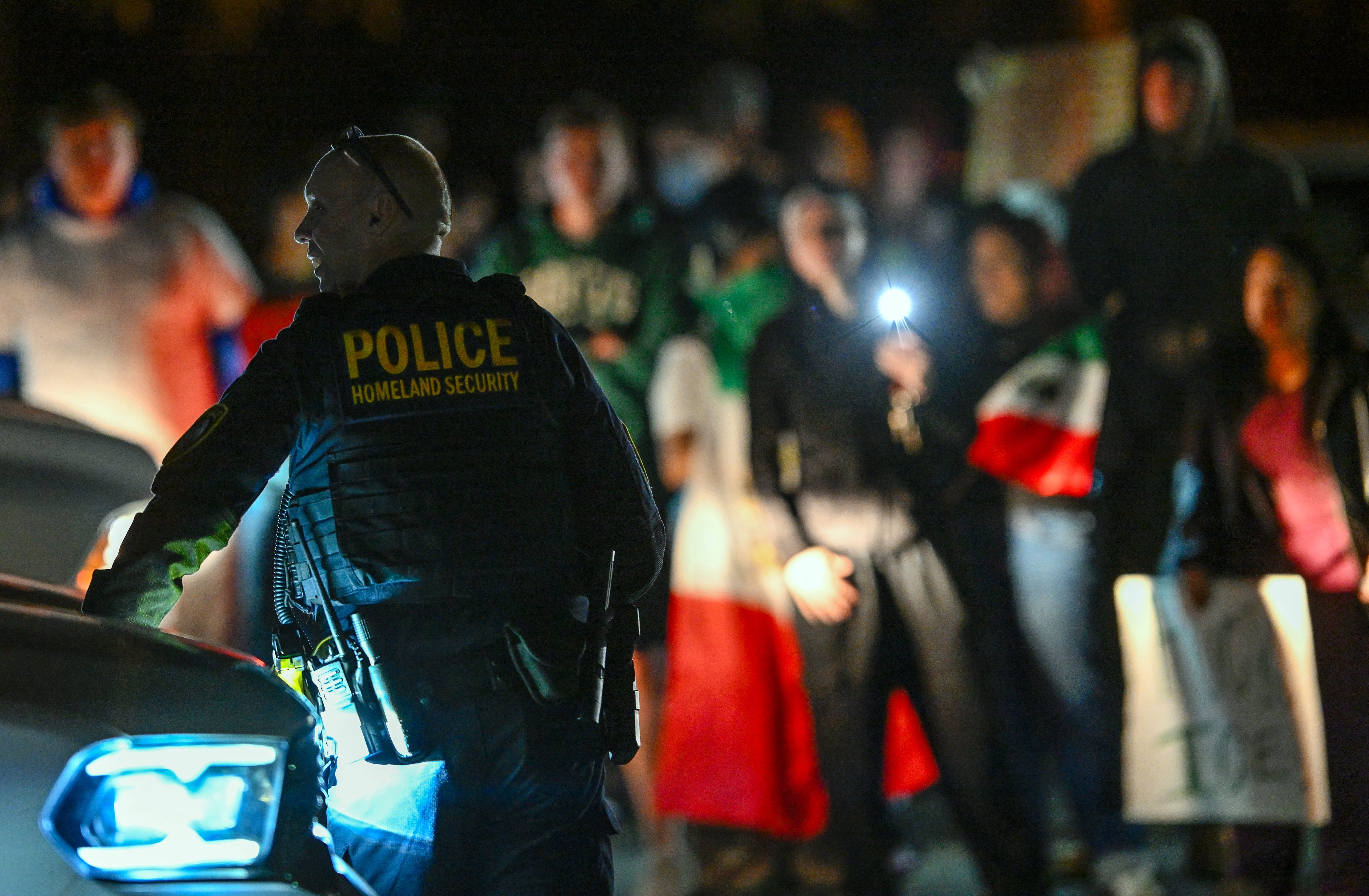
OVER THE PAST WEEK, a portion of President Donald Trump’s underqualified, overmilitarized immigration police decamped from Chicago and rolled into Charlotte, North Carolina. Last Saturday, they grabbed 81 people; by Wednesday, the number of arrests had passed 250. Siembra NC, an immigrant-rights group that works with people across the state, told me on Thursday that they had received more than 2,000 calls to their ICE hotline just since Saturday, which is more than they typically receive during an entire month.
That Trump’s masked forces were ordered to focus their efforts on Charlotte is notable: It is a city that attests to the growing Latino presence in American society generally. Between 1990 and 2020—in a little over one generation—Hispanics went from comprising 1 percent (6,700 people) of the Mecklenburg County population, which includes Charlotte, to 15 percent (156,000 people). That trend has continued: Over the four years from 2020 to 2024, the Latino presence there has grown a further 22 percent.
It’s these facts more than anything that account for “Charlotte’s Web,” CBP head Greg Bovino’s gracelessly named operation that targeted the city.
Bovino’s playbook is by now as familiar as an old coat. In Charlotte, federal agents waited on popular highways and stopped people who simply looked Hispanic. Locals described to me the way ICE and CBP agents revved up to Home Depots and Compare supermarkets, and how they aggressively questioned people at construction sites and gas stations.
As in other cities, Charlotte has seen its share of American citizens subjected to forcible mistreatment during “Kavanaugh stops,” where federal agents target them because of their race. It is blatant profiling. And it’s exactly what happened to a man named Willy Aceituno.
Aceituno, 46, was grabbing breakfast before his construction job when he was accosted by border patrol agents. Confident that his U.S. citizenship would protect him from the perils of immigration detention, he bantered back and forth with the agents, figuring any time he could get them to waste would allow others nearby extra time to get away. Those agents, as the New York Times reported, eventually allowed him to go.
But after he got in his truck, a second group of agents rolled in and started to harass him, banging on his window. His friend Karina Sanabria told me Aceituno warned them not to break it because he would demand they pay for it. And then they went ahead and broke the window. Two agents pulled him out and threw him on the ground. A passerby recorded the altercation, imploring the agents to leave Aceituno alone because he had already shown his citizenship documentation to the first group of agents.
“They just ID’d him, don’t you guys fucking coordinate?” the passerby asked.
Aceituno had kept his calm while dealing with agents earlier, but after this second group drove him to the ground and then threw him into a van, he started to get scared. Sanabria told me that another detained immigrant who was in the van wept as they were driven around. When he tried to share his wife’s phone number with Aceituno so that he could call her and let her know where he was, the agents started yelling at both men to shut up.
“They were yelling at them treating them like shit, as if he was one of the worst animals, that’s when he got scared thinking these assholes are going to take me somewhere and no one is ever going to see me again,” said Sanabria, who is part of Latino Tu Voto Cuenta, an electoral-focused group in North Carolina.
After Aceituno again told the agents he was a U.S. citizen, they finally threw him out of the van. By then, he was a twenty-plus-minute walk away from his car, which he still could not drive anywhere because the agents had taken his keys. Eventually, someone from a local advocacy group contacted the agents to get the keys back.
(If you want complicated, here you go: Aceituno voted for Trump in 2024 because of the border and the economy. He now calls it “the worst decision of my life.”)
Aceituno and I were going to get on the phone for an interview this week, but we never connected. That’s because each time I checked in, he was either doing an event to bring attention to what was happening in his state or delivering food to people in his city who had become too scared to leave their homes.
“Not everybody came here with a visa on an airplane and has the life that I have”
Manolo Betancur isn’t just a Charlotte-area baker—he’s an institution unto himself.
Manolo’s Bakery, one of the oldest Latino bakeries in the Carolinas, has been serving the community for 28 years. All those Latinos coming to North Carolina to work, live, and send their kids to school? The bread they’re buying is likely coming from Manolo’s, as he delivers to a hundred stores across the state. But as border patrol agents descended on Charlotte, Betancur’s flagship bakery had to do something it had never done before.
“For the first time in twenty-eight years, we had to close the doors” of the flagship location, he told me. “We didn’t close during the pandemic, we didn’t close during the [2008] recession.”
Betancur’s personal story reads like a clichéd illustration of the American Dream. He came to the country with just $900 in his pocket and unable to speak any English; he went to college and eventually joined Bill Clinton’s Americorps program. Working with farmworkers, he began feeling kinship with immigrants who had a different legal status than he did. His connection to the immigrant community would eventually save his business: As the devastation of the 2008 recession forced him to close four bakeries, Betancur was still able to deliver bread to areas in the Appalachian mountains where thousands of farmworkers live and work. Their patronage saved his bakery.
Betancur is a dynamo. During the pandemic, he partnered with churches to cook and deliver 50,000 meals out of the bakery. He raised money for Ukraine following Russia’s full-scale invasion in 2022, and he even visited the country to help rebuild bakeries destroyed by bombs. He has gone to Mexico to help migrants and seen the dangerous Darién Gap that U.S.-bound immigrants traverse during their long trek across Central America. He partnered with a church and took his kids to the border in Texas to bring food to the affected migrants during Trump’s first term.
And he’s become an integral part of his community, in ways that you might not expect even of an accomplished and successful entrepreneur. A few years ago, Betancur partnered with a nonprofit to donate 5,000 cakes to celebrate the birthdays of the homeless. In 2018, a member of the nonprofit called Betancur out of the blue and told him that he had saved a man’s life. Betancur said, “Stop it, I don’t know what you mean.” It turned out that one of the homeless people, when given a cake, began crying—explaining it was the first time they ever had a birthday cake in their life. Then they took out a gun and placed it next to the cake and said their plan had been to kill themselves on their birthday.
Manolo’s Bakery is normally a mainstay of an immigrant-heavy area that depends on foot traffic along the Central Avenue corridor in Charlotte. But since Friday, that corridor has been a ghost town, Betancur said. Last Friday, before federal agents began to arrive in force, people were already spooked enough that they were avoiding the area. That day, he posted photos of empty parking lots on Instagram.
By Saturday, the community’s anxiety gave way to fear as Trump’s enforcement goons descended on Central Avenue. As Betancur walked from an auto shop to his bakery, he saw several unmarked SUVs and vans quickly corner people on the sidewalk, jump them, and throw them on the ground. Within ten minutes, the agents had made off with three people.
Like Aceituno, Betancur trusted that his American citizenship would afford him some protection—he had his passport on him. But he also recognized that would change quickly if he were being thrown on the ground without being given an opportunity to show his papers, as happened to the people he saw being detained on the sidewalk.
“It was so freaking scary, man,” Betancur told me. “Trust me, it takes a lot for me to be scared. I was part of the Colombian military forces! I have seen shit in this life, man.”
He quickly got to his bakery, shut the lights off, and locked the doors. Customers who were already in the building stayed inside. Betancur then started calling his “American friends,” he said. Soon enough, fifty people were outside the bakery. By 11 a.m., agents finally arrived. They rolled up to witness an unexpected show of force from locals who did not want them to be there. “We had three SUVs in the parking lot when they saw all these Americans at my front door.”
“We decide what happens here, we’re North Carolinians”
As parts of Charlotte became ghost towns, other cities in North Carolina braced for Trump’s immigration agents to come. That includes areas like Raleigh and Greensboro, where Rev. Sadie Lansdale serves as minister for the Unitarian Universalist Church.
Her congregation church is an example of the degree to which some community groups and institutions have revamped themselves in the age of Trump. Though it has been working with the advocacy group Siembra NC since 2019, UUC Greensboro has taken on an even greater responsibility for helping migrant communities in recent weeks. The church hosts ICE watch trainings, raises money, provides childcare, and offers up its building to help those in need.
While the community in Greensboro hasn’t seen ICE and CBP enforcement actions yet, Lansdale told me, they were deeply fearful of the jackboots to come.
“The intensity of this action is scary to people all across the state, and my congregation is no exception,” Lansdale said. “Immigrants are a part of our community, their kids go to school with our kids, they live and go to work with us, so it’s a threat to our entire social fabric.”
In these moments, Lansdale has been thinking of her friend, a therapist who is managing fatigue stemming from long COVID. In spite of this debilitation, the woman organized three hundred people for an ICE watch training.
People are packing church sanctuaries across the state to learn how to “protect our neighbor, heal the sick, feed the hungry, and welcome the stranger,” Lansdale said, speaking from experience as she is working to organize clergy across Greensboro and the state.
“They’re stepping up because we all belong here and to say ‘If you want to get to our immigrant neighbors, you have to get through us.’”
It’s one of the bright spots during a week of dread, fear, and confrontation.
“It is very evil and it’s hard to watch—to wrap your mind around the extent of it,” Lansdale said. “But if you can find where to look, it’s not hard to be inspired by all the people standing up to fight it.”
Just cried through this entire piece. Beautiful writing about what is happening in our city. The terror that has been brought upon our immigrant community is unforgivable. But I am so grateful for the bravery shown by all the people in Charlotte to protect the people who are the backbone of our city.
Thank you. It's so important to keep with all of what's happening now, front and center. As Trump disintegrates, things will become worse before they get better.