Trump’s Surgeon General Pick Needs a Spine Implant
A recent exchange revealed a troubling lack of political courage—but the job practically demands it.

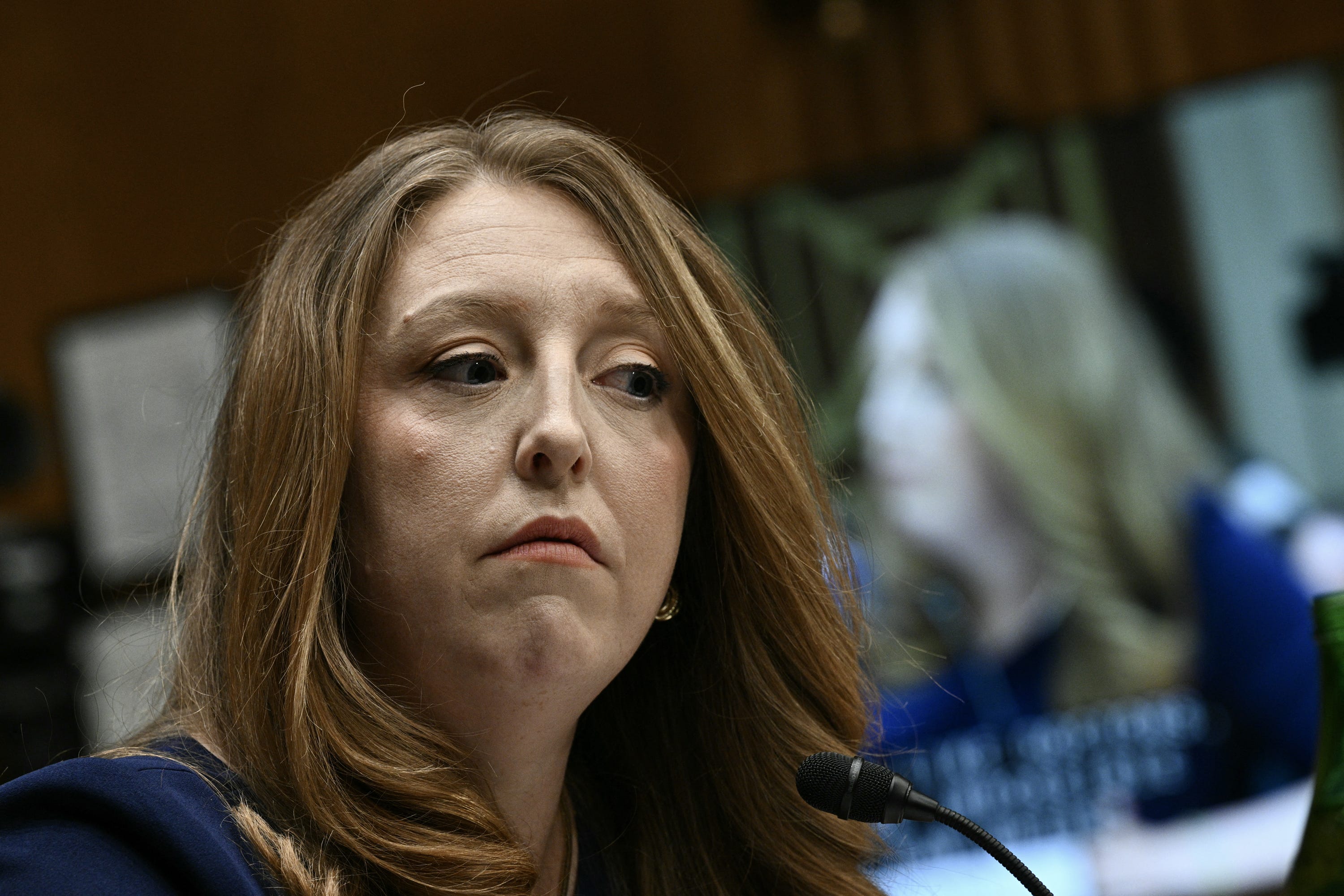
CASEY MEANS IS DONALD TRUMP’S NOMINEE to be surgeon general, a position that would, in theory, make her the nation’s most important doctor. If you want a glimpse of how she would approach the job—and a sense of why her nomination has become so controversial—consider a key moment from her confirmation hearing before the Senate Health, Education, Labor, and Pensions (HELP) committee two weeks ago.
The moment came when Means, a Stanford-medical-grad-turned-wellness-influencer, got a question about vaccination for seasonal influenza—that is, the flu shot. The senator asking, Virginia Democrat Tim Kaine, wanted to know whether Means agreed with her would-be boss, Health and Human Services Secretary Robert F. Kennedy Jr., who had claimed in January that there’s no evidence to show the vaccine is effective.
Initially, Means declined to answer, saying she hadn’t heard Kennedy’s statement directly. Fine, Kaine said, forget about Kennedy’s comments and stick to the science. “Do you believe,” the senator asked, “that there’s no evidence that the flu vaccine has efficacy in reducing serious injury and hospitalization?”
Still Means wouldn’t answer. Instead, after a pause and some stammering, she said that she would endorse CDC guidelines, whatever they are, and that she personally believes vaccination in general saves lives. Those two statements were versions of platitudes that she had offered previously in the hearing. Notably, neither revealed what she thought of the flu shot.
Only after this had gone on for more than two minutes—and only after Kaine asked for what was the eighth time—did Means concede that evidence showed the vaccine to be effective “at the population level.” Kaine acknowledged the response, such that it was, adding with exasperation that “this was not a hard question.”
It certainly should not have been. There are literally dozens of high-quality, peer-reviewed studies showing that if you get the flu shot, you’re significantly less likely to become severely ill or need hospitalization. That is no small thing given that flu in the United States leads to hundreds of thousands of hospitalizations every year, and tens of thousands of deaths.
So why wouldn’t Means give a straight answer? One possibility is that Means shares Kennedy’s skepticism of the shot, but was trying to downplay her feelings because recent polling has shown the public turning against Kennedy’s anti-vaccine crusade.
Relatedly, Means might have been nervous about holding on to support from key Republicans on the committee—like chairman Bill Cassidy, a Louisiana physician—who have been outspoken supporters of vaccination despite their support of Kennedy’s nomination.
Another possibility is that Means knows the flu vaccine research and accepts its validity, but didn’t want to undermine Kennedy—or, at least, didn’t want to anger leaders of the MAHA movement who are still crusading to stop government support of vaccines. Her confirmation hearing came right after the White House issued a controversial decision on pesticides that infuriated many in the MAHA movement. It’s not hard to imagine why she’d be nervous about alienating those activists further.
Those are three different reads, obviously. But they have one key thing in common. They all suggest Means was tailoring her statements to avoid political blowback, to an extent that past surgeons general have not. That’s a big warning sign on a nomination where the lights were already blinking bright red.
ON PAPER, THE SURGEON GENERAL of the United States does not have a lot of power. The primary line authority of the office is to oversee the U.S. Public Health Service, a uniformed group of roughly 6,000 health professionals who work alongside other public employees at federal health agencies like CDC and NIH, with occasional call-ups for special initiatives and emergency duty.1 The work is vital, but it’s part of a much broader federal health enterprise over which the surgeon general has no administrative responsibility.
The real power of the surgeon general comes from the chance he or she has to shape the national conversation about health care, as then-Surgeon General Luther Terry famously did with his 1964 report declaring that smoking was “causally” related to lung cancer. That report is widely believed to have played a critical role in launching the war on tobacco that, since the 1960s, has reduced smoking in the United States by about 75 percent and almost certainly saved millions of lives.
The surgeon general’s reach was just as visible two decades later, when C. Everett Koop issued a groundbreaking report on AIDS and produced a brochure on the disease that went out to every American household. The plain-language, eight-page document not only offered practical advice on prevention, including the importance of condoms, it also played a pivotal role in transforming the AIDS fight from a moral controversy into a public health crusade, fueling research, prevention, and treatment efforts that likewise saved millions.
A more recent instance of a surgeon general exerting that kind of influence came during Trump’s first administration, when Jerome Adams made combating the opioid epidemic a top priority of his tenure. In 2018, Adams issued an advisory urging wide distribution and use of naloxone, the fast-acting, potentially life-saving agent that reverses the immediate effects of opioid overdoses. Greater use of the agent (known by many as “narcan,” after its first commercial version) is widely understood to be a big reason opioid deaths have dramatically fallen in the past two years.
As it happens, Adams has emerged as one of the most visible critics of confirming Means to serve as surgeon general. And like many of her detractors in the public health community, he has cited past statements she has made on vaccines (like her telling Joe Rogan there might be a link to autism, despite mountains of research finding no such link) as proof she spreads misinformation.2
“Right now, we’re in the grip of a massive, record-shattering measles outbreak: over 1,100 cases already in 2026 alone, on pace to eclipse last year’s historic high,” Adams tweeted last week. “We can’t afford health leaders who hesitate on vaccines.”
ANOTHER BIG ISSUE in the Means nomination has been her resume—or, more precisely, what is not part of it. Means never completed her surgical residency, instead turning to a career of entrepreneurship and advocacy. That is how she—along with her brother—became prominent members of the MAHA and MAGA universe.3
Means and her supporters say she left the conventional medical track because she had grown so frustrated with the focus on treatment rather than prevention—partly because of what she saw in residency, and partly because of what she saw when her mother died from pancreatic cancer. Critics say her financial stakes in companies that sell wellness products represent conflicts of interest, and that her theories about “metabolic health” are rife with pseudoscientific hooey. They also wonder if she left her residency because of stress, rather than philosophical disagreements, as some people who knew her back then have told reporters.4
Whatever the true circumstances of her departure—and whether or not she’s got conflicts of interest—there is no question about her current professional status: She currently has no active license to practice medicine. That is meaningful, Adams told me during a phone interview this week, because so much of the surgeon general’s job involves understanding the nature of medical care and getting the people who administer it to change their behavior.
“As a practicing anesthesiologist . . . I can stand in front of physicians and say, ‘Here is the problem that we face, and here’s what I need you to do,’” said Adams, who during his tenure kept up his clinical work by treating patients at Walter Reed Hospital. “An unlicensed Casey Means, who never finished her residency, is not going to be able to stand in front of the American Medical Association, or ACOG [the American College of Obstetricians and Gynecologists], or a group of licensed nurse practitioners with any credibility.”
Adams isn’t the only one openly wondering what kind of credibility Means would have—or with whom—should she be confirmed.
“I don’t know why anyone would get their health advice from a social influencer who lacks scientific credentials and public health experience,” Lawrence Gostin, a distinguished university professor at Georgetown and widely respected public health scholar, told me. “She will not be trusted by the wide swath of the public, except for Secretary Kennedy’s political base in the MAHA movement.”
AND THEN—ABOVE AND BEYOND ALL THAT—there are the questions about her political mettle. One reason Terry’s report on smoking was so important was that it helped break a political stalemate on tobacco, one being kept in place by the industry’s powerful allies in Congress. Koop’s report on AIDS was a breakthrough because it was a rebuke to the many public officials—including many of his colleagues in the Reagan administration—who still saw AIDS as a moral problem rather than a medical one.
You could say nearly the same thing about the Adams advisory on naloxone, which challenged officials—again, including many who were serving alongside him—who saw the opioid crisis primarily as a moral issue, and were at best ambivalent about anything that deviated from zero-tolerance policies.
Adams, in our interview, noted that he was hardly alone in making the case for the use of naloxone and other public health measures to save lives and reduce harms. He said he was one of several scientists who, as part of a broader anti-opioid strategy, were making the case from within the administration.
“It shows in a positive way that even in difficult times—and even under administrations and political groupings that might seem hostile to what you’re proposing—you can advance policy if you’re willing to stand up for the science, and present it in an evidence-based way,” Adams said. “And I just worry that Casey Means has not demonstrated that she would be a person who would do that in the midst of the current crises.”
There is of course no way to know whether Adams is right to worry about that, just as there is no way to know exactly how Means would use the power of the surgeon general’s office if it were hers. At least in principle, it’s not that hard to imagine somebody with her priorities using the platform to promote desperately needed changes in medical care and lifestyles—or to check the influence of powerful lobbyists in the drug and food industries—without the kind of medical quackery that has come to personify RFK Jr.’s tenure.
That could genuinely make America a healthier country, leaving the kind of legacy that Terry, Koop, and Adams all did when they were in office. But the starting point for all three was an ability to speak clearly and confidently about what scientific research showed. The question from Senator Kaine was a test of whether Means has that ability. She failed.
The surgeon general’s position, for all its prominence, is also the subject of considerable public confusion, arising both from the attire and the title: Some people mistakenly believe because of the uniform and the word “general” that it is a military office. (In fact, the word “general” in this context is not a noun but a postpositive adjective, as in “attorney general” and “solicitor general.”) The position dates back to the late nineteenth century, when Congress created it to run a group of hospitals that treated merchant sailors—and, relatedly, played a key role in quarantining diseases from abroad before they could spread in the United States. John Maynard Woodworth was the first to hold the position—it was called “Supervising Surgeon” back then—and one of his initiatives was to create a workforce for the system he was overseeing, consciously modeling it on the military, hence evolving uniforms and the use of Navy-like ranks and insignia. It evolved into the U.S. Public Health Service and its officers played an especially important role in combating health threats like the 1918 influenza pandemic.
Kate Yandell and Jessica McDonald of Factcheck.org posted a thorough fact-check of Means’s statements from the hearing. It includes some of those prior statements on vaccines—and factchecks of those, as well.
I didn’t realize her residency was in surgery. And she left because Drs were focusing more on treatment rather than prevention? Of course she was focusing on treatment, it was effing surgery! Surgeons are not who you go to for preventative care! It makes her look even more ridiculous.
I find it odd that there's a huge overlap between the group that castigates modern medicine for being focused on treatment rather than prevention, and the group that refuses vaccines which are probably the single most effective way of _preventing_ infectious disease. Of course, it's perhaps too much to expect science-deniers to understand the illogic of their position.