

Democrats Are Done With Vanity Candidates
Party insiders worry about running long-shots or no-shots who’ll drain money and energy.

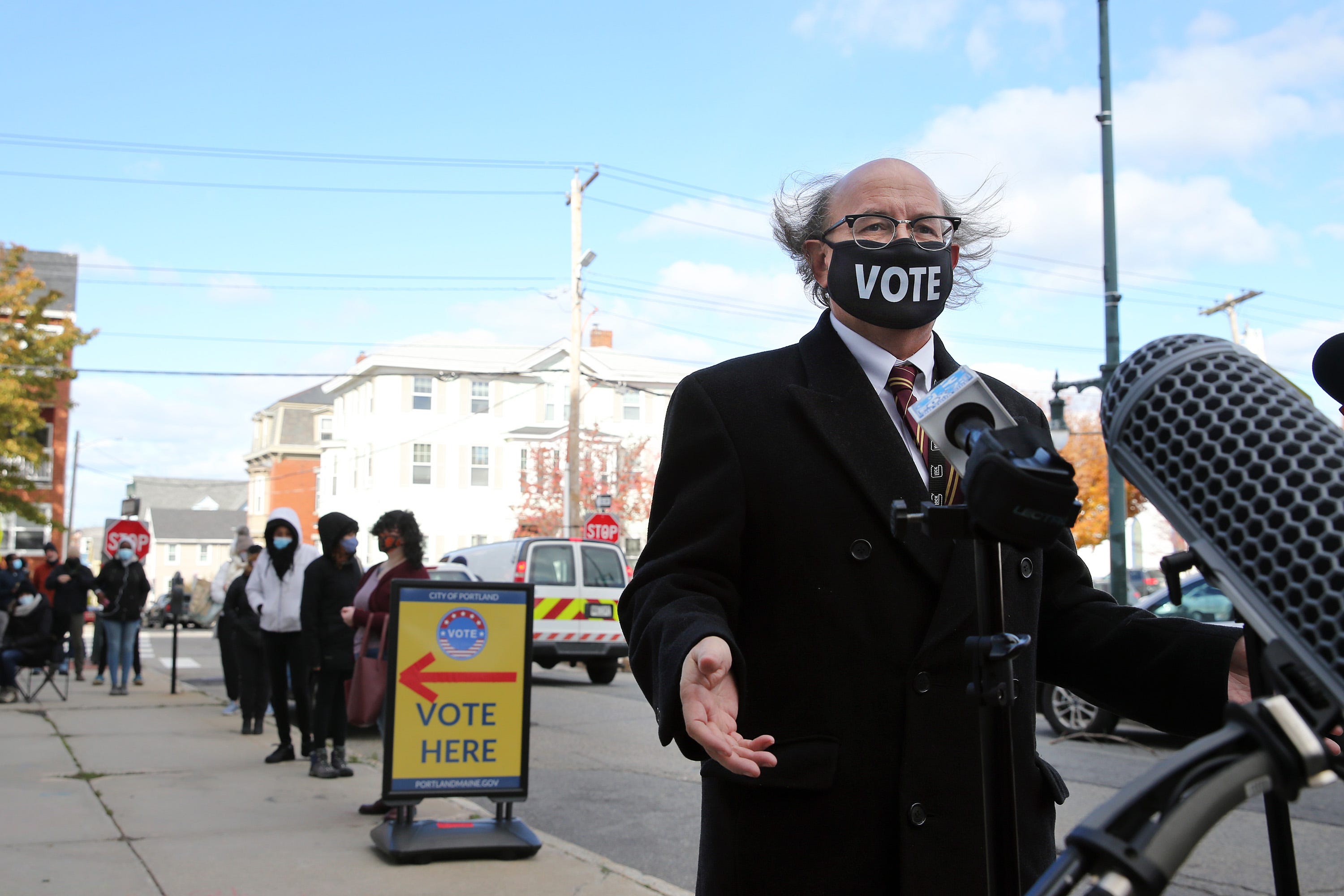
WHEN DEMOCRATIC PARTY OFFICIALS first got wind earlier this year that Matt Dunlap, Maine’s state auditor, was considering a primary challenge against Rep. Jarden Golden, there was a collective annoyance inside the Democratic Congressional Campaign Committee’s headquarters in Washington, D.C.
Golden represents a rural part of the state that voted for Donald Trump by 10 percentage points in 2024. It’s one of the most competitive House districts in the country, but one he’d managed to find success in for four straight cycles. National Democratic officials had little patience for a progressive challenger trying to mess with the party’s chance at holding the seat.
And so, in May, DCCC officials—including the committee’s chair Suzan DelBene—called Dunlap to bluntly warn that a primary challenge was a bad idea. They argued that he had no shot at winning a general election and would instead waste the party’s time and money on a frivolous primary—time and money that could be better spent defending the seat in the general election.
But Dunlap wasn’t convinced. On Monday, he announced his campaign in a video attacking Golden for voting with Republicans and slamming the congressman for an opinion piece he wrote ahead of the election downplaying concerns that Trump was a threat to democracy. In a Zoom interview, Dunlap told me Maine voters wanted “somebody who’s gonna fight for them.”
“I think I can attract a lot of moderate independents and even some conservative independents, and probably a few Republicans,” said Dunlap. “That’s the same formula that Jared has counted on over the years, but I think it would work better for me. That’s a risk I’m willing to take.”
What was notable wasn’t that Dunlap ultimately decided to jump into the race, despite efforts to keep him out of it. Politicians are ambitious people, after all. Rather, what stood out was the chilly reception he received after doing so.
Massachusetts Rep. Jake Auchincloss tweeted that any “Democrat who tries to trip [Golden] up as he sprints into the general election is helping MAGA.” Democratic strategist Lis Smith called Dunlap’s campaign “the dumbest, vainest primary challenge of the cycle.” Democratic pollster Adam Carlson noted that he wasn’t a Golden fan but hoped the congressman “absolutely obliterates” Dunlap.
For a party that has often had its complaints with Golden—recall that he was, most recently, the only House Democrat to vote for the Republican government shutdown funding resolution—it felt somewhat surreal to see such a rallying to his side. But it also illustrated a larger trend: There is exceptionally little patience within the Democratic party at this moment for campaigns that are viewed as money sucks, vanity projects, or unnecessary risks.
“I want people to be practical and strategic about primaries and where we improve in the party,” Democratic strategist Mike Nellis told me, noting that primary challenges should be aimed at “do-nothing” members of Congress in safe districts. “We’re not going to do better than Jared Golden in Maine’s 2nd Congressional District, we’re just not. And I’m okay with that.”
Dunlap isn’t the only Democratic candidate to announce a congressional bid this week only to catch heat from their own party. Democrats largely rolled their eyes at Amy McGrath after she announced Monday that she was running for Kentucky Senate again. McGrath, a retired fighter pilot, raised over $90 million in her 2020 campaign against Sen. Mitch McConnell, only to lose to him by nearly 20 points.
“Please don’t,” former Rep. Susan Wild (D-Pa.) tweeted at McGrath.
McGrath said that Democrats “need to stay focused on the real fight and not each other.” And in a text, Wild told me she didn’t have anything to add and that the tweet spoke for itself. But in case the subtext was lost on anyone, it seemed plainly clear that she saw a McGrath bid as a shiny object that would do Democrats little good—and that, she believed, the party has had enough of those.
After all, it wasn’t just McGrath who won over the party’s grassroots and raked in mind-blowing sums of money on a longshot campaign. Jaime Harrison raised more than $130 million in his 2020 bid to unseat Sen. Lindsey Graham, only to lose by 10 points. Harrison was viewed as a fundraising powerhouse coming out of the race, catching the eye of President Joe Biden, who tapped him to chair the Democratic National Committee. His tenure there proved shaky, though, with the fundraising prowess he showed in his Senate race eluding him as party chair.
“Political fundraising is in part based on emotion,” said Rufus Gifford, who served as the campaign finance chair for the Biden-turned-Harris presidential campaign, noting that it’s not all that difficult for candidates to raise money from grassroots donors when they’re running against some of the most-disliked GOP leaders, such as McConnell and Graham. “But at a time when democracy is under threat every single day, we can’t let our emotions dictate our decisions. We have to be level-headed and understand what the winnable races are.”
Most Democratic officials agree with that sentiment. For many cycles, Democratic governors and statehouse officials have bemoaned how the party’s resources are often poured into high-profile races, leaving the more winnable down-ballot candidates to pick up the scraps.
But changing longstanding political behaviors can be hard to do in practice. It’s not easy to tell excited grassroots donors that Democrats simply have no shot at a South Carolina Senate race, however charming they might find the Democratic candidate to be.
There is also the flip side of the politics of prudence, moderation, and caution: You can’t win races where you don’t try. Politics is unpredictable and you never know when a bad candidate like Roy Moore is going to give the party an opening in a deep-red state such as Alabama. Democratic officials have stressed the importance of running candidates across the map, even in races that might seem unwinnable, if for nothing more than to force Republicans to expend resources themselves. They add that the only way to strengthen the Democratic party in these states is to show up and compete.
The solution, said Florida-based Democratic strategist Steve Schale, is not to skip long-shot races. It’s to find ways to make Democratic candidates who are palatable to conservative voters more exciting to liberals as well.
“We’ve gotten really good as a party at falling in love and throwing a bunch of money at hopeless endeavors,” said Schale. “People can spend money where they want. But somehow we have to make the boring shit interesting. I don’t know how you do that, other than just trying to lay out the facts about how we get to a win in Congress.”
🫏 Donkey Business:
— I know I said in the last edition of this newsletter that I’d have some thoughts on the shutdown for y’all this week, but let me instead direct you to this piece by my colleague Jonathan Cohn in his newsletter, The Breakdown. He did an excellent job explaining how Democrats have the upper hand at this moment. Spend some time with his piece.
— Tennessee state Rep. Aftyn Behn won Tuesday’s Democratic primary in the special election to replace former GOP Rep. Mark Green. As regular readers may recall, I wrote about the dynamics of that Democratic primary over the summer and how party leaders were battling over whether a progressive like Behn had the best shot at flipping a district Trump won by 22.3 points. Some state party leaders had serious concerns about nominating Behn, warning that only a moderate Democratic candidate could reasonably have a chance at winning in such a challenging district. We will find out in the general election on December 2, when Behn faces Trump-endorsed Matt Van Epps.
— It’s been a tough week for former Democratic Rep. Katie Porter, a frontrunner in the California gubernatorial race. On Tuesday, someone who used to work with Porter leaked a video of her threatening to storm out of an interview with a local CBS News affiliate. Just watch it; it’s incredibly unflattering. Then on Wednesday evening, another video was leaked of Porter yelling at a staffer for getting in her Zoom shot during a conference call with the Biden administration. Porter built her reputation in no small part by creating memorable moments during congressional hearings, using a whiteboard and grilling witnesses in a way that resulted in video clips that went viral—so there’s some irony in the thought that her reputation might now be remade by candid video clips like those leaked out this week.
My open tabs:
— Paul Finebaum’s Next Play Is His Riskiest Yet
— Trump’s Tariffs Are Upending Democratic Politics
— The Superintendent’s Bio Seemed Too Good to Be True. It Was.
The twin issues facing Democrats, that they are unpopular as a party nationally and that they are unelectable in much of the country, is actually the same problem with the same solution. Rather than run candidates that are palatable nationally, they need to run each race locally.
The problem with candidates like McGrath and Beto and others is that they're very appealing to the national brand and not appealing to the people who actually vote for them. The problem, of course, is finding local Democrats who have support locally without them turning into Manchin's and Sinema's. By which I mean, being toxic to the party's prospects nationally once they get elected.
McGrath is exactly the kind of candidate people from California or New York or Maryland would want to see representing Kentucky. The problem is that she's not the kind of person people in Kentucky want representing Kentucky, as they've shown before.
I Use Beto as the ultimate example of this though; a guy who sucks up money and energy and then loses to Ted Cruz. In fact, I would almost say that if people nationally like you as a Democrat you have no business running in most places, because you simply won't win.
That doesn't mean we don't run people. It means we need to fundamentally change what kind of people run.
Oh those women candidates aren't "nice."I remember when people were complaining that Amy Klobacher was mean to her staff too. Maybe she was. Seems like Katie Porter is caught on video. Does anyone ever complain when male elected officials yell at their staff? I don't recall any incidents but maybe others do.