Dems Quietly Start Their Next Big Health Care Effort
They want to undo the damage done by Trump—and some are laying the groundwork for bigger reforms.


THERE ARE SIGNS that the debate about health care in America is about to get out of the rut it’s been in for about fifteen years—and that Democrats are preparing for the moment when it does.
Ever since 2010, the most high-profile fights in Washington have been about the Affordable Care Act and Medicaid. Mainly that’s because Donald Trump and the Republicans keep attacking those programs—as they did last year when they enacted the largest-ever cuts to Medicaid, then refused to extend lapsing “Obamacare” subsidies that had helped millions to get coverage, and reduced premiums for many millions more.
Democrats are determined to reverse those two steps, somehow, and you can expect them to make that a rallying cry in their campaigns for November’s midterm elections. But at least some Democrats don’t want to stop there. On March 19, a dozen of the party’s senators released an open letter announcing their intention to develop policies that would address a broader topic: The underlying increase in health care costs that is affecting everybody, not just people who are uninsured, on Medicaid, or buying coverage at HealthCare.gov.
The roughly 170 million Americans who get coverage through their employers are now paying (directly and indirectly) an estimated $27,000 a year on average for a family policy. “The American people need relief from rising premiums and deductibles that are forcing families into financial ruin,” the Senate Democrats wrote in their letter. “They also want an insurance system that doesn’t require them to jump through hoops and hack through red tape every time they need care.”
That may sound like a bunch of frothy boilerplate, given that the letter contained no specifics. But it’s not just these Democratic lawmakers who say it’s time to have a broader conversation, one that goes beyond undoing what Trump and the Republicans have just done. You hear the same thing from prominent analysts and advocates like Anthony Wright, president of the pro-coverage, pro-consumer organization FamiliesUSA.
“I do think people recognize that, as we wage the fight to defend coverage and consumer protection and specific communities under attack, that we don’t fall into a trap of defending the status quo that people thought rightly was broken,” Wright told me in an interview. “We need to show that we have a plan, not just to repeal bad stuff, or even to rebuild—but to reimagine what the health system should look like.”
That kind of reimagining can’t happen right away. Trump and the Republicans seem incapable of putting forward serious reform proposals, unless they involve hacking away at insurance coverage for people who need it. And the first chance Democrats might have to govern with a trifecta is nearly three years away. But it’s with an eye to that possibility that Democrats and their allies are starting to plan now—to make sure they are “prepared to take action on these issues the next time Democrats have an opportunity,” as the Senate Democrats put it in their letter.
And there’s an unmistakable parallel here, to a politically similar time when Democrats and their allies started laying the groundwork for future legislation. “This moment feels a bit like twenty years ago,” Larry Levitt, executive vice president for health policy at KFF, told me in an interview, “when groups of policy experts, advocates, and politicians started to talk about health care ideas that ultimately coalesced into the passage of the Affordable Care Act.”
But the challenge is different this time, and in some ways more difficult. Reducing health care costs inevitably involves reducing the flow of money into somebody’s pockets, which just as inevitably angers powerful constituencies and industry groups. Democrats aren’t even close to having a consensus on what to do. And 2029 is a lot closer than it might seem.
ONE PERSON WHO KNOWS THIS all too well is Ron Wyden, the senator who organized the open letter and who hopes to lead discussions inside his caucus. He’s been focusing on health care ever since the 1970s, when as a freshly minted college graduate he helped to establish Oregon’s chapter of the Gray Panthers, a grassroots organization to defend the interests of seniors.
The unfailingly earnest Wyden will bring this up anytime you talk to him about health care. It’s part of his wonky charm, if you’ve gotten to know him as some of us have, and a point of information that is genuinely relevant. Helping elderly Americans get health care really has been a signature cause, going all the way back to 1981 when he first got to Congress.
In fact, when I spoke to Wyden last week, he said he was still angry over testimony that Mehmet Oz gave a year ago, during hearings for his confirmation as administrator of Medicare and Medicaid. The celebrity doctor had refused to stand by a Biden-era rule that raised the minimum staffing standards for nursing homes—requiring more personnel and a nurse on duty 24/7 by 2029—instead arguing that technology and telemedicine could take the place of extra staff.
“Are you kidding me,” Wyden said in our interview, “an 85-year-old woman trying to go to the bathroom in a dark bedroom is somehow going to be able to be safe and get there by an algorithm?”1
But Wyden has also put in the time to think about and propose policies for non-elderly Americans. In late 2006, shortly after Democrats won control of the House and Senate in that year’s midterm election, he unveiled what he called the “Healthy Americans Act”—a detailed legislative proposal, complete with a financing scheme and independent analysis of its likely cost and impact.
It was a watershed moment, because it signaled that mainstream Democrats were serious about trying to enact legislation to achieve or at least approach universal coverage. Democratic leaders had mostly abandoned that effort in the 1990s, after a failed reform effort by then-President Bill Clinton helped to fuel a political backlash that ended up giving Republicans full control of Congress for the first time in decades.
Wyden’s proposal didn’t ultimately become the template for new reforms, partly because it envisioned everybody—even people who already had employer insurance—buying coverage on their own through newly regulated markets. That violated what most strategists believed was the single biggest lesson of the Clinton fiasco: Don’t mess with employer insurance, because it will spook anybody who has it already.
Another reason Wyden’s proposal didn’t go far was that he was not in charge of the Finance Committee, whose jurisdiction over taxes, Medicare, and Medicaid make it the single most critical committee for health care legislation. The chairman at the time was Montana Democrat Max Baucus, whose politics skewed more conservative and whose close ties to industry lobbyists 2 enraged many of his fellow Democrats. Baucus—whose relationship with Wyden was never great—favored the less ambitious reform model that eventually became the Affordable Care Act, which left employer coverage in place.
Wyden finally got his chance to legislate years later, as ranking minority member and then (after the 2020 elections) chairman of the Finance Committee. That’s when he helped craft the Inflation Reduction Act’s prescription drug price reforms, including provisions that allow Medicare to negotiate with manufacturers over the prices of certain high-priced drugs, a longtime Democratic goal.
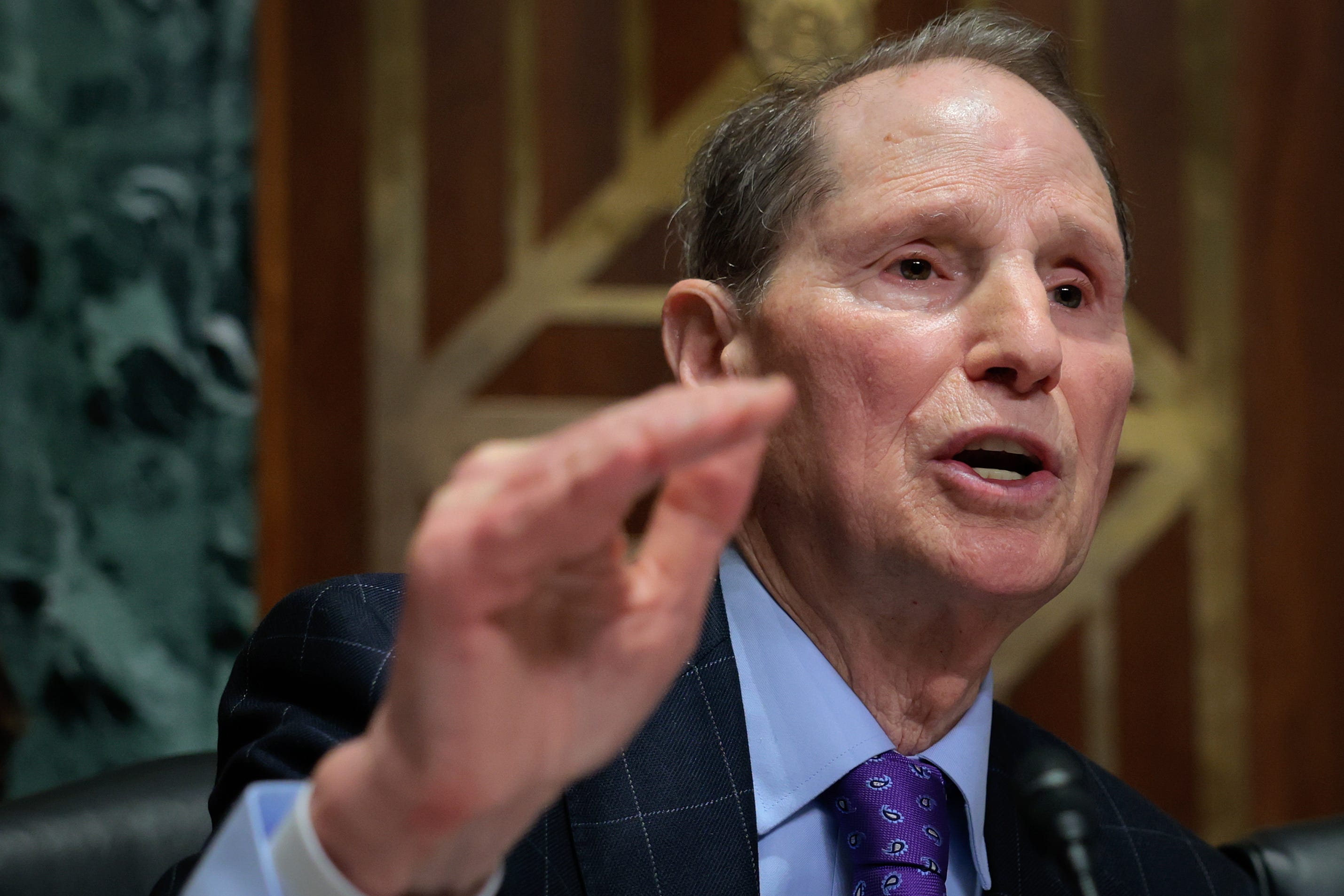
Wyden is in line to again become Finance chairman if Democrats retake the Senate in 2026, meaning that he would once more have the staff and jurisdiction to shape legislation. And he’s already taking the initiative, in case the opportunity presents itself. The March 19 open letter outlines steps, including a series of conversations with both fellow senators and outsiders who have something to say, that Wyden hopes can lead to some kind of framework for legislation that the Finance Committee would formally release.
“Senate Finance Committee Democratic staff will develop policies that lower costs, make it simpler to get and use insurance, and rein in shameless profiteering by corporate insurance companies,” the March 19 letter states, hinting at the directions Wyden and his colleagues want to go with policy.
This letter is actually the second one Wyden and his colleagues have released. The first was about prescription drugs. There are plans for a third, which will focus on long-term care. It’s a lot to take on, which is why—Wyden told me—it’s important the work gets started now.
“It takes a lot of sweat equity if you want to get into major changes,” he said.
Join Bulwark+ at 20 percent off for the next year. Support the mission. Support independent journalism. Join a community built on good faith.
WYDEN IS BY NO MEANS THE ONLY MEMBER of the Democratic caucus who is thinking big thoughts on health care, or who would be expected to play a key role in legislation should the party get a chance to govern. The list of others starts with Bernie Sanders, the independent and self-described democratic socialist from Vermont, who has spent a political lifetime making the case for a single-payer, “Medicare for All” system.
Should Democrats regain power, Sanders would be in line to take over the Health, Education, Labor and Pensions Committee—which, despite its name, has traditionally played a junior role to the Finance Committee on health care issues because it has more limited jurisdiction. But Sanders’s long history on health care, plus his position as leader of the party’s progressive wing, means he would have to be part of any serious legislative effort.3
Sanders isn’t on the open letter. But a few other high-profile progressive Democrats are (Elizabeth Warren of Massachusetts, Peter Welch of Vermont) as are some more conservative senators (Elissa Slotkin of Michigan, Mark Warner of Virginia). And it’s not just on Capitol Hill where there’s broad interest in thinking about the long term. There have been stirrings of activity in the world of think tanks and advocacy groups, too.
“There are various interactive conversations in this world, including advocacy and think tanks, and they are just starting,” said Wright, whose experience includes more than two decades spent helping to lead reform campaigns in California. “I don’t want to overstate how far they’ve gone—really just getting underway, a lot of it informal. But you can tell people are thinking ahead.”
Let us help you see around corners: Sign up for a Bulwark+ membership to unlock all our independent journalism, access ad-free versions of our videos, and join our growing pro-democracy community:
One reason such efforts led to legislation in the past, with the Affordable Care Act and with prescription drug reforms, is that Democrats were able to coalesce around some core ideas. Doing that now is going to require working through some contentious, complex questions, starting with one that dominated the 2020 presidential primaries—i.e., the last time Democrats were the party out of power—when the debate was about whether or not to endorse Sanders’s version of Medicare for All.4
That debate is certainly worth having. Among other things, Medicare for All represents one way to deal with costs, since the early-stage proposals from Sanders and others generally envision the federal government controlling spending through a combination of budgets and price regulation, as countries abroad with national health systems do.5
But like all proposals it comes with tradeoffs. It would be taking money away from at least some parts of the health care industry—including hospitals—and those affected sectors would argue (plausibly or not, depending on your point of view) that the change would lead to rationing. And that’s to say nothing of the fact that—like Wyden’s old plan—the purest schemes envision the new public insurance system replacing existing employer coverage.
A healthy internal Democratic debate would consider that idea, just as it would consider other ideas for controlling costs—including some that haven’t yet gotten a ton of political attention. That might include, for example, going after costs with budgets and price controls but without requiring everybody to shift into a new public insurance plan.6 It could also include proposals that create a new public plan but that make enrollment purely voluntary—what’s come to be known as a “public option.”
Yet another way to go would be to focus on a set of discrete, targeted reforms—like expanding the new prescription drug negotiating powers or resurrecting the once-popular idea of a “patient’s bill of rights” that restricted the ability of insurance companies to deny treatments. One advantage of this approach is that, depending on the specifics of the proposals, Democratic lawmakers might be able to pass narrower reforms more quickly. (Most likely, they’d have to use the budget reconciliation process to avoid a Republican filibuster.) That could help build trust with voters for subsequent efforts.
Of course, even the smaller, more targeted ideas would also come with tradeoffs. More aggressive drug price regulation, for example, could affect innovation. And deterring insurance company reviews could end up making it harder for them to control costs. That’s the whole point of taking up these ideas now: To weigh those tradeoffs, figure out how to present the worthwhile ideas, and then build a consensus behind them.
“You can’t win health reform before the election, but you can lose it,” said Wright. “If you don’t set things up, then you won’t be ready when the window opens.”
And the window is bound to open, probably in the next few years, because that’s how it goes in American politics. Big debates about how to reform health care reliably start once the problems of the status quo have become impossible to ignore, and once the battle scars from previous debates have started to fade. Typically the cycle takes about two decades. And it’s been almost exactly two decades since the start of the process that led to the Affordable Care Act.
This doesn’t mean the Affordable Care Act was a failure, as Republicans frequently claim. It simply means there is a lot more to do, because—as Barack Obama tweeted last week—the law “was always meant to be a first step.”
And now, just maybe, it might be time for the next one.
Baucus’s determination to work with Republicans, especially Charles Grassley, the committee’s top Republican, also enraged Democrats—especially in 2009, when Baucus kept trying to get Grassley to support what became the Affordable Care Act.
Back in the Obama era, the same was true for HELP Chairman Ted Kennedy, because of his own long history of engagement on health care as well as his reputation as a legislative maestro.
Most of the Democratic candidates in the 2020 presidential primary looked for ways to present something that sounded like Medicare for All and attempted to capture its appeal, but without threatening the disruption that the Sanders plan would. The candidate most resistant to that was Joe Biden, who preferred a more gradual transformation that leaned more heavily on beefing up the systems already in place. The issue more or less vanished once the pandemic hit, when the focus on health care turned to emergency measures, like bolstering those Affordable Care Act subsidies. But the debate could return in 2028.
Correction (March 29, 2026, 8:30 a.m. EDT): This sentence has been edited to correct which subset of Democrats has tended to embrace proposals that would use federal control of spending to bring down prices; it originally referred to Sen. Wyden but now mentions Sen. Sanders.
Longtime health care journalist Merrill Goozner recently sketched out how such a plan would work in an article that ran in the Washington Monthly and on his Substack, the delightfully named GoozNews, which I highly recommend.
As someone who worked in health care for over forty years I sure am tired of hearing about why we can't have single payer health care like all the other advanced nations do. It works for them so why can't it work for us? Oh I know because Americans so love the current system lol. Thank God I am now on the government system known as Medicare but woe to all those who have to depend on their employment to ensure they get care. Believe me I spent a lot of time and mental energy getting insurance companies to pay up, energy that could have been directed elsewhere.
A small point in the overall scheme of things I know, but please stop calling it "Obamacare." It's the Affordable Care Act. Calling it Obamacare just plays into the right's attack on health care.