Dems’ Stealth Plan to Reclaim the Senate Hits a Rough Patch
If the “D” label is a liability, sidestepping it might work—but only if everybody plays along.

FOR A BRIEF MOMENT over the weekend, some Democratic officials in Montana had high hopes that their party’s candidate for the United States Senate would drop out.
It’s not that the candidate, Alani Bankhead, an Air Force veteran and political newbie, was beset by scandal. It was that they wanted the field to be cleared for someone without a D next to their name. Seth Bodnar is an independent running for the seat being vacated by Republican Sen. Steve Daines, and he’s backed by several prominent Democratic leaders, including former Sens. Jon Tester and Max Baucus, who over the past few years have come to believe that the Democratic party’s brand has grown far too toxic to win statewide.
But after teasing a “very important announcement” that was interpreted in some quarters as a coming campaign suspension, Bankhead instead doubled down. Standing at a lectern in front of the University of Montana’s iconic bronze grizzly bear statue, she didn’t just say she was “never dropping out,” of the race, “ever, ever.” She made clear that Bodnar was one of the reasons why.
“Seth Bodnar is absolutely the last person on the face of the Earth I would ever drop out of this race for,” Bankhead said.
The press conference was the latest hiccup in a bank-shot play Democrats have been making to wrest control of the Senate from Republicans. Hoping to grab GOP-held seats in traditionally conservative states, the party has tried to elevate independent candidates without putting too much of the Democratic party’s odor on them.
It has proven to be a tricky balancing act, nowhere more so than in Montana, where Bankhead’s commitment to stay in the race has ignited a fresh round of debates about whether the Democratic brand is damaged beyond repair, or if giving up on it is premature and shortsighted.
Some Montana party officials I spoke with argued that in the face of Trumpism and democratic backsliding, Democrats had to shed their partisan preferences and do whatever was required to deny the GOP another Senate majority. And that meant being clear-eyed about the fact that the era of Democrats realistically being able to win statewide in Montana was over—at least for now. But others in the party believe that Tester and his allies have over-learned lessons from his 2024 campaign, which he lost to Republican Tim Sheehy after serving three terms. They argued that the party needed to run different types of candidates, not shed party labels entirely.
“[Tester’s] conclusion was, as he looked in the mirror, that if Jon Tester can’t win, nobody can win. I disagree with that,” said former Montana Gov. Brian Schweitzer, who told me that he unsuccessfully tried to convince Bodnar to run as a Democrat instead of an independent.
Honest news.
Smart analysis.
No-BS commentary.
Support our independent journalism and join our growing pro‑democracy community.
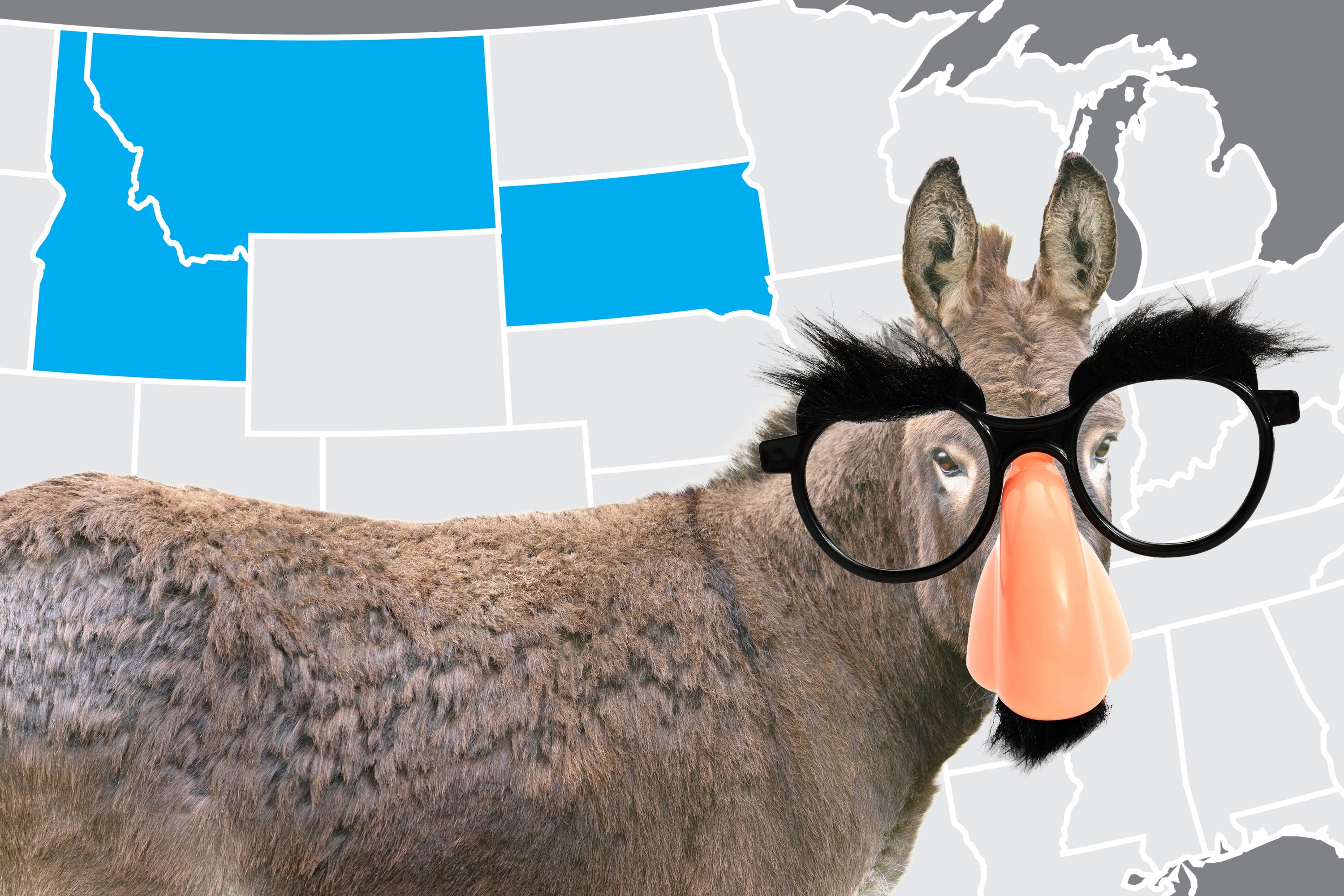
MONTANA ISN’T THE ONLY STATE WHERE this intraparty debate is getting spicy. It is also heating up in South Dakota and Idaho, where there are both Democrats and independents running for Senate. Democratic leaders in these states have sought advice from the Nebraska state party chair Jane Kleeb, hoping to glean some wisdom from how she handled the decision in 2024 to keep Democratic candidates out of the race and clear the field for independent Dan Osborn. Osborn lost to Republican Sen. Deb Fischer, but only by 7 points while Donald Trump carried the state by 20. Osborn is running as an independent again this year against Sen. Pete Ricketts.
“Every state chair needs to make a decision that’s best for themselves, but they also need to make a decision that’s best for the electorate, that’s best for the state, and what’s best for our country. So sometimes you do put aside your partisan loyalty,” Kleeb told me. “I’m not saying every election cycle we’re now going to endorse an independent in a congressional or senate race, but for this cycle, with this candidate, it makes sense for us.”
But not all state party leaders share Kleeb’s outlook. Some feel it’s their duty to stand by the Democratic nominee, no matter how doomed their candidacy may be. And to be clear, their prospects don’t look great. The Democratic candidates in South Dakota, Idaho, and Montana have very little cash on hand, while their independent and GOP counterparts have far bigger war chests. Just looking at the numbers, it’s almost like the Republican and the independent are the major parties, and the Democrats are the third-party spoiler.
And then there’s the matter of state history. Trump carried all three states by wide margins. The last Democrat elected to the Senate in Idaho was Frank Church in 1968; the last Democrat elected to the Senate in South Dakota was Tim Johnson in 2008. Although Tester won his 2018 re-election bid, some party officials view that as an anomaly in this hypernationalized political era.
“Democrats, at least in Montana, are struggling,” said Baucus, who was the longest-serving U.S. senator from Montana ever when he was appointed by Barack Obama in 2014 to serve as ambassador to China.
“The Democratic leaders that I talk to—the Democrats who hold leadership positions—publicly have to be for the Democrats, because they’ll lose their job if they don’t. But privately, they’re not. Privately, a lot of them really, really like Seth Bodner,” Baucus added.
But simply pointing to recent history, campaign finance reports, and polling data is often not enough to convince Democratic nominees that they should cede the floor to independents. Unlike in Nebraska, where Democrat Cindy Burbank promised during her primary campaign to drop out of the general to give Osborn a clear shot at Ricketts, there hasn’t been the same level of coordination in other states.
Which leads to that same bizarre spectacle we’ve seen in Montana: Some party officials in Idaho and South Dakota have been trying to come up with strategies to force their own party’s candidates there to drop out. Former Idaho Rep. Larry LaRocco, a Democrat, told me he’s spoken with other officials in his state about hiring a professional mediator to see what would get the party’s nominee, David Roth, to consider ending his campaign. LaRocco has also considered asking prominent party strategists like Jim Messina, who grew up in Idaho, to sit down with Roth and explain why it’s in the interest of the party that he end his race and support independent Todd Achilles.
“I’m looking for a person who might be able to talk to David, and I’m trying to be respectful. But this is his fourth run,” said LaRocco. “The brand has been beaten up quite a bit. . . . At some point, you can’t keep doing the same thing and expect a different outcome. That’s the definition of insanity.”
Meanwhile, over in South Dakota, the independent candidate running for Senate, Brian Bengs, told me he sat down earlier this spring with Democratic nominee Julian Beaudion, and they agreed that if one of them didn’t drop out, Sen. Mike Rounds would coast to re-election. Bengs suggested that they reconvene in early summer and “judge the health of a campaign based on who’s got the best polling and the best fundraising.” A recent poll sponsored by Bengs’s campaign found that Rounds was up 25 points in a head-to-head with Beaudion, but led by just 4 points against Bengs.
But that was an internal poll. And Bengs said Beaudion hasn’t been willing to pick the conversation back up. He argued that Beaudion had been buoyed by Joe Biden’s endorsement earlier this month and was no longer looking at the race objectively. Beaudion did not respond to an interview request.
“The question for the Democratic party in the state is: Do we want to have another sacrificial lamb?” Bengs said in a phone interview. “Or do you want to support somebody who can’t guarantee a win, but is in the game and is within striking distance?”
DEMOCRATIC OFFICIALS in Montana, South Dakota, and Idaho remain somewhat paralyzed about how to proceed, especially as deadlines to drop out of the race near. While whoever emerged in each of those states to take on the Republican would remain a long shot, there is still opportunity in trying to make these races competitive—if, for nothing else, draining GOP resources on a state they assumed would be a cakewalk.
In Montana, at least, there is some chatter that the contest could actually get competitive, given the state’s more recent history of electing Democrats statewide.
“Montana ain’t Nebraska. We simply ain’t Idaho. And we’re not South Dakota,” said Schweitzer. “The right Democrats can win in Montana.”
The questions about whether or not Democrats should run have been shaping these races since the primaries. In Montana, Schweitzer and other prominent party leaders had initially backed former state Rep. Reilly Neill in the primary. Neill had vowed to stay on the ballot in the general election, and as she appeared poised to win the nomination, Democrats advocating for the independent route grew anxious. In the final few days of the primary, a super PAC popped up and dropped $3.3 million on ads for Bankhead, securing the party’s Senate nomination for the political novice who moved to Montana around three years ago.
And then . . . she too decided to stay in the race.
“They knew Riley wasn’t going to drop out, and so they hedged their bets on me, but I’m not going to drop out,” Bankhead told me in a phone interview, when I asked her about the super PAC investment. She said no one approached her beforehand to ask if she’d consider withdrawing from the general. “You guys are making a lot of assumptions about what you think I’m gonna do, and dropping out is not one of them.”
Given that the money came from a super PAC, it’s difficult to pin down exactly who was behind it and what their intentions were. By law, super PACs cannot coordinate with candidates or campaigns. But that hasn’t stopped frustrated Democratic officials from engaging in some finger-pointing.
As one Montana Democratic official put it to me: “Alani [Bankhead] now really believes she won the election. . . . But she didn’t win the election, somebody decided she was going to win the election. And that somebody created a monster.”
Wow. Interesting intra-party dynamics. Also says so much about the Democratic party brand in certain parts of the country. Plus the ego it takes to run for public office. Nice article. Thanks.
Bankhead could be the new Jill Stein.