

DeSantis Declares War on Woke Sidewalk Chalk
He says it’s about safety, and if you believe that…

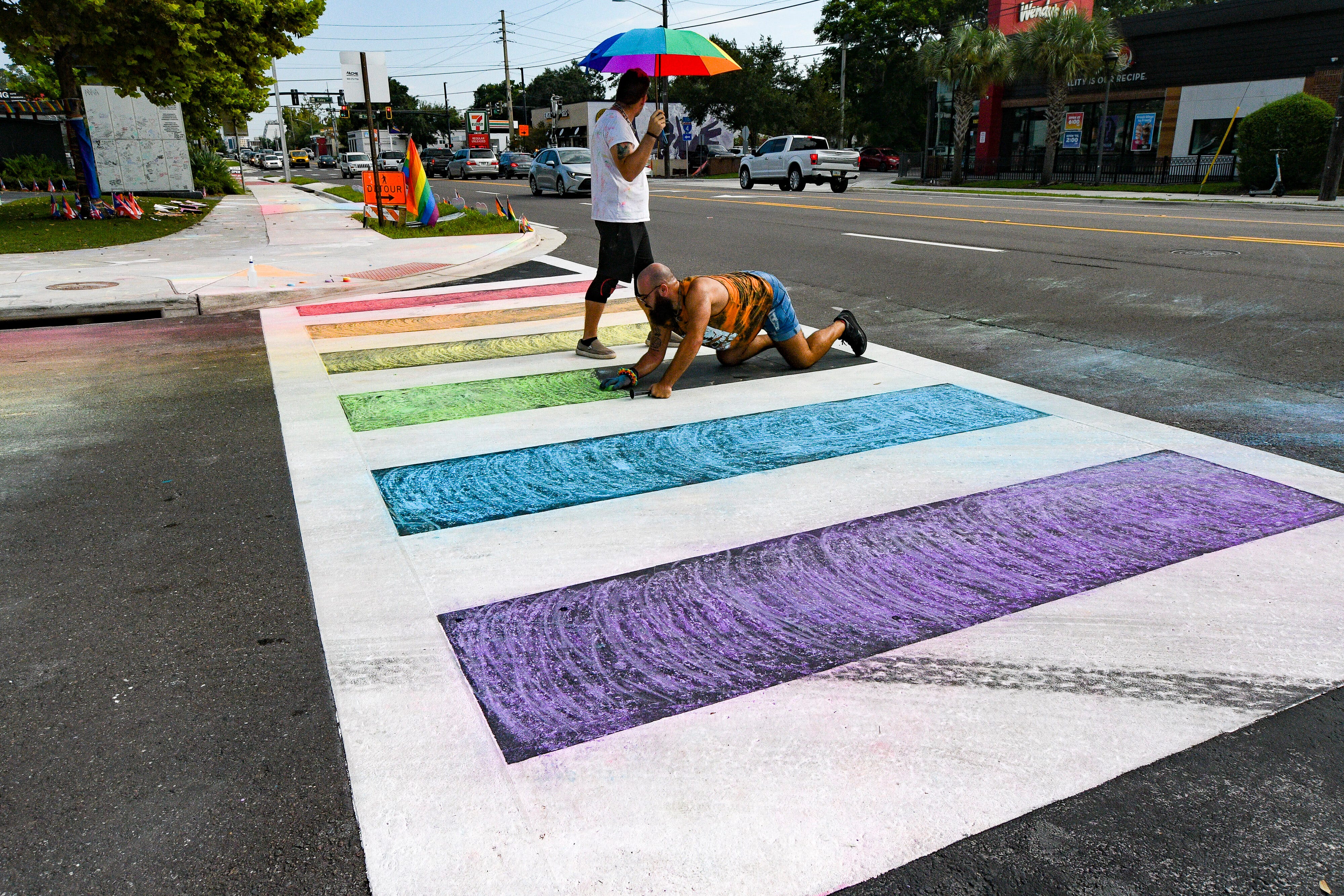
A MAN WALKING ACROSS an intersection in Florida was arrested over the weekend.
His alleged crime? Felonious use of pink sidewalk chalk.
The man’s name is Sebastian Suarez. On Friday evening, he crossed a street in Orlando with chalk dust on his shoes, leaving pastel-covered footprints on the asphalt. Members of the Florida Highway Patrol, who had taken up a post on the corner, promptly arrested him.
You might be wondering why Suarez allegedly wanted to leave his prints in the street—and, for that matter, why state troopers were there watching him. The answer to both questions is that this isn’t just any old patch of Florida roadway, or any routine arrest for that matter.
The street in question sits in front of the Pulse nightclub, where in 2016 a gunman killed 49 and wounded 53 in what was at the time the deadliest mass shooting in American history. The Pulse was a gay club. It is now a memorial to the victims. As part of the tribute, local officials and LGBTQ community leaders decided to fill in the empty spaces of a crosswalk outside the site with colorful paint, so that it would evoke a Pride flag.
They got state approval, laid down the paint one year later and turned the crosswalk into a rainbow—which is how it looked until late August, when state workers removed the colored paint. That set off a series of protests by LGBTQ activists and attempts to recolor the crosswalk, which is what police and state attorneys say Suarez was attempting to do with his chalk.
They charged him with defacing a traffic device, which can be a felony, and kept him in jail overnight.
“We came out here yesterday just to show our support, to come out and help with the chalking,” Suarez, a tourist who was visiting from Georgia, told the Orlando television station WESH. “We put some chalk down on the ground, and before we knew it, an officer was approaching us, saying, ‘We wanna talk to you,’ I identified myself, tried to do everything the correct way, and before I knew it, I was in the back of a squad car.”
Suarez told reporters he hadn’t seen the “Roadway Defacement Prohibited” signs on the corner. The next day, a judge released Suarez after finding no probable cause. But the controversy isn’t going away.
On Sunday, police arrested three more alleged street-coloring bandits. They too have been released from jail without charges, but this time the judge found probable cause, evidently because police—perhaps having been schooled by a state attorney in what the law in question actually prohibits—are now claiming that the chalk is causing more than $1,000 in damages.
Blake Simons, the lawyer who has represented all four, says the state is interpreting the traffic-defacement law in a way that is overly broad and infringes free speech. Simons also argues the arrests are part of a “political fight against the LGBTQ community,” which is what local Democratic officials are saying too.
It’s hard not to agree with them. It’s also hard not to see the removal of street art as part of a broader upending of political imperatives, in which the merits of every policy decision come second to MAGA’s crusade against “woke” culture—and in which even basic decency toward LGBTQ Americans is suspect.
It’s happening all over the country, every day—although in an all-too-familiar twist its most pronounced version is taking place in Florida.
THE ORIGINAL ORDER to remove the painted memorial and arrest anybody trying to restore the colors came from the administration of Republican Gov. Ron DeSantis. And it was done following a July directive from the Trump administration, in which Transportation Secretary Sean Duffy threatened to withhold federal highway funding from states that did not remove street markings unrelated to traffic or directions.
The memo making that demand cited safety concerns from street art, which is what a Federal Highway Administration spokesperson told me Tuesday when I asked about the policy’s rationale. “Under Secretary Duffy’s leadership the department is getting back to basics and enforcing the rules already on the books,” the spokesperson said. “Roads are for safety not political messages or artwork.”
This is also how DeSantis has justified the action ever since the crosswalk controversy started to get national attention in mid-August. He and his aides have said that their policy is forcing the removal of more than four hundred street decorations across the state, including a checkered flag on a street in Daytona (home of the raceway) and one in Tampa that says “Back the Blue” (in honor of the police).
It’s not clear from press accounts whether removal of these art pieces is actually underway. When I asked the governor’s office about this, as part of a broader set of questions, a spokesperson referred me to the state transportation department, which did not respond.
But the safety defense would be a lot more believable if there were some evidence that painted crosswalks were actually endangering drivers or pedestrians. There doesn’t appear to be.
On the contrary—and as articles in the Washington Post and Guardian have noted —a key 2022 study using crash data and observational studies from around the country found asphalt art actually improves safety, by making crosswalks more visible to drivers. As it happens, six of the seventeen intersections in the study were in Florida, which has the nation’s fourth-highest pedestrian fatality rate.
The Pulse crosswalk was not part of the study, but last week the Orlando Sentinel published its own analysis of traffic data and reached the same conclusion—i.e., that colorful street decorations make the city safer for pedestrians.
“Crosswalks were all installed in close coordination with the state and adhere to national safety standards,” Buddy Dyer, Orlando’s Democratic mayor, said in an incensed social media post after the state first removed the street art. In fact, the crosswalk that is part of the Pulse Memorial was installed by the state.”
The safety excuse would also be more credible if Duffy, in his initial tweet announcing the policy, hadn’t explicitly singled out LGBT memorials. “Taxpayers expect their dollars to fund safe streets, not rainbow crosswalks,” Duffy wrote. “Political banners have no place on public roads.”
State officials haven’t said anything about rainbows, although right after Duffy’s announcement Florida Transportation Secretary Jared Perdue (a DeSantis appointee) tweeted that “Florida’s proactive efforts . . . ensure we keep our transportation facilities free & clear of political ideologies.”
DeSantis invoked the same basic line two weeks ago in response to a state senator angry about the removal, before the debate became a full-blown controversy. “We will not allow our state roads to be commandeered for political purposes,” he tweeted.
SPEECH IN OR ON PUBLIC PROPERTY presents genuinely complicated questions, legally and philosophically—in part, because it can force elected officials to make decisions about what expression is acceptable, and under what circumstances.
Just ask the people of Newton, Massachusetts.
The upscale Boston suburb still has a middle-class Italian-American enclave where local volunteers have for ninety years painted the red, white, and green of the Italian flag over the yellow lines in the middle of the neighborhood’s main thoroughfare. Once a year, they spend a day repainting the quarter-mile stretch by hand, going until 4 a.m., in advance of a summer festival to honor Italian heritage.
This year, city officials ordered workers to remove the colors, setting off a cycle of repainting and removal and protest that has played out a lot like the Orlando controversy, with Newton Mayor Ruthanne Fuller citing safety concerns and residents accusing her of gross overreach that disparages their community.
But there are some pretty important differences too.
For one thing, Fuller has no history of poor relations with the Italian-American community. On the contrary, festival organizers originally planned to honor her this year, because she is retiring.
And in a July newsletter explaining the decision to paint over the flag lines after the controversy started, Fuller started by paying her respects to the longstanding practice, saying “we know how important the Italian center line is to people who love the Italian-American heritage of this special village. This part of Newton is steeped in history and Italian cultural pride. The tricolor center line has been an important and meaningful tradition.”
Fuller went on to say she had spoken previously with festival organizers about the plans, though she said “we certainly could have done better with communication.” She then explained what she said was a real safety concern because of data showing the thoroughfare to be the city’s most accident-prone. Painting over the lines, she noted, was part of a broader strategy that included raising pedestrian crossings and installing new traffic signals.
Most important of all, Fuller offered a deal: She said the organizers could paint a new tricolor line down the middle of the street as long as it was separated from the center (and reflective) yellow line. She also said it would be fine for organizers to paint sidewalks, streetlamps and other pieces of public property, just as long as they weren’t in the street.1
“I love the Italian traditions that happen in [the festival] and very much want to support and continue those traditions,” Fuller told me in a phone interview. “We can do both here in Newton, celebrate tradition and lift up public safety.”
SUCH ASSURANCES AREN’T WINNING OVER festival organizers at the St. Mary of Carmen Society. They say the mayor and her advisers never took their wishes seriously, and have invented a problem where none existed for the better part of a century.
“She kept on telling us that we could put the lines next to yellow lines again, but that is not who we are, that is not what we’ve been for ninety years,” Chuck Proia, a Newton firefighter who is the society’s festival chairman, told me in a phone interview. “You’re erasing our heritage, you’re erasing our traditions, and it just was not acceptable.”
Among the local leaders who agree is a former state transportation secretary, Gina Fiandaca, who called the move “tone-deaf and dismissive of a proud, longstanding cultural tradition.”
The debate over the street lines in Newton is a heartfelt one and appears—as a recent New York Times story noted—to be part of a long-simmering struggle over identity in a gentrifying metropolis. But even Fuller’s critics acknowledge that she has been talking to representatives of the Italian-American community, and offering ways to honor its heritage.2
Whether or not the effort is sincere—a question that’s very much part of the dispute—it’s a lot more than what DeSantis has done in Orlando. And that doesn’t seem to be accidental.
Making even a token effort to acknowledge the importance of the street painting to the LGBTQ community would be quick and easy. The same goes for offering to work on some other kind of tribute, or specifying that safety prohibits certain artistic demonstrations while making clear that others would be welcomed.
These are the sorts of things you do in politics as a matter of routine, especially for the sake of memorializing a tragedy that’s not even ten years old—and that shook a community to its core.
But that’s not how DeSantis, Duffy, or anybody else in MAGA operates. Maybe they want to be hostile to LGBTQ Americans—or to be seen as hostile to LGBTQ Americans. Or maybe they simply want to not be seen as friendly to LGBTQ Americans. Who knows.
Whatever their motives, it seems clear that somebody really is trying to commandeer the Pulse crosswalk to make a political point. And it’s not the people holding the chalk.
Fuller nodded to Duffy’s new directive out of Washington, saying that her plan to allow a tricolor line parallel to the yellow line was dependent on the U.S. Department of Transportation not prohibiting it. My queries to the department included a question about the Newton situation; the spokesperson did not address it in their response.
Although I lived in and around Boston for nearly two decades, I am not a metro Boston beat reporter, so I will not even attempt to adjudicate the rights and wrongs of this debate. I will merely mention that the two sides have one other thing in common: Both are excited about the Red Sox and their prospects of returning to the playoffs this year.
He's not just removing what he claims to be "political art" he is forcing removal of street art painted by students in front of their primary, secondary and senior schools that has been painted in the crosswalks, including such things as Dolphins, Manatees and the American flag. I live in Pinellas county on the west central coast and saw it reported on the local news channel this morning.
DeSantis is a Nazi with serious visions of grandeur.
Apparently DeSantis has a lot of time on his hands. I’m sure there are more important things that need his attention.