What Pete Hegseth’s Spiritual Mentor Wants for America
Pastor-theologian Douglas Wilson advocates theocracy, the restriction of the franchise from women and nonbelievers, and much else—and he is closer than ever to real power.

IN THE COLLEGE TOWN OF MOSCOW, IDAHO, a once-obscure pastor-theologian has spent decades building his church into an empire. Today, he leads not only that church but a denomination to which more than 150 churches around the world belong—plus a private school and an association of over 400 Christian schools, a college, a seminary, and a publishing house. In his writing and speaking over the decades, he has sought to revise our understanding of the reality of chattel slavery in the American South; articulated a vision of innate, virtuous hierarchy that includes an extreme form of male headship; and advocated the wholesale conversion of the United States of America to a theocracy that would apply Old Testament law across the land. Democracy, he once said, is “foolishness.” And in his view, God is not just a God of love, but a God who actively participates with his people in war.
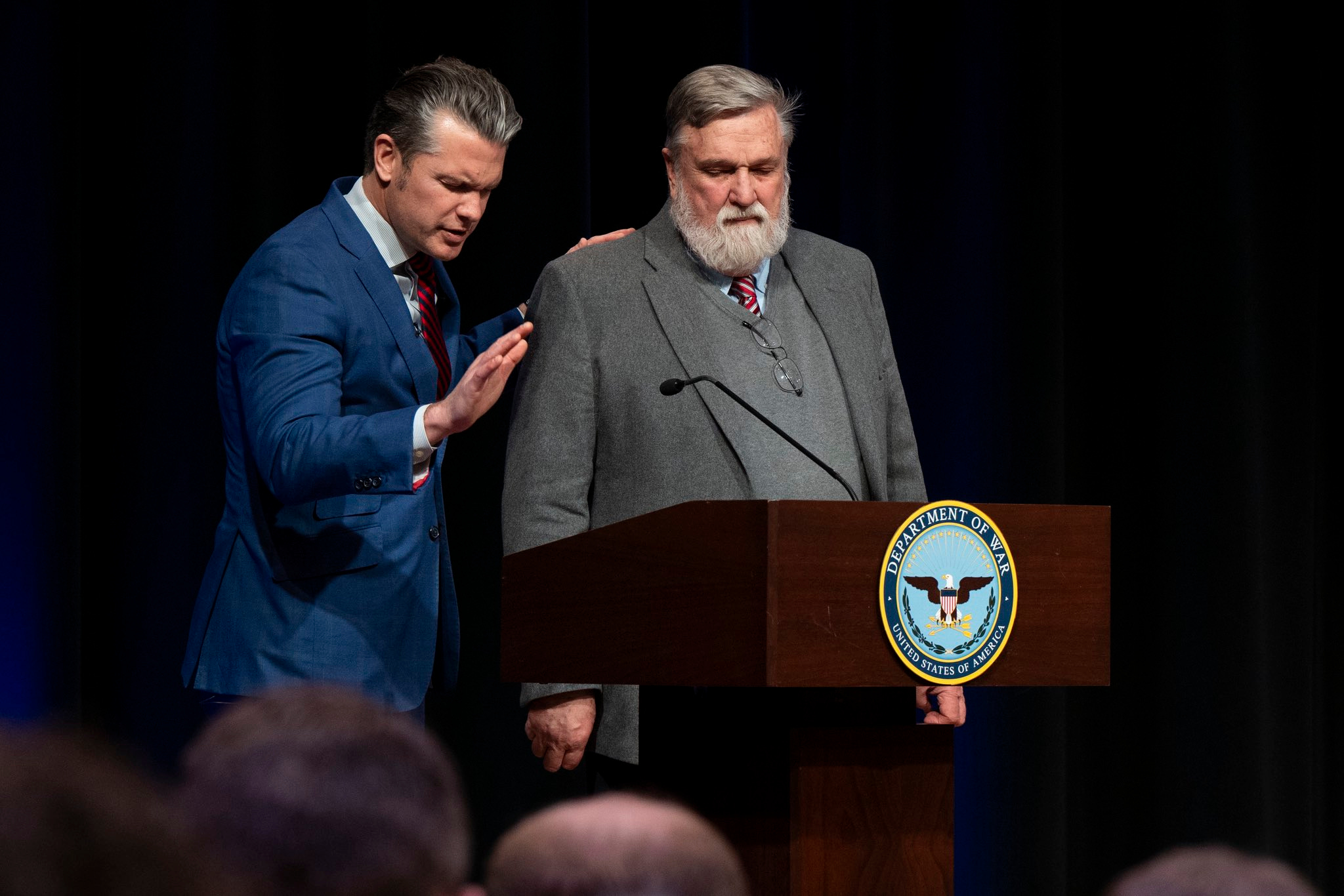
Last month, that pastor, Douglas Wilson, stepped up to a lectern at the Pentagon to address a monthly gathering of military leaders. He had come at the personal invitation of Secretary of Defense Pete Hegseth.
Hegseth is Wilson’s most powerful and well-known follower in Donald Trump’s America. The secretary belongs to a church in Wilson’s denomination, the Communion of Reformed Evangelical Churches (CREC), and sends his children to a Christian school affiliated with Wilson’s Association of Classical Christian Schools (ACCS). During the worship service at the Pentagon, Hegseth thanked Wilson for his “mentorship” and his “willingness to be bold.” He has previously described Wilson as a mentor and publicly praised and elevated his work on multiple occasions. Two earlier sermons at the monthly service—a recurring event Hegseth introduced last spring—were delivered by Hegseth’s CREC pastor. In an interview with New York Times opinion columnist Ross Douthat last fall, Wilson described himself as being “more influential than I used to be, and at significantly higher levels.” He offered his connections to Hegseth, Russell Vought, and other figures in the Trump administration as evidence of his new reach in the halls of power.
Wilson has taken a long road from his early days as an obscure pastor-theologian to becoming a spiritual mentor to one of the most powerful members of Trump’s cabinet. His early efforts at attaining influence were thwarted by a book he coauthored with Steve Wilkins, a neo-Confederate1 and a leader in the League of the South, which the Southern Poverty Law Center has described as a white supremacist organization. Their collaboration, Southern Slavery As It Was (which Wilson put out with Canon Press, the publishing house he founded, in 1996), promoted the idea that the institution and practice of slavery is not only biblical but often benign, with those enslaved ultimately being better off for it. Wilson’s ostracism followed, but it was short lived: Within a decade, mainstream evangelical leaders like John Piper and John MacArthur had started inviting him to speak at their gatherings and promoting his books to their audiences. And Piper and MacArthur opened the door for Wilson to influential evangelical outlets such as Christianity Today, which named a novel Wilson wrote its book of the year in the fiction category in 2013.
Wilson is an important figure to know in the larger political-religious movement that journalists and scholars call Christian nationalism. Christian nationalism is an amalgamation of different expressions of Christianity that are loosely united by the idea that America should be a Christian nation. One of the movement’s most potent forms is a segment of the Pentecostal/Charismatic movement called the New Apostolic Reformation, which is guided by the strategic vision of Seven Mountains dominionism. Another important form of Christian nationalism is Catholic integralism, which advocates a union of government and Catholic religious authority; Steve Bannon is a representative figure. And a third form, the one to which Wilson and Hegseth belong, is rooted in Reformed Protestantism and Christian Reconstruction, a mid-twentieth-century movement that developed a unique theology of dominion and sought the application of biblical law to all of society.
These three expressions of Christianity have long been at odds with each other; in the case of Reformed Protestants and Catholics specifically, their theological differences have in centuries past given rise to significant violence and bloodshed. What brings them together now is the rejection of several fundamental American values articulated in our founding documents. Advocates of Christian nationalism do not believe in democracy, pluralism, egalitarianism, or the separation of church and state, and they desire a return to a naturalized gender hierarchy. They reject the notion that the legitimacy of the state is grounded in the “consent of the governed.” Government, in their view, should be headed by leaders who carry the mandate of heaven—quite literally.
As the label of Christian nationalism became more widely used in scholarship and the media, with most Christians renouncing it, Wilson’s publishing house took an aggressive stance in favor, publishing Stephen Wolfe’s The Case for Christian Nationalism in 2022.2 The book, which joins a manifesto of sorts to a study of early modern political theology, sparked conversations in national media. In combination with many other provocations engineered by Wilson’s publicity-savvy operation, this helped to bring Reformed Christian nationalism to more general public attention—much to the dismay of the many Reformed Christians who want nothing to do with Wilson, Wolfe, or their larger theocratic project.
With Wilson speaking to top military leaders and receiving public praise from the secretary of defense, it’s useful to get a sense for what his goals are in the context of the larger Christian nationalist movement.
PROPONENTS OF AMERICA AS A CHRISTIAN NATION are often somewhat hazy about what the end state of a “Christian nation” would look like specifically, but Wilson and his followers have carefully laid out a detailed vision. For them, a Christian nation would be governed directly by biblical law, and in every area of its common life and culture it would be shaped by a comprehensive “biblical world and life view.”
Perhaps the most important component of this worldview comes from the unique way Wilson and his followers understand the relationship of the two testaments of Christian scripture. Wilson rejects a view held by most Americans that the New Testament in some way “fulfills” the Old, especially its political/legal and moral claims, in a way that makes it less relevant today. His teaching, rooted in the Reformation and called the “unity of scripture,” holds that the Old Testament and the New Testament instead comprise one continuing revelation beginning with Genesis and ending with the Book of Revelation, with no substantive break between them.
Finding Jesus in the Old Testament may be problematic as a historical matter, but thanks to the doctrine of the Trinity, typological readings of scripture that see Christ or the Holy Spirit into the Old Testament are deeply orthodox. Construed in good trinitarian fashion, God exists as three equal and eternal persons but one substance. So it is that Jesus, champion of the peacemakers, shows one side of the character of God, but so too does the God of War as described in Deuteronomy 20.
Wilson draws a great deal on this latter view of God, and he couches his larger goals explicitly in terms of dominion: Not only does he want America to be a Christian nation; he wants all the nations of the world to be Christian nations. (Hegseth takes a similar stance, as illustrated by his large Crusades-themed tattoos.) There is ultimately no room here for pluralism, and the reasons go down to the level of epistemology. Wilson claims that there are just two possible ways for us to know what we know: either God’s revelation in the Bible is true, making it our primary source of real knowledge about the world, or we must trust autonomous human reason to sort things out for ourselves—a sinful misuse of the faculty, in his account. Those two sources are understood as ultimately incompatible and mutually exclusive; there is no neutrality.
If you accept that the Bible is true, Wilson believes that the rest of his political-theological paradigm must follow. A Christian nation, in his account, is a nation in which there is no area of life and culture where the Bible is not the ultimate authority. Wilson and other Christian nationalists draw on a framework known as “sphere sovereignty” to interpret and apply the Bible to every area of modern life. Building on the controversial work of mid-twentieth-century Christian Reconstructionist Rousas John Rushdoony, Wilson’s view of sphere sovereignty begins with the proposition that God has delegated authority to human institutions in three distinct spheres: the family, the church, and the civil government.
In his interpretation of the framework—and Hegseth’s—each of these “spheres of authority” has distinct responsibilities and strict limits on its remit of appropriate action. The family, for example, is responsible for the care and protection of its members, including the education of children. (This sometimes results in unexpected outcomes: Economic matters, even up to the scale of nations, fall under family authority, for instance, and public education is considered unbiblical.) Meanwhile, the church on this model is responsible for providing a minimal social safety net and preaching the Gospel, while the civil government’s core function is to punish evildoers, and also to protect private property, which includes providing for a national defense.
SO, WHAT WOULD ALL THIS MEAN in practice, were the United States to be recut to Wilson’s pattern? The main practical consequence would be a return to the idea that social hierarchy is natural and desirable, and that social equality undermines the right ordering of society as ordained by God. It would legitimize strict inegalitarian limitations on civic participation, including who can lead in society and even who can vote.
The government would advance a view of the world that is deeply patriarchal—not merely condoning a form of women’s submission in marriage that has been common in evangelicalism, but also severely limiting leadership roles in the church and in government and society to men only. We have seen a preview of what this might look like in the way that Wilson and the other men who serve as the public face of Reformed Christian nationalism on social media, podcasts, and other online platforms seem to relish opportunities to be aggressively provocative and transgressive, especially in advancing their views on women.
Hegseth has systematically removed women from high-level posts in the military, firing widely respected, admired, and even groundbreaking leaders. He has also sought to make the military less hospitable to women in general. Wilson, for his part, has said such things as, “Women are designed to make the sandwiches,” and “Women are people that people come out of.” He has also gone further, sometimes attacking specific women in abjectly vile terms. A number of men in this part of the Christian nationalist ecosystem are now willing to say what they have believed all along: that women should not have the right to vote.
Wilson and his followers would deny not only women but also non-Christians the franchise and the right to pursue public office. They would limit the ability of believers of other faiths—including non-Protestant Christians—to publicly practice their faith; Wilson recently said on a podcast that the theocratic society he envisions would ban mosques from broadcasting calls to prayer and prohibit Catholic parades honoring the Virgin Mary. But even though this—and their belief in the death penalty for all manner of crimes—implies a significant amount of coercion on the part of the state, they also insist that the societal transformation they seek will occur at a grassroots level, from the “bottom up.” That’s because it will come about primarily through conversion to their point of view through the adoption of their principles. Wilson and his co-travelers believe this vision will be realized, albeit over a very long time horizon: Wilson has recently suggested it would take 250 years for them to achieve the “exercise of dominion” he seeks.
WHERE DOES WILSON BELIEVE the most important battles (figuratively speaking) are to be fought to achieve these goals? His ideological forebears offer insight into his strategy. In the middle of the twentieth century, an earlier iteration of Wilson’s movement known as Christian Reconstruction brought conservative Reformed evangelicals together to advance similar goals. It was led by Rushdoony, an influential figure to whom evangelicals rarely admit their debts on account of his controversial reputation, according to historian Frances FitzGerald. (Wilson is the rare figure to openly profess his admiration.)
To move the United States in the direction of theocracy, Christian Reconstructionists focused their efforts on education. While Rushdoony never garnered the attention that Wilson has, he was a key figure in launching the Christian school movement, which laid the groundwork for the rise of the Christian homeschool movement. Rushdoony argued that because education falls within the authority of the family, public education run by the civil government was a usurpation of authority and therefore unbiblical.
Many in Rushdoony’s Christian audience took their children out of public schools in response to his teaching. But he also developed consequential legal arguments that ultimately helped to codify the freedom of parents to choose a Christian education for their children as a right protected under the free exercise clause of the First Amendment; the right secured, he then helped to develop Christian school curricula and launch Christian schools across the country. In the 1990s, many of those schools, which are often exempt from the state-level standards and oversight that apply to public schools, adopted what was called the Classical Christian model of education and joined Doug Wilson’s Association for Classical Christian Schools. A key component of Wilson’s vision for a Christian nation would include the complete dismantling of public education. And he has now spent decades in Idaho building the sorts of institutions he hopes might someday become a functional replacement at scale.
WILSON’S REMARKS AT THE PENTAGON assured the audience that their battles were God’s battles, that God would be their protector just as he was for figures from scripture like Noah and David. He suggested that God’s people, having searched for the enemy, now realize they are surrounded—the implication presumably being that the real enemy is other Americans. The initiation of Christian services at the Pentagon, Wilson said, could be a “black swan event,” a turning point in the decades-long Christian effort against secularism. He maintained this bracing and triumphant register throughout.
Wilson might not be lying about having accepted that it may yet be centuries before his Christian nation will rise out of the ashes of the secular United States. But standing at the center of global American military power and exhorting the leaders of the country’s armed forces that day, he must have felt a large step closer to the realization of his dominionist dream.
For his part, Wilson describes himself as a “paleo-Confederate,” meaning that while he doesn’t want a redo of Gettysburg, he would say “the South had a point on the constitutional matters surrounding the war.”
Correction (March 19, 2026, 9:35 p.m. EDT): As originally published, this article mistakenly referred to Stephen Wolfe’s 2022 book as In Defense of Christian Nationalism; it’s correct title is The Case for Christian Nationalism.
 | A guest post by
|