Gabbard Garbles 2016 ‘Russiagate’ Intelligence
Her memo is smoke and mirrors—but it boosts both MAGA and Kremlin narratives.

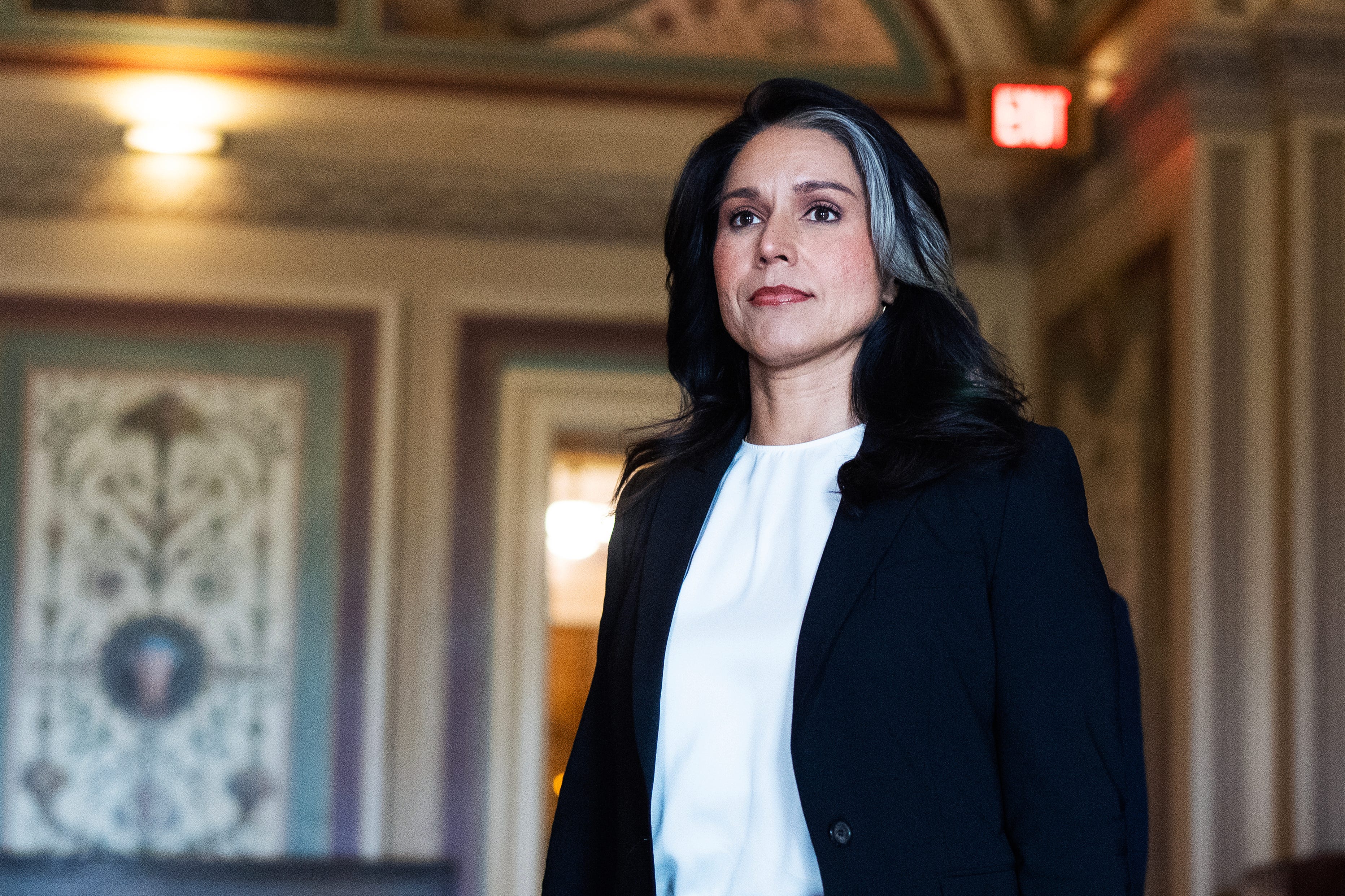
FRIDAY’S MEMO RELEASED BY TULSI GABBARD, the director of national intelligence, claiming that the intelligence community “manipulated and withheld” key evidence in the “Russiagate” investigation in 2016—and her even more explosive allegation that high-level Obama administration officials “weaponized” intelligence to “lay the groundwork for what was essentially a years-long coup” against Donald Trump—was met with predictable joy among the usual suspects: MAGA loyalists as well as those leftists, like Matt Taibbi, whose loathing of the American “national security state” has made them de facto MAGA bedfellows. Gabbard’s statement, which explicitly threatened the alleged wrongdoers (including former FBI Director James Comey, CIA Director John Brennan, and DNI James Clapper) with prosecution for “treasonous conspiracy,” not only vindicates the Trumpian narrative of the “Russia, Russia, Russia hoax” but represents a disturbing escalation in Trump’s vendetta against officials who he feels crossed him during his first administration.

Yet even a cursory look at the actual substance of Gabbard’s dramatic claims shows . . . a nothingburger. There is no actual substance. Instead, there is blatant sleight of hand and manipulation of evidence, debunking a theory of Russian election interference that the Obama administration never endorsed.
The Gabbard narrative goes like this: Throughout the fall of 2016, intelligence assessments found that Russia “did not use cyberattacks on election infrastructure to alter the US Presidential election outcome” (and lacked the capacity to do that). Then, a December 8 intelligence assessment reiterating this conclusion was abruptly pulled “based on some new guidance.” (The memo Gabbard cites to back up this claim says that the publication of the December 8 assessment was being “push[ed] back.”) At a December 9 White House meeting that included Obama, Brennan, and Clapper, “Obama directed the IC to create a new intelligence assessment that detailed Russian election meddling, even though it would contradict multiple intelligence assessments released over the previous several months.” By a week later, major media outlets were hyping secret assessments by intelligence agencies that Russia, using “cyber means,” had intervened in the election “to help Donald Trump win the presidency”—and that Vladimir Putin was “personally involved.”
If true, that would indeed be outrageous. But this supposed scandal rests on a crude bait-and-switch. A quick look at the media reports Gabbard cites shows that they weren’t talking about altering the election outcome through “cyberattacks on election infrastructure”ؙ—that is, actual tampering with the vote count. Rather, the claims of election interference via cyber warfare concerned, as the Washington Post put it, “individuals with connections to the Russian government who provided WikiLeaks with thousands of hacked emails from the Democratic National Committee and others, including Hillary Clinton’s campaign chairman.”
Was this a new, post-election assessment, as Gabbard seems to claim? Hardly: The same conclusion was announced at the start of the October 7, 2016 joint statement issued by the DNI and the Department of Homeland Security on behalf of seventeen intelligence agencies:
The U.S. Intelligence Community (USIC) is confident that the Russian Government directed the recent compromises of e-mails from US persons and institutions, including from US political organizations. The recent disclosures of alleged hacked e-mails on sites like DCLeaks.com and WikiLeaks and by the Guccifer 2.0 online persona are consistent with the methods and motivations of Russian-directed efforts. These thefts and disclosures are intended to interfere with the US election process. . . . We believe, based on the scope and sensitivity of these efforts, that only Russia’s senior-most officials could have authorized these activities.
The Gabbard memo mentions this statement but only to suggest that it, too, played fast and loose with the facts—by “suppress[ing]” a September 12 intelligence report that found “foreign adversaries” lacked the capabilities for successful cyberattacks on American election infrastructures and technologies, and by omitting that “the FBI and NSA had ‘low confidence’” in linking the hacking and the leaks to Russia.
The first charge is, quite simply, false: The October 7 statement explicitly notes the intelligence community’s finding that “it would be extremely difficult for someone, including a nation-state actor, to alter actual ballot counts or election results by cyber attack or intrusion.” The second is misleading. Yes, the September 12 report, which was coordinated among nine intelligence agencies and concluded that “Russian services probably orchestrated at least some of the disclosures” of DNC and Clinton campaign documents, acknowledged that the FBI and the NSA had “low confidence” in this linkage (because they felt the technical details were insufficient to confirm it). Did their view change by October 6, perhaps because more technical details had become available? Perhaps. In any case, both agencies signed on to the October 7 joint statement.
For what it’s worth, even the Gabbard memo is compelled to admit that there is “supporting evidence indicating the Russian government directed hacking of the DNC and [Democratic Congressional Campaign Committee].” But the memo omits another key fact. Obama’s decision to order a review of the evidence of Russian hacking in early December 2016 wasn’t some bizarre whim explicable only by a plot to sabotage his Republican successor by portraying him as a Kremlin puppet. Obama was under strong pressure from congressional Democrats to open a probe into Russian election meddling after briefings from intelligence and law enforcement, and Senate Republicans were talking about launching their own investigation. President-elect Trump’s stubborn insistence that he saw no reason to believe there had been any Russian interference at all added to the urgency of completing the review before his inauguration.
Did any reputable Democrats—or mainstream journalists—ever allege that Russian cyberwarfare targeting the 2016 U.S. election included actual vote-rigging? Gabbard certainly produces no examples of such claims. (Notably, when former Senate majority leader Harry Reid was quoted as making such a claim in David Shimer’s 2020 book about the history of Russian interference in American elections, Rigged, Washington Post senior political reporter Aaron Blake zinged him for spreading misinformation.)
One can arguably fault media outlets for using shorthand like “Russia hacked the election”—or “election-tampering”—with regard to email hacks and leaks that may or may not have moved the needle in extremely close battleground-state votes: People who don’t pay close attention to the details may well assume that such language refers to actual alteration of votes or vote tallies. But such careless language hardly justifies Gabbard’s shameless use of election infrastructure hacks as a red herring.
GABBARD’S DRAMATIC CLAIMS echo CIA Director John Ratcliffe’s recent declaration, in unveiling a CIA review he had commissioned of the 2016 inquiry into Russian election interference, that “This was Obama, Comey, Clapper and Brennan deciding ‘We’re going to screw Trump’” and that the intelligence chiefs “manipulated” and “railroaded” the investigation. In reality, as CIA veteran John Sipher showed in his analysis in The Bulwark, the review doesn’t support Ratcliffe’s explosive charges: While it concludes that the “accelerated process” of the inquiry and the unusual involvement of high-level officials created concerns about bias and rush to judgment, it does not conclude that the process was corrupt or partisan or that its results were shoddy. (Indeed, the review praised the overall “analytic rigor” of the 2016 assessment.) And of course, as Sipher notes, the rapid inquiry and high-level involvement happened for a reason: With a presidential election a few weeks away, there was evidence of an adversarial power trying to subvert it.
The CIA report was a professional, if somewhat slanted, review irresponsibly and dishonestly touted to Trump-friendly media by a Trump-picked, sycophantic CIA director. By contrast, Gabbard’s new memo is itself full of dishonestly packaged snippets of information and contradictory claims from someone who, in a sane world, shouldn’t have qualified for security clearance, let alone a national security post—due partly to her history of amplifying Kremlin propaganda narratives and conspiracy theories. (Remember those sinister U.S.-funded “biolabs” supposedly in Ukraine?)
While there is no point in relitigating “Russiagate” in 2025, it is worth recalling that nothing in Gabbard’s memo or supporting documentation affects the conclusions of the 2020 bipartisan Senate Intelligence Committee report on “Russian active measures campaigns and interference in the 2016 U.S. election.” That report found that Kremlin operatives did interfere in the election with the purpose of damaging Clinton and boosting Trump. It also found that key members of the Trump campaign made active efforts to capitalize on the Russian hack-and-leak operation via contacts with WikiLeaks, which was almost certainly knowingly acting as a Russian asset. While there is no confirmation that Trump knew about these contacts, the fact remains that he gleefully hyped WikiLeaks at dozens of campaign events in the weeks before the election. (I discussed the evidence of Russian interference, and Team Trump’s willingness to collaborate with Russian “helpers,” in Bulwark articles in 2022 and 2023.)
IF ANYONE STILL HAD DOUBTS THAT GABBARD IS A BAD ACTOR, installed in her present job with the purpose of corrupting U.S. intelligence and turning it into a tool of Trump’s personal agendas and vendettas, the Russiagate report should put those doubts to rest. Was the timing of her memo meant as a distraction from the scandal around Trump’s connections with Jeffrey Epstein? Hard to say; it was probably being prepared before the Epstein story catapulted back into the news. What’s clear is that it boosts not only the MAGA narrative of Trump as victim of the “deep state”—a convenient excuse for Trump’s moves to purge and MAGAfy intelligence agencies—but also the narrative of Trump as victim of a “coup,” inverting the reality of the attempt to steal the 2020 election.
Of course, this joke of a report is a gift to the Kremlin, too. Russian news services were quick to pick up the story. “Fraud, American-style: Barack Obama fabricated data on Russian election interference,” a news anchor on Russia’s Channel One announced with palpable satisfaction. “The evidence has been presented by Director of National Intelligence Tulsi Gabbard.” Meanwhile, Dmitry Polyanski, Russia’s first deputy permanent representative to the United Nations, reposted Gabbard’s “Creation of the Russia Hoax” graphic on his Telegram channel, whined about the sanctions imposed by Obama “because of this canard”—including the expulsion of Russian diplomats and the shuttering of two compounds Russian embassy staff had used as waterfront retreats—and plaintively inquired about restitution. (I wish I could say it’s definitely not going to happen.)
Back in 2022, Kremlin TV’s chief propaganda jock Vladimir Solovyov famously referred to Gabbard as “our girlfriend Tulsi.” It seems that three years later, she’s earning the compliment.