

The Disney Heiress, the Soybean Farmer, and Trump’s Dangerous Decisions
Two views of how the president’s senseless economic and moral acts put the country at risk.

HOW DOES DONALD TRUMP’S ECONOMY feel to a corn and soybean farmer? How does it feel to a wealthy daughter of a family whose name is synonymous with American entertainment?
Last week, farmer John Bartman and documentary filmmaker Abigail Disney each talked about money in unusually personal, detailed terms. It was a stark glimpse into two very different lives—different from each other and different from what most of us will ever experience—and the ways Trump has affected both of them.
Let’s start with John Bartman and his combine.1 He’s a small-town Illinois corn and soybean farmer, fifth generation, and the star of a new Democratic National Committee video about the hardships and risks of farming amid Trump’s on-again, off-again tariffs and threats.
Last month, Bartman ran into a problem: He needed a new wiring harness for his combine. “It basically runs the computer in the combine,” Bartman said in a phone interview. “It’s one of those things you hope you never have to buy. When you gotta have it, you gotta have it.”
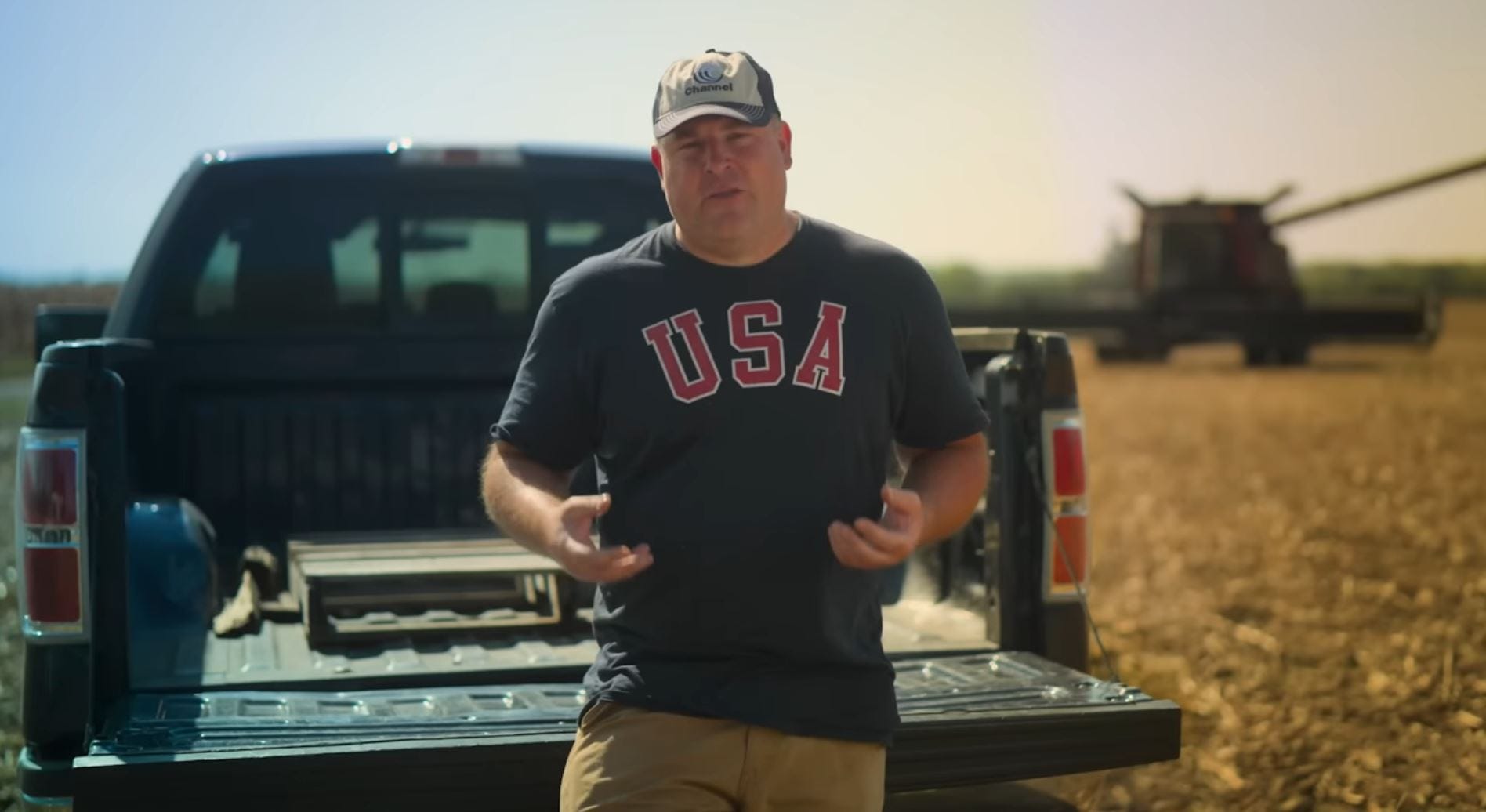
The particular wiring harness he needed was not available at his local dealership. So Bartman extended his search on the company app and found there was only one in all of North America—in Sleepy Eye, Minnesota (named for a Dakota tribal chief, not an eye condition). So he drove there and back, he told me, seven hours each way.
“Farmers are driving all over the country right now to get parts. The manufacturers don’t know what to do because the tariffs change every week. It’s very challenging,” Bartman said on an October 14 call organized by the DNC. “So we as farmers have been paying for the tariffs, too. It’s not like we’re not paying into this.”
And don’t get him going on washers. Two weeks after the drive to Minnesota for the wiring harness, he said, his combine needed a washer. The local outlet had them in stock, but they only came in a four-pack for $3.99. Bartman, whose family has been farming since 1846, needed one washer and told me it should have cost 25 cents.
“I didn’t buy them. They were too expensive. It drove me nuts,” he said. Plus, they were made in China—“another reason I didn’t buy them.” He ended up going home to look for a used washer, and found one.
ABIGAIL DISNEY IS A NEW YORK CITY-BASED philanthropist and member of the Patriotic Millionaires, a group that wants the government to raise taxes on wealthy people like them. In a discussion last week with a few journalists, she traced the evolution of the tax code and her family’s finances since the death of her grandfather, Roy O. Disney (brother of Walt).
The top federal estate tax rate when he died in 1971 was 77 percent, and the exempted amount before any tax kicked in was $60,000. When her grandmother died in 1984, the maximum rate was 55 percent and the exemption was $325,000. When her father died in 2009, the top rate was 45 percent and the exemption was $3.5 million.
The trend is clear. The top tax rate for the largest estates has stayed at 40 percent since 2013, but as Trump told friends at Mar-a-Lago in late 2017, “You all just got a lot richer.” He had just signed the signature GOP tax law that doubled the estate tax exemption from $5.49 million to $11.18 million, with adjustments for inflation through 2025. It’s now $13.99 million.
This year, in their so-called Big Beautiful Bill, Trump and his party made the larger, inflation-adjusted exemption permanent and raised it to $15 million for the estates of people who die in 2026. For comparison purposes, the $60,000 exemption when Disney’s grandfather died would amount to roughly $480,000 in 2025 dollars.
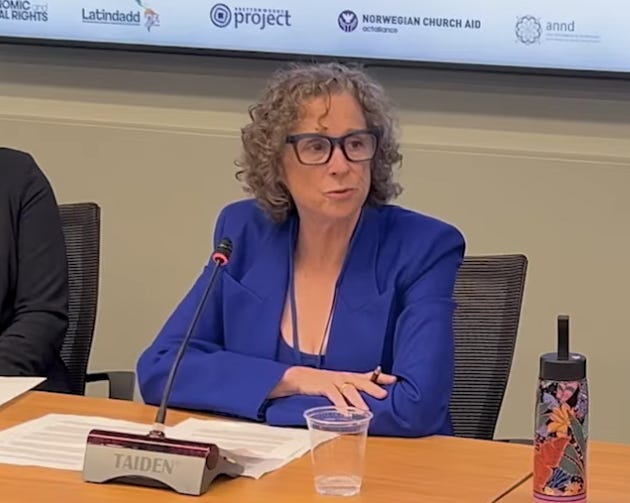
“My grandfather made a lot of money in his lifetime, and he didn’t have the option to choose among the tax rates,” Abigail Disney told us at the October 16 session. But even at the relatively astronomical top rate back then, “he was able to not only take care of his son and his family, he took care of each of the four of us [grandchildren] as individuals all the way through our entire lifetimes, and he set up another trust . . . that took care of our children.”2
Even so, “I was left more money than I could ever possibly use,” she added. She has given away 70–75 percent of what she inherited, she said, “and I’m still working hard at it. I have a long way to go.” One clue: In 2019, she told the Financial Times her net worth was $120 million.
FROM THEIR DISPARATE POINTS on the financial and geographic spectrum, Disney and Bartman see economic and moral failures they both attribute to Trump and his circle.
Bartman remembers listening to Orion Samuelson—the “American Farmer’s Best Friend”—who broadcast agriculture analysis and information on WGN radio in Chicago for sixty years starting in 1960. “He would often preach the need for a marketing plan in order to lock in profitability,” Bartman said on the DNC call. “This year, thanks to Trump, most farmers never have the opportunity to lock in profitability.”
Trump’s “stupid governmental policy” is costing people sleep and jobs, and not only in farm communities, Bartman said. Trump spent $28 billion to bail out farmers in his first-term trade war with China. Under Trump’s renewed tariff chaos, to the fury of Bartman and many others, China is now buying Argentine and Brazilian soybeans, and Trump is floating another bailout.
“A bailout is like putting a Band-Aid on a bullet wound. Government bailouts do not make up for our loss of income. We don’t want a bailout. We want markets for our crops,” Bartman said on the Democratic call. “We want to be able to work hard every year and enjoy the fruits of our labor and know that we did it on our own.”
Disney wrote in a 2017 USA Today op-ed that she did not recognize “the values and priorities” in Trump’s tax bill that year.3 Her grandfather and great-uncle, Roy and Walt, worked their way up from “the razor’s edge of poverty to lives of unimaginable wealth,” she said, but they couldn’t have done it without “the high-functioning American system of schools, roads, hospitals and courts.” Don’t lower my taxes, she wrote. But Trump did, and then did it again this year.
At a World Bank panel last week, Disney said extreme wealth destroys empathy: “There is such a thing as too much money. It’s bad for the world for sure, but it’s also bad for the people who own it. . . . It is painful, soul-crushing, alienating, and morally corrosive for the people who own it.” What’s even worse, she suggested, is when extremely wealthy people hold “the keys to our democracy,” as they do now. “Lives are quite literally depending on us taking away those keys,” she said.
The Elon phase of this oligarchic presidency is over, but the Trump era endures. His team—both inside his administration and out—remains saturated with the uber-rich, and there’s another generation at the ready. “We don’t need a world run by David Ellison and Jared Kushner and Donald Trump Jr.,” Disney told us.
No, we certainly don’t.
What the heiress and the farmer share is the quaint idea of evidence-based, common-sense policies, and investments that, like highways and schools, create paths to success for as many people as possible. The yardstick is simple: What’s best for America?
That does not seem like too much to ask from the leaders of a (for now) global superpower. But all indications are that Trump and his wealthy allies care far less about the nation’s future than their own literal fortunes.
A combine is a machine that combines three tasks: harvesting the grain (cutting and gathering it), threshing it (removing the kernels or seeds from the stalks [straw]), and winnowing (separating the grain from the husks [chaff]).
To be precise, those taken care of included her father, Roy E. Disney (an only child); his four children, Abigail and her three siblings; and their sixteen children. That’s a lot of people.
I was the editor of Abigail Disney’s 2017 op-ed.
 | A guest post by
|