How Russia Learned to Love Stalin Again
The Red Czar’s cult of personality is key to Putin’s cult of legitimacy.

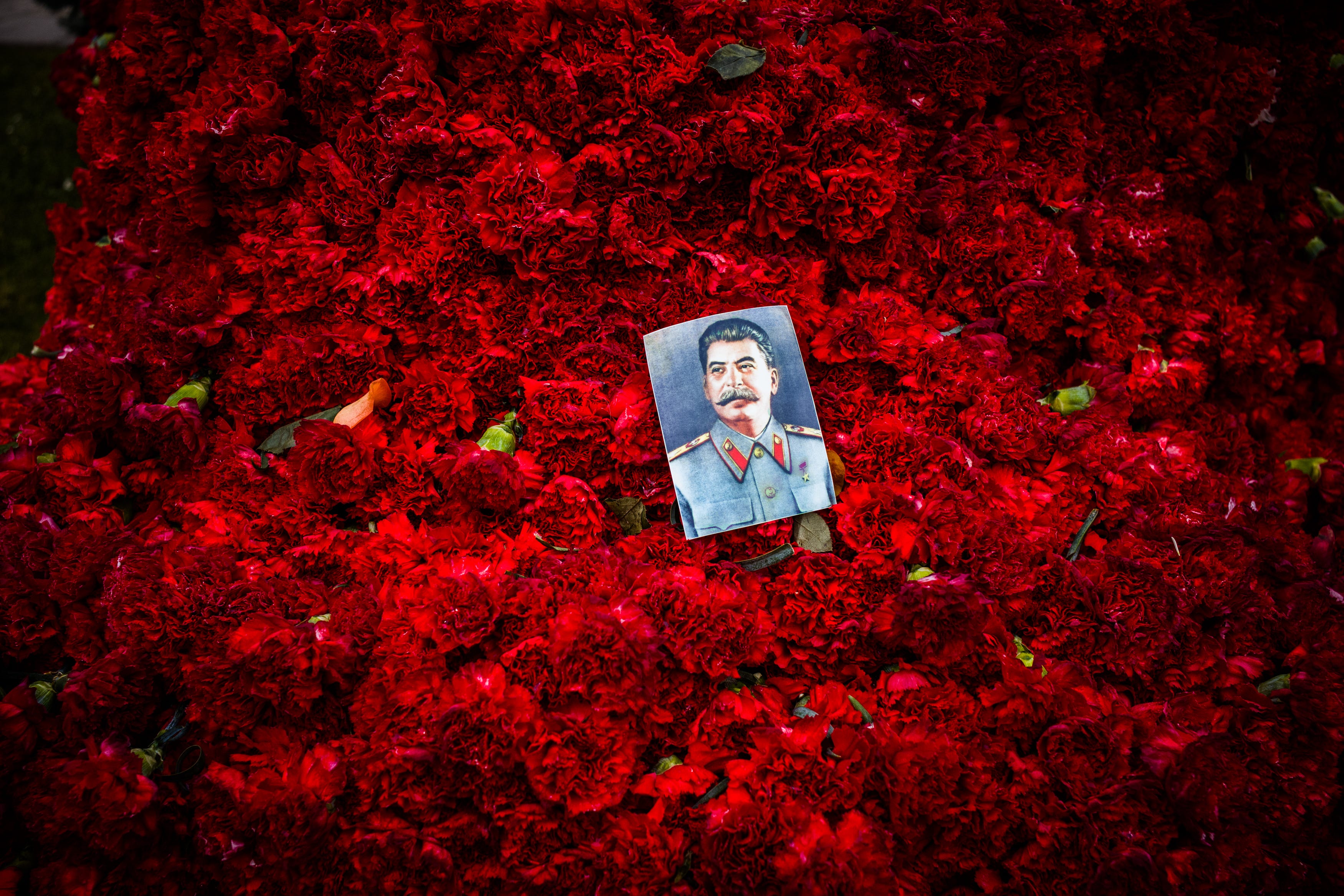
IN THE SPRING OF 2022, THE EARLY DAYS and weeks of Vladimir Putin’s war in Ukraine were marked by a drastic hardening of authoritarianism in Russia—or, perhaps more accurately, a drastic plunge from authoritarianism into full-fledged totalitarianism that leaves no space for a civil society independent of the state. Protests and even private expressions of discontent were ruthlessly suppressed and punished; nearly all remaining independent media were shut down or hounded out of the country. At the time, it looked as though the crackdown was a wartime measure as the “special military operation” dragged on and the casualty lists grew. Yet in hindsight, the hardening of Russian politics long predates the war in Ukraine.1 And three years into it, the totalitarian restoration is almost complete. Case in point: the symbolic rehabilitation of Joseph Stalin.
Some of the Stalin nostalgia may be attributable to the coincidence (okay, not really a coincidence) that Stalin led the Soviet Union to victory in World War II, which has become the central myth Putin has used for years to justify his rule and Russia’s claims to great-power status. At the end of April, the Volgograd Airport was officially renamed Stalingrad Airport after the city’s pre-1961 name, ostensibly to honor the Battle of Stalingrad in time for the 80th anniversary of the end of World War II. In contrast to earlier, temporary revivals of the name “Stalingrad,” this this was a permanent name change Putin himself decreed. He even floated the idea that the name of the city itself might permanently change back to honor the dictator.
But the Stalin commemorators were just warming up. In mid-May, a major piece of Stalin kitsch made its appearance in a major metro station in downtown Moscow: A haut-relief sculpture titled “The People’s Gratitude to the Leader and Commander” was unveiled inside the Taganskaya station. It’s a replica of a Stalin-era sculpture originally installed in 1950 and dismantled in 1966. A majestic Stalin in military uniform stands at the center of the composition, gazing forward, surrounded by men, women, and children bearing flowers.
Moscow is the most cosmopolitan and probably the most liberal city in Russia, so not all the commuters are enthused by the new decoration. Novaya Gazeta reporter Miron Samkov recorded comments like “My God, what a disgrace” and angry gestures and jeers at the sculpture’s “crappy” quality. An elderly man delivered a passionate lecture on Stalin’s crimes and expresses disgust at the ignorant people bringing flowers for “that scumbag.” Even two young women who brought white carnations to place at the foot of the monument explained that the ribbons tied to the flowers’ stems were actually in honor of Stalin’s victims (“We won’t forgive or forget”). And while the security guard posted at the sculpture took the ribbons off after the women left, he also expressed irritation at his job and thought the installation was a bad idea. “Why the hell do I need this monument, really?” he asked Samkov. “Why did they put it here? To provoke people?”
One woman told Samkov that she was shocked by the news of the installation and came mainly to see people’s attitudes toward it, concluding dejectedly, “I think it’s mostly positive.” Samkov records those comments, too: “This is the kind of leader we're missing now,” or “I address him with honor and respect . . . the greatest, the best . . . he did everything for Russia.” Some of those who come to pay their respects are Ukraine war veterans; one such man said that “fighters in the Donbas revere and love Stalin” and that many of them wear Stalin patches.
IT SHOULDN’T BE SURPRISING that even in educated, globalized Moscow, the Red Czar has admirers. After all, the Stalin restoration project has been underway for a long time. As early in 2007, the standard manual for history teachers encouraged a supposedly balanced “teaching the debate” approach to the Soviet dictator: There’s a view that he was a mass murderer, but you could also see him as an “effective manager.” In 2009, renovations of a different downtown metro station, Kurskaya, included the inscription of a verse from the old Soviet anthem—“Stalin raised us to be faithful to the people, and inspired us to labor and heroic feats”—supposedly for no other purpose than to restore the station’s original 1950 look.
Starting in 2010, Stalin posters began to appear in Moscow and other cities for Victory Day celebrations. The imagery is layers deep: Stalin was the leader when Russia—albeit in its Soviet incarnation—was at the apex of its power, with Stalin as the omnipotent generalissimo. He may have been a communist revolutionary as a young man, but the Stalin imagery in today’s Russia emphasizes his embrace of Russian nationalism (despite his Georgian origin) and even, albeit for purely pragmatic reasons, of the Russian Orthodox Church (another similarity to Russia’s current post-Communist czar). The choice of World War II–era Stalin as the mascot for national greatness reveals not only how Putin sees his country but how he sees himself.
Also around 2010, Stalin monuments, mostly sponsored by local chapters of the Communist Party, started sprouting up around the country. Commemorations and discussions of Russia’s “Great Patriotic War” against Nazi Germany increasingly credited Stalin’s wise leadership—even though, in reality, the consensus among historians is that Stalin’s policies left the Soviet Union poorly prepared for the 1941 invasion and led to initial catastrophic defeats. A 2013 documentary on Stalin that aired on a major national television channel portrayed the man who presided over gulags and mass executions as a true Russian patriot—and blamed the Great Terror on Western perfidy and overzealous low-level henchmen.
The propaganda invariably had its effect. According to surveys by the Levada Center, Russia’s most trustworthy polling firm2, the combined share of Russians expressing “respect,” “sympathy,” or “admiration” toward Stalin went from 36 percent in 2006 to 44 percent in 2017, 51 percent in 2019, and 63 percent in 2023. The prevailing emotion among the rest was “indifference”; the share expressing “antipathy,” “fear,” or “hate” toward the late dictator plunged from 38 percent in 2003 to just 8 percent two decades later.
For years, this creeping Stalin worship coexisted uneasily with acknowledgments and condemnations of the Great Terror. (The new Russia, after all, also reveres Alexander Solzhenitsyn, the man who made gulag a universal word.) In the past, Putin visited and honored memorials to Stalin’s victims. Reports in 2007 even claimed that he was genuinely shaken by his visit to the Butovo Firing Range, a Stalin-era mass execution site outside Moscow where at least 20,000 people were killed just between August 1937 and October 1938. “We must do everything to make sure that this tragedy is not forgotten,” Putin was quoted as saying at the time. He also lamented that “superficially appealing but empty ideals were placed higher than the greatest of values—the value of human life, of human rights, and freedoms.”
In 2025, Putin isn’t saying much about the value of life, rights, or freedoms—or about the importance of remembering the Great Terror. A Stalin memorial has returned not only to the heart of Moscow but also to the Russian-occupied Ukrainian city of Melitopol, with a plaque honoring Stalin’s role as the man who “organized and inspired the victory of the Soviet people over Nazi invaders.” Meanwhile, Stalin’s atrocities are increasingly relegated to forced amnesia.
Memorial International, an organization founded in 1989 to chronicle the history of Soviet repressions, was ordered disbanded shortly before the full-scale invasion of Ukraine. The Gulag History Museum in Moscow was shut down last November, supposedly for violating fire safety rules; its director, Roman Romanov, was fired in January. (The museum is expected to reopen eventually—but after an overhaul that will likely amount to a whitewash.)
The government-enabled forgetting is also targeting a project called “The Last Address,” which consists of plaques on the walls of Moscow buildings commemorating Great Terror victims who were arrested there and never returned. About 200 of 700 plaques have vanished, some repeatedly and despite attempts to protect them. Some of these disappearances are apparently the work of far-right groups. However, Moskvich magazine reports that attempts to get the police to investigate such incidents have been futile—surprise, surprise: the Russian capital’s ubiquitous security cameras never manage to catch the culprits in the act—and that least in some cases the authorities may have given orders to remove the plaques.
ANDREI KOLESNIKOV, ONE OF THE FEW independent journalists still working in Russia, writes that while Stalin’s comeback may not be happening on the Kremlin’s direct orders, it’s “perfectly aligned with the structure and ideology of the regime”:
The desecration of the memory of Stalinism’s victims—worse, the open explicit effort to erase it, the purposeful fight for historical amnesia—is the obverse of the persecution of today’s dissenters. The repression of memory goes hand in hand with the elimination of domestic enemies. And this process needs its own historical symbol, since, without a “great” history, there is no Putinism. Naturally, Stalin has been and still is such a symbol. The degree of Stalinization is measure of the brutality of the current regime.
De-Stalinization was the beginning of two cycles of liberalization in the Soviet Union: in the late 1950s and in the late 1980s. There is a certain symbolism in the fact that overt re-Stalinization marks the final de-liberalization of post-Soviet Russia. It is no coincidence, after all, that Stalin’s return has coincided with reports of the truly Stalinesque normalization of torture in Putin’s modern-day gulags—not only toward Ukrainian prisoners of war but toward Russian political prisoners. A harrowing video on the subject was recorded last month by former journalist and Nobel laureate Dmitry Muratov, who describes practices ranging from sleep deprivation to denial of medical aid to freezing cells in which prisoners are forced to sleep on the floor with no blanket, and more explicit torture methods such as beatings and electric shocks to genitalia. With grim sarcasm, Muratov predicted that Russia may soon introduce “Punisher Day” as an official holiday to celebrate the profession of torturer.
Stalin, gazing out from the wall of the Taganskaya Metro Station, would no doubt approve.
Some commentators deserve credit for noticing Russia’s slide toward totalitarianism long before the 2022 full-scale invasion of Ukraine. For what it’s worth, I first wrote about Putin’s authoritarian backsliding in 2001.
While Levada is the most credible source of public opinion information in Russia, there are serious reasons to doubt any poll taken in a country that criminalizes dissent, practices mass surveillance, and rigidly and ruthlessly controls political discourse.