
IF YOU EVER TOOK AN ECON CLASS, you probably learned the two main ways the government can stimulate a sagging economy: The Federal Reserve can cut interest rates, or Congress can pass a spending or tax-cut package.
We may soon discover an innovative third form of stimulus, courtesy of the Supreme Court.
As this week’s elections made clear, Americans are unhappy about the economy. With good reason. Layoff announcements have reached recessionary levels; subprime borrowing is back; electricity prices are skyrocketing. To the extent we can actually measure anything right now—given that the shutdown has halted the release of government economic data—we appear to be suffering from the dreaded s-word: stagflation.
What’s stagflation, you ask? It’s when prices are rising (inflation) while the economy is slowing (stagnation). Suffering from both problems simultaneously is somewhat rare. And solving both problems simultaneously is really difficult. That’s because the typical remedies for fighting inflation would likely worsen the job market, and vice versa.1
Fortunately for Donald Trump, there’s One Weird Trick that can help cure stagflation without turning to Congress or the Fed. He could just cut tariffs. After all, it’s tariffs that are driving prices up. And it’s tariffs that are dragging growth down. Get rid of them, and boom! Problem(s) solved.
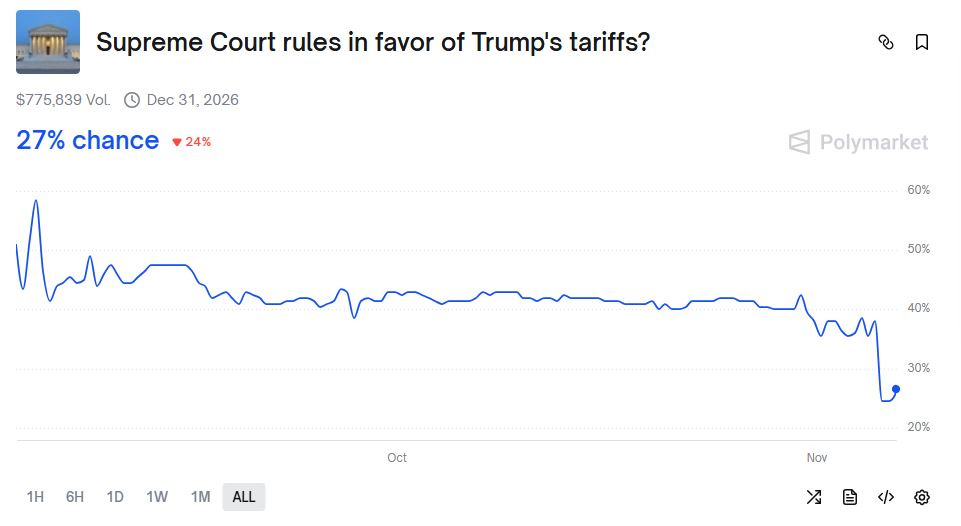
Alas, our self-described “Tariff Man” president hasn’t taken the hint. Instead, Trump has septupled(!) the average effective tariff rate (from 2.4 percent in early January to 17.9 percent today), and threatened to jack up rates further. His tariffs are being challenged in court, however. SCOTUS heard oral argument yesterday in one of those cases, and the justices sounded pretty skeptical that Trump has the broad tariffing power he claims. As of this writing, betting markets placed the odds that Trump’s tariffs survive at a measly 27 percent.
Trump has already begun catastrophizing this expected outcome, predicting that if the Court strikes down his tariffs, “our economy will go to hell.” In reality: If the justices decide to undermine Trump’s economic agenda, they’ll be doing him a favor.
Fewer businesses would be wasting their time on pointless, tariff-minimizing bullshit, like scheduling and rescheduling shipments. Plus, a sudden tax cut worth hundreds of billions of dollars—in the form of refunds for those tariffs already paid—could trigger the long-awaited boom Trump has been promising. The only real question is whether he’d be smart enough to accept it.
No more Hokey-Pokey
Navigating Trump’s ever-changing tariffs has made it hard for companies to make decisions and plan for the future. The tariffs are also a huge distraction from actual economic activity. Normally, businesses should be spending their time developing products, finding new customers, improving their operations, that sort of thing. Instead, they’re spending their time gaming out how to minimize their tariff burden.
“We have ordered and canceled and uncanceled and recanceled so many different times as the tariff rates went up and down and again,” Mac Harman, CEO of Balsam Hill, told me. Harman’s company sells pre-lit artificial Christmas trees, products that are just not economically feasible to make in the United States. He estimates he now spends about half his time optimizing around tariffs, which is both an economic and emotional drain. “I feel like I really can’t go more than six hours without following the news.”
In 2024, Harman says, his company paid $1 million in tariffs. This year’s tariff bill, by contrast, will be about $15 million. Which is painful enough. Even worse when you consider that it took an enormous effort to keep that tally from reaching $117 million, the maximum he says his company would have owed if it had mistimed its factory orders.
In addition to scheduling and rescheduling factory orders and shipment dates to adapt to the ever-changing Trump tariff rates, Balsam Hill has also had to line up more warehouses and trucks—and optimize when to move what where. It’s been a wasteful, goods-moving dance, what Harman calls the “Hokey-Pokey.” And even the Hokey-Pokey couldn’t fully mitigate the damage; this year the company also had its first layoff in its twenty years of existence, even as its markets are growing.
I’ve talked to a lot of CEOs like Harman in recent months. Pretty much everyone, even those sympathetic to Trump’s apparent trade aims (Harman, who started in the steel industry, counts himself in that camp), say they’d prefer lower tariffs. But if that’s not possible, they’d at least like some certainty about what the tariffs are. That would free them up to make informed decisions and invest with greater clarity over the medium- and long-term horizon. Instead, a company’s main profit center is now the guy tasked with monitoring the president’s Truth Social account. And that’s never a good sign.
We’re all Keynesians now. Even the Supreme Court.
The tariff case before the Court pertains to one particular kind of tariff authority Trump has invoked most frequently, by declaring a “national emergency” under the International Emergency Economic Powers Act. The chief question is whether the president can specifically issue tariffs under the IEEPA, as the law’s text doesn’t explicitly mention tariffs, and the Constitution puts tariff authority squarely in the hands of Congress. A related secondary question that arose in Wednesday’s oral argument is what counts as a “national emergency” for the purposes of the IEEPA. (Do trade deficits count? What about being mean to the president’s Brazilian buddy?) The justices sounded somewhere between skeptical of and hostile to the government’s arguments.
There’s another, more straightforward reason why SCOTUS striking down Trump’s tariffs would benefit the economy. It’s that all the tariffs that companies have already paid would then have to be rebated, and plugged back into the economy. That would, in effect, mean a huge, one-time tax cut.
In other words: a Keynesian-style fiscal stimulus.
And it’s a significant chunk of change: Somewhere around $200 billion is expected to be collected by the end of this year through these IEEPA tariffs alone (though anywhere between $100 billion and $300 billion is reasonable, according to calculations the Penn Wharton Budget Model ran for me).
There’s some question about how quickly that $200 billion or so could be refunded, but as some Cato Institute scholars wrote in an amicus brief challenging the tariffs, there’s precedent for doing large-scale refunds pretty much automatically.
This alone would add to GDP growth, probably around 0.15 to 0.4 percentage points, per more Penn Wharton Budget Model calculations for me. That may not sound like much, but it would be a very real shot in the arm for a flagging economy.
But beyond that simple Keynesian effect, there are other ways this could boost economic activity. “I think most of the action would be in the form of capital markets,” Kent Smetters, director of the Penn Wharton Budget Model, told me. “They might be relieved to see a limit on presidential powers. They might also hope that capital investment flows return, which gives the federal government more fiscal space going forward.”
Harman notes that it would be super-duper extra nice if the Court made this decision sometime during the holiday shopping season, as some legal watchers expect. Even if any tariffs rebates aren’t immediate, the boost they’d give to markets and consumers watching their 401(k)s would be. He fantasizes about getting a big fat check for $15 million alongside a surge of happy customers.
“The Supreme Court could save Christmas!” he says.
But the Grinch could still ruin it.
The Trump Rebate?
Markets may have already partly priced in the possibility that Trump’s tariffs will be unwound. (Investors paid attention to the Supreme Court oral argument too—not just John Mulaney.) With help from Commerce Secretary Howard Lutnick’s kids, some strapped companies have even sold their claims to future tariff refunds, because they needed the cash earlier. So we’re already experiencing a little bit of stimulus via jurisprudential boost. This in turn means it would be very painful if the Court surprises everyone and ultimately decides Trump does have the authority under IEEPA to implement these tariffs. Expect a market rout and widespread panic if that happens.
But the bigger problem may be Trump, who apparently does not (and likely will not) appreciate the blessing the Supreme Court is expected to hand him. This isn’t even a situation where he’d have to exhibit grace in defeat (never his strong suit). The smart thing for him to do here would be to rebrand a SCOTUS rebuke as a $200 billion windfall for the country, maybe even dub it the “Trump Rebate.” He could declare victory and watch shoppers go nuts. He could even (falsely) claim that this “Trump Rebate” is being funded by evil foreigners, who supposedly paid all his tariffs. (Economists overwhelmingly disagree.)
Instead, the administration has made clear that it plans to replace any lost IEEPA tariffs with different kinds of tariffs. The good news, for some businesses at least, is that those other tariff authorities are somewhat narrower, with important substantive and procedural limits. They take longer to propose, implement, and change—there’s a whole process and set of hearings required, not just a fat-fingered tweet—and they’re vulnerable to legal challenge, too.
But even under those rosier circumstances, we’d have, at a minimum, economic uncertainty and a tariff regime that benefits almost no one.
In short order, we could find ourselves in a scenario in which the Supreme Court, stacked with three Trump-appointed justices, hands him a political gift. And then, Trump, stubborn as always, scrambles to give it right back.
When inflation is high, the Fed usually raises interest rates. When GDP and job growth are weak, the Fed usually cuts interest rates instead.
Welcome Catherine!!
Welcome Catherine! Glad to have you at the best lil media out there 🤩
I have a question… If he’s forced to rebate all his companies who paid the import tariffs, that’s great for those companies.
But how about all us little people who were charged so much more for everything? Sure, he could send everybody a check for a couple hundred bucks, but we’ve paid far more than that in a year of these stupid tariffs. Are there gonna be lawsuits to try to get our money back? Are these companies going to drop their prices like a rock? I have a hard time imagining that they’re going to do that. Neither stagflation nor deflation are good situations to be in….