

How the Tech Right Learned to Love Mordor
The history of the American right’s long romance with J.R.R. Tolkien, from earnest fandom to arms-industry branding exercise.

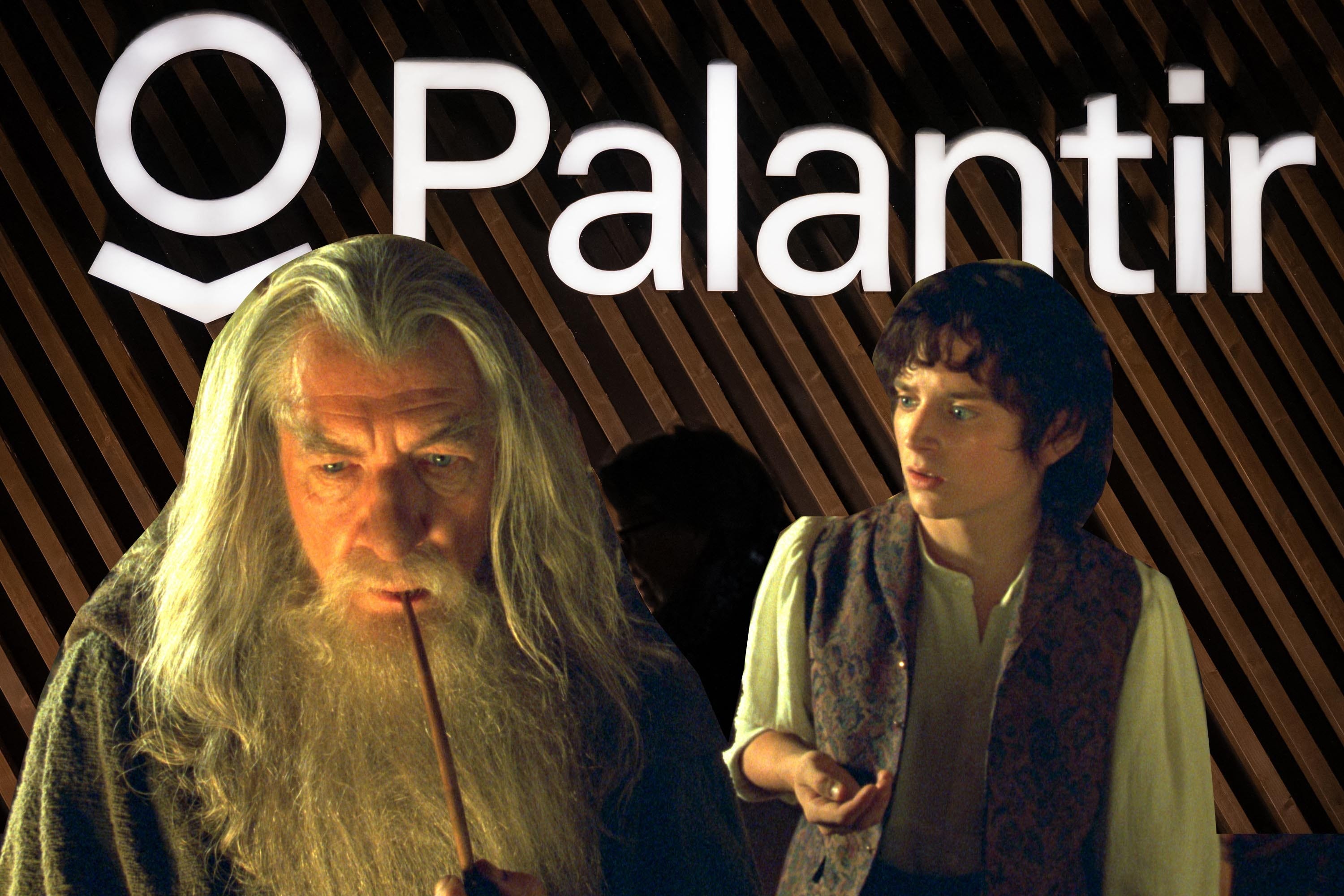
THE TECH LORD PETER THIEL and those in his orbit have a thing about naming their companies after elements from J.R.R. Tolkien’s The Lord of the Rings. The most infamous of these is, of course, Palantir, the data-analytics and intelligence-software company heavily integrated into wartime decision-making, law enforcement, and the Trump administration’s immigration crackdown. Others include Mithril Capital and Lembas LLC. It doesn’t stop with Thiel, though. His friend and business partner Vice President JD Vance co-founded Narya Capital, an Ohio-based firm with an LOTR-derived name. And Palmer Luckey, the cofounder of Oculus, has shifted his attention to Anduril Industries, a defense company specializing in autonomous systems, once again lifting its name from the pages of the British fantasy series.
Tolkien—whose creations famously include walking trees that overthrow an industrial despot whose satanic mills have wrought destruction on their green and pleasant lands—is an unlikely source of imagery and symbolism for Silicon Valley’s new war boys.
Nevertheless, fed up with criticism that he and Thiel had missed the point, earlier this year Luckey took to a podcast to defend their Tolkienphilia. “‘Oh, I can’t believe Palmer named his company after something from Lord of the Rings. He doesn’t understand the novels. They don’t understand that Tolkien hated war. Blah, blah, blah,’” he mimicked his critics. Well, he’d come prepared with a quotation from Tolkien’s friend and Inklings buddy C.S. Lewis:
Almost the central theme of the book is the contrast between the Hobbits (or “the Shire”) and the appalling destiny to which some of them are called, the terrifying discovery that the humdrum happiness of the Shire, which they had taken for granted as something normal, is in reality a sort of local and temporary accident, that its existence depends on being protected by powers which Hobbits forget, against powers which Hobbits dare not imagine.
There you have it. If you aren’t ready, like Palantir’s frenetic CEO Alex Karp, to ensure that America’s enemies fear “something really bad is going to happen to you and your friends and your cousins and your bank account and your mistress and whoever was involved,” then you’re just a peacenik hobbit, living under the AI-defense umbrella, smoking your pipe and chasing Proudfoot girls or what have you.
The tech right joins a long tradition of conservative or right-wing claims to possess Tolkien and the one true interpretation of The Lord of the Rings. In some ways, Tolkien lends himself to certain conservative interpretations. Yet, at least regarding our new military industrialists, it’s hard to imagine a group that could get him more wrong.
Understanding just what is going on here requires some Thieleological analysis.
CONSERVATIVE INTELLECTUALS embraced Tolkien early, when the writer’s work had a significant following, but less critical credibility. One of his early fans on the American right was the books and culture editor of the foundational conservative magazine National Review, a rambunctious figure who was quietly a fan of sci-fi and fantasy, Frank Meyer. Meyer, who had supposedly memorized parts of LOTR, boosted Tolkien’s work in the magazine in the early 1960s. According to friends, Meyer saw in the wizard Gandalf’s “war upon the Orcs” his own battle against communism.1
Palantír. Noun. 1. A crystal seeing stone granting the user knowledge and insight at the cost of their soul. 2. A data-analytics and military-intelligence business whose integration into military and law and immigration enforcement carries no risk at all to anyone’s soul, honest.
Tolkien’s work is now esteemed as an extraordinary literary achievement, built upon decades of philological scholarship and involving innovative worldbuilding techniques that gave the stories a richness beloved by generations of readers. But it didn’t always enjoy the prestige it possesses now. Many midcentury critics saw his work as escapist, and ultimately for children (and those who wouldn’t grow up). A smaller number saw its merit. W.H. Auden, who had studied with Tolkien, warned, “If someone dislikes it, I shall never trust their literary judgment about anything again.”
Meyer spread the good news of the books to some of his magazine’s writers, including highbrow literature professors Hugh Kenner and Guy Davenport. These two hoped to imbue conservatism with a sophisticated sensibility derived from modernist poets like T.S. Eliot and Ezra Pound. They, especially Davenport, enthused about Tolkien too. “My Gawd, what clarity of eye and heart in those books. The power of Wagner, the eye of Disney, the inventiveness of Shakespeare,” Davenport wrote to Kenner, reminding us how original Tolkien was before his work was replicated into tropey cliché.2 “Note that [H.G.] Wells and Jules Verne would have used the Nazgûl for one book, elves for another, orcs for another,” he marveled. Although cooler on the books than Davenport, Kenner was a genuine admirer of Tolkien’s epic too.
Davenport championed Tolkien to conservative readers. As he put it in National Review in 1965, Tolkien “restored to dignity the all but buried world of European myth—dragons, elves, kings and queens, wizards, trolls, dwarves, and the power of the unseen, both good and evil, to move through ordinary lives.” More broadly, National Review stood up for Tolkien’s literary rights against bootleggers, notified readers of new Tolkienalia, and published research by a Tolkien scholar. Internally, the magazine staff noted that “Any mention of Tolkien brings mail from the remotest corners of the earth, of course.”
Anduril. Noun. 1. An elvish blade, shattered and reforged, symbolizing the return of Aragorn, the king of Gondor, and his sacrificial leadership. 2. Purveyors of, among other things, unmanned drone systems designed to kill at a safe distance.
These conservative Tolkien fans saw conservatism as a cultural, rather than economic or even political, project. They had ambitions of a high cultural movement, literary, thoughtful, symbolically rich. Tolkien’s mythology resonated with them, and other traditionalists, on several levels. For instance, in 1968 the conservative journal Modern Age celebrated Tolkien’s literary circle, the Inklings, as “traditionalists in manners and morals.” They appreciated Tolkien’s anti-materialist outlook, which, perhaps ironically, they saw as the defining feature of modern liberalism and socialism. Russell Kirk, a traditionalist conservative icon, praised Tolkien for reviving myth and allegory in both theory, in his writings on fairy tales, and in practice, in The Lord of the Rings.
IF CULTURE-MINDED CONSERVATIVES discovered Tolkien in the early 1960s, in a near example of horseshoe theory, in the late 1960s, Tolkien fandom became popularly associated with hippie subculture. Something about pipe-smoking peaceniks taking trips, I guess. Conservatives contended, though, that their claim over Middle Earth was a truer one.
Valar. Noun. 1. “Angelic powers” or “gods,” who shaped Middle Earth and governed its forces. 2. The humble namesake of Valar Ventures, a firm whose founders, like their mythic counterparts, seek to shape the world from a distance.
The right’s Tolkien appreciators reveled in the depth of the imaginary history in his writing, which implied he shared their mystical reverence for the past. And they sensed, too, the deep religiosity that permeated his writing. And as cold warriors, they cheered his rigorous treatment of good and evil that had to be repelled by arms—what Davenport dubbed Tolkien’s “moral clarity.” As two writers put it in the conservative journal Modern Age, The Lord of the Rings had expressed “the mature acceptance of the necessity of fighting evil, even by the use of force.” Not a crusading effort to “finally conquer evil,” but a “recognition of present duty.” Kenner, too, felt “the moral discriminations” would escape nobody, nor Tolkien’s distinguishing between “blind adventure” and “responsibility clearly felt.” Far from “tuning in, turning on, and dropping out,” the members of the fellowship that set out to destroy the Ring embraced duty and calling.
“That these Adamite-hippie positions”—including free love, pacifism, and hostility to authority—“are incompatible with the underlying values expressed throughout The Lord of the Rings . . . ought to be obvious to anyone who has read the trilogy. It is evidently not obvious to the hippies,” huffed Modern Age. Conservatives dismissed hippies as nihilistic hobbits, insulated in their Bay Area urban Shire, unable to grasp the moral use of force. Anticipating Palmer Luckey’s defense of his Tolkien appropriation, the Modern Age writers complained that “neither the hobbits nor the hippies would long survive in their respective worlds if they were not constantly sheltered by those around them whom they ignore (hobbits and hippies) and condemn (hippies).”
The effort to make American conservatism into a culturally rich worldview ultimately failed, descending into populist slop and hackery—Kenner briefly broke with National Review in 1968 over its support for the presidential ambitions of Gov. Ronald Reagan, whom Kenner (and other National Review literary lights, like Joan Didion) dismissed as vulgar. Likewise, while the anti-materialist critique still permeates parts of the traditionalist right, the conservative coalition has broadly fetishized the allegedly natural workings of the market to the point that the metaphysical theorizing of traditionalists is either irrelevant or mendacious.
Mithril. Noun. 1. A metal, resembling silver, but stronger than steel, the greedy mining of which unleashed demonic forces. 2. Thiel’s limited liability company, Mithril Capital, the name of which makes no commentary on the nature of venture capitalism.
Love for Tolkien persisted on the right, though. Like the works of C.S. Lewis, Tolkien’s books became treasured parts of America’s evangelical and Catholic intellectual subcultures. In the late 1990s and early 2000s (coinciding with Peter Jackson’s cinematic adaptation of the trilogy), writers like Joseph Pearce and historian Bradley Birzer wrote books on Tolkien. (This trend among conservative writers has not abated.) And while critics dismissed the way “these authors tend to overplay the superficial Christian elements like the eucharistic symbolism of the elven waybread lembas, or the Marian imagery behind the depiction of the elven Lady Galadriel,” they came to their reading of Tolkien fairly.
They emphasized not only Tolkien’s profound Catholic faith, but also his uncomfortable disposition toward modernity. Like traditionalist conservatives, he found himself looking philosophically, religiously, philologically, and personally askance at modernity.
ALL OF WHICH MAKES the tech embrace of his work all the more ironic. The tech defense industry’s obsession with drawing insights from the structured data is peak high modernity—undercut only by the AI sector’s tendency for post-religious mysticism about the unknowable god-in-the-box to come.
Lembas. Noun. 1. A deeply sustaining elvish bread. 2. An LLC Thiel used to sell Facebook shares, suggesting where his bread gets buttered.
With this intellectual heritage, a set of now-classic films, and the flourishing of nerd culture beyond its confines, it’s no surprise that the contemporary right reaches for Tolkienesque imagery. And yet it still offends. The conservative intellectuals saw themselves as part of high culture with depth of imagination, an anti-materialist critique, and strong moral realism. They conflated their moral surety with not only themselves, but their political and economic prescriptions on issues like social security, civil rights, and nuclear war.
The tech-right Tolkienists torque this moral arrogance up to 11. Because at the core of Tolkien’s work is a form of moral clarity, yes, but also humility, sacrifice, and a certain recognition of human frailty. My favorite passage, and I am surely not alone in this, addresses the tension between humility and duty directly. Frodo Baggins, the hobbit who comes into possession of the all-powerful One Ring, laments: “I wish it need not have happened in my time.” To which, the wise Gandalf replies, “And so do all who live to see such times. But that is not for them to decide. All we have to decide is what to do with the time that is given us.” Far from approaching wealth, power, and the means of destruction with fear and trembling, the Thiels, Luckeys, and Vances of the world instead say with Boromir, “It is a gift, I say; a gift to the foes of Mordor.”
Narya. Noun. 1. The “ring of fire,” one of three forged for the elves, but secretly beholden to the One Ring. 2. A venture capital firm cofounded by JD Vance, with funding from Thiel, perhaps not quite as independent as at first glance.
For while there may be moral clarity in Tolkien’s writing, it’s not the cartoon Palmer Luckey draws for us. For Tolkien, the “malign magic” of Sauron and Saruman is, according to Ralph C. Wood, “the product of panicked despair.” This vision of evil, as Daniel Kennelly has pointed out, “is so developed, its presentation of sin and fallenness so painful, and its conclusion mixed so strongly with grief and joy, hope and despair, that one would be justified in asking why anyone would think that reading such a novel is an escape from reality.”
For conservatives to make an honest claim to Tolkien, they need moral realism and clarity in their choice of leadership, not authority without justice, certitude without humility. Such attitudes are nowhere to be found among the tech right, who are “mortal men, doomed.”
These interstitial definitions that appear in the piece were written by the author.
Stephen King, writing a generation ago, on the way fantasy writers mimicked Tolkien: “Sometimes it’s beautiful and . . . even after a thousand pages we don’t want to leave the world the writer has made for us, or the make-believe people who live there. You wouldn’t leave after two thousand pages, if there were two thousand. The Rings trilogy of J.R.R.Tolkien is a perfect example of this. A thousand pages of hobbits hasn’t been enough for three generations of post-World War II fantasy fans; even when you add in that clumsy, galumphing dirigible of an epilogue, The Silmarillion, it hasn’t been enough. Hence Terry Brooks, Piers Anthony, Robert Jordan, the questing rabbits of Watership Down, and half a hundred others. The writers of these books are creating the hobbits they still love and pine for; they are trying to bring Frodo and Sam back from the Grey Havens because Tolkien is no longer around to do it for them.”
I think these tech bros misread Tolkien in much the way that millions misread the New Testament. They pick and choose the parts that match their desires and ignore the overall message. If you want to think about them as an Ent might, they admire a few trees and ignore the forest.
Overall, The Lord of the Rings suggests that the best thing to do with power - symbolized by the ring itself - is to recognize its tempting danger and then get rid of it.
I want to be generous and say that perhaps Tolkien and LotR is a touchstone for Thiel and his epigones; he (and perhaps they) read the books when they were younger and innocent lads and the books made a huge, lasting impact on them. So they 'honor' their memory of the books by appropriating a few key words and terms...
Except their act of honor is, for many people (me included), more a disgrace than an honor. I would prefer they use their other touchstone, Ayn Rand and Atlas Shrugged. They could name their companies and projects, Galt's [Big] Gulp for the portfolio management venture, Train in Tunnel for something explosive, etc. I would be good with that. Just stop data-mining Tolkien and LotR. Please.
Thank you for an excellent article. Much appreciated!