Frank Meyer’s Path from Devoted Communist to Promoter of Conservative ‘Fusionism’
A detailed, exhausting, and ultimately too-gentle treatment of the midcentury writer and editor.

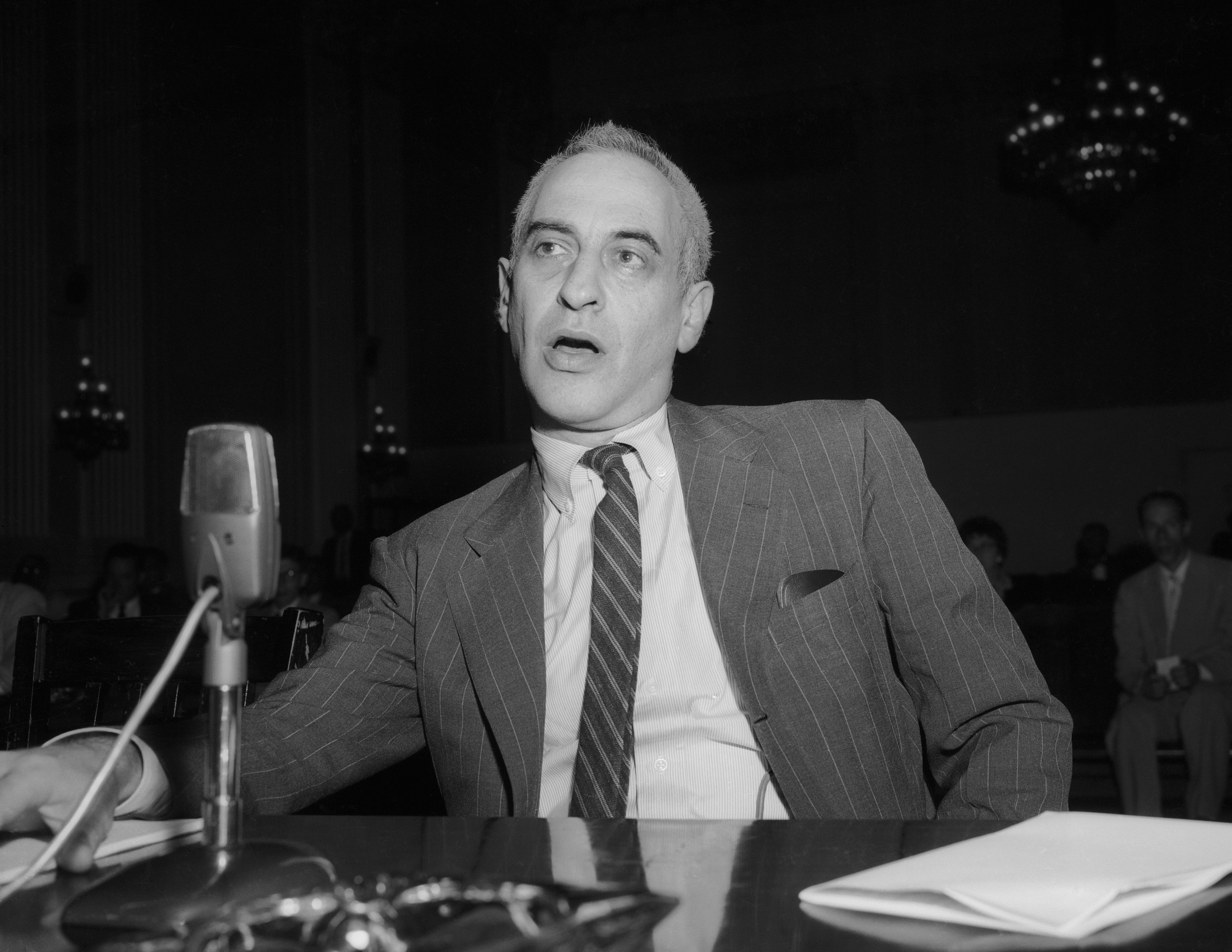
The Man Who Invented Conservatism
The Unlikely Life of Frank S. Meyer
by Daniel J. Flynn
Encounter, 544 pp., $41.99 (hardcover)
FRANK MEYER DESERVED A COMPREHENSIVE BIOGRAPHY, but I thought it would be impossible to write one about him.1 For historians of American conservatism, Meyer is often a stand-in figure. He represents a libertarian-leaning conservative mainstream against Burkean, traditionalist, or other alternatives. In clunky prose, Meyer laid out conservative dogma from his perch at National Review as well as in a handful of books or edited collections. For someone writing intellectual history, if Meyer hadn’t existed, it would almost be necessary to invent him.
Every other conservative luminary has a dedicated biography telling their life story. Sometimes two or three. So why not Meyer? There just wasn’t the right material. As a young graduate student, I trekked out to Palo Alto in the summer of 2016. The Hoover Institution’s archives contained the papers of a number of major conservative figures, and I was performing research that would become the basis of my doctoral dissertation. Such archival work is all-important for biographers and historians: Private notes and correspondence can really bring historical figures to life. I requested Meyer’s papers, and, much to my dismay, there was very little worthwhile: Instead of the letters and notebooks I had hoped to find, there was just Meyer’s research collection with some occasional marginalia. “He must have burned his papers,” I thought. These things happen, but what a shame. I moved on to other sources.
To his immense credit, Daniel J. Flynn, a senior editor at the American Spectator, refused to accept this dead end. He performed an archival miracle and found fifteen unprocessed boxes of Meyer’s correspondence languishing in a warehouse. Out of this incredible trove, Flynn has produced the first biography to tackle the totality of this critical figure in the history of intellectual conservatism.
BORN IN NEW JERSEY IN 1909, Frank Straus Meyer studied at Princeton then Balliol College at Oxford University. He became a youthful Communist and dedicated his life to the party. Upon returning to the United States, Meyer worked for the party, teaching classes about communism. One of his students, a young married woman named Elsie, fell in love with him; in 1940, she divorced her husband of five years and a week later married Meyer. By the mid-1940s he broke with the party. In part because he feared reprisals, he remade his life—and his family’s life—by adopting nocturnal habits. As he moved to the right intellectually, Meyer began to write for conservative magazines, becoming a senior editor at National Review, where he long edited the books and arts section. He waged intellectual battles left and right, and was especially associated with conservative “fusionism.” A lifelong chain-smoker, he died of lung cancer, aged 62, in 1972.
That’s the capsule biography of Meyer that will be more or less familiar to anyone who has encountered him before.
Flynn deepens the story dramatically. He’s especially strong on Meyer’s youth and young adulthood. I had no idea, for instance, that Meyer came from relative wealth and enjoyed a privileged wastrel youth. The Meyer that emerges is a libidinous gadabout and skeptic. He experienced antisemitism while entering Princeton. While there, his skepticism toward authority led him to poetically explore Milton’s Satan. “What is this but an exposition of some of the noblest qualities known to man?” the young man wrote of Paradise Lost’s sympathetic villain. “Frank did not merely disbelieve in God. He despised God,” writes Flynn. After leaving Princeton, it took time and expensively purchased tutoring for Meyer to gain entrance to Balliol, where he gave himself over to the Communist Party. Flynn gives us a lively portrait of the professional activist barely maintaining his studies (or not at all). He draws on an impressive range of transnational sources, including declassified MI5 reports on Meyer, to illuminate both Meyer’s personal life in the 1930s as well as the British Communist Party.
With mountains of detail, Flynn traces Meyer’s role back stateside in the Communist Party USA. While he had been something of a radical firebrand in Britain, back home, Meyer found himself becoming more American. In the intra-Communist disputes, Meyer aligned with the faction of Earl Browder, chairman of the CPUSA, who sought to Americanize the party. Most intriguingly, Flynn suggests that Meyer, who later equated his vision of conservatism with the American political tradition, first developed this strategy while finding communism deep in American institutions. “‘A people’s America and a socialist America must be presented all the time—not simply as an occasional article or on the 4th of July—as a natural, integral outgrowth of our whole past history, and presented in terms of our tradition,’ he wrote.” Meyer “wanted a fusion between Communism and the American Founding. He attempted to force Marxism upon the American tradition.” But
this fanatic had grown wiser and more prudent since he had written those articles. He was no longer the hyperventilating, Marx-quoting nutter described in Oxford student newspapers. An honest inquiry into whether actual history meshed with this desire could not help but show that the two clashed.
Meyer broke with the Communist Party over the course of the 1940s. He, his beloved Elsie, and their two sons, John and Eugene, lived a life of bohemian intellectuals on family money. Gradually, Meyer began to think of himself as a libertarian and to find work for right-wing magazines. I hadn’t realized the relative paucity of Meyer’s above-ground intellectual record before the 1950s: He had a lifelong tendency to begin but not complete projects.
Eventually Meyer landed at National Review, where he edited the Books, Arts, and Manners section. Really, though, he just commissioned the reviews, Flynn reveals, and Elsie Meyer did the editing. From this perch, Flynn argues, Meyer built a startlingly impressive “back of the book”—an argument made with less insistence and more nuance elsewhere.
More importantly, Flynn posits Meyer as the “man who invented conservatism”—at least as we know it, the Reaganite “fusion” of tradition, liberty, and strident anti-communism. In the 1950s, the nascent conservative movement was made up primarily of anti-modern traditionalists and anti-statist libertarians (and some ultra-hawks who thought liberal anti-communism was a contradiction in terms). Despite the considerable gulfs in their worldviews, libertarians and traditionalists were united by opposition to the New Deal welfare state. “Fusionism”—a term Meyer never really liked—posited that libertarianism and traditionalism were complementary, actually. Meyer argued that the traditionalist branch of conservatism and the libertarian one had once been a unified, Western tradition that had split sometime in the nineteenth century.
It’s certainly true that Meyer was a leader in the intraconservative process of defining conservatism as a philosophical exercise, especially in essays and columns in National Review and Modern Age. But the idea that traditionalism and libertarianism were complementary had already become the working assumption of conservative activists outside the circle of ideas-first scribblers. Meyer actively participated in all of this, but he wasn’t alone, and in some ways his thinking followed the times. His most important contribution to fusionism, the essay “Freedom, Tradition, and Conservatism,” appeared smack between two other fusionist building blocks, Barry Goldwater’s The Conscience of a Conservative and the “Sharon Statement” from the Young Americans for Freedom.
But Flynn, as a true-blue conservative himself, uncritically accepts the conventional narrative that conservative intellectuals have told themselves—that fusionism, or, really, conservatism, is a coherent philosophy. He doesn’t grapple with the messier reality that Meyer’s fusionism simply doesn’t have the depth or sophistication to truly stand as a political philosophy. Indeed, Meyer himself worried conservatives had “constructed a demonology to contemplate rather than an avant garde to move forward, theorize, and explore.” Flynn insists Meyer’s 1962 book In Defense of Freedom became a conservative classic despite its meager sales record—a theoretical equivalent of the Velvet Underground. But Flynn offers no evidence for this, and you would be hard pressed to find conservative intellectuals of any generation who considered the book a major influence. Meyer’s columns and essays were important to the debates of the early 1960s, but In Defense of Freedom simply was not. If “the man who invented conservatism” refers to fusionist conservatism, then Flynn overstates the case.
At the same time, Flynn’s centering of Meyer in the history of the conservative movement is convincing in another way. From his home in rural Woodstock, New York, Meyer participated in a bevy of conservative counter-institutions—from the Conservative Party of New York to the American Conservative Union to the Philadelphia Society. Ex-Communists, Frank and Elsie Meyer saw the molding of conservatives as one of their critical functions. They imbued their charges with a sense of discipline, mission, and apocalypticism. Many of the young people shaped by Meyer manned the key institutions of the American Right—none more so than his son Eugene Meyer, cofounder of the Federalist Society. How the bohemian intellectuals that constituted the wider National Review circle begat a strident political movement is a fascinating puzzle to which Flynn has contributed.
FLYNN IS A FRUSTRATING WRITER. At times, his desire to withhold the identity of a character for the sake of drama ends up confusing the plot. Other times, his exposition of an event is so convoluted I could only follow it if I already knew the contours of the story, such as during some internal National Review fights over Barry Goldwater. Flynn also comes across as overly impressed by the cleverness of his own turns of phrase; he seems never to have written a bon mot he didn’t want to shoehorn into the text. Within two pages, Flynn writes: “The daughter’s preoccupations had little to do with her father’s occupation” and “The Show Me State student showed little and guarded much” and “Not for the first time through a movement did a misfit fit in.” Later, Flynn jokes about Communists that “Party people were not party people.” Thanks, Dad. The rate of these quips is genuinely distracting.
There’s a larger quandary here, too—a problem shared by other biographies of conservative icons written by partisan conservatives. It is a problem of critical distance. I don’t mean to impugn Flynn’s research: It’s exhaustive and genuinely impressive. I learned a lot about Meyer’s life, including about some of his contributions to conservatism I wasn’t aware of. Indeed, Flynn describes a moment where one conservative luminary—Willmoore Kendall—complained about Meyer in a letter while both were at Oxford. Neither Kendall nor Meyer seems to have recalled that interaction decades later when they became close at National Review. But Flynn did.
However, I question the balance of the biography. Nearly 60 percent of the book is dedicated to exhaustingly analyzing Meyer’s activities in the conservative movement. As another National Review editor wrote when providing feedback on a James Burnham biography in the works, “I think some cutting would be in order. The reader does not have to hear Jim’s analysis of absolutely everything.” The same is true here. Flynn seemingly spells out every last twist and turn behind the scenes at National Review. For those who thought Sam Tanenhaus skimped on NR lore in his new biography of William F. Buckley, this is the book for them. Otherwise, the minutiae simply overwhelm.
Flynn is almost duty-bound to provide as much detail as he can: He is a conservative writing a book about a conservative icon under contract to a conservative press. Perhaps it’s what his audience wants. It warps the book, though. One wonders whether there might have been more to say about Meyer’s extraordinary engagement with both the British and American Communist Parties, whether it shaped their longer-term trajectories, and what it says about the attraction of the party in the 1930s. But one also wonders whether Flynn, who tendentiously labels “Soviet Socialists” and “National Socialists” as “ideological cousins,” has the patience or sophistication to handle Meyer’s pre-conservative life adroitly.
Likewise, when conservatives write about icons of the movement, they face the temptation toward hagiography. The Man Who Invented Conservatism is hardly the worst offender in this regard (ahem), but Flynn’s instinct is to defend Meyer. For instance, he normalizes Meyer’s extreme views, including his equation of the New Deal welfare state with totalitarianism, that represent some of his major contributions to conservatism.
In this vein, Flynn struggles with the racist subtext of some of Meyer’s work, especially in the mid-to-late 1960s. Contrast this with the portrait of late-in-life Meyer found in Garry Wills’s autobiographical Confessions of a Conservative (1979). Wills describes how “Elsie could no longer argue and laugh” with the aging and dying Meyer to get him “out of his antiblack outbursts.” Flynn is obviously aware of the allegations on this front. He insists “Meyer’s critique of the civil rights movement did not stem from racial animus; evidence of such an inclination is absent from his tens of thousands of extant letters.” It may be true that Meyer doesn’t stoop to naked racism in his private correspondence, but it’s impossible to disentangle Meyer’s catastrophist thinking on civil rights from race. This is a man who looked at Freedom Summer in 1963 and saw the threat of “revolutionary attack” on the American system of government. Meyer even acknowledged that compared to other conservatives he “may be seeing developments more luridly dramatic than we will have to face.”
Flynn does show how, in response to black and student radicalism, Meyer’s libertarianism gave way toward greater emphasis on order in the 1960s. But what Flynn can’t confront is that Meyer’s racial assumptions contributed to this hardening. For instance, Meyer told an audience at the Philadelphia Society that conservatives had to reckon with the “basic problems involved in a people”—blacks—“who have never produced a civilization” making up 10 percent of the United States’ population. Conservatives need to “stop being afraid to consider reality,” he intoned. What he called the “Negro-genetic Question” fascinated Meyer enough for him to collect research and clippings on it before his death, including material by controversial scientists like Arthur Jensen and the racist writers Henry Garrett and Carleton Putnam. On race and intelligence, Meyer no doubt borrowed from his friend and neighbor, Nathaniel Weyl—another Communist-turned-conservative, but also a scientific racist from whom Meyer commissioned articles, including on questions of race, until his death. I can’t shake the feeling that if there were other unsavory aspects in Meyer’s thought or life following his conservative conversion, Flynn mightn’t be the one to surface it, or even think to.
It would be insufficient to write off Meyer as a racist and move on. But perhaps a biography written by a non-conservative, or at least an author with more disinterested detachment, would have engaged with the interplay of Meyer’s political thought and racially charged assumptions rather than simply assert that he “approached the civil rights movement from a dispassionate, constitutional perspective that moved further from fashion as time passed.”
The Man Who Invented Conservatism is a fascinating portrait of a striking figure, but one that also exposes the limits of conservative auto-biography.
Correction (August 26, 2025, 11:00 p.m. EDT): As originally published, this review described Daniel Flynn’s book as the first published biography of Frank Meyer. In fact, the first biography of Meyer was Principles and Heresies: Frank S. Meyer and the Shaping of the American Conservative Movement by Kevin J. Smant (ISI Books, 2002). Focused on Meyer’s ideas and activities as a conservative intellectual, it lacks the scope and archival basis of Flynn’s cradle-to-grave biography. A handful of sentences in this review have been modified to remove the claim about Flynn’s priority.
 | A guest post by
|