How the Military Celebrates Thanksgiving
Across the world, members of our armed forces come together, share a meal, and remember that they are not alone.

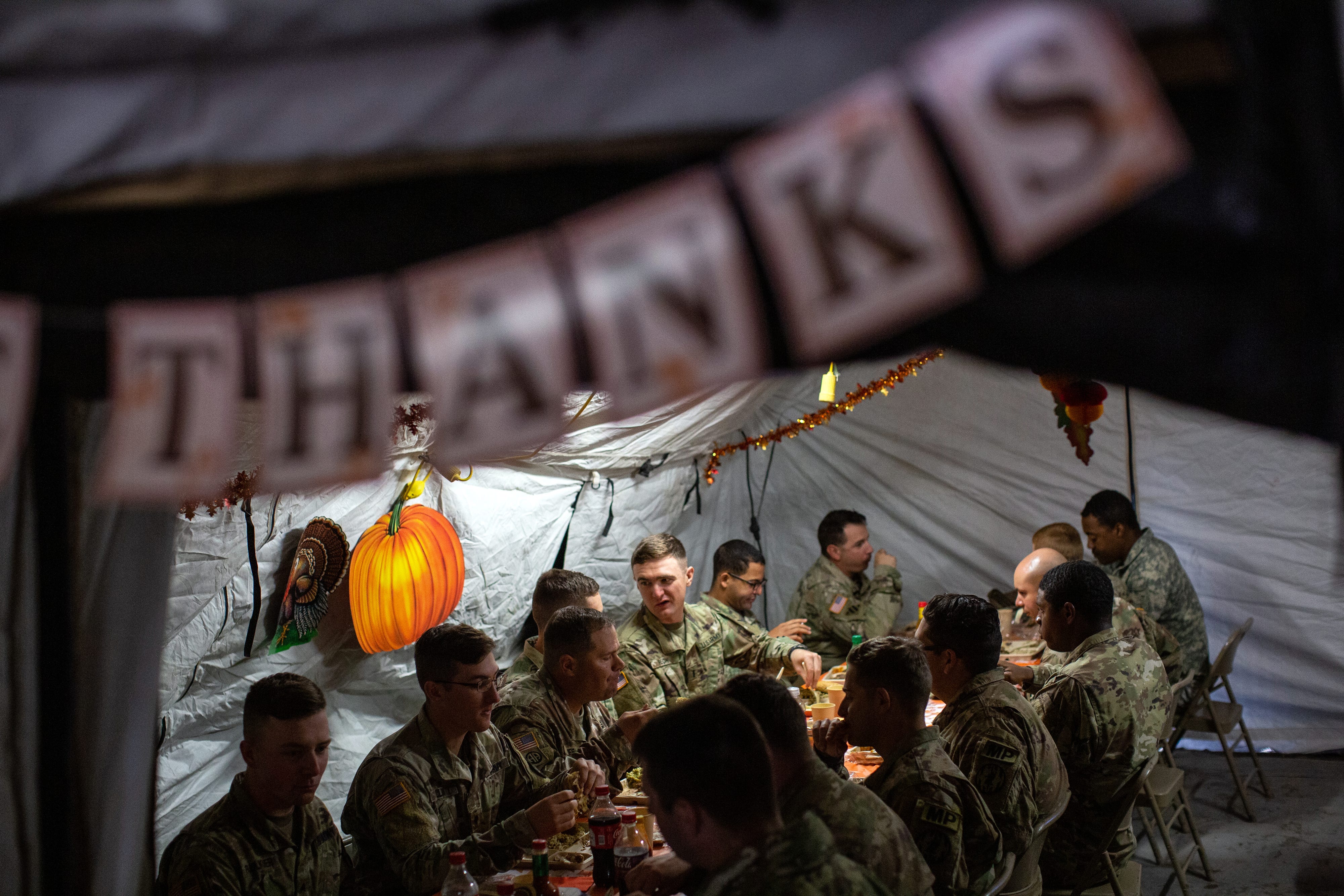
ONE OF MY BULWARK COLLEAGUES recently asked me a simple question: How do soldiers spend Thanksgiving? I’m glad she asked.
Imagine a crisp November morning on a U.S. Army post, anywhere in the world. Before dawn, military and civilian cooks—whom we affectionately call “spoons”—have already been at work for hours, making final preparations for a throng of diners coming to what are officially called dining facilities, what the troops call “DFACs,” or what old soldiers know as mess halls. Their labors are really the culmination of days or even weeks of planning and work on the special Thanksgiving meal: turkeys thawed and seasoned; ovens calibrated and humming; decorations arranged; amateur ice sculptures with unit patches or logos emerging from the hands of proud amateurs who do this only a few times each year. On this day, the mess—usually a place for quick meals between duties—transforms into a warm, welcoming restaurant, an American holiday table built far from home.
By midday, soldiers and families begin to arrive. Children are dressed a bit nicer than usual. Spouses greet their unit friends and neighbors with hugs. Retirees who are former members of the unit drop in as honored guests. Officers and senior NCOs, wearing their fancy Army dress blue uniforms, eventually take their place behind the serving line—carving turkey, ladling gravy, and offering jokes and smiles to soldiers and their families who file through. For a service culture that cares deeply about symbols and rituals, this one is very special: Leaders serve the led.

In a peacetime garrison environment, the mission is clear: Bring a taste of home, acknowledge service, and reinforce community. The cooks—soldiers trained in the military occupation called “food service specialists”—stand ready in chef’s whites, quietly proud. Their message to their fellow soldiers and their families is unspoken: We did this for you. You matter. You are seen. Even if you couldn’t be at your grandmother’s table, you are at a table where you belong.
Those scenes became, for me, my wife, our children, and countless others, some of the most meaningful days of our service—moments of connection, leadership, and gratitude. Thanksgiving in uniform is one of the traditions I miss most in retirement.
Military duties don’t stop for the holidays, but service members still celebrate. Thanksgiving will find some units deployed in combat, some in the field training, others in remote outposts that are dusty, cold, dangerous, or little more than sandbagged shelters. Airmen are on alert stations, Marines are guarding embassies, sailors are well into a deployment at sea. With all the duties, the decorations might be meager, the tables improvised, but the tradition still happens, and its meaning is usually deeper.
During one deployment in northern Iraq in 2008, my battle buddy—Division Command Sergeant Major Roger Blackwood—and I committed to visiting for Thanksgiving twenty-seven forward operating bases, combat outposts, and remote nodes across four provinces spread across an area the size of Pennsylvania in two days. At every stop, we unloaded our personal “care packages”: cases of near-beer and cartons of Twinkies that would supplement the meals that came in marmite cans to forward bases, and these small touches added meaning far more than they should have. Landing on windswept Mount Sinjar, where a handful of young Marines manned a remote communications outpost—and that small team of unsung professionals kept our thirty-thousand-person task force connected—were surprised when we landed. They laughed, accepted the treats, and welcomed us into their small gathering. Their turkey had arrived in ration cans; their décor consisted of sandbags. But the message we hoped to bring was clear: We remember you. You matter. You’re part of this family, too.
Behind the Scenes of a Military Thanksgiving

Lt. Gen. Mark Hertling (Ret.) joins Bill Kristol to reflect on what Thanksgiving means for the military, sharing his favorite stories from years of service, including the traditions, the meals, and the special efforts to bring a taste of home to troops and military families.
THERE ARE ALSO MOMENTS in the military Thanksgiving story that became part of national memory.
One came in 2003 when I was serving with the 1st Armored Division in Iraq. President George W. Bush made an unannounced Thanksgiving visit to Baghdad that year that only a handful of people knew about. Air Force One flew in without lights. The secrecy was tight because the risk was real. The moment he walked into a massive dining facility, packed wall-to-wall with hundreds of stunned American troops who had no idea he was coming, the room erupted. For hours he stayed—serving turkey, shaking hands, posing for photos, later talking strategy with just the commanders. He wore an Army PT jacket with a 1st Armored Division patch sewn on the front, a simple gesture that spoke volumes to the troops who were wearing that same patch in combat.

He must have understood how meaningful it was. That jacket—and the photos of him sneaking into Baghdad, surprising the troops, and standing behind a serving line—is now a centerpiece display in his presidential library. For those of us who were there, both the memory and the lesson endures: leadership sometimes means simply showing up when it matters most.
Across American military history, Thanksgiving has always mattered. In World War II, logistics officers moved mountains to get turkey and cranberry sauce to units scattered across Europe and the Pacific. In the Aleutians in 1943, airmen lined up in the freezing wind for a holiday meal. In Vietnam, Special Forces teams on remote hilltops shared turkey flown in by helicopter between mortar attacks.

And every service continues the tradition. Navy ships underway receive holiday supplies months before they set sail. Marines at expeditionary bases gather for their own feasts, no matter how bare the surroundings. Coast Guard crews pause their patrols on the open ocean to share a meal. The Air Force, and even the Space Force—young as it is—embrace the ritual. Wherever Americans serve, the message is the same: You are remembered; you are valued; you are not alone.
Military service often means long hours, unfamiliar places, and the emotional strain of being far from home. Holidays sharpen that ache. That’s why Thanksgiving in uniform—whether in a beautifully decorated mess hall in Texas or a dusty outpost somewhere in the Middle East—becomes more than a meal. It is an act of leadership and community. It’s a reminder that our oath binds us not just to the Constitution, but to each other.
In this time when civil–military relations are increasingly strained—when political leaders sometimes use the military as a prop, or question its loyalty, or undermine the nonpartisan ethic that has sustained trust for generations—these Thanksgiving rituals offer a counterpoint. Soldiers piling into mess halls aren’t red or blue. They are Americans who have sworn an oath and who are often asked to spend holidays far from home to uphold it.
THIS YEAR, Thanksgiving in our family’s civilian home will be a smaller and quieter affair. And as much as I look forward to that, and the leftover turkey sandwiches that we never had after going to the mess hall, I’ll miss those crazy days of jumping from dining facility to dining facility, slapping backs, greeting families, teasing the kids sprinting through the serving line, and feeling the warmth of being surrounded by soldiers and the people who love them.
Commanders around the globe, of large and small teams, will share this Thanksgiving experience with their teams. I know what their day will be like: moving from dining facility to dining facility, complimenting cooks, shaking hands, thanking spouses, making sure every member of the team feels seen. I also know how they will feel at the end of the day, as my wife and I remember those nights well: collapsing into a chair in their quarters or deployment hooch with that quiet, satisfied exhaustion familiar to anyone who has ever led soldiers—grateful for the day, grateful for those he or she serves alongside, grateful for the privilege of service itself.
It is one of the purest forms of giving thanks, and one of the greatest kinds of joy.
My wife often says that every American should experience a military deployment sendoff, a welcome-home ceremony for units, and a memorial service for a young soldier who has made the ultimate sacrifice. Each of those moments—life-defining moments for the service members and their families—point to selfless service and doing the difficult things the military is asked to do. But she also leaned over to me at one of our Thanksgiving meals at a large dining facility when I was brigade commander in Washington state and said she also wished every American could experience that event, too.
In this fractured time, I would agree. Because at these meals, we always saw unity, camaraderie, and joy. For that reason, we would do well to understand what these humble meals teach. That leadership is service. That community is built by showing up. That gratitude is expressed not only in words but in the labor of preparing a meal, carving a turkey, or flying halfway across a war zone with cartons of Twinkies to join with others who are enduring hardship. In this, the profession of arms, our nation’s military—despite all the challenges—remains bound together by trust, humility, and shared purpose.
Somewhere this holiday, a young lieutenant will carve turkey for her platoon. A cook will stand behind a serving line watching his officers dish out the meal he proudly prepared. A commander will take a quiet breath, look around a crowded dining facility, and feel grateful for the people he or she serves. Because that is their family at Thanksgiving.
And that, more than the turkey or the trimmings, is what the military gives thanks for every year.