

Hungary Proved That Liberalism Can Win
Péter Magyar ran against authoritarianism, not the price of eggs.

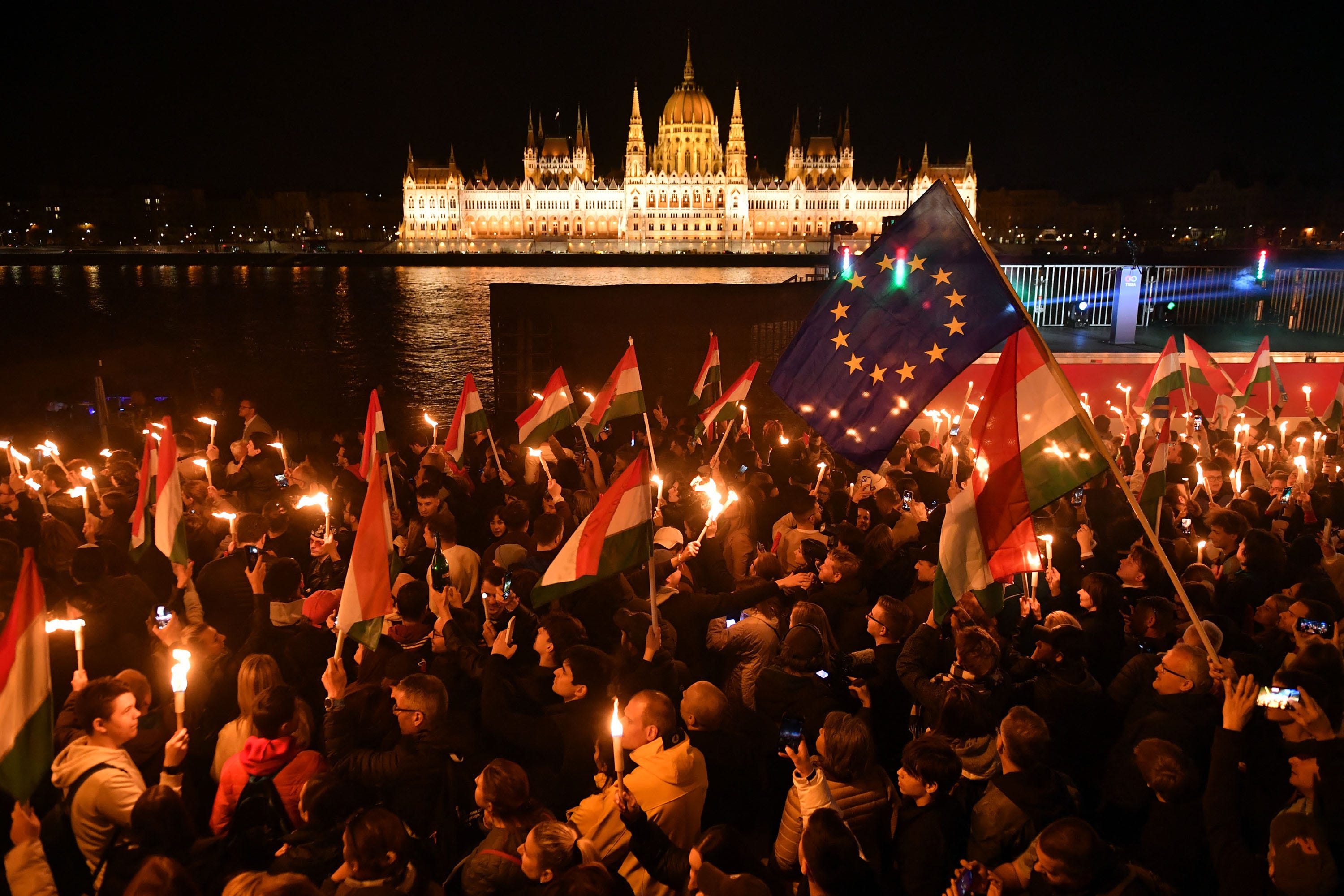
WHILE HUNGARIAN PRIME MINISTER Viktor Orbán’s defeat was a critical victory for NATO and the EU, it was an even more important victory for liberalism—one the opponents of populist authoritarianism in the United States and around the world should be studying closely. Orbán explicitly described his political project in Hungary as “illiberal democracy.” Fidesz has spent years consolidating power through control of the media, the use of state resources to harass and investigate the political opposition, and rampant gerrymandering. The Orwellian-sounding Sovereignty Defense Office, established in 2024, regularly targeted journalists and anti-corruption NGOs with investigations, police raids, and other forms of intimidation. Freedom House explains that the Sovereignty Defense Office has “extensive, vaguely defined powers to investigate and report on any activity suspected of serving foreign interests.”
A central component of Orbán’s illiberal democracy was a sustained assault on the rule of law. Fidesz used its supermajority in 2010 to draft an entirely new constitution with no input from opposition parties or the public. It expanded the Constitutional Court from eleven to fifteen members, allowing Fidesz to appoint four new judges. Fidesz also changed the nomination process, giving the party direct control over which judges could be considered. The new constitution enabled the ruling party to select the chief judge—a task once handled by the court itself. The retirement age for judges was slashed from 70 to 62, allowing Fidesz to replace much of the judiciary all at once. The National Judicial Office was created to give Fidesz the power to appoint, promote, and fire judges, as well as the ability to transfer cases to different courts (which could secure more sympathetic rulings in cases that impact the party’s interests).
After sixteen years of manipulating the judiciary, suppressing political dissent, harassing civil society, and using the power of the state to enable corruption on an industrial scale, Orbán’s defenders now say his electoral defeat absolves him of any accusation of authoritarianism. Because Orbán lost, “we have to conclude as a matter of intellectual honesty that he was something less than an autocrat,” writes Mike Pesca in the Free Press. Rod Dreher—an American expatriate writer at the Danube Institute, which is funded by Orbán’s government—demanded to know: “How many semi-fascist autocrats offer gracious concession speeches after losing an election, as Orban did?” Instead of engaging with any of the specific arguments about how Orbán consolidated power and persecuted political enemies, his defenders can say: See? He isn’t Hitler, so he must be a freedom-loving democrat. The ease with which they can make this pivot is a glimpse of the strategies that will be deployed by Donald Trump’s defenders if the Republicans suffer a significant defeat in the midterm elections or if he finally leaves office in 2029.
Even Orbán’s defenders are forced to admit that corruption was endemic in Hungary under his illiberal rule. “Orban’s Fidesz has permitted far too much cronyism,” Dreher acknowledges, “and the creation of an oligarch class.” Orbán was “by any reasonable accounting, corrupt,” notes Pesca. The New York Times’s Ross Douthat argues that the claims about Orbán’s authoritarianism were exaggerated, but he observes that “Orbanism ended . . . in corruption and defeat.” Each of these Fidesz apologists assumed implicitly that Orbán’s corruption is separable from his authoritarianism, but the two features of his system are deeply entwined.
According to Transparency International, corruption steadily worsened after Orbán took office. The 2025 Corruption Perceptions Index ranked Hungary below Cuba, South Africa, and Côte d’Ivoire. Fidesz used the public procurement process to funnel huge sums of money to friends of the regime. Many of these funds came straight from Brussels—Hungary was the largest recipient of financial aid from the EU, and a handful of businessmen close to Orbán received a huge share of EU-funded contracts. This led the EU to freeze a total of €18 billion in direct support, which Magyar is now working to restore.
The EU stated that the misallocation of funds was “indicative of breaches of the principles of the rule of law.” This is how Orbánism comes full circle—first, Orbán’s friends and cronies receive huge government and EU-funded contracts through rigged procurement processes. When these processes face legal challenges, Fidesz-friendly judges—which the entire judicial system is crammed with, a problem Magyar will have to navigate—are more likely to rule in favor of the government. Finally, Orbán’s corruption drove his assault on civil society. Freedom House reports that government officials “harassed anticorruption organizations and investigative media with frivolous and arbitrary investigations.” The government also intimidated critics with “smear campaigns by progovernment media outlets” and politicized audits.
Corruption wasn’t a side-effect of Orbánism; it was the engine that drove it and gave it power outside the state and over the state.
MAGYAR CHALLENGED ORBÁN’S CENTRAL conceit that his illiberal democracy was preferable to the liberal democratic alternatives. While Fidesz attempted to present Magyar as a traitor more loyal to Brussels and Kyiv than Hungary—billboards urging Hungarians to vote for Fidesz read, “Don’t let Zelenskyy have the last laugh”—he focused on Orbán’s corruption and economic failures. Unlike previous opposition candidates, his campaign extended to the countryside, where he would visit up to eight villages in a single day. The countryside was once dominated by Fidesz, as Orbán’s gerrymandering ensured that districts with fewer votes, which were more likely to vote for him, received disproportional representation. But Magyar managed to flip many of these districts for his Tisza Party, which now enjoys the benefits of over-representation.
Voters overwhelmingly supported Magyar’s anti-corruption message—Tisza won 53 percent of the popular vote, beating Fidesz by almost 15 points—and the end result was a wipeout for Fidesz and Orbánism: Tisza won 141 out of 199 seats in the National Assembly, giving the party a supermajority (compared to a meager 52 seats for Fidesz). This means Tisza will have the votes to undo Orbán’s constitutional overhaul and deliver on his anti-corruption agenda. Magyar isn’t wasting any time. Days after the election, he announced: “We are receiving increasing reports of large-scale document destruction from various ministries, affiliated institutions, and companies close to Fidesz.” He has emphasized accountability: “To the Fidesz leaders, I say this: No matter how much you pretend that nothing has happened, we know what you have done to our homeland and to the Hungarian people.”
Make no mistake: The defeat of Orbán is a major victory for liberalism—and not just in Hungary. “On April 12,” Magyar declared after a meeting with the leaders of the European Commission, “the Hungarian people made a clear and decisive choice: Hungary’s place is in Europe.” Despite Orbán’s endless fearmongering about globalist tyranny, Hungarians were tired of watching his cronies get rich while €18 billion in EU support remained frozen. Orbán’s defeat is an example of EU economic pressure working exactly as intended—Brussels was able to use financial leverage to generate organic political resistance to a corrupt authoritarian. In the fevered imaginations of anti-EU populists, this is an intolerable assault on national sovereignty. But the reality is that Hungarian voters simply preferred to support a prime minister who won’t constantly pick pointless, costly fights with Europe.
These voters were sick of Orbán’s economic failures, too. Hungary’s GDP growth has been stagnant in recent years, while inflation has increased at almost twice the EU average (peaking at over 17 percent).
But the election was about more than the economy—Magyar’s focus on corruption and European integration made his political movement a push for a stronger commitment to liberal values in Hungary. A record 78 percent of Hungarian voters turned out to achieve this result—much higher turnout than in the United States.
AMERICAN LIBERALS HAVE A LOT TO LEARN from the Hungarians who overturned an authoritarian system that was entrenched in their society for the better part of two decades. They should focus on Trump’s corruption in the context of his gross economic incompetence. They should refuse to let Trump systematically destroy the liberal international order maintained by every postwar president. They should do whatever it takes to win elections in places they’ve been losing for the past several years. But most of all, they must recognize the power of building a political movement around a commitment to fundamental liberal principles—which means recovering the radical and inspiring political vision of liberalism.
Today, liberalism is often unjustly presented as a neutral set of technocratic procedures designed to defend a dysfunctional status quo. Even liberals themselves struggle to defend liberalism. Ezra Klein recently lamented the state of liberalism in the United States. He wondered why liberalism “feels so exhausted and uninspiring” and concluded: “I think liberalism has settled into: Our institutions suck, but you should defend them anyway. It sucks.” Liberals constantly fret about being perceived as too committed to the “status quo”—which is a weirdly deflating way to describe core institutions and practices of American democracy. After Trump’s victory in 2024, many liberals convinced themselves that it was necessary to focus on “kitchen table issues” like the price of eggs instead of authoritarianism.
That, to borrow one of Barack Obama’s favorite phrases, is a false choice. Democrats should be making the case that the health of American democracy is a kitchen table issue. Americans are aware of Trump’s concerted effort to overthrow the results of the 2020 election, which he lost decisively. They witnessed the assault on the Capitol on January 6th. They watched as Trump and his defenders rewrote history, presenting insurrectionists who assaulted police officers and smeared shit on the walls of the Capitol as peace-loving patriots. They can see Trump’s corruption in his self-enrichment, his doggedness in pursuing inflation-causing tariffs, his treatment of the Jeffrey Epstein scandal, and his complete indifference to the real consequences his disastrous war in Iran has for Americans’ lives.
It’s insulting to suggest that Americans are indifferent to the spectacle of a sitting president laying siege to their democracy—especially when the evidence of Americans’ awareness and alarm is greater than ever. In 2024, many voters cited democracy as a major issue—not enough, but still a huge number. In the past year and a half, Trump’s second term has galvanized American voters in opposition to his authoritarianism. There’s a reason they’re called “No Kings” rallies, not “No Expensive Eggs” rallies. Trump’s approval ratings are abominable and only getting worse.
LIBERALISM MAY SEEM LIKE A STATUS QUO force in mature democracies like the United States, but it’s actually the most revolutionary political force in human history. It seeks to protect radical ideals like universal human rights, equality, and dignity from the constant encroachments of our more reactionary impulses. The same liberal principles that destroyed the justifications for hereditary rule, slavery, and oppression of all kinds centuries ago militate against corruption and authoritarianism today.
We’re living in an era of illiberalism in the United States. The rule of law is under assault, blood-and-soil nationalism and religious fundamentalism are making comebacks, and core features of American democracy—such as the peaceful transfer of power—have been trampled. But these are the political conditions under which the radical character of liberalism becomes visible once again. To truly appreciate the revolutionary power of liberalism, it may be necessary to glimpse the tyranny it was designed to replace and prevent.
The Trump administration threw its full weight behind Orbán. Trump offered his “complete and total endorsement.” Secretary of State Marco Rubio showed up in Hungary to reiterate that support. Days before the Hungarian election, Vice President JD Vance appeared alongside Orbán at a campaign event and declared that a vote for Fidesz was a vote for “sovereignty,” “democracy,” and “Western civilization.” But Hungarians knew that a vote for Orbán was actually a vote for corruption, authoritarianism, and illiberalism.
Hungarians’ proximity to authoritarianism gives them a perspective on liberal democracy that Americans lack. They had been stuck with Orbán for sixteen long years, during which his corruption became institutionalized and his power became so consolidated that it seemed impossible to dislodge. And then he lost. Hungarians understand the value of liberalism because the most powerful forces in their country have been trying to crush it for over a decade and a half. As Trump’s authoritarianism and corruption become all the more visible, Americans too are rediscovering their commitment to liberalism. Perhaps that will be Trump’s most lasting legacy.
 | A guest post by
|