In Russia, a New Dissident Rises—But What’s His Game?
Why Ilya Remeslo is sus.

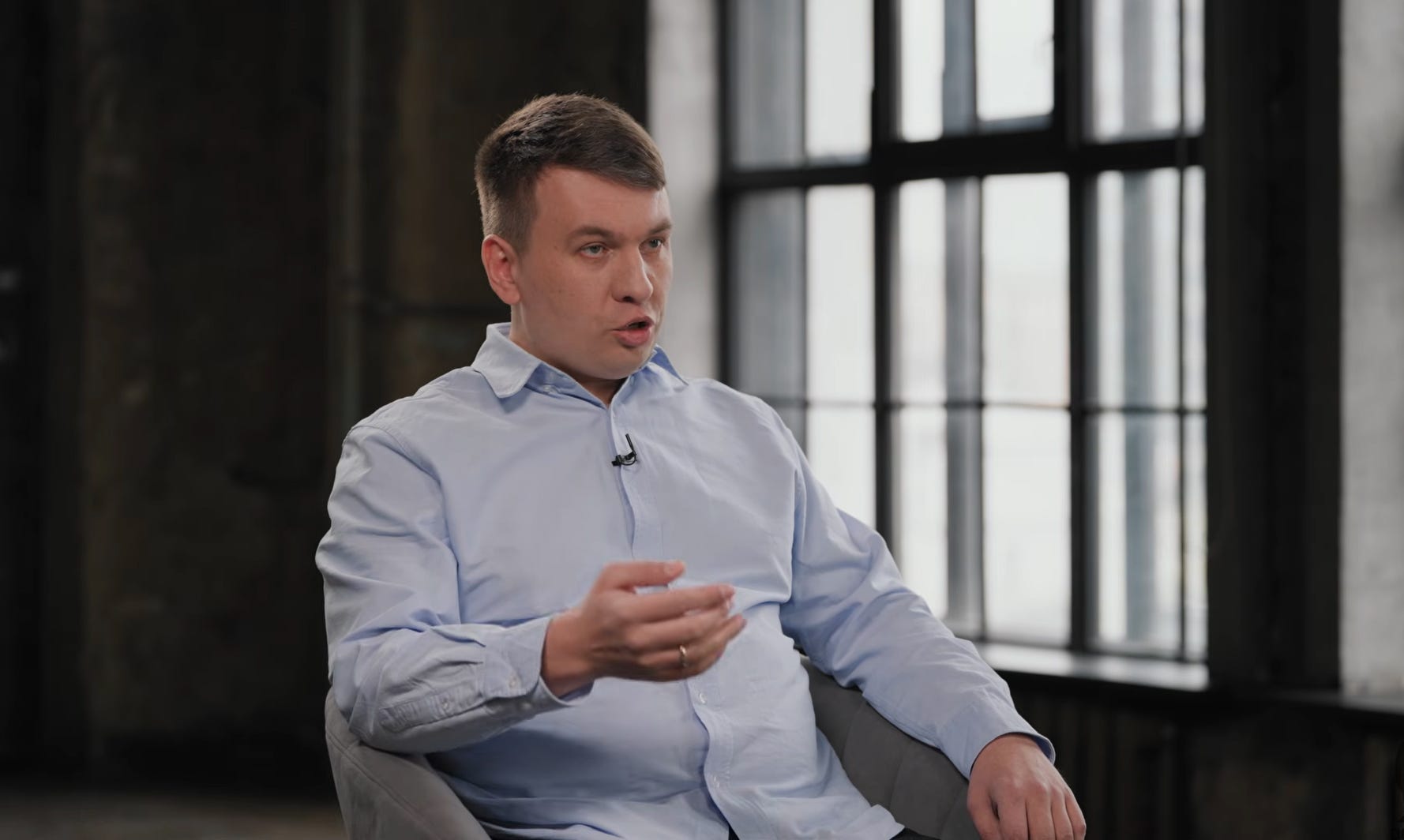
WITH RUSSIA SEEMINGLY HEADED into the summer of its discontent, the rumblings of a possible Kremlin crackup have heartened the mostly exiled opposition. They have also generated drama that could be another sign that things are changing—or could just amount to little more than political soap opera.
Six weeks ago, I wrote about the sudden mutiny of lawyer/blogger Ilya Remeslo, a man who had been staunchly pro-Putin and pro-war—not just a regime supporter but a propagandist and henchman who had denounced liberal media and harassed opposition activists, including Alexei Navalny, with bogus legal complaints. On March 17, Remeslo suddenly posted a diatribe on his Telegram account calling Vladimir Putin a war criminal and an illegitimate president corrupted by absolute power. It was such a shock, some people thought he’d been hacked.
After Remeslo continued his broadsides against the regime in a couple of interviews to dissident media, the news came that he was in a psychiatric hospital. Speculation abounded: Was this Soviet-style punitive psychiatry or a clever ploy? Would Remeslo come out chastened and blame his outbursts on a mental breakdown? Had he arranged his own hospitalization to escape arrest? Was the whole thing a Kremlin-staged distraction?
And now, act two: After a month in the mental hospital, Remeslo came out apparently unscathed—he says he was treated with lithium and given a diagnosis that does not affect his legal competency—and completely unrepentant. A few days after his discharge, in a scandalous two-hour interview to controversial Russian media figure Ksenia Sobchak, he declared that he was “planning to continue what he started on March 17.” He also said that his objective was to become “a leader of the opposition” (or maybe even the leader) and help facilitate a coming “transfer of power.” As in: Putin must go.
“Everyone,” Remeslo asserted, was sick of Putin and of the war—even high-level siloviki or “power agents,” i.e., security and military officials. Never mind “good tsar, bad boyars”: Remeslo insisted that Putin alone, not bad ministers or other top officials, was to blame for Russia’s economic woes and international ostracism. He even argued that it was important to fight not only Putin but “Putinism” as an ideology.
But Remeslo’s most intriguing replies were to Sobchak’s repeated and baffled questions about the motive behind his self-reinvention as a dissident—a move absolutely nothing in his earlier career would seem to anticipate. (“It’s all very strange,” Sobchak reasonably pointed out.) Remeslo’s reply:
You simply don’t know certain things, just like other people who are trying to figure me out or look for some conspiracy. In fact, everything is a lot simpler. I’m a man who knows how to fight Vladimir Putin, who knows what the system’s weakest links are, how to interact with it, how people can be coaxed away from it. Incidentally, I am using this interview to speak to those within this system who are still trying to decide whether to get out of it or not. Guys, don’t be afraid, we are definitely going to win, and no one is going to do anything to you. . . . You see, at some point, after certain events happen, you and other people will understand why I did this and what the end goal of my actions was.
When Sobchak pushed for a hint, Remeslo replied with a startling prediction: There would be “a breakup of the old system and the birth of a new one” this or next year. A revolution? No, more like a “palace coup”: “Something very quiet. You know, like in 1953. We’ll wake up in a different country.” What happened in 1953? Oh, yeah, the death of Stalin.
A lot of Remeslo’s claims were obvious self-serving bullshit: For instance, he explained with a straight face that his praise for Putin as recently as last year was simply “meta-irony.” But never mind Remeslo’s morality. What’s really going on?
The interviewer’s identity gives this drama an added element of both soap opera and thriller. Sobchak, a onetime reality TV star sometimes dubbed the “Russian Paris Hilton,” is not only someone with a scandalous history but someone widely viewed as a faux dissident; after a brief involvement with protest activism in 2012, she found a niche within the system and ran as a Kremlin-approved “liberal opposition” candidate in Russia’s 2018 presidential elections.1 She is also the daughter of Putin’s onetime boss and political mentor, the late Anatoly Sobchak, mayor of St. Petersburg in the early 1990s; not only does she know Putin personally, there’s a longstanding though unconfirmed rumor that he is her godfather—in the traditional sense. (On the same day her interview with Remeslo was released, Sobchak herself gave an interview to expatriate YouTuber Zinaida Pronchenko in which she expressed gratitude to Putin for making it possible for her to live in Russia and stay out of prison.) Today, she is one of Russia’s top influencers, with more than four million YouTube subscribers and a million on Instagram, even if some of those subscribers may now be blocked from accessing her content; her brand is a tame and toothless liberalism that remains careful not to cross certain lines.
To U.S.-based émigré journalist Stanivlav Kucher, the Sobchak-Remeslo interview was an encounter between “two inhabitants of a nasty swamp.” It would be easy to conclude that both of these swamp creatures were playing a Kremlin-orchestrated game: Sobchak, the pretend liberal journalist, interviewing Remeslo, the pretend opposition activist.
THERE’S A COMMON VIEW among Russian dissidents and opposition activists that Remeslo’s “heel-face turn” is simply his latest Kremlin assignment: an attempt to channel popular dissatisfaction in safe directions and build up a fake opposition figure as a distraction to undercut real opposition or protest. Expatriate political analyst Dmitry Oreshkin believes that the truth is “so obvious it doesn’t even need explaining”: Remeslo is a “Kremlin project”—a “dumb, bad, bungled project” at that—and the involvement of Sobchak, Putin’s house liberal, confirms it.
But too many details don’t add up. For one, Sobchak was too doggedly trying to expose Remeslo as a phony: She even suggested that he might be a provocateur with a mission to draw potential dissidents out of the closet and into the sights of Russia’s security services. And too much of what Remeslo said was too seditious to have been cooked up by Kremlin operatives for public consumption. When Remeslo told Sobchak that “there is no lunatic in [Russian special services] who would approve such an operation, with such personal attacks on Vladimir Putin,” it was self-serving—but also probably true. And he has also made disclosures that seem too compromising for the Kremlin regime to be authorized: for instance, that he was paid by administration officials to fabricate a fraud charge against Navalny.
Kucher’s view is that Remeslo is the “project” of a faction within the Kremlin—presumably the same faction that is trying to pull off a soft coup, taking Russia in a more “liberal,” business-friendly, and pro-Western direction. (Prime minister Mikhail Mishustin is often suggested to be the head of this “technocrat” faction; so is Sergei Kirienko.) A part of Remeslo’s message is that there are good people in the upper echelons of the Kremlin, even among the siloviki—and they should be given a chance to run things.
Of course, if you’re actually planning a palace coup, especially against someone as paranoid and vindictive as Putin, the last thing you want is to get a mouthpiece to hint about it in public interviews. And if the liberal faction’s goal is to coax Putin to its side, a mouthpiece who bashes Putin and calls for his removal isn’t going to do the trick, either. Or could it be that, as Russian-born Polish journalist Igor Winiawski speculated on his YouTube show, Putin now exists in such an information bubble that he remains unaware of Remeslo’s mutinous statements or Sobchak’s interview with him? In Russia in 2026, anything is possible. The mystery remains.
BUT WAIT! THE PLOT THICKENS further still. In the latest twist, Remeslo’s attempted redemption arc goes global: He was the main focus of a Wednesday feature in the Washington Post by veteran foreign correspondent Catherine Belton (author of the acclaimed 2020 book Putin’s People). His message is not particularly original: The dissatisfaction is “colossal”; “part of the system is already starting to work against Putin”; there is a “battle for power,” particularly between the FSB and the presidential administration. But it rings differently when coming from Remeslo, a former Kremlin insider who says he still has contacts on the inside, and who is either playing the regime’s game or backed by a powerful faction within it. (Those are apparently the only possible explanations for Remeslo’s release and apparently safe position, as former oil tycoon-turned-dissident Mikhail Khodorokovsky pointed out to Belton.)
A lot of voices from the Russian opposition—particularly Navalny’s Anti-Corruption Foundation, which understandably has not forgiven Remeslo’s role in Navalny’s persecution—are aghast at the Kremlin stooge’s self-reinvention. “This is a man who sold his soul to the devil,” said RAIN-TV host and journalist Ekaterina Kotrikadze. Some dissident journalists think that Remeslo should be ignored because the alternative is to “platform” him. Others think it’s important to expose him and warn the public that he should not be trusted. To dissidents who make this argument against him, Remeslo responds: Would you rather have moral purity or success? If he can use his unique position and experience to effectively resist the regime far more effectively than the opposition has been able to do, is that bad?
Of course, so far there is nothing to indicate that Remeslo can be an effective opposition activist. The real significance of Remeslo’s rebellion, real or fake—as Kotrikadze and many other Russian dissidents agree—is that it’s a sign of the times. And it’s one of many, from a leaked European Union intelligence report claiming that Putin fears a coup headed by former defense minister Sergei Shoigu (a scenario perhaps even less likely than Remeslo as an opposition leader) to an Economist piece by an anonymous “former senior official in the Russian government” saying that most current holders of such posts now believe that “Putin has led Russia into a dead-end” and the system is no longer working.
Exiled Russian political analyst Stanislav Belkovsky, himself a Kremlin adviser in the early 2000s, has long talked about “black swans”—unforeseeable events with the potential to upend the status quo—that could signal the beginning of the end for Putin. As the Russian dictator cowers before Ukrainian drones before the May 9 parade, maybe he should also watch for black wings flapping.
In 2018, the Kremlin needed a “spoiler candidate” because it still had to worry about Navalny challenging Putin. While Navalny could not have won—certainly not in the Kremlin-controlled media environment—his campaign could have proven disruptive to the regime. With Navalny disqualified by election officials, Sobchak’s run may have been intended to signal that young people and moderate dissidents would have someone to vote for. It’s also worth noting that compared to Remeslo, Sobchak’s criticism of Putin in 2018 was very muted and deferential.