Is This Who We Are?
Political violence has always been a dark part of America. Can we move past it again?


An apparent political assassination in America yesterday and the twenty-fourth anniversary of 9/11 today. It’s a day of death, a day of mourning, a day of reflection about who we are as a people and the century we’re in. Violence increasingly defines us. But maybe not as much as how we choose to respond to it. Pray for better times. Happy Thursday.
The Sickness Unto Death
by Andrew Egger
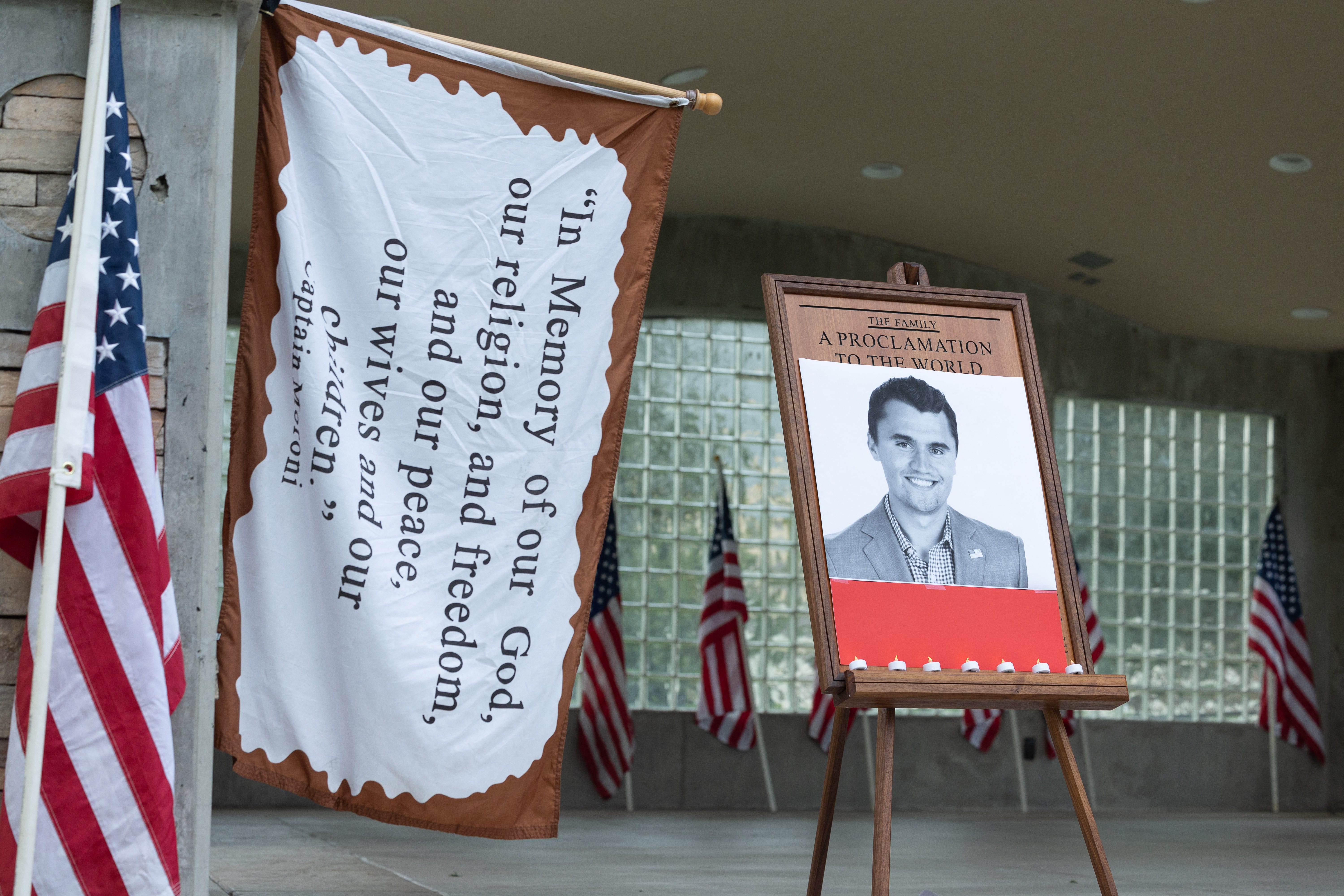
For about twenty minutes at Utah Valley University yesterday, Charlie Kirk was doing something he had done dozens of times a year for his entire professional career: Sitting in front of a campus crowd, arguing about politics with whoever showed up. Then somebody shot him in the neck and killed him.
The summer of 2025 had already been a season of alarming political violence—the May killing of two young employees of Israel’s D.C. embassy, the June shooting of two Minnesota state lawmakers and their families, the firebombing of a pro-Israel march in Colorado, the August shooting at the Centers for Disease Control. But Kirk’s killing was an act of a different order—the assassination of maybe the most prominent young person in American political media today, especially online. No matter where you stand, things are unquestionably a lot worse today than they were yesterday.
The reactions played out online much as you’d expect. Horrified leaders of both parties issued statements condemning political violence and issuing condolences to Kirk’s family. Below that seethed the eternal, inescapable culture war, each side excoriating the other. It barely mattered how representative of their broader political cohorts these posters were; every American’s social-media algorithms made sure they got to see whichever ones would make them maddest.
The same fight, too, could be seen on cable news. Over on MSNBC, just minutes after the shooting, pundit Matthew Dowd ghoulishly rushed to lay the blame at Kirk’s own feet: “I always go back to, hateful thoughts lead to hateful words, which then lead to hateful actions.” (He was later fired from the network.) On Fox News, Jesse Watters seemed ready to anoint Kirk the first martyr of the second U.S. Civil War: “Whether we want to accept it or not, they are at war with us. And what are we going to do about it?” (He was not fired by his network.)
Cable news and X are cesspools, designed to rile up the anger of their users and viewers. Congress is supposed to be more reasoned. But up on Capitol Hill, the House of Representatives couldn’t even manage to get through a moment of silence for Kirk without partisan incident. As that moment ended, Rep. Lauren Boebert (R-Colo.) requested a verbal prayer as well, provoking some audible Democratic grouching and an objection that the House had not acknowledged a school shooting in Colorado the same day. This, in turn, sparked an angry outburst from Rep. Anna Paulina Luna (R-Fla.): “Y’all caused this! You f—ing own this!”
It was all such a sad, awful spectacle, reflective of a deeply sick nation. If we aren’t yet broken we surely seem hellbent on tearing ourselves apart.
Can anything be done about this? Or are we too far gone already? Maybe we are doomed to spiral into increasingly violent cycles of recrimination and counter-recrimination, with both sides convinced all the way to their deathbeds that the other side is to blame.
I don’t know what we can do to avoid this fate. All I know is what I can do. And what I can do starts with the acknowledgment that, while Charlie Kirk may have been an ideological opponent, he wasn’t my enemy. My enemy—an enemy I share with many who would call themselves my enemy—is the person who shot him, and anyone else who would reach for violence as a means to a political end.
Charlie Kirk’s political project was controversial and provocative in its aims. But in its approach, it was simple and fundamentally laudable: He went where the people were and evangelized to them. His signature “prove me wrong” debates were always a little silly—arguments between halting college students and a professional pundit backstopped by a sympathetic crowd aren’t exactly fair fights. But they also reflected an intrinsically liberal, American view of how politics is done: by convincing people from the ground up.
That Kirk was assassinated at work on this mission is a horrible tragedy. That he leaves behind a wife and two young children is an unspeakable one. But don’t just mourn for them; mourn for yourself. Liberalism is a fragile thing; once lost, who knows if we’ll ever get it back? As Jeremiah Johnson wrote last year, after the attempted assassination of Donald Trump:
There’s no material reason any of this should be happening. Instead, we’ve driven ourselves insane due to political hysteria and polarization. And chief among the reasons we’ve gone insane is social media, with its algorithmic promotion of the most divisive messages possible.
As much as you can, resist the hysteria. Refuse to participate in it, refuse to make the polarization worse. The purpose of liberalism is to allow us to disagree with someone without discriminating against them, without harassing them, without killing them. It’s a precious thing, perhaps the most precious thing our civilization has achieved. Every time you break bread in peace with an outsider, every time a Catholic and Protestant shake hands, it’s a miracle. Don’t take it for granted.
Revisiting April 4, 1968
by William Kristol
America has, unfortunately, a history of political violence. Americans also have, thankfully, a history of rising above political violence. In that spirit, I reproduce here Robert F. Kennedy’s remarks in Indianapolis on the evening of April 4, 1968, to what had been intended as a campaign rally, after the assassination of Martin Luther King Jr.
Kennedy spoke without a text for about five minutes, in front of a predominantly black audience. While numerous cities experienced riots that night, Indianapolis did not.
I have bad news for you, for all of our fellow citizens, and people who love peace all over the world, and that is that Martin Luther King was shot and killed tonight.
Martin Luther King dedicated his life to love and to justice for his fellow human beings, and he died because of that effort.
In this difficult day, in this difficult time for the United States, it is perhaps well to ask what kind of a nation we are and what direction we want to move in. For those of you who are black--considering the evidence there evidently is that there were white people who were responsible--you can be filled with bitterness, with hatred, and a desire for revenge. We can move in that direction as a country, in great polarization--black people amongst black, white people amongst white, filled with hatred toward one another.
Or we can make an effort, as Martin Luther King did, to understand and to comprehend, and to replace that violence, that stain of bloodshed that has spread across our land, with an effort to understand with compassion and love.
For those of you who are black and are tempted to be filled with hatred and distrust at the injustice of such an act, against all white people, I can only say that I feel in my own heart the same kind of feeling. I had a member of my family killed, but he was killed by a white man. But we have to make an effort in the United States, we have to make an effort to understand, to go beyond these rather difficult times.
My favorite poet was Aeschylus. He wrote: "In our sleep, pain which cannot forget falls drop by drop upon the heart until, in our own despair, against our will, comes wisdom through the awful grace of God."
What we need in the United States is not division; what we need in the United States is not hatred; what we need in the United States is not violence or lawlessness; but love and wisdom, and compassion toward one another, and a feeling of justice toward those who still suffer within our country, whether they be white or they be black.
So I shall ask you tonight to return home, to say a prayer for the family of Martin Luther King, that's true, but more importantly to say a prayer for our own country, which all of us love—a prayer for understanding and that compassion of which I spoke.
We can do well in this country. We will have difficult times; we've had difficult times in the past; we will have difficult times in the future. It is not the end of violence; it is not the end of lawlessness; it is not the end of disorder.
But the vast majority of white people and the vast majority of black people in this country want to live together, want to improve the quality of our life, and want justice for all human beings who abide in our land.
Let us dedicate ourselves to what the Greeks wrote so many years ago: to tame the savageness of man and make gentle the life of this world.
Let us dedicate ourselves to that, and say a prayer for our country and for our people.
And let us once again dedicate ourselves to wisdom and compassion and justice for all human beings who abide in our land.
EDITOR’S NOTE: At The Bulwark, authors decide whether to enable comments on their newsletters and are responsible for moderating them. Given the nature of today’s news, we’re disabling the comments for this edition. We’re open to the possibility that this is the wrong call. But we want to just let the pieces speak for themselves today. As always, we welcome your feedback and invite you to share your thoughts by replying to this message.
AROUND THE BULWARK
We’re in a Very Dangerous Place… TIM MILLER and SARAH LONGWELL react to the shooting of conservative commentator and activist Charlie Kirk.
The Assassination of Charlie Kirk… JVL on who we are, and who we want to be.
How Does Israel Adapt After Failure? On Shield of the Republic, ERIC EDELMAN and ELIOT COHEN host YAAKOV KATZ, coauthor of While Israel Slept, on Israel’s misreading of Hamas and the October 7 attack.
Quick Hits
THE LATEST: For many Americans, the first confirmation they got of Charlie Kirk’s death may have been a 4:40 p.m. Truth Social post from President Trump: “The Great, and even Legendary, Charlie Kirk, is Dead. No one better understood or had the Heart of the Youth in the United States of America better than Charlie.”
Last night, Trump posted a four-minute video address on the news. He began by commemorating Kirk’s life and work, calling him a “martyr for truth and freedom” and “a man of deep, deep faith.” And he issued what sounded at first like a nonpartisan condemnation of violence: “It’s long past time for all Americans and the media to confront the fact that violence and murder are the tragic consequences of demonizing those with whom you disagree.”
But he quickly made clear just whom he was talking about. America’s particular problem, Trump said, was “radical-left political violence.” He pledged to “find each and every one of those who contributed to this atrocity and other political violence, including the organizations that fund and support it, as well as those who go after our judges, law enforcement officials, and everyone else who brings order to our country.”
Meanwhile, his administration’s attempt to find the actual killer remained ongoing. Two people were detained by law enforcement yesterday—an older man at the scene of the crime whose picture was widely circulated on social media, and a second unspecified person. After the second person was detained, FBI Director Kash Patel spiked the football online: “The subject for the horrific shooting today that took the life of Charlie Kirk is now in custody,” he wrote. “Thank you to the local and state authorities in Utah for your partnership with @FBI.” An hour later, Patel backtracked: “The subject in custody has been released after an interrogation by law enforcement. Our investigation continues and we will continue to release information in interest of transparency.”
Vice President JD Vance, who posted a lengthy tribute to Kirk last night, is reportedly heading to Utah today to pay tribute to his slain friend and comfort his surviving family.
THE REST: Other news has been happening as well, obviously.
Consumer prices rose faster than expected in August, ticking up 0.4 percent for the month, according to Bureau of Labor Statistics data released this morning. Annualized inflation was up 2.9 percent—the fastest pace since the beginning of 2025, while weekly initial jobless claims came in at the highest level in nearly four years. On the other hand, the producer price index ticked unexpectedly lower last month after a dramatic surge in July, falling 0.1 percent, far short of the 0.3 percent rise economists had predicted. The Federal Reserve will make its latest decision on whether to cut interest rates further next week. Read more in the New York Times and the Wall Street Journal.
Three high-profile former FBI agents, including the bureau’s former acting director Brian Driscoll, filed a lawsuit against Director Kash Patel and the bureau yesterday, alleging that they were improperly fired amid a “campaign of retribution” against non-loyalists. From the moment he was appointed acting director earlier this year, Driscoll alleges that he was under pressure to help the White House root out those Trump considered personal enemies, especially anyone who had worked on cases related to January 6th or any of the criminal probes of Trump himself. Read more at NPR.
And long-simmering tensions between Joe Biden’s and Kamala Harris’s political camps are spilling into the open after the first excerpt from Harris’s campaign memoir 107 Days was published in the Atlantic yesterday. In it, Harris is more candid than ever about Biden’s long-belated decision to drop out of the presidential race: “‘It’s Joe and Jill’s decision.’ We all said that, like a mantra, as if we’d been hypnotized. Was it grace, or was it recklessness? In retrospect, I think it was recklessness.” Read more in the Atlantic—and more about the fallout in Politico.