Is Trump *Trying* to Lose the Midterms?
Between rising prices and gilded ballrooms, Trump has practically giftwrapped oppo ads for Democrats.

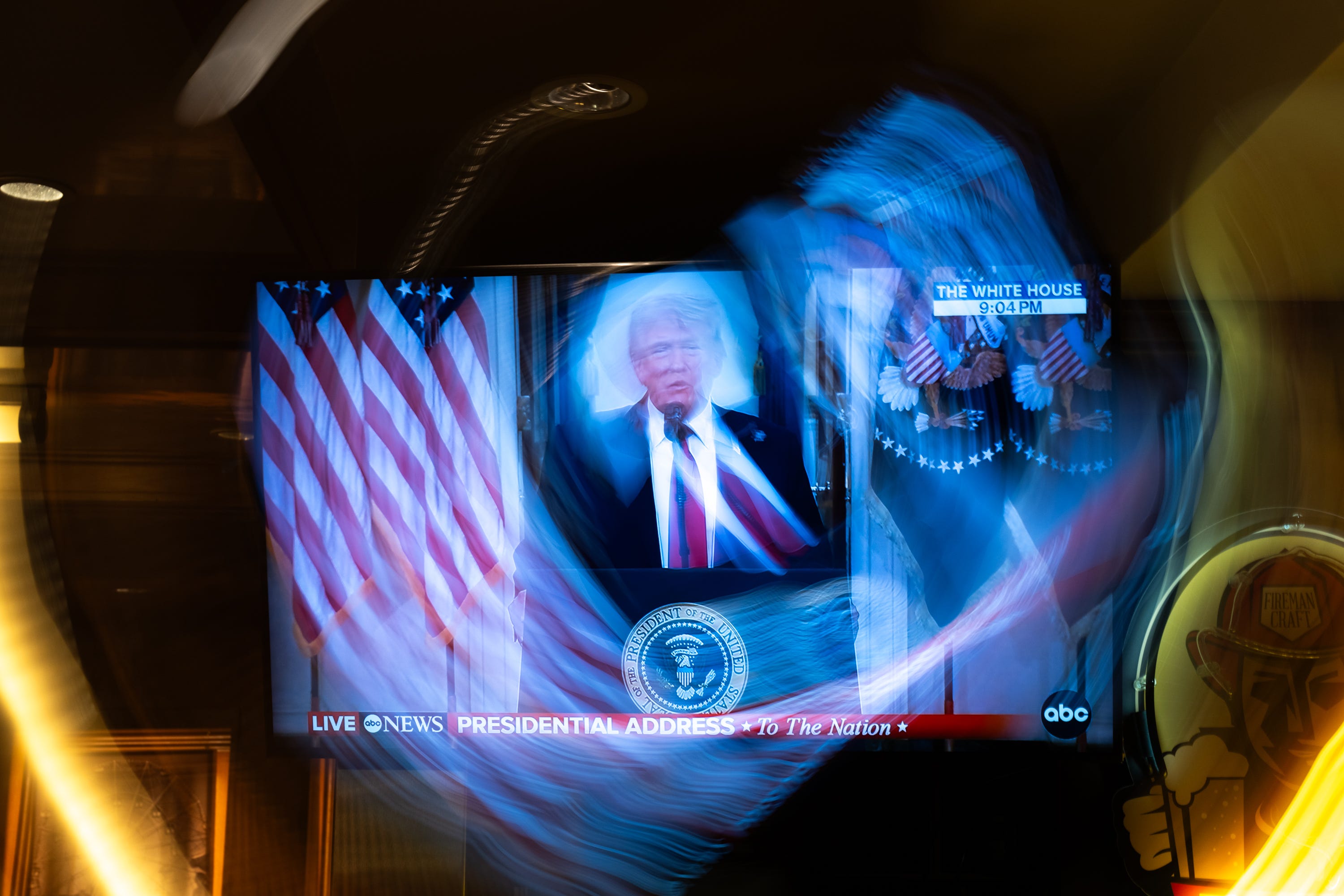
I’M NOT SAYING DONALD TRUMP is trying to lose the midterms. But if he were, would he really be doing anything differently?
In recent days, the president has practically giftwrapped affordability-related oppo ads to Democrats via at least four channels:
his war, and the resultant rising costs;
his tone-deaf comments brushing off Americans’ concerns about rising prices;
his proposal for (even more) safety-net cuts; and
the gilded, marble-walled, money-making totems to Trump himself.
Any one of these things might be seen as political suicide in an election year. But all of them together, at once? It really starts to look like a deliberate plan to undermine his own party. Dems have a unique opportunity to (accurately) blame rising costs on Trump right now, and to shame him for his indifference to—at times, derision of—the pain he has caused. Will they take it?
Americans are big mad about the economy. So mad that they now miss the Biden economy, which trust me when I tell you they absolutely detested:

While some of this Debbie-Downerism may be “bad vibes,” real economic conditions do appear to be deteriorating. New data show that in February we had the lowest level of hiring since April 2020 (i.e., when the economy was shuttered due to COVID). Wholesale prices rose sharply in February as well. And those metrics were captured before Trump decided to start a war in the Middle East, which is making everything worse.
Crude prices spiked after Trump’s confusing and incoherent speech on the Iran war last night, in which he insisted that the Strait of Hormuz “will open up naturally.” Major measures of crude oil futures prices closed Thursday around 10 percent higher, at $110 per barrel; meanwhile “spot prices” for Brent crude reached a whopping $141, the highest level since the 2008 financial crisis.1
And of course the war hasn’t merely forced an oil crisis; we’re well on our way to an everything crisis, given the many supply chains disrupted by the strait’s closure.
Disruptions to fertilizer shipments and higher diesel prices are already raising food input costs. Fuel surcharges for shipments are lifting grocery prices, too. A global helium shortage is jeopardizing the AI boom, since helium is used to manufacture semiconductors (and has lots of other critical industrial applications, like MRI machines). Plastics prices are spiking too. And so on.
These disruptions won’t merely lead to higher prices; they are also boosting the risk of recession. That’s because higher energy costs (among other rising input costs) and lingering uncertainty effectively serve as a kind of tax on nearly all economic activity. Already Goldman Sachs estimates that the war is costing about 10,000 jobs a month.
Trump’s other misguided economic policies (on trade, immigration, the Fed, etc.) are also compounding the warflation.
For example: aluminum smelters across the Middle East are closing down because of the war. Some have reportedly sustained damage from Iranian drones and missiles. But even if the war ended today, and if a shuttered facility had been completely unscathed by bombing, it can still take up to a year for an aluminum-smelting plant to restart operations. It’s not like flipping a switch.
But amid these developments, Trump has decided to increase the price of products made with aluminum.
Specifically, his administration is overhauling his existing steel and aluminum tariffs so that the tariffs will now apply to the entire value of a product that includes metal inputs, rather than just on the value of the steel or aluminum components alone.
Today is also the one-year anniversary of “Liberation Day,” when Trump announced global tariffs on adversaries, allies, and penguins alike. Even though the Supreme Court struck down those particular tariffs, the Trump administration is still refusing to issue refunds and working to reconstitute the stricken tariffs through other legal authorities.
Trump Doesn’t Feel Your Pain
What is Trump’s response to concerns over the costs he’s imposed upon American consumers and businesses, via both his trade wars and actual wars?
He says it’s a sacrifice Americans must be willing to make, or, as he puts it, a “very small price to pay.” Maybe, he says, it’s even a good thing if oil prices rise, since America is home to big oil producers. And downstream companies shouldn’t care anyway about the costs: “You make enough money, it doesn’t matter to you, right?” he recently told farmers.
The words of a true political empath.
But it gets worse. Because while Trump is also giving us higher prices, he is also taking away programs to cushion the blow of those higher prices.
For instance, on Wednesday Trump said he directed his budget chief to stop sending states money for daycare because we need that money for wars instead:
Don’t send any money for daycare because the United States can’t take care of daycare, that has to be up to a state. We can’t take care of daycare. . . . We’re fighting wars, we can’t take care of daycare. You gotta let a state take care of daycare, and they should pay for it, too. . . . It’s not possible for us to take care of daycare, Medicaid, Medicare, all these individual things.
This is quite the midterm message: We can afford a billion-dollar-a-day war but not the popular safety-net programs that keep many American families afloat.
Putting (Your) Money Where His Mouth Is
Lest you think this was merely an errant gaffe, Trump actually did try to freeze federal childcare funds sent to several blue states (though his efforts have been blocked by judges). And soon these spending priorities will soon be laid out nationwide, in black and white, in the White House budget.
Trump’s fiscal year 2027 budget, expected to be released Friday, “will frame his party’s midterm election message around a massive defense buildup, partially paid for by cuts to domestic agencies,” Bloomberg reports.
White House budgets rarely become law, and are usually seen as messaging documents. But on this particular set of fiscal choices, Trump may find a willing audience up on Capitol Hill.
Axios reports that House Republicans are currently weighing cuts to U.S. health programs to offset an additional $200 billion in spending on the Iran war and immigration. These cuts would be in addition to the $1 trillion+ cuts in Medicaid and SNAP that Republicans already passed in last year’s One Big Beautiful Bill, to pay for regressive tax reductions.
Those program cuts, coupled with the expiration of enhanced Obamacare premium subsidies that Republicans refused to re-up, have fed into Americans’ worries about health care affordability. In fact, new Gallup polling shows that health care leads Americans’ list of domestic concerns, with more respondents saying they worry “a great deal” about the “availability and affordability of healthcare” (61 percent) than said so about fifteen other domestic policy areas.
Trump’s timing here is pretty impeccable. The only way he could possibly appear more tone-deaf is if he were simultaneously spending hundreds of millions of dollars on a gilded White House ballroom and erecting a giant golden statue of himself in his presidential library/hotel.
Trump is worsening affordability while building himself a new Versailles—it’s a split screen that Democrats dream of.
Ramparts
— In case you’re wondering if anyone is getting rich off of those Medicaid cuts, the answer is: Yes.
— It’s a strange state of the world when socialists are fantasizing about the rich getting (even) richer, but the New York City mayor’s office now finds itself doing just that after learning that the city’s finance professionals took in a bit less than expected last year. The city’s 2026 budget under Mayor Zohran Mamdani was counting on the average Wall Street bonus to soar an average of 15 percent above the prior year, but instead it rose “only” 6 percent (to $246,900). Tiny violins, I know; but this leaves an even bigger budget hole for the city to fill. That said, no one in government seems to have had a solid handle on how high the bonuses would climb: New York governor and self-described “staunch capitalist” Kathy Hochul’s office had projected that they would go up by 25.9 percent, resulting in an even larger budgetary hole at the state level.
— A federal judge ruled that the Trump administration’s efforts to extract a list of Jews from the University of Pennsylvania were legally above-board. You may recall that Barnard got a similar demand last year, and complied. Penn says it is appealing the ruling. Meanwhile, a handful of states say the administration has defied a federal court order by continuing to share the private health information of millions of Americans with immigration officers. (I last wrote about all this, plus other examples of the administration’s abuse of confidential records and compilations of uncomfortable “lists,” back in January.)
— GLP-1s continue to rack up wins, with the latest being a demonstration of the drugs’ potential value for helping to treat psoriatic arthritis. One of my unpopular opinions is that people are probably overstating the medium-term economic impact of AI while underestimating the economic impact of GLP-1s.
— Happy Passover! RFK Jr. is bringing the plagues back.
The “spot price” is the price you pay if you need the oil right now (well, in the next ten to thirty days). Most of the time when you see oil prices cited in headlines, those are for futures prices (what people are willing to pay for oil a couple of months out). Typically, spot prices are lower than futures prices. The fact that they aren’t right now could mean that markets think that this is only a temporary disruption and things will go back to normal-ish soon. Or it could mean that futures markets just aren’t pricing in everything. Which is basically what the CEO of Chevron said recently: “There are very real, physical manifestations of the closure of the Strait of Hormuz that are working their way around the world and through the system that I don’t think are fully priced into the futures curves on oil.”
Psychotherapist here - I think it’s clear from an understanding of his psychology that he is not trying to lose. His behavior is much better explained by his long term narcissistic personality, cognitive decline, and his privilege and sheer luck. He doesn’t care about affordability or the middle class, we know that. He has faced no serious consequences for any of his criminality and immorality, due to his privilege and ridiculous luck. Voters have looked the other way over and over again. After a lifetime of these experiences, and being the type of person who wants what he wants and doesn’t care about other people, he is just not afraid enough to inhibit himself from doing just what he likes. He is surrounded by sycophants so he is not experiencing the reality that we are. And with aging, he’s experiencing cognitive decline which is also lowering his inhibitions further. Additionally I think he’s not inhibited right now because he doesn’t intend to follow the rules of democracy when elections come around - though I’m not sure he has a plan for how to get around them, I do not think he cares what the consequences are because he’s done following the rules. This is what happens to dictators over time - they become less afraid, more impulsive, more delusional, and more unable to inhibit their worst instincts.
As unappealing a visual a naked Trump may be, it certainly does seem for certain now the emperor has no clothes. He and Hegseth may brag about destroying a 50 year old decrepit Iranian Navy and Air Force (many assets which were originally gifted from America to Shah in 1950s) but fact remains Strait of Hormuz is closed, uranium is still in Iran and any allies we might have had despise him and Netanyahu is using this crisis to seize Lebanon, West Bank and ignore Gaza, guaranteeing chaos for years to come.