JAGs Shouldn’t Be Civilian Prosecutors
The mass deportation policy is a legal mess—and reassigning military lawyers to support it would only create more problems.

DEPARTMENT OF HOMELAND SECURITY lawyer Julie Le apparently spoke for many of her colleagues when she told a federal judge last week, “The system sucks. This job sucks.” The Trump administration’s campaign of mass deportations has, intentionally or otherwise, overwhelmed the legal system. In the Department of Justice, experienced federal prosecutors have been resigning in droves. Those who remain are, like Le, expressing their exhaustion and ethical and legal concerns about how they’re being instructed to handle cases (though not always as spectacularly as Le did).
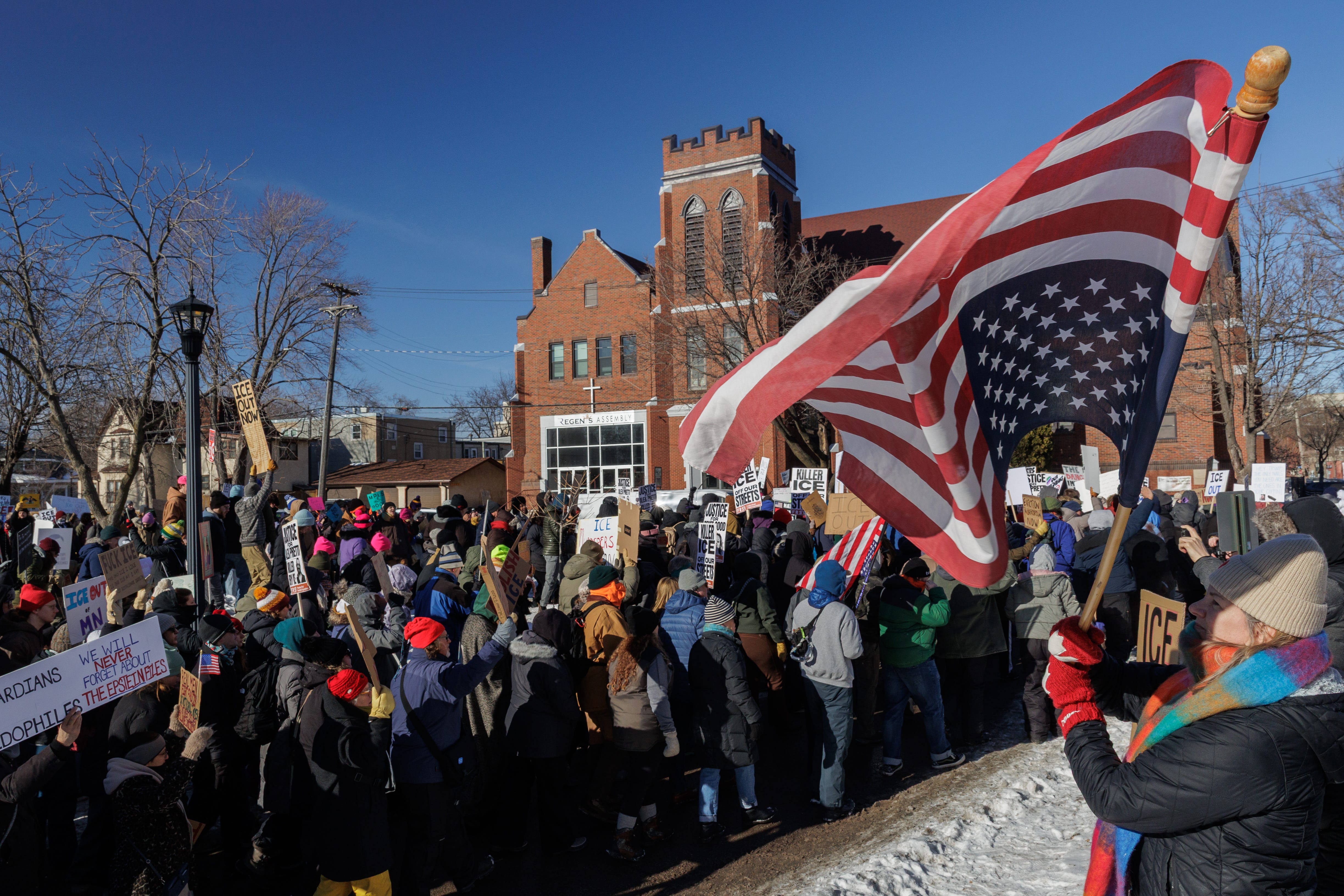
In Minnesota, the problem is especially acute. Federal judges in Minneapolis have admonished government counselors for repeatedly failing to comply with court orders. The U.S. attorney’s office for Minnesota has seen an exodus, losing nearly 10 percent of line prosecutors.
When experienced government lawyers resign rather than pursue cases they believe are legally flawed or ethically suspect, when legal professionals express their burnout to a judge, they are exercising the very discretion that distinguishes a justice system from an enforcement machine.
But this scale of dissent is unprecedented. What is also unprecedented is how the administration is attempting to respond. Rather than address the underlying causes—overreach, volume, or questionable legal grounding—the Department of Justice appears to be seeking outside help: military lawyers.
In Minnesota, military lawyers have been temporarily detailed as “special assistant U.S. attorneys” to fill gaps left by resigning prosecutors. Additionally, the Pentagon has authorized the transfer of up to 600 military lawyers to serve as temporary immigration judges within the Executive Office for Immigration Review, expanding the immigration bench by drawing on uniformed officers who, in most cases, lack specialized backgrounds in immigration law. The administration has also sworn in dozens of new immigration judges, the majority of whom have military experience, following the removal or departure of hundreds of civilian judges.
In short, the Trump administration’s solution to a judicial crisis of its own making is to replace civilian prosecutors and judges with military officers. This decision will harm both the courts and immigration processes to which these officers are being assigned, and the military from which they’re being pulled.
ARMY, NAVY, MARINE CORPS, AND AIR FORCE1 judge advocates general (JAGs) are certainly not biding their time, twiddling their thumbs while waiting to be injected into a civilian enforcement environment. They are deeply embedded in the daily functioning of military units, responsible for enforcing discipline, advising commanders, and ensuring that operations—whether in garrison or combat—remain within the law. Pulling them into domestic immigration adjudication should not be viewed as a viable “surge capacity.” It is instead a structural reallocation of critical military personnel that will have severe consequences on the good order and discipline of service members and their families.
Every member of the military benefits from the JAGs. Military lawyers and their teams prepare wills and powers of attorney for soldiers deploying into harm’s way, giving them the confidence that, if the worst should happen, their families are legally prepared. They also help with marriages and divorces, adoptions, name changes, tax issues, military benefits, and a host of other issues for which a member of the armed forces might need legal assistance. In any multinational environment where our troops are stationed, military lawyers are key to ensuring compliance with host-nation laws and agreements. Most importantly, in combat they advise on rules of engagement, detention operations, and the lawful use of force. Operational readiness is inseparable from legal readiness; military forces do not fight effectively if they fight unlawfully.
For commanders, especially, the staff judge advocates (SJAs) and their organizations of JAGs are indispensable. Having commanded at multiple levels—from battalion to brigade to division, and later as commander of U.S. Army Europe—it’s difficult to express how much I relied on my legal advisers daily. They are essential to every command action, and they play a critical role in helping commanders maintain good order and discipline among thousands of soldiers. Every Article 15 non-judicial punishment, every court-martial decision, every administrative separation, every sensitive disciplinary call passes through a judge advocate’s counsel. Without that action and advice, discipline becomes uneven and arbitrary, eroding trust inside units that depend on fairness as much as authority. JAGs even counsel commanders on interactions with civilian authorities surrounding our installations and help resolve disputes involving local communities.
Most critically, judge advocates provide commanders with something that cannot be improvised: independent legal judgment that advises on the legal ramifications of orders received from civilian authorities. Many times in my career, I relied on my legal adviser to help me determine whether an order from higher civilian authority was lawful, ambiguous, or potentially unlawful; and they also helped me find a legal solution I could offer to my boss when those orders crossed a line. That distinction matters. It’s the difference between obedience and complicity, between constitutional service and institutional failure. Removing from commanders the lawyers who might otherwise provide that counsel risks exactly the kind of interference a democracy should fear: fewer legal brakes on questionable decisions at the very moment those brakes are most needed.
Besides the obvious—that military lawyers have different expertise and experience than their civilian counterparts—there is another important difference between the two. Civilian government attorneys can resign. Many have. That option is part of what preserves prosecutorial discretion and our rule of law.
Uniformed military lawyers do not have that option. While JAGs can request reassignment or separation, they cannot simply refuse an assignment because they disagree with the policy it supports. Even if they meet the criteria to retire or resign—i.e., having fulfilled their commission’s service requirements—the process of separating from the military can be prevented. Requests for resignation can often be denied for the “good of the service,” and if they are approved, they can take months, during which time the lawyer officers are still bound by the Uniform Code of Military Justice to obey lawful orders. When an administration responds to civilian legal resistance by substituting a workforce that cannot easily dissent or resign, it is not solving a staffing problem. It is attempting to bypass professional judgment and ethos.
THE MILITARY HAS LONG ASSISTED authorities with surges of professionals in genuine national emergencies. Federal troops helped restore critical services during the 1981 air traffic controllers’ strike. The armed forces have supported disaster relief efforts following hurricanes, pandemics, and infrastructure failures, and they train for such missions. In each case, the military augmented civilian capacity to restore essential functions; it did not replace civilian professionals because they refused to implement controversial policies.
What’s happening now is much different. Using military lawyers to prosecute or adjudicate cases because civilian lawyers are resigning over ethical or legal concerns crosses a line. It transforms the armed forces from a support instrument into a workaround for institutional dissent. It militarizes the American government, and at the same time politicizes the military. That should trouble Americans regardless of where they stand on immigration policy, or on the political spectrum.
The danger here is not only to the justice system, but to civil-military relations. The military’s legal corps exists to preserve the rule of law within the force, to advise commanders navigating morally and legally complex missions, and to serve all military personnel in the pursuit of fairness and justice. Treating it as a reservoir of compelled compliance undermines that role and risks normalizing the idea that when some professionals say “no,” the answer is to find other professionals who cannot.
A republic that values the rule of law must resist this temptation. And a military that has spent decades insisting it serves the Constitution, not a man or a moment, should never be put in the position of enforcing policies civilian lawyers believe the law cannot sustain.
For the time being, the Space Force doesn’t have its own lawyers, and relies on the Air Force’s.