Legacy of a Libertarian Leader
Longtime Cato Institute head Ed Crane died this month. Many in the movement he helped build have trouble seeing Trump clearly.

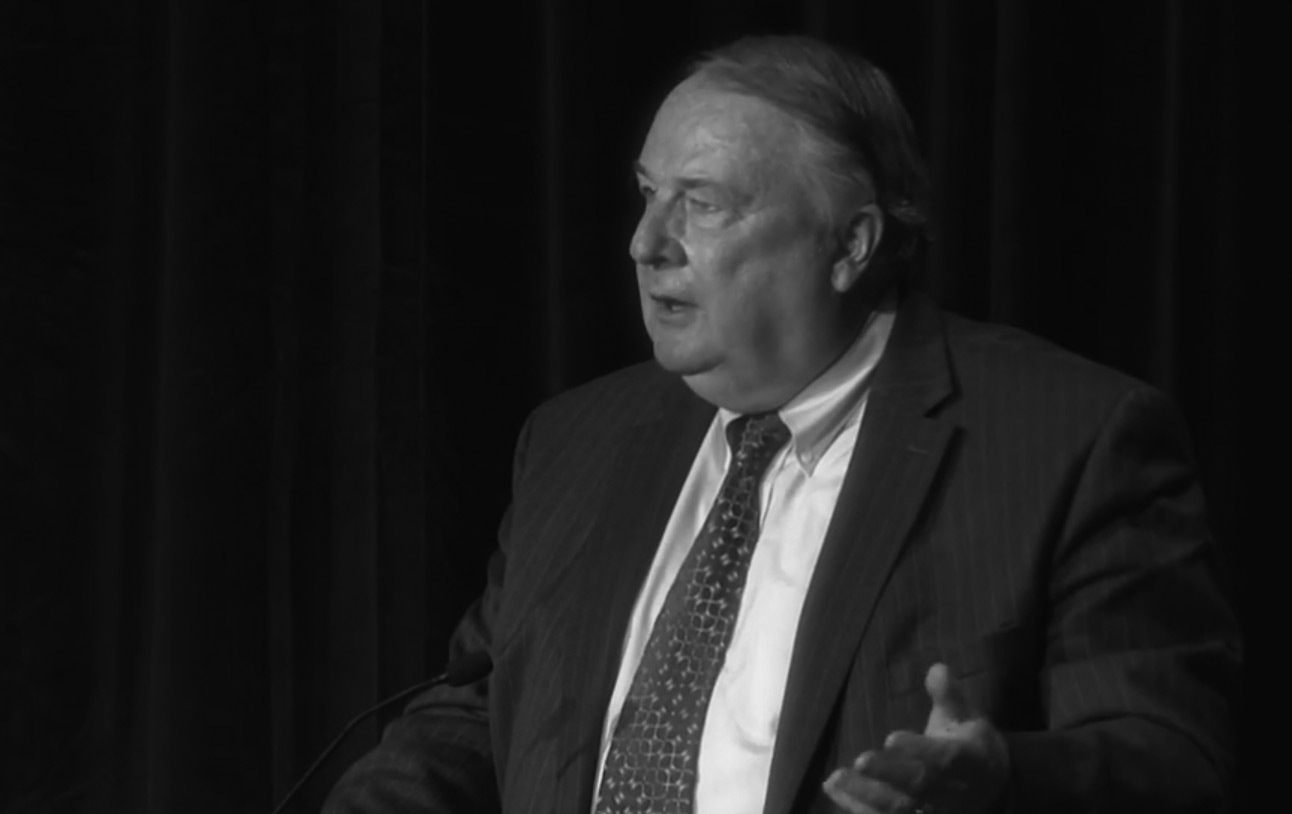
ED CRANE USED TO SAY, as one of his longtime colleagues recollected a couple of years ago, “that the thing he did for libertarianism was put libertarians in suits and ties.”
The burly institution builder was not a household name, but he made the modern libertarian movement into what it is today, dragging weirdos and dreamers to the halls of power. A driven activist and domineering organizer once described by P.J. O’Rourke as having a “sequoia spine,” he built both the modern Libertarian Party and the preeminent libertarian think tank in the United States, the Cato Institute. Crane left Cato in 2012 after a contentious struggle with his erstwhile money men, Charles and David Koch. MeToo allegations after Crane’s exit from Cato further sidelined him. His passing—Crane died at the age of 81 on February 10 at his home in a suburb of Washington, D.C.—is an opportunity to consider where libertarianism fits on the American right and how libertarians should act in a right-wing authoritarian moment.
Born in California in the summer of 1944, Crane studied business at UC Berkeley in the heady 1960s. Captain of two precincts in the Goldwater campaign, he knew every voter for his candidate in both of them—all thirteen people. Campaigning for Goldwater led Crane to libertarian texts, including Ayn Rand’s Atlas Shrugged. All the reading radicalized the twentysomething financial analyst; he wanted to do more. Through the libertarian underground he learned of a 1972 party meeting in Colorado and went along.
He found there an extremely variegated movement. According to Whitney McIntosh, a historian and scholar of libertarianism at Worcester Polytechnic Institute, “At the dawn of the 1970s, libertarians forged an ecumenical coalition of Objectivists, anarcho-capitalists, limited government libertarians, libertarian feminists, hard-money advocates, science fiction fans, survivalists, and defectors from the New Left and New Right.”
In 1972, Crane became the Libertarian Party’s nominal campaign manager and built the party in California. With the help of Roger MacBride, a former member of the Vermont House of Representatives who had been a faithless elector in the 1972 presidential election, Crane took over the national party, becoming its chair in 1974. This apparently involved an 80 percent pay cut from the work in finance he was leaving behind—a considerable sacrifice to pursue his principles. Exasperated by the party’s state-level laxity, he whipped it into shape, turning it into something that was—well, if not electorally competitive, at least visible and coherent.
“Crane was an accomplished man with a professional vision for the LP who wasn’t charmed for long by the peccadilloes and amateurism of many in the party—and he wasn’t shy about letting them know it,” writes the libertarian historian Brian Doherty in his groundbreaking book on libertarianism, Radicals for Capitalism. “I still have enemies to this day in most states in the union,” Crane told Doherty in 1998. Intramural critics dubbed him and his allies the “Crane Machine.”
A singular challenge for the professional Crane was corralling the mad prophet of late-twentieth-century libertarianism, Murray Rothbard, into a movement that was going legit. The anarcho-libertarian Rothbard personified libertarianism at its most wild-eyed and imaginative. Incorporating the anarchists into the party meant that, on principle, the party could never endorse any positive function for the state.
My Kochtopus teacher
Crane made a critical ally in the libertarian industrialist Charles Koch. Eager to move on from the ideological but nonpolitical quietism he’d previously adopted, Koch, in his mid-forties in the 1970s, turned to the Libertarian Party. He provided the funds to stand it up, and Crane brought the organizational expertise and drive to get it rolling. According to Doherty, Koch’s massive cash injection into the tiny movement led to a “bizarre gravitational shifting as Planet Koch adjusted everyone’s orbits.” Crane stayed at the center. Crane and Koch were able to mobilize the movement like never before, but also exercise discipline, reshaping the movement in their image. Koch or Koch-adjacent enterprises included magazines and journals, think tanks, student organizations, and the Libertarian Party itself. David Koch, Charles’s brother, ran for vice president on the Libertarian Party ticket in 1980, in part to skirt campaign finance laws.
By the 1980s, LP activists were fed up with Crane and Koch’s high-handedness. They rebelled, ousting the Crane Machine. Lacking funds and direction, and in the face of Ronald Reagan’s libertarian-tinged conservatism, the party’s Koch-blown inflationary bubble burst.
By then, though, Crane had already started another venture—one more intellectual and less quixotic (one might even say less contradictory) than party politics among libertarians: a new think tank, the Cato Institute. Founded in 1977 by Koch, Rothbard, and the 32-year-old Crane, the organization took its name from a set of early-eighteenth-century British republican pamphlets (and, ultimately, from the arch-republican Roman senator, Cato the Younger).
Originally based in San Francisco, the Cato Institute chimerically blended the character of its founders, which gave it, among other things, a strong anti-interventionist stance. One early enterprise, a magazine named Inquiry, grew out of an earnest hope to draw New Left voices into the libertarian world. “We’re going to have to attract support from the left,” Crane said in 1978. National Review, which always had a tetchy relationship with pure libertarians, scolded Cato in 1979, complaining about the obscene “Invisible Finger” given by Cato’s platforming of lefty writers in the Institute’s most ecumenical publication. The conservative magazine’s exposé shone light on Rothbard’s World War II revisionism, and grumbled that the left-libertarian Inquiry’s criticism of state surveillance amounted to “an unrelenting editorial campaign against all American security services, almost to the exclusion of any other topic.” In retrospect, Crane reflected that this gambit alienated the right unnecessarily even as it “helped create a distinctive image for libertarianism.”
Eventually, Rothbard’s idiosyncratic ideological purity clashed with Crane and Koch’s relative pragmatism and efforts to smooth the kooky edges off libertarianism. When Rothbard found himself cashiered in 1981, he beat a path toward the paleolibertarianism of Ron Paul and Lew Rockwell.
Cato’s rise
Crane moved Cato to Washington, D.C., in 1981, setting it up in lavish style. With its move inside the Beltway, Cato shifted focus from scholarship to policy-oriented research, where it worked constantly to push the policy window. The institute gained a significant boost in credibility and fundraising power in 1985 when William Niskanen, the former chair of Reagan’s Council of Economic Advisors, became its chairman—a post he held until 2008.
Crane and Niskanen made Cato the leading libertarian think tank in the United States. It advanced policies in favor of drug decriminalization, privatization, deregulation, anti-interventionism (including opposing the Gulf War and War in Iraq), and favoring immigration. Crane focused on making Cato a high-quality marketplace for libertarian ideas. According to David Boaz, a distinguished senior fellow and the executive vice president at Cato, the “mainstream presentation of radical ideas was one of the things we always thought about.”
It may sound like this would all align with the Reagan Revolution of the 1980s and the Gingrich Revolution of the 1990s. But Cato under Crane, weathered by his years in the Libertarian Party, was not an easy ally for Republicans—or politicians in general. Crane could be quotably terse. About Reagan, he wrote in 1982 that “Reaganomics has not failed. Reaganomics is simply a fiction transmitted to us with unblinking innocence by the nation’s media.” Reagan happily used libertarian rhetoric, Crane thought—in the manner of an actor reading lines. When Speaker of the House Gingrich attempted to get Crane to meet with House Republicans in 1997, Crane replied, “Tell the speaker to cut some spending” and hung up. On politicians in general: “I feel like I have to take a shower after I meet with some of these guys.” Those who want “to be congressmen are creepy people.”
“Don’t vote,” he quipped, “it only encourages them.”
Eventually, Crane’s purist instincts led to his 2012 ouster from Cato. Evidently, the Kochs, at the height of their Obama-era notoriety, wanted the think tank, a nonprofit, to operate in closer coordination with the rest of their machinery. “In their battle against statist disease, the Kochs seem to regard Cato’s individualism as too individualistic. They want a more collective effort to cure collectivism,” as O’Rourke put it in the Weekly Standard. There followed a fight for control of the institute between the Kochs, who had seeded it, and Crane, who had largely built it. The Kochs sued. In the end, Crane left, and the Kochs appointed a new president.
Crane’s reputation suffered in enforced retirement. Unlike intellectuals such as Rothbard, whose ideas can be constantly rediscovered, institution-builders are rarely memorialized. They’re often forgotten as their power fades. Crane’s name means little to libertarians under 40. Indeed, in 2018 credible allegations came to light of sexual harassment by Crane going back decades at Cato, further damaging Crane’s legacy.
HOW DO WE MAKE SENSE of libertarianism in the past and in the present? To some extent, the “Don’t-tread-on-me” style of folk libertarianism is close to the American default. What Crane, Koch, Rothbard, and the inheritors of their legacy today have developed is something more distinct. It’s far more rigid—or, if you like, principled—and, it must be said, it is out of step with the modern state and most people’s assumptions about the purposes and limits of government.
It’s an open question how, exactly, libertarianism fits with the broader American right. McIntosh calls libertarianism “protean in form: attaching itself to many kinds of intellectual pursuits, policymaking endeavors, and activism across the political spectrum.”
As the example of Inquiry attests, libertarians have often reached out to the left on matters of common concern, sometimes quite successfully. The message of individual freedom of choice, and libertarians’ persistent criticism of the state’s coercive, surveillance, and war-making powers, make it possible to imagine a left-libertarianism. But Crane—and in his own way, Rothbard—found their movement’s leftward outreach to be strategically limited.
In the United States, libertarians have historically made common cause far more often with conservatives. Yet this relationship is extremely complex and often fraught. In the early years of the conservative movement, Whittaker Chambers compared Ayn Rand’s worldview to that of the genocidal Nazis. In 1962, Frank Meyer accidentally sparked a deep theoretical battle over how conservatives and libertarians ought to relate when he excoriated libertarian pacifists. As we’ve seen, National Review thought Cato and Koch were New Left communist sympathizers. In 1997, the editor of the libertarian magazine Reason complained that the neoconservative writers at the Weekly Standard sprinkle “the word ‘libertarian’ almost randomly, as an all-purpose epithet.”
Despite all the name-calling, at least some political theorists accept that, thanks largely to its willingness to embrace hierarchies and inequalities (as a natural and inevitable result of the market), modern libertarianism is, in the final analysis, a right-wing ideology. Left-wing Big Government seems to be the greater threat in the libertarian mind than right-wing Big Government.
In the early days of their fraught alliance, conservatives and libertarians came together out of a belief that if only the liberal elite and its statist ways could be rolled back, the American people would revert to living virtuously. Conservatives could thus be the party of liberty and virtue. If that was ever true, the post-liberal New Right no longer seems to believe it. The threat of right-wing authoritarianism is real.
Where are the libertarians in Trump’s America? Personally and institutionally, many remain as principled as ever and staunchly anti-Trump. Yet some lecture the public about how they should have listened to libertarians’ longstanding warnings about state power, as if the problem had more to do with constitutional machinery and precedent than politics.
Among both professional and folk libertarians, there is a tendency toward a nihilistic both-sidesism that is ill suited for the present. Many libertarians—not all, but many—cannot see themselves as part of a left-leaning alliance that votes for Democrats; they still see the statist danger as emanating equally from the left and right. The origins of this outlook are obvious. Libertarians have spent decades sitting outside the two-party system; they’ve worked, donated, and voted for the scrappy Libertarian Party; they have an iron commitment to principle and are used to resenting politicians; and it is not hard to detect their residual preference for the hated Republican party over the feared Democrats.
Unfortunately, our moment requires libertarians who love this country and its freedoms to break out from their familiar political enclave. It’s time to take a side.