Many Gen Zers Rooted Against Team USA. Here’s Why.
Some of the reasons were personal, but some were strongly political.

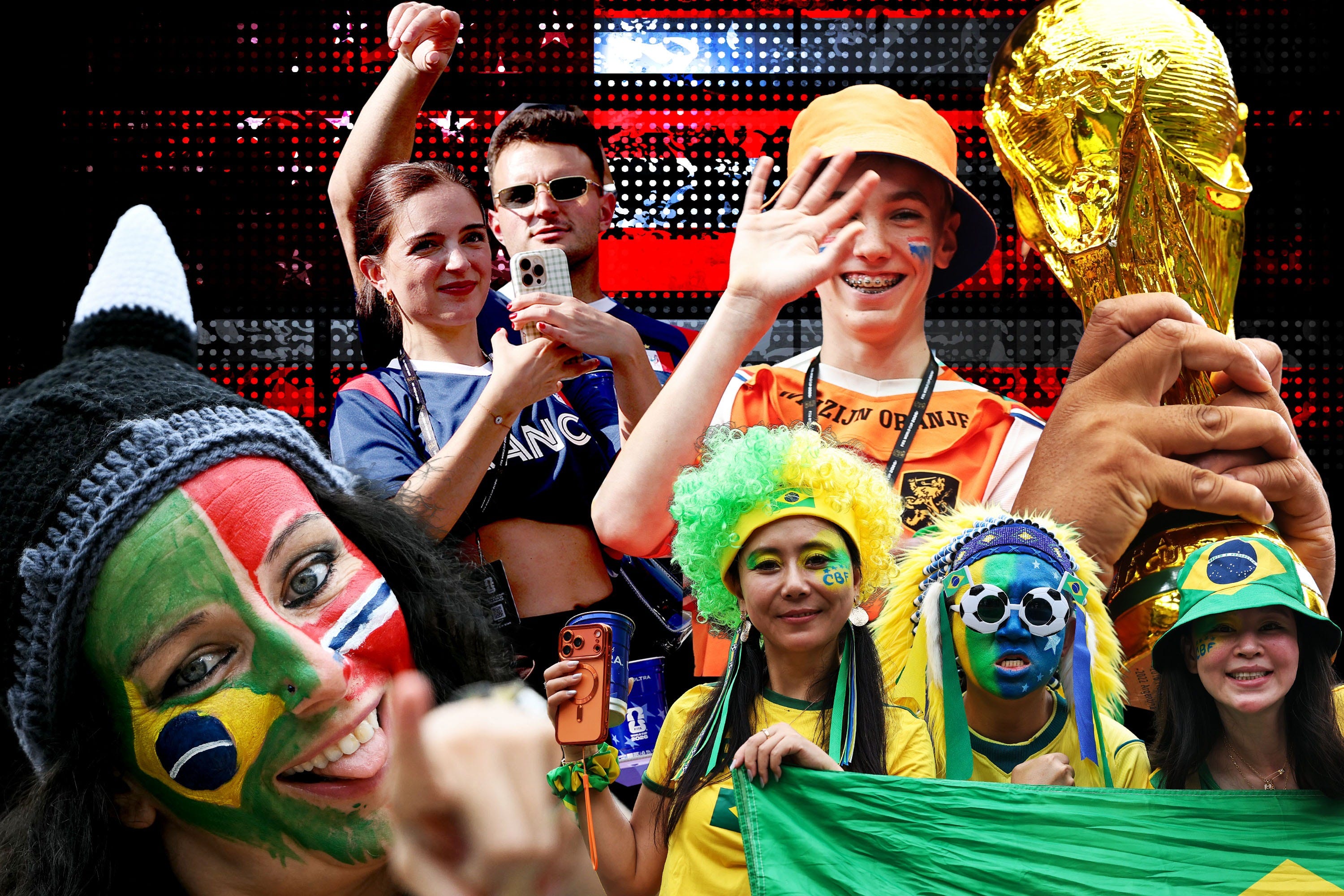
EVEN THOUGH THE U.S. men’s national soccer team lost last night, plenty of young Americans still have a team to root for in this year’s World Cup, because many weren’t rooting for Team USA in the first place.
“The U.S. kind of seems like they don’t really need the support right now,” said Nicholas, 18, from Arizona. After he heard that Trump had appealed directly to FIFA President Gianni Infantino to overturn American striker Folarin Balogun’s red card (the White House maintains the phone call between Trump and Infantino was just an inquiry and didn’t exert any pressure), he was even less interested in backing his home team:
Trump calling FIFA and getting it dropped like that’s just really embarrassing on a world stage. This is why people don’t really like the U.S. for a lot of reasons. It seems like we have this power imbalance over the rest of the countries. It’s kind of like the parallel with Trump having a lot of corruption problems right now in his administration. It’s just, it’s a bad look for the country.
Nicholas explained that his decision is a recent one and a departure from his normal rooting habits. This year, he’s rooting for a range of other, smaller nations instead. “I was really excited for Haiti, Congo, Cape Verde. There were a bunch of countries that were really having historic runs, [and] I was really excited for them,” he said, adding that he’s now supporting Egypt. (Unfortunately for Nicholas, Argentina knocked Egypt out 3-2 this afternoon in a pulsating come-from-behind win.)
Nicholas isn’t alone—not by a long shot. A June 15 YouGov poll (apparently conducted entirely online) found that just 32 percent of Americans ages 18 to 29 were supporting the U.S. team—the least of any age group—while 17 percent of Americans ages 18 to 29 were supporting another team, the most of any age group.1 I spoke to more than a dozen young adults in the past few days to get a sense of why they weren’t high on the red, white, and blue.
Young Americans’ choice to back a foreign team comes amid a growing generational gap in national pride. Only 34 percent of young Americans 18–29 are proud of being Americans according to data from Public Religion Research Institute, compared to 43 percent of Americans ages 30–49, 59 percent of Americans ages 50–64, and 66 percent of Americans 65 and older. Similarly, an NBC News poll found that just 31 percent of Americans 18–29 are “extremely” or “very” proud to be Americans, compared to 75 percent of those 65 and older.
Asked why they were rooting for squads other than Team USA, Gen Zers from across the country shared a variety of reasons. Owen, 18, from Arizona is rooting for France because he’s visited the country and has friends from there. Arna, 20, from New York is rooting for Argentina because of star player Lionel Messi. And Dorothy, 20, from Pennsylvania said she’s backing Norway because of an affinity for their star player Erling Haaland, who’s become a social media darling.
But Dorothy’s decision to back Norway over the USA wasn’t purely personal—it also had a political dimension. “My main reason for not supporting the US in the World Cup this year is because our sportsmanship hasn’t been there,” she said:
This could unite us, but there’s been nothing there. There’s been no support. It hasn’t been publicized in the way that it should to . . . bring unity. This could bring patriotism. The Fourth of July was two days ago. If [the World Cup is] in the U.S. and all this stuff is happening, and we’re seeing Norway and Mexico City, and them all coming here to support, and I just don’t think the U.S. has had that.
She suggested that, if anything, the fact that the United States hosted so many World Cup teams encouraged Americans to support other teams. “I haven’t really heard anything through Twitter or through any other media sources for the cities that the World Cup has been in to promote the US,” she said. “When Scotland was in Boston, everyone was talking about how great it was, and how they loved the little traditions . . . We’re supporting other countries, which is fantastic and I love that. But we’re not giving the same energy to our country.”
Others also chose their favorite teams through a political lens. Leo, 22, from Arizona, said that while they don’t “really care about sports all that much,” they’re more in favor of supporting “teams that are kind of disenfranchised politically, like their country is disenfranchised politically. And the U.S. is definitely not that. So I just kind of don’t care about what happens to the U.S., and I’m more so supporting the underdogs.”
“I mainly root for the underdog, so it’s really not like any single country,” said Brian, 18, from Arizona. “So there have been games where I do support the US, but it’s not every single game. But, like, Cape Verde: I supported them last time they played against Argentina because they were kind of the underdogs and it was a more exciting game.”
KJ, 18, from New York, told me that he’s rooting for Jamaica, where his family is from. “I feel like a lot of Gen Zers don’t really identify with the U.S. simply because of acknowledgement of the U.S.’s history. I feel like there’s a lot [of] wokeness I would say. And I think a lot of people like to identify with the countries where they originate from,” he said.
“I support Colombia by default just because, I mean, my entire family’s from there,” said Marianna, 19, from New York:
I feel like the team that you support definitely changes by the game. For example, if the team that you don’t primarily root for isn’t playing, then you do have backups. And sometimes if you’re from South America, your backup will just be the next South American country. So, I think it definitely depends on who you are and what game you’re watching.
Many of the young adults who didn’t rally behind Team USA said they felt the sting of a missed opportunity—an own goal, you might say. “I feel like, in a country where so much division already exists, it’s unfortunate to put aside an event like sporting, which can unite a country so much” said Marianna. “We saw that with the Knicks in five, all of New York together celebrating in the streets. So, I feel if we try and frame not supporting the U.S. as a political statement, we’re kind of ignoring the part of politics where it can inspire unity and inspire some sort of bipartisanship among the people.”
One-third of Americans in the same cohort reported no preference or rooting interest, the least of any cohort.
 | A guest post by
|
I've followed the USMNT for most of my adult life, and it's one of the few ways I will actively express my pride in my nation in the age of Trump.
Reading some of the reasons that people aren't supporting the US makes me role my eyes. Read even a little bit about this team and you'll realize that the team itself represents the BEST of our country.
There are the sons of servicemen who learned the game while the lived overseas.
There are sons of immigrants who moved to the US for a better life.
There are dual nationals who could have played somewhere else, but chose to represent the Stars and Stripes.
There are players who are representing the US in leagues all over the world.
I like this team precisely because they are so much more diverse and open to the international world than some of our other sports. The team is not the presidential administration.
Gen Xer here who also found joy in rooting against the USA. I no longer have a major rooting interest in the tournament, because previously I was simply rooting for whoever was playing against the USA in a given game. Now that we lost in a humiliating fashion after our embarrassing and corrupt leader put his thumb on the scales, I'll just watch and hope for good games. But it was pretty satisfying seeing us get our asses handed to us by a country with a small fraction of our size and population. We didn't belong on the same pitch with those guys, and in hindsight, anyone who thought we had a shot at winning this thing was rather foolish.