Michael Anton’s Final Flight
Before he quits the Trump administration, the author of the infamous “Flight 93 article” will try to make sense of ‘America First.’ Good luck with that.

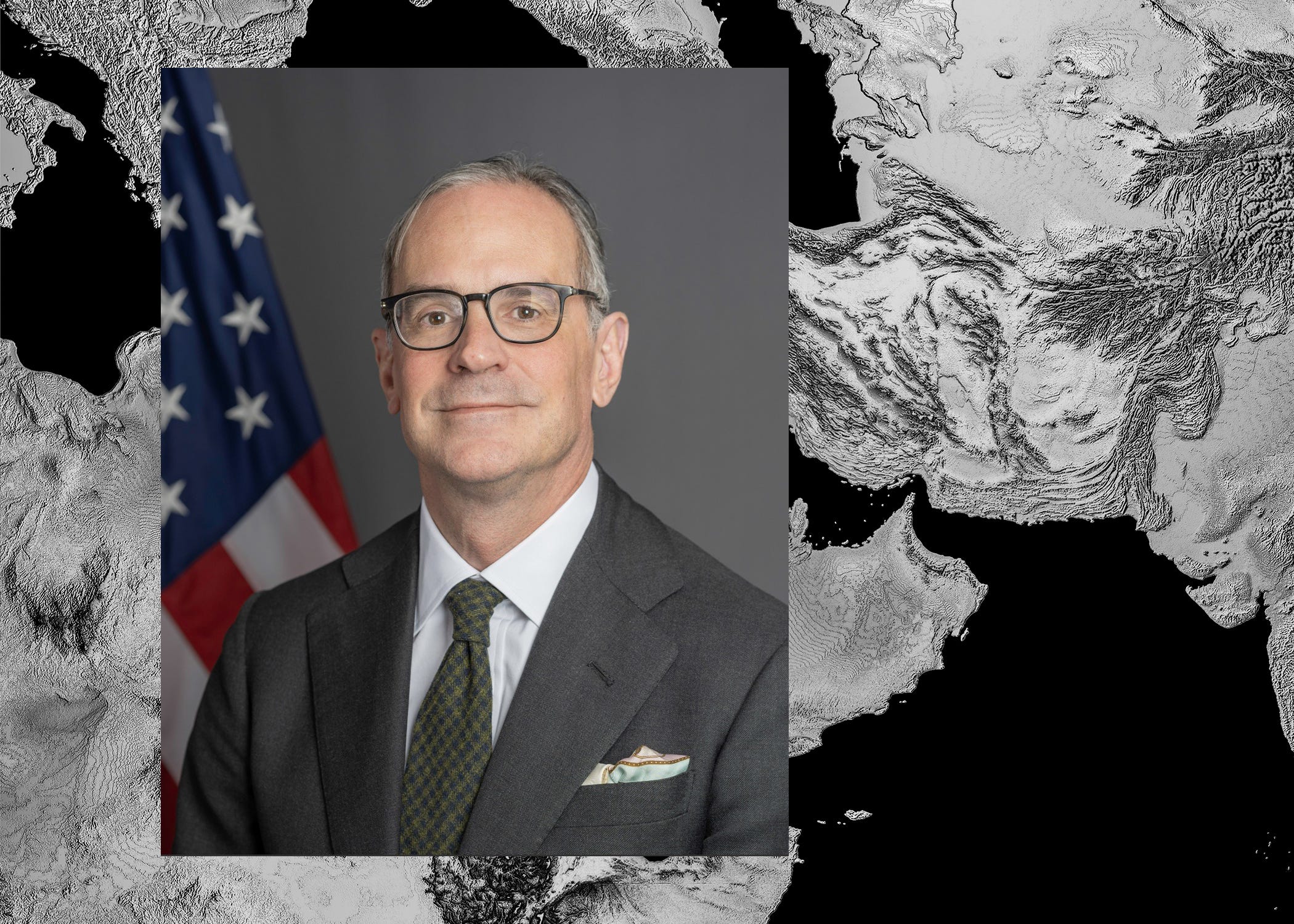
LAST WEEK, POLITICO REPORTED that after he completes drafting the Trump administration’s national security strategy, Michael Anton will step down from his post as director of policy planning at the Department of State and return to private life. Anton is the most famous of the small collection of what a few years ago were dubbed the “MAGA intellectuals”—the scholars who set out to explain and justify Trumpism. Previously known only for his somewhat obscure writings on men’s fashion, he came to the center of national attention as the author of the notorious “Flight 93 article” that made the case for Trump’s election in 2016.1
Anton’s argument there was that a Trump victory was an existential necessity for the United States. Americans had to do whatever was necessary to stop Hillary Clinton and the Democrats from destroying the republic by (among other things) allowing unchecked immigration of black and brown people—or in his words, “the ceaseless importation of Third World foreigners with no tradition of, taste for, or experience in liberty.” Like the passengers aboard the doomed hijacked plane, Americans had to “charge the cockpit or you die”—in other words, vote for Trump.
The most famous previous occupant of Anton’s policy-planning slot in the State Department was George F. Kennan. A brilliant writer, Kennan authored such historically significant documents as the Long Telegram and the “Mr. X article” in Foreign Affairs, setting out a coherent strategy for contending with the Communist USSR in the Cold War, a strategy that would go by the name he gave it, containment. In his prestigious post, Anton has had his work cut out for him. If anything, drafting a national security strategy today in our multipolar world is a far greater challenge than it was at the height of the Cold War.
America First is, of course, the name under which Trump’s foreign policy doctrine travels. It is a term with a history. Though it is unclear if Trump was aware of this history when he embraced the phrase while first campaigning for the presidency, it was the banner under which isolationism flourished in the years leading up to World War II. Along with such eminent Americans as the socialist Norman Thomas and future president Gerald Ford, the America First movement also attracted a gaggle of antisemites, most notably Charles Lindbergh, who warned in his notorious September 11, 1941, Des Moines speech that Roosevelt, the British, and “the Jewish” were attempting to drag America into the European conflagration.
Whatever its defects and ugliness, the original America First movement had a strong measure of coherence. Its proponents believed that the United States, separated by two oceans from the decadent old world and from Asia, should tend to its own business and not expend treasure and blood on behalf of faraway peoples of whom we knew little (to borrow a phrase).
One problem confronting Anton is that Trump’s version of America First is far more complex than its pre–Pearl Harbor forebear. To be sure, Trump has had a similar impulse to pull back from the world. This is most visible in the drastic constriction of military assistance to Ukraine, the wholesale dismantling of U.S. foreign aid with the gutting of USAID, and the decision to shutter the U.S. global media enterprise (Voice of America, Radio Free Europe/Radio Liberty, Radio Marti, and so on, which penetrated the airwaves of closed countries such as Russia, China, Iran, and Cuba).
Of a piece with this retrenchment is Trump’s announcement, made during his visit to Saudi Arabia, that henceforth the United States would stop hectoring other countries over shortcomings in their internal arrangements. In his address to the assembled Arab dignitaries, Trump condemned his predecessors for giving “lectures on how to live or how to govern your own affairs.” “In recent years,” he continued, “far too many American presidents have been afflicted with the notion that it’s our job to look into the souls of foreign leaders and use U.S. policy to dispense justice for their sins.”
But as Jonathan Chait observed in the Atlantic, Trump “does care about the internal character of regimes he deals with.” The only difference is that “rather than following a foreign policy that ignores values altogether, Trump has a clear preference for values that are, in the American context, historically anomalous or—to put it in less neutral terms—bad.”
A notable display of this contradiction is the case of South Africa. Evidently impelled by racial solidarity with supposedly beleaguered white Afrikaners, on the occasion of a visit to the White House by South African President Cyril Ramaphosa, Trump did indeed deliver a lecture to a foreign power on how to live and govern its own affairs. This included Trump’s spurious allegation that blacks were engaged in the wholesale murder of white farmers and that the South African government was failing to protect them. One pities Michael Anton as he tries to reconcile Trump’s spoken words with Trump’s diplomatic practice: contradictions in the doctrine of America First abound.
Another set of issues with which Anton has had to grapple is raised by the example of U.S. policy toward Vietnam, where in April Trump initially set a punitive tariff rate of 46 percent. But when Hanoi offered Trump prime real estate for a Trump hotel and a Trump golf course, the rate was promptly lowered to 20 percent. How does one fit such an instance of naked personal enrichment into a national security doctrine?
Another complexity presumably confronting Anton: Trump’s fawning and submissive behavior to dictators around the world, and in particular, Vladimir Putin. Is there strategic rhyme or reason that Anton could discern in Trump’s repeated insistence that Ukraine chose to start the war with Russia even though the facts are plainly quite the opposite? Or what about the praise that Trump regularly bestows on North Korea’s Kim Jong-un and China’s Xi Jinping?
India is a fellow democracy that has for decades been courted as a significant ally of the United States. How should Anton interpret Trump’s bitter and consequential quarrel with India’s prime minister Narendra Modi over the latter’s failure to engage in sufficient flattery, refusing to indulge Trump in the absurd fantasy that he deserves to be nominated for the Nobel Prize? The spat has led to a punitive 50 percent Trumpian tariff on Indian exports and it has pushed India closer to the Chinese orbit.
While we’re at it, how does the U.S. bombing of Iran’s nuclear facilities (which I applaud) fit into the America First picture? Or Trump’s endorsement (which I condemn) of the ethnic cleansing of Gaza with the objective of turning it into a Riviera-style resort? What about the demented threats to annex NATO ally Canada as a fifty-first state, seize Greenland from NATO ally Denmark, and reacquire the Panama Canal by force?
Producing a blueprint for Trump’s foreign policy, the task Anton has been engaged in, is the errand of a fool on steroids. The basic problem arises from the fact that U.S. foreign policy under Trump is driven not by any thought-out conception of U.S. interests but by whims and impulses shaped by Trump’s peculiar combination of prejudice, avarice, and an unquenchable thirst for praise.
We have come a long way down from George F. Kennan. To carry out the impossible task of backfitting Trump’s jumbled foreign policy into a coherent national-security-strategy document requires a special kind of mind: one that is both fiercely ideological and outstandingly mediocre. Anton has been the perfect man for the assignment. He will be sorely missed.
In much of his fashion criticism and in the original publication of “Flight 93 article,” along with his other early pro-Trump articles, Anton at first wrote pseudonymously.
 | A guest post by
|