Paying Too Much for Energy? Dems Say Blame the GOP
Plus: Redrawing more maps for 2026, and rewriting calendars for 2028.

EARLIER THIS YEAR when Democratic officials began to strategize about the midterm elections, there was widespread agreement that their message should emphasize rising costs. In the Democratic campaign committees and up and down the halls of Congress, the consensus was that the party should focus relentlessly on Donald Trump’s tariffs and the GOP’s Medicaid cuts.
But that focus has started to shift.
High prices are still the main theme, and Medicaid cuts and tariffs will continue to be an important component of Democrats’ midterms argument. But the party increasingly sees political opportunity in centering its message on rising energy prices. As electricity bills are spiking around the country—rising twice as fast as the rate of inflation—Democrats have started to weave the issue into more of their ads and talking points, believing it’s an effective way to tar a president who reneged on his commitment to lower prices.
Most of the Democratic consultants and lawmakers that I spoke to for this newsletter said that energy prices are easier to talk about on the campaign trail than tariffs (especially when some Democrats have gotten tripped up talking about the merits of “targeted tariffs”). Soaring energy bills will also be of interest to a wider audience than, say, Trump’s Medicaid cuts, as energy prices affect nearly all Americans. And the sense is that this issue is only going to become more pressing: Energy is expected to keep getting more expensive before next November.
Plus, Democrats believe, it’s fairly straightforward to explain why Republicans are to blame.
“They ran on this platform of lowering costs. And Trump and Republicans in Congress then passed legislation that will increase costs across the board,” said Sara Schreiber, the senior vice president of campaigns at the League of Conservation Voters, which recently launched a $4 million push in swing states on the GOP budget law. “It’s an intuitive thing. You’re thinking about your electric bill all year round.”
A few other recent efforts:
This month, the Democratic Congressional Campaign Committee ran digital ads focusing on rising energy costs. It has also been more aggressive about amplifying local coverage of spiking costs.
Clean Energy for America, an advocacy group, recently ran billboard ads in swing districts going after Republican House members who “just voted to raise your electricity bill.”
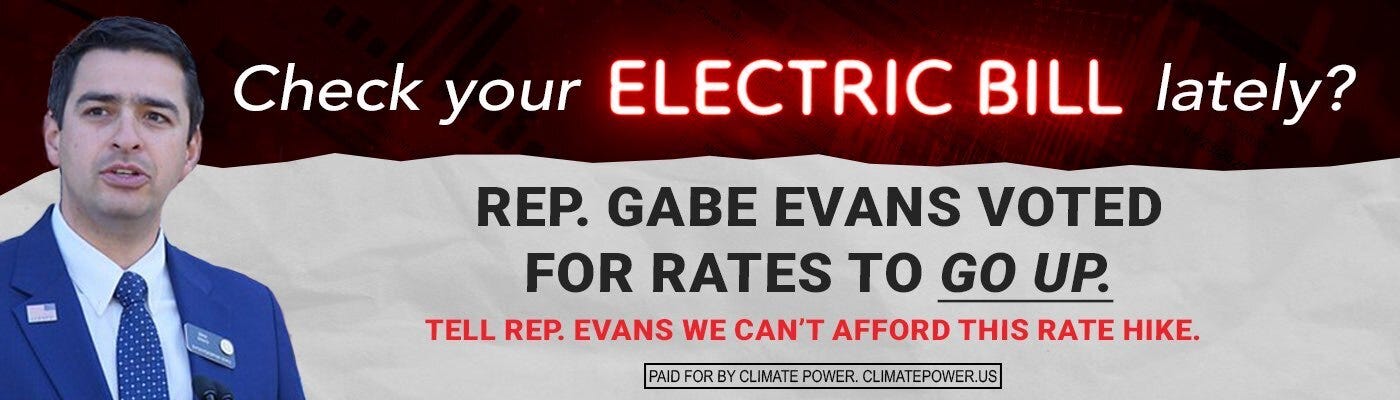
Climate Power, a Democratic-aligned advocacy organization, is airing an ad blaming Trump for higher energy costs.
And the Democratic National Committee has also been focusing on the issue, with plans to have former Washington Gov. Jay Inslee (who now works at Climate Power) on their YouTube show this week to highlight the topic.
Beyond the 2026 midterms, rising energy costs also present Democrats and climate groups with an opportunity to hit reset on the issue. For much of the last quarter-century, from the days of Al Gore through the debates over the carbon tax, the party has struggled to talk about climate change without using alarmist rhetoric that feels divorced from most voters’ focus on the dollars and cents of their energy bills. Efforts from lawmakers and climate advocates to center the conversation on pocketbook issues haven’t generally been effective, leaving Democrats vulnerable to GOP attacks. But there’s growing hope that will change this election cycle.
“It is critical to talk about climate change in an economic frame,” said Christina Polizzi, a spokesperson for Climate Power. “It is a political liability for Republicans to directly raise costs on Americans across the country, and for Donald Trump to say, ‘Hey, you’re on your own if an extreme weather event comes to your town.’”
Even before the Republicans’ “Big Beautiful Bill” was signed into law, energy prices were rising in part due to new data centers for cryptocurrencies and AI. But the bill compounded that issue by stripping away Biden-era federal tax credits for cheaper renewable energy like wind and solar. Recent analyses found that the new law could increase the average family’s energy bill by as much as $400 per year within a decade.
THERE ARE CERTAIN STATES and congressional districts where Democrats believe focusing on energy costs could be particularly beneficial. Energy prices have already become a key issue in the governor’s race in Virginia, which is home to dozens of energy-guzzling data centers. Plus, the argument could be more potent in red states that will lose clean-energy jobs under the new law as well as states with more extreme climates that make voters especially vulnerable to increased prices. JoAnna Mendoza, a retired Marine who is running in the Democratic primary for the chance to challenge Republican Rep. Juan Ciscomani in Arizona’s 6th Congressional District, has focused a lot of her campaign messaging so far on rising energy bills.
“In Arizona, it is hot as hell. It is so freaking hot, it’s triple digits. AC is on nonstop. Just last month, I had a $400 bill and I know I’m not alone,” Mendoza said in a phone interview. “It doesn’t matter whether you’re a Republican, an independent, a Democrat, or you don’t follow party politics at all—you’re going to feel it in your pocketbook.”
In a social media post last week, Arizona Sen. Ruben Gallego described it as a matter of life or death: “Across the country electricity prices are rising twice as fast as inflation. Families already stretched thin can’t afford it. And in Arizona in August, this isn’t just about comfort. It’s about survival.”
Most Democratic officials that I spoke with last week said that the fact that Republicans were already acting anxious and attempting to blame this problem on past Democratic administrations was a sign that Democrats had landed on a winning issue.
Listen, for example, to how Donald Trump’s energy secretary, Chris Wright, talks about the blame game. “The momentum of the Obama-Biden policies, for sure that destruction is going to continue in the coming years,” the former fracking CEO said in an interview last week with Politico. “That momentum is pushing prices up right now. And who’s going to get blamed for it? We’re going to get blamed because we’re in office.”
Democrats are counting on that.
🫏 Donkey Business:
— Among the most contentious subjects the Democratic National Committee will discuss at its annual summer meeting this week is the 2028 primary calendar. Alex Thompson reports in Axios that “Nevada, New Hampshire, and Michigan are currently the frontrunners to be ‘the new Iowa,’ and lead off the 2028 Democratic primary season.” Potential presidential candidates are already reaching out to DNC members to quietly develop relationships with them before they lock in the calendar.
The primary calendar might seem in the weeds, but whatever the DNC ends up deciding will say a lot about how they view the future of the party and which parts of their coalition they want to prioritize.
Some party leaders that I’ve spoken to about this in the past few weeks have expressed concern about going with a bigger state like Michigan where the candidate with the most money to run TV ads will be at an advantage. Thompson also notes that some “operatives worry that a spotlight on the state’s large Arab and Jewish populations could further stoke divisions in the party over the war in Gaza.” Other party leaders have suggested that they ought to go with a smaller, more rural state (like Iowa!) that would force candidates to tailor their message to parts of the country that have turned away from Democrats in recent elections.
— As the two most populous states move forward with their plans to redraw their congressional maps—with a more-red Texas map just awaiting Gov. Greg Abbott’s signature and a more-blue California map to be voted on in a special election this November—pressure is growing on other states to also take action ahead of the 2026 midterms. Republicans are eyeing Florida, Ohio, Missouri, and Indiana as potential opportunities to pad their advantage in the House while Democratic leaders in New York, Illinois, and Maryland are considering their options. Republicans still have a clear advantage here, since more Democratic-leaning states have independent redistricting commissions that complicate mid-decade map drawing. Yet Democratic leaders are still urging them to act.
“Right now, these other states need to step up,” Rep. Robert Garcia (D-Calif.) told Politico. “I know it’s hard, I know it’s complicated. . . . But, if you’re a blue state governor, the time is now to step up and get it done.”
My open tabs:
— The United States Is Southern Now
— NIL Goes to High School: Million-Dollar Teen Quarterbacks, Legal Battles, and Fast Cash
— The 1988 Trap: Democrats Are in Danger of Repeating a Painful Lesson
Democrats shouldn't waste time deciding what issue to focus on. They should hammer the Republicans on every issue, every day. It's a target rich environment. But their arguments need work.
"Across the country electricity prices are rising twice as fast as inflation."
Yes, but this isn't good enough. This is better: "Across the country electricity prices are rising twice as fast as inflation, and inflation is accelerating because of Republican tariffs." Don't just go after Trump on tariffs, hang this on every single Republican, every day. Remind voters that congress has the constitutional authority to set tariffs, and they empower Trump to do what he is doing. It wouldn't hurt if Democrats became the free-trade party and walked away from tariffs except in really extreme circumstances. This has the benefit of being good policy, because it lowers prices and helps companies become more competitive. But this amounts to an unnatural act for Democrats. For decades they have played the game of advocating tariffs to gain political advantage with this constituency or that trade union; enough to matter, but small enough that the rest of us won't notice the hit to our pocketbook. How is that working out? The largest constituency of all is the American consumer. Republicans have left the door open for Democrats to walk through it and take the issue away from them.
Please, please, drop the idea of the "new Iowa" leading off the primary season. There is no new Iowa. I grew up there, and I am still well connected. At most, Democrats have a chance (much like a snowball in Phoenix) to flip a single congressional district in Iowa. Iowa is one of the whitest states in the country, and they most fervently want to stay that way. For nearly two decades, they sent Steve King to congress. You know, the guy who said immigrants were "poisoning the blood" of Americans. He was the most racist member of congress in a competitive field. Iowans all go to church (a very slight exaggeration), and they think god created Iowa just for white Europeans (no exaggeration at all). Making it a priority to find a candidate who appeals to Iowans will be death to turning out what remains of the Democratic base.
We went solar 4 years ago, taking advantage of state and federal tax credits. We have a heat pump providing heat and ac. Our energy bills are at or near zero half the year, and quite affordable the rest. Those who can should get busy.