‘Peace Through Trump’ in Ukraine? Don’t Count on It.
Trump rolled out the red carpet. Putin rolls out new missiles.

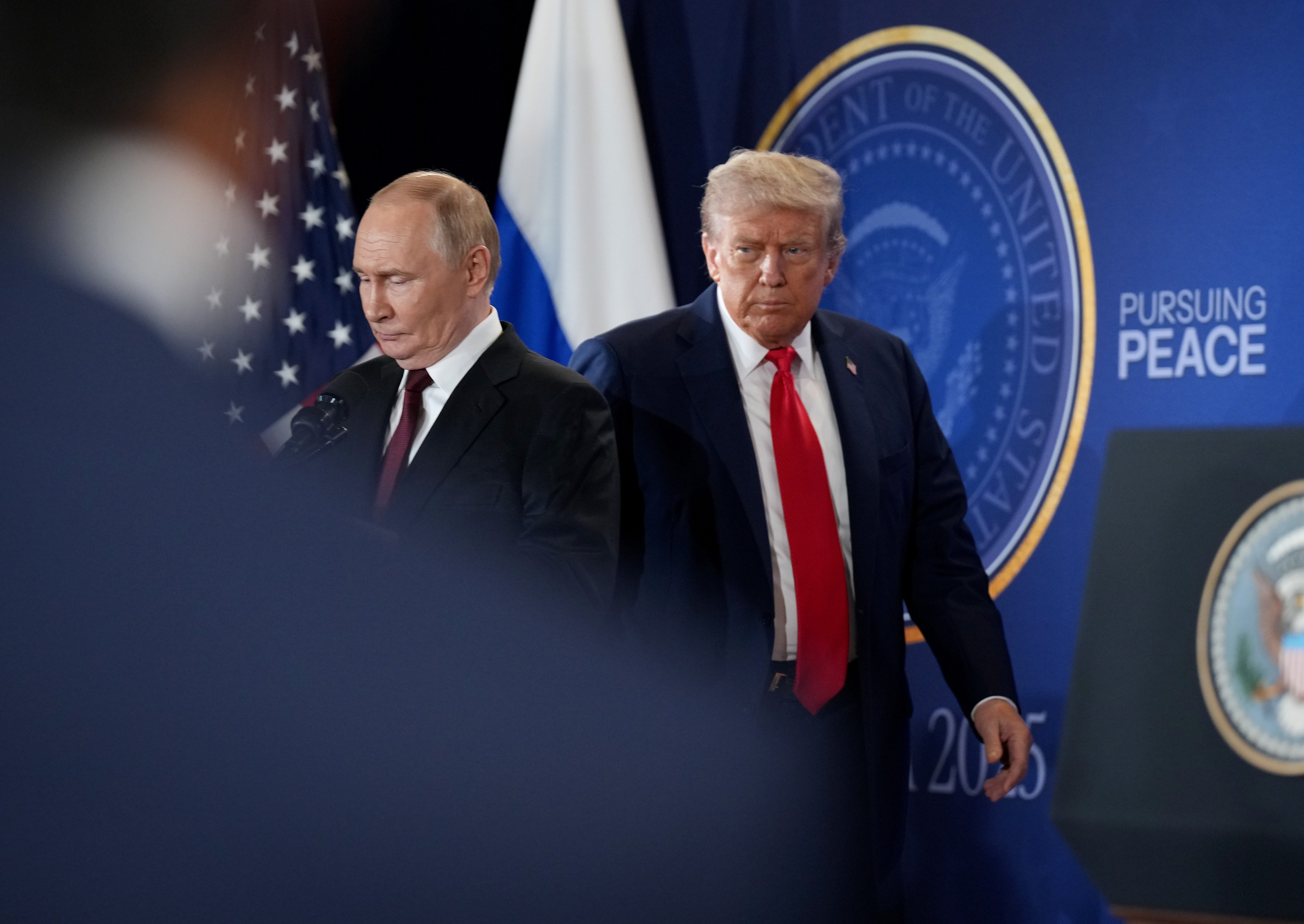
THREE MONTHS AFTER DONALD TRUMP gave Vladimir Putin a literal red-carpet welcome in Anchorage, Alaska, Putin rattles his nukes, Trump rattles back, and the long-promised peace deal has never seemed so far away. But what is happening on the ground (and in the air) between Russia and Ukraine—and in the messy relations between Russia and the United States? Let’s review the news from the last few weeks for a better picture.
On September 23, five weeks after the Alaska summit, Trump mocked Russia’s stalled war effort in Ukraine, saying it made Russia look like a “paper tiger.” That remark came on the heels of a summer offensive in which Russia suffered massive losses and captured very little land. Then came another phone chat with Putin, a near-miss of a summit in Budapest (averted after Secretary of State Marco Rubio spoke to Russian foreign minister Sergei Lavrov and realized that Russia was not backing off its goal of biting off large chunks of Ukraine and turning the rest into a vassal state), and a reportedly tense meeting on October 20 between Trump and Volodymyr Zelensky. While the Trump/Putin bromance wasn’t quite back on, by last week Putin had succeeded in scuttling U.S. delivery of long-range Tomahawk missiles to Ukraine (if those missiles actually were on the table).
Meanwhile, the Kremlin has stepped up the narrative of its inevitable victory on the ground in Ukraine. Thus, at a televised meeting on October 26, Chief of the General Staff Valery Gerasimov presented Putin with a frontline report that even many of Russia’s war-hawk “milbloggers” found absurdly inflated: Among other things, he claimed that Russian forces had completely surrounded over five thousand Ukrainian troops in the Pokrovsk combat zone and eighteen battalions at Kupyansk. (Maybe they’re the same thousands of Ukrainian soldiers supposedly trapped in Russia’s Kursk province back in March, when Trump dramatically pleaded with Putin to spare their lives.) Numerous Russian milbloggers dismissed these claims as fictitious or at least premature.
Nonetheless, it does seem clear that the Russian offensive has picked up speed in some areas in the last two or three weeks. Right now, Russia does appear to be on the cusp of taking Pokrovsk, or the ruins of Pokrovsk, after more than a year of intense fighting; the new tactic of piecemeal infiltration by small units, replacing the massive frontal assaults gruesomely dubbed “meat storms,” seems to be yielding results. The danger of encirclement for Ukrainian forces in the Pokrovsk pocket—and especially in the neighboring suburban town of Myrnohrad—is real; since Ukraine, unlike its adversary, remains a country where such questions as the human costs of prolonging a city’s defense can be openly debated, there have been calls to withdraw and cut the losses. So far, Ukraine’s high command has refused to do so. The real situation is difficult to assess since, as the Kyiv Independent puts it, “the city has descended into a deep gray zone, in which the concept of territorial control is lost in a fog of chaotic movement.” With the fall weather setting in, the fog is sometimes literal, and it has helped Russians enter Pokrovsk under its cover and evade drones.
In some parts of Pokrovsk, Ukrainian troops are still pushing the Russians back; on October 31, Ukrainian military intelligence also pulled off a daring nighttime operation in which two commando platoons were flown into Pokrovsk on two Black Hawk helicopters to join with other elite units already in the area, apparently for the purpose of strengthening Ukrainian defense lines and ensuring a safe path of retreat. (Some Russian media outlets claimed that Ukraine’s military intelligence chief, Kyrylo Budanov, was part of the landing operation, but there is no confirmation of this, and the Russians may have misunderstood reports that the mission was “under Budanov’s command.”)
If Pokrovsk—which French author and filmmaker Bernard-Henri Lévy called a “martyr city” in his documentary Our War, released earlier this year—does fall to the Russians soon, it will certainly be a dark moment in the history of this war. It will be a depressing conclusion to Pokrovsk’s heroic defense chronicled by Lévy; it is also a frightening prospect for the few civilians remaining in the city, mostly because they waited too long to leave safely. (The number of residents who are still there is estimated at 1,300, though this also includes some local Russia sympathizers who are waiting for the Russians to come.) But the fall of Pokrovsk won’t signal the collapse of Ukrainian defenses that Putin keeps predicting; nor will it be a big step toward Russian victory in Eastern Ukraine. Once a major transit hub, Pokrovsk’s strategic significance has plummeted since Russia began its siege of the city in the summer of 2024, and its surrender won’t get Russia much closer to the coveted fortifications in the Slovyansk-Kramatorsk area that it would need to take to complete the capture of the Donbas.
Most Ukraine war-watchers, such as Russian émigré military expert Yuri Fedorov, think that Pokrovsk now has little strategic importance and that its true significance for both Russia and Ukraine is political. Partly, it’s politics for domestic consumption: The loss of Pokrovsk would likely have a negative impact of Ukrainian morale while enabling Russian propaganda to tout a victory. But Trump may be an even more important audience: The fate of further American aid to Ukraine, and of U.S. relations with Ukraine and with Russia, depends for the foreseeable future on which side he regards as the “loser.” Ukrainian soldiers may die needlessly at Pokrovsk, or risk capture, because their country desperately needs to impress the American president.
FOR PUTIN, NUCLEAR WEAPONS—especially of the Wunderwaffe variety, the nickname given the “superweapons” the Nazis frantically worked to design while losing World War II—are another way to impress. Last week, he announced that Russia had started mass production of the Oreshnik, the intermediate-range ballistic missile first trumpeted last year as a formidable new weapon capable both of carrying nuclear warheads and of doing tremendous damage with conventional ones. The next day, at a celebration of Russia’s November 5 “National Unity” holiday, the Kremlin dictator presented awards to the designers of two new alleged superweapons—the Burevestnik, a nuclear cruise missile of nearly unlimited range, and the Poseidon, a nuclear-powered and optionally nuclear-armed torpedo—and gloated about their fearsome capabilities. That was followed by an obviously staged moment during a televised meeting of Russia’s Security Council in which, supposedly departing from the scheduled agenda, Duma speaker Vyacheslav Volodin raised the question of Trump’s just-announced plan for renewed nuclear weapon testing (itself a response to the Burevestnik test, which Trump decried as “inappropriate”); Gerasimov and Defense Minister Andrei Belousov urged Russia to respond by starting “preparations for full-scaled nuclear testing,” and Putin ordered officials to submit proposals for such tests.
It’s hard to say to what extent Putin believes in the game-changing capabilities of his superweapons, almost universally doubted by experts. Pavel Podvig, a Geneva-based analyst specializing in Russian nuclear forces, summed up the prevailing view in a pithy comment to NBC News on the Burevestnik: “The main reason that no one else has tried to build something like this is that it doesn’t really have any use.” (The name, which means “Storm Herald,” has unmistakable Soviet echoes: It’s the title of a 1905 allegorical poem by Maxim Gorky in which the flight of a storm petrel heralds the coming revolution, and which every Soviet schoolchild had to learn by heart.) The real point, of course, is to scare the United States and Europe out of helping Ukraine—in this case, most likely, out of giving Kyiv the Tomahawk missiles. As Russian expatriate journalist Michael Nacke put it on his YouTube stream, “The Russian tests are intended for an audience of one: Donald Trump.” Nacke, who is no Trump fan, has also expressed the view that in this case, Trump’s notoriously fragile ego may actually be an asset, making him more resistant to Putin’s intimidation and sending him into “My button is bigger” mode: witness his pointed reminder, in response to the Burevestnik test, that the United States has a nuclear submarine “right off [Russia’s] shores.” Nuclear one-upmanship may cause jitters, but in today’s environment, it’s almost certainly preferable to deference to nuclear blackmail.
Putin’s missile-flexing suggests that his confidence in Russia’s ability to win the war is not as great as he would have his various audiences believe. Maybe, as open-source intelligence analyst Ruslan Leviev says, Russia could take all of Donbas in a year or a year and a half if the fighting continues at its current pace. But given Russia’s massive recent casualties, which have forced it to turn to foreign fighters and send recovering wounded soldiers back into combat, it’s far from clear that anything like this pace could be sustained much longer. A recent confidential poll commissioned by the Kremlin reportedly found that some 80 percent of Russians say they are “tired” of the so-called “special military operation” in Ukraine (including 56 percent who say they are “very tired”). Ukrainian strikes deep inside Russia, which have recently caused power and heating outages in two major cities, are contributing to this fatigue. So are, no doubt, the proliferating stories of murders, rapes, and robberies by men who have returned from fighting in Ukraine—some of them former convicts recruited from prisons. In one survey by the Levada Center, Russia’s most respected polling firm, 40 percent of respondents said they feared growing crime and instability caused by homecoming veterans.
Add to this, finally, the impact of recent U.S. sanctions targeting Russia’s oil companies. Skeptics like University of St. Andrews (Scotland) strategic studies professor Phillips O’Brien are inclined to think that the sanctions are mostly meaningless bluster, since the enforcement delay until November 25 gives major buyers like India and China plenty of time to find loopholes. But in fact, those countries have already cut their Russian oil imports. (It’s also worth noting that the loopholes generally mean discounted prices and lower revenues for Russia.) And there are other signs that the sanctions have real bite: Last week, the Swiss commodity trader Gunvor dropped its proposal to buy the foreign assets of Lukoil, one of the targeted Russian companies, after the U.S. Treasury slammed the company as a Russian “puppet” and made it clear that the U.S. opposed the deal. If the sanctions put a tangible dent in Russia’s already plunging oil profits, they can significantly slow down Putin’s war machine. Meanwhile, Ukraine may soon get a big boost from a €140 billion interest-free loan backed up by frozen Russian assets if the European Union finally finds a way to do it.
Unfortunately, U.S. support for Ukraine remains essential, and it remains in the hands of an ego-driven, volatile, ignorant man easily wooed with fabulism and flattery. On a visit to the White House last Friday, Hungary’s Trump-friendly semi-autocrat Viktor Orbán got an exemption from the oil sanctions (albeit with a promise to expand his purchases of American natural gas to diversify Hungary’s energy sources) by repeating to Trump his favorite story: that the war in Ukraine would not be happening right now if Trump had been president in 2022. Orbán, who also reiterated his “Ukraine can’t win” leitmotif, made it almost refreshingly clear what his “peace through Trump” scenario was: After the invasion, Ukraine would not have received significant aid from the United States or Europe, and the war would not have been prolonged. In other words: Ukraine would have folded, and Putin would have won.
Trump, of course, lapped it up.
It remains to be seen whether the conversation with Orbán will influence Trump’s Ukraine policy beyond Hungary’s exemption (the scope of which is still unclear) from the oil sanctions. But, for Ukraine’s and the free world’s sake, we should all hope that Volodymyr Zelensky’s own Trump-ego-stroking skills remain sharp—and that Trump is impressed by Ukraine’s skill at taking out Russia’s oil depots and drone warehouses. As the war inches toward its four-year mark in February, we are still waiting to see whether the Trump administration will act as Ukraine’s ally or resume trying to force it into a bad peace.
Thank you for this update Cathy and for all your continuing coverage of this terrible war. What a stark contrast between the courage of the Ukrainians in defying the Russians and the cowardice that so many Americans have shown in the face of Trump's attempted destruction of our Constitution, rule of law and simple human decency.
Europe is the only hope. Donald Trump at the first sign he sees an opportunity will say he ended the war and whatever “peace” agreement Trump & Rubio extort Ukraine into will leave the Ukrainian territory as safe as the East wing of the White House.