

Hegseth’s War on the Press Is a War on the Pentagon’s Credibility
All the news that fits the narrative.

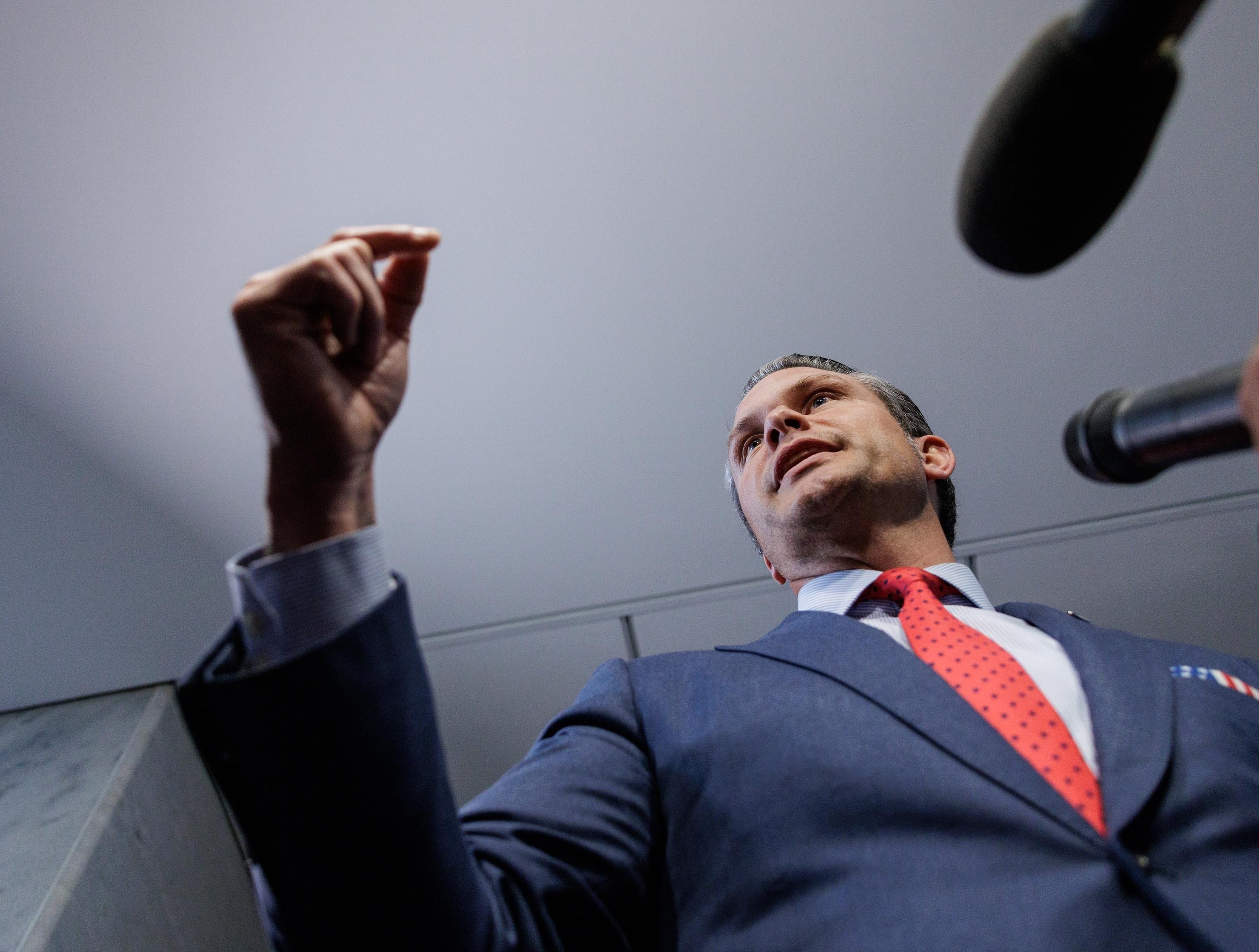
LATE IN BARACK OBAMA’S PRESIDENCY, the speechwriters for the secretary of defense—of which I was one—still occupied an expansive office in the Pentagon that Donald Rumsfeld had used for his scribes more than a decade before. With comfortable couches, widescreen televisions, and enough room for a general and their staff, we hated to give it up.
When a few midlevel bureaucrats showed up one day unannounced, like the Bobs from Office Space, poking around and taking measurements, we knew our luck had run out. The Pentagon press corps needed more room closer to “the bullpen” where uniformed press officers fielded questions. And so, the Bobs explained, the speechwriters were moving to smaller quarters. The message was clear: The most important writers in the Pentagon were not the secretary’s. They were the press.
Pete Hegseth has taken a far different approach at the Pentagon. Days after his confirmation as secretary of defense, he kicked out media outlets with deep experience in the building, including the New York Times, NPR, Politico, and NBC News, providing their office spaces instead to outlets that had been supportive of President Donald Trump. Last October, Hegseth’s press office required reporters to sign a pledge to report only information pre-approved by the Pentagon. If they refused, they would lose their press credentials and Pentagon access. Most reporters voluntarily surrendered their credentials, walking out of the building.
Hegseth has appeared sparingly (though a bit more of late) in the Pentagon’s briefing room to take questions. The briefings he has provided give new meaning to the phrase “bully pulpit.” Last week, he alternated between referencing scripture and disparaging the press. He called journalists “unpatriotic,” described their reporting as “an endless stream of garbage” that they “cannot resist peddling,” and compared the press to the Pharisees, the biblical scribes who helped hand over Jesus to Roman authorities.
Hegseth’s approach to the press risks lasting damage to the institution he leads. A Pentagon that shares only good news with the public, and a secretary who consistently insults the press, lose both the benefit of the doubt and an important mechanism for self-correction. Hegseth’s posture endangers more than accountability at the Pentagon. It limits the effectiveness and legitimacy of U.S. service members who are called to carry out their mission.
HEGSETH DIDN’T ALWAYS SEE THE PRESS as a threat. And not just because he previously worked as a host at a news outlet. While serving as a civil affairs officer during the Iraq War, he described the work of a Wall Street Journal reporter embedded with his platoon for a week in Samarra. “For the most part it was a fair article,” he wrote in an email home, adding legitimate concerns about whether the reporter had revealed too much about an Iraqi official who was working with Hegseth’s unit. In the same note, Hegseth praised the work of Iraqis in setting up a city council and a newspaper. He described a placard above his work area to remind himself about his Iraqi partners. “They want to believe,” it said.
Most reporters who cover the Pentagon feel the same way. They take pains to protect operational security and report accurately to the public. Earlier this year, the New York Times and the Washington Post both chose not to report on the raid on Caracas before it happened so as not to endanger American forces. These reporters want to believe the Pentagon is acting in good faith, but Hegseth has made that nearly impossible.
One of Hegseth’s criticisms of the press is that it doesn’t report enough about the military’s heroism. But the secretary of defense is not an assignment editor. And even if he were, the Pentagon’s policy of embedding reporters with units in combat theaters has faded away over the past decade, preventing journalists from getting the access they would need to bring stories of heroism home to Americans.
Secretary Rumsfeld’s decision in 2003 to embed hundreds of journalists with units in combat theaters was controversial and, in some corners, criticized as an attempt to control the narrative. Years later, it’s clear that journalists helped spur changes that made U.S. forces more effective in tangible, life-saving ways.
Take the reporting of Edward Lee Pitts, then of the Chattanooga Times Free Press, embedded with 278th Regimental Combat Team, built around a storied unit of the Tennessee National Guard. The unit was heading into Iraq from Kuwait in 2004 with a limited number of up-armored vehicles. Before the unit was scheduled to attend a town hall with Rumsfeld, Pitts worked with two soldiers on questions they should ask about the protection their vehicles provided. Spc. Thomas “Jerry” Wilson asked Rumsfeld why soldiers had to “dig through local landfills for pieces of scrap metal” to protect their vehicles.
Rumsfeld’s response became infamous: “You go to war with the Army you have, not the Army you wish you had.”
Reporters from Stars and Stripes along with other embeds revealed that other units were also scavenging metal for protection or using sandbags to secure the floors of their vehicles. “Hillbilly armor” became part of the vernacular. As a result, the procurement process at the Pentagon pivoted to provide more up-armored vehicles for soldiers.
Or take Robert Little’s and Tom Bowman’s reporting in the Baltimore Sun on the lack of tourniquets provided to soldiers. After the story broke, the Pentagon made tourniquets standard-issue for everyone deployed. The roughly $20 investment per soldier is estimated to have saved between 1,000 and 2,000 lives. Whether on improvements to personal body armor, reduced medevac times, or traumatic brain injuries, reporting from Iraq and Afghanistan helped make the force stronger. Today, with large-scale ground combat in Iran still a real possibility, both the Pentagon and the public have less access to information precisely because journalists have less access to the armed forces.
LESSONS FROM THE BATTLEFIELD RARELY come easy. I saw this firsthand working at the Pentagon as a speechwriter for Secretary of Defense Ash Carter and as director of strategic communications for Secretary of the Army Eric Fanning. I was at the Pentagon when a hospital in Afghanistan staffed by Doctors Without Borders was bombed in 2015. The first reports from Kunduz were confusing. Perhaps it was Afghan forces, believing the Taliban was operating from the hospital, who were responsible. But U.S. forces were also nearby.
The next day, Secretary Carter was on the way to Spain, Italy, and the United Kingdom for a trip focused on strengthening NATO’s “southern flank” to address an influx of refugees and potential instability. Rather than avoiding reporters or news of the Kunduz strike, he understood the need to address both directly on the flight to Madrid. In a gaggle with reporters aboard his plane, he led with the difficult news, and a commitment: “We will get the facts, and we will be full and transparent about sharing them with the American people, but also with the people of Afghanistan, and for that matter, the entire world.” The press peppered him with questions, not about the ostensible purpose of his visit to Europe, but about what he knew about the tragedy in Afghanistan, which he answered at length. Two days later, Secretary Carter committed to a thorough review. “When we make mistakes, we own up to them,” he wrote.
Six months later, the Pentagon released its report, finding American forces responsible. Sixteen members of the military were held accountable. Payments were made to the victims’ families. Questions from the press helped to make that accountability possible.
This is in stark contrast to how Hegseth’s Pentagon operates today. When the U.S. hit a Houthi fuel terminal in April 2025, killing an estimated eighty civilians, the Defense Department provided little information. Three senators wrote to Secretary Hegseth asking whether the Pentagon had assessed civilian casualties from individual strikes. No public response was provided.
In fact, Hegseth never appeared before the Pentagon press corps for a full briefing during the air campaign against the Houthis. Dubbed “Operation Rough Rider,” the campaign cost taxpayers up to $2 billion and consumed a meaningful share of Tomahawk and JASSM missiles that Pentagon planners had husbanded for contingencies in the Pacific. Houthi counterattacks also cost the Navy two F/A-18 Super Hornets—one knocked off the flight deck of USS Harry Truman when the carrier was forced to maneuver quickly, and another in a failed landing.
Hegseth did find time, however, for an interview with his old network, Fox News, after the first strikes against alleged drug traffickers in the Caribbean last September. “I watched it live,” he said. “We knew exactly who was in that boat, we know exactly what they were doing, and we knew exactly who they represented.”
Later, after the Washington Post reported that Hegseth had provided a spoken directive to kill any survivors of a first strike, raising questions about violations of international law and the military’s own code of ethics, Hegseth’s story appeared to change. At a cabinet meeting, Hegseth said he had not seen the strike in its entirety. “I watched that first strike live,“ he said. “At the department of war, we got a lot of things to do, so I didn’t stick around.”
HEGSETH HAS ACCUSED THE PRESS of partisan bias as part of his rationale for limiting access. But consider two of the outlets Hegseth’s press office first removed from the Pentagon and what they reported during the Biden administration. One of those outlets was the New York Times, which revealed in 2021 that what then-Chairman of the Joint Chiefs Gen. Mark Milley called “a righteous strike” against ISIS during the exit from Afghanistan had, in fact, killed civilians, including an aid worker and seven children. Milley, despite being appointed by Trump in his first term, had since become a major enemy of MAGA. The other outlet, Politico, broke the news in 2024 that Secretary of Defense Lloyd Austin was absent from the Pentagon for days without notifying President Biden or other senior national security officials.
In this context, Hegseth’s accusations of bias appear to be another effort to avoid scrutiny entirely. It is not that Hegseth is shy. His talents as a performer and effectiveness as a pro-Trump voice on Fox News helped to make him secretary. Early in his tenure at the Pentagon, he reportedly renovated space near the press briefing room to use as a make-up studio. The clips he produces are sharp, ready-made for TikTok and Instagram.
Hegseth’s press strategy is designed to get his message out without relying on journalists as an intermediary. On its own, this is nothing extraordinary; many officials from both sides of the aisle attempt the same. But Hegseth appears not to be interested in speaking on behalf of the military and the administration to the American people, but rather in speaking just for himself and just to the MAGA base. This month, Secretary Hegseth has removed the top uniformed leader of one service, Army Chief of Staff Gen. Randy George, and the top civilian leader of another, Secretary of the Navy John Phelan, without going on the record to explain why.
IN THE WEEKS BEFORE WE LEFT the Pentagon speechwriters’ office space, I discovered some materials that Rumsfeld’s team had left behind. Rumsfeld had departed in quick retreat; the day after the Republicans suffered a resounding defeat in the 2006 midterm elections, George W. Bush accepted his resignation. In our office was a bookcase full of binders, at the front of which were Rumsfeld’s famous “snowflakes,” short directives on Post-it notes, with a full set of supporting materials in response. One compared U.S. combat fatalities in Iraq to American deaths in traffic accidents over different years. It was a grim report, though an attempt to reframe the war’s mounting costs. The fact that Rumsfeld felt compelled to make that argument at all, to justify the war to a questioning press and a watchful public, was itself a form of accountability. Rumsfeld knew he had to answer.
Secretary Hegseth behaves as if he feels no such compunction. He will not be secretary of defense forever. But the distrust he has created between the Pentagon and the press, and the damage he has done to the credibility of the U.S. military, will take far longer to repair. In a democracy, the effectiveness of a military is always tied in some sense to its legitimacy with the public. Both will continue to erode as long as the changes Secretary Hegseth has made at the Pentagon remain in place.
Patrick Granfield served as a national security appointee in the Obama administration and, most recently, as senior adviser at the U.S. International Development Finance Corporation (DFC).
 | A guest post by
|