Please, Mr. President. More Conventions, More Campaigning!
In the Democratic party’s quest to make this election a referendum on Trump, Trump is helping.


Donald Trump’s 2025 financial disclosures are out, and boy, did he rake it in last year: a $500 million deal to sell half his crypto company World Liberty Financial to a UAE firm, hundreds of millions more in fees related to sales of his memecoin and other digital assets, and on and on. All told, Trump pulled in more than $2.2 billion last year.
It’s a good moment to revisit a favorite Karoline Leavitt quote: “Neither the President nor his family have ever engaged, or will ever engage, in conflicts of interest.” Which may even be true: Trump plainly cares a lot about his personal fortune and zero about the future of America, so where’s the conflict? Happy Wednesday.
Join Mark Hertling and Ben Parker live on Substack and YouTube at 10:30 a.m. EDT today for Command Post.

DONALD J. TRUMP to the Rescue
by William Kristol
Late yesterday afternoon, some of us were taking a much-needed break from politics as we watched Kylian Mbappé take a pass from Michael Olise, slice through the defense, and score France’s first goal in their impressive World Cup victory over Sweden.
But not President Trump. He was busy with weighty matters of state. He was posting an announcement on Truth Social. And not just any old announcement. It was “BIG NEWS!”

To which those of us who think it crucial that Trump and his party suffer a decisive defeat in this November’s mid-term elections could only say one thing: THANK YOU, President DONALD J. TRUMP!
Polling on Americans’ voting intentions for the midterms shows Democrats now have an advantage nationally over Republicans of about 6 points. How can that number be increased? Well, polling also shows that about 58 percent of Americans now disapprove of DONALD J. TRUMP, with only 39 percent approving—a net disapproval of almost 20 points.
So: Remind voters that Republicans are above all the party of the man of whom they disapprove by so significant a margin, DONALD J. TRUMP. And make sure that November’s election is above all a referendum on DONALD J. TRUMP, and whether you want him and his administration emboldened or checked.
The New York Times this morning reports on a new survey of voters in the six states that are likely to determine control of the Senate this November. Trump won five of these six states in 2024, four of them by more than ten points. Today they’re all in play. Republicans lead by a slim two or three points in Alaska, Iowa, and Ohio. Democrats are comfortably ahead in North Carolina, and they have a slight edge in Maine. Texas is tied. Across all six states, voters’ preferences are tied at 47 percent for each party.
But judgments of DONALD J. TRUMP aren’t tied. He has an average approval rating in these states of only 43 percent, with 54 disapproving—a net 11 percent disapproval. By a margin of 14 percentage points, voters in these battleground states said that his policies have done more harm than good. And only 36 percent of voters in these states approve of his handling of the cost of living.
So it’s good that the Republican party is leaping to satisfy DONALD J. TRUMP’s desire for a big show in September. It’s good that the party is wrapping itself ever more closely in DONALD J. TRUMP’s smothering embrace. It’s good of them to remind the voting public that if they vote for Republicans, they’re voting for obedient supporters of the policies and the administration of DONALD J. TRUMP.
And it’s good of Republicans to do this right after Labor Day, as voters start to focus on the November elections. It’s good of them to make the theme of their convention a GREAT AMERICAN COMEBACK when only about a third of Americans think the nation is in fact on the right track. It’s good of them to gather in Texas, where the GOP Senate candidate, Ken Paxton, is particularly corrupt and the state GOP particularly extreme.
The greatest threat to a big Democratic victory in November is . . . the Democrats. Their brand isn’t good. And in some states they’re nominating problematic candidates, whom Republicans and their media allies will be working overtime to make the faces of the party.
But DONALD J. TRUMP is coming to the rescue. He’s doing his best to make sure November is about DONALD J. TRUMP. Democrats can help out by remaining focused on making the case against DONALD J. TRUMP, and on the need to check DONALD J. TRUMP in November.
But they should also take a little time to enjoy the World Cup.
Contra the SCOTUS Doomers
by Andrew Egger
It’s easy for me to understand why many people, including our own fearless leader JVL and my colleague Adrian Carrasquillo, are so cynical about yesterday’s 6–3 (or is that 5–4?) ruling in Trump v. Barbara, the birthright citizenship case. Birthright citizenship has seemed settled law for a century; the idea that three or four justices seem receptive to reevaluating it, apparently at the behest of Donald Trump, seems—to put it mildly—ominous. But let me offer another take.
The chief thing to understand about yesterday’s ruling is that it was not merely an up or down ruling on whether Trump’s order challenging the citizenship of all Americans born to foreign parents would be allowed to go into effect. Chief Justice John Roberts, writing for a five-justice majority that also included Amy Coney Barrett and the court’s three liberal justices, declared Trump’s order challenging birthright citizenship facially unconstitutional in its entirety—the judicial equivalent of nuking it from orbit and salting the rubble.1 They didn’t just block the Trump administration from challenging the citizenship of the illegal aliens they want to deport. They created a strong constitutional precedent against any president ever challenging the citizenship of any person born in the United States ever again.
If you read the dissents, you’ll notice that it is this decision to rule the order facially unconstitutional, not necessarily a determination to uphold Trump’s order as written, that primarily motivates the dissenters. All three dissenters2 express skepticism that the challenges to Trump’s order meet the Salerno test, not because of the case of the children of illegal immigrants—which is what Trump cares the most about—but because of the much smaller-ball matter of “birth tourism,” the practice of foreigners briefly visiting the United States to give birth to a child without any intention to remain.
In their dissents, Gorsuch and Thomas both suggest they would have ruled in such a way as to rule out the children of birth tourism. In their view, such children are not “domiciled” in the United States—do not, in other words, consider it their home, and are thus not “subject to the jurisdiction thereof” as the text of the Fourteenth Amendment requires. And yet neither justice argues they would necessarily condone Trump zeroing out the citizenship of the children of illegal immigrants who do consider the United States their permanent home—the vast majority of those Trump’s order was intended to target. On this matter Thomas is more agnostic, saying there are strong arguments both for and against the idea that illegal immigrants can be “domiciled” in America,3 while Gorsuch strongly suggests that he believes children of illegally resident aliens should be considered “domiciled” here.4
Is all this just pointless legal hair-splitting? I don’t think so. If Gorsuch and perhaps even Thomas would have been willing to protect birthright citizenship for the American children of illegal immigrants, and only balked at enshrining those protections for birth tourists, then we need not fear—as Adrian suggests—that “the door remains open” for future legislative attacks on birthright citizenship “with only one justice needed to flip.” This might be true as far as children of birth tourism go, but the Court has given us no reason to think it is true on the broader matter of children of illegal immigration.
Which in turn leads to another insight about what Chief Justice Roberts was up to here. It is possible to imagine a world in which Roberts—on the hunt for greater consensus on a controversial issue—agreed to slice the matter more finely: perhaps by kicking the matter back to the lower courts along with some test for determining who is properly considered “domiciled” and who is not. Such an order, which would still have been a giant wrench in the gears of the Trump administration and its mass-deportation plans, could perhaps have turned a 5–3 tangle into a 6–2 or even 7–1 decision.5
But such a decision also would have been a colossal burden for many Americans who are children of immigrants. It would have forced them to fight a hostile administration to defend rights that had been, until now, guaranteed them, and would have complicated their lives in countless other ways besides: Consider, for instance, the enormous difficulties presented to a baby whose citizenship status the hospital who delivers her does not know.
Instead, Roberts and his majority took a fiercer stand. He seems to have considered it a moral obligation. “Citizenship, then and now, was the right to have rights—to freely participate in our political economy,” he wrote in the order. “The Framers of the Fourteenth Amendment extended that promise to ‘every free-born person in this land.’ We keep that promise today.”
We should appreciate that here Roberts was acting the way he, if you go by the popular caricature, never acts—discarding a few extra votes of possible consensus for a stronger, more “controversial” ruling that gives extra protection to a group targeted by the president. The resulting order is a major punch in the mouth for the Trump administration. Not every justice was willing to haul off and deliver such a punch. But a majority of the Court, it seems, was not merely willing but determined to do so. That isn’t just something to breathe a sigh of relief over. It’s something to stand up and applaud.
AROUND THE BULWARK
Shame Won’t Save Us From the Autocrats… One mistake anti-authoritarian movements keep repeating—and the urgent lesson for Americans, writes AMI FIELDS-MEYER.
American Intelligence Is in Crisis. Where’s Congress? The intelligence community needs direction, oversight, and empowerment from the legislative branch, argues JANE HARMAN.
The Birthright Citizenship Ruling Should’ve Been 9–0. On the Flagship pod, DAVID FRENCH joins TIM MILLER to discuss the sobering reality of the decision: four Supreme Court justices appear to believe the Constitution’s guarantee of birthright citizenship can simply be wished away.
Quick Hits
THE MADDEST GUYS ALIVE: Not convinced by Andrew’s argument about the birthright citizenship case? Well, maybe you’ll feel better once you see how ballistic Team Trump and conservative media went over it.
Stephen Miller decried the decision as “one of the most destructive and outrageous decisions in the long history of the Supreme Court,” as did a whole host of MAGA commentators. Ben Shapiro called it a “legal abomination.” The Heritage Foundation’s Kevin Roberts called it a “tremendous betrayal of the republic” that had “inflamed the all-out assault on our sovereignty.” Grant Stinchfield of Real America’s Voice called it “one of the worst decisions the Supreme Court has ever made.” Many commentators took particular aim at Amy Coney Barrett, quarreling among themselves about whether her betrayal was due to her black adopted children or to her inferior female brain. Maybe both, some suggested.
Yet as is so often the case, nobody could surpass for stark raving lunacy the Federalist’s Sean Davis:
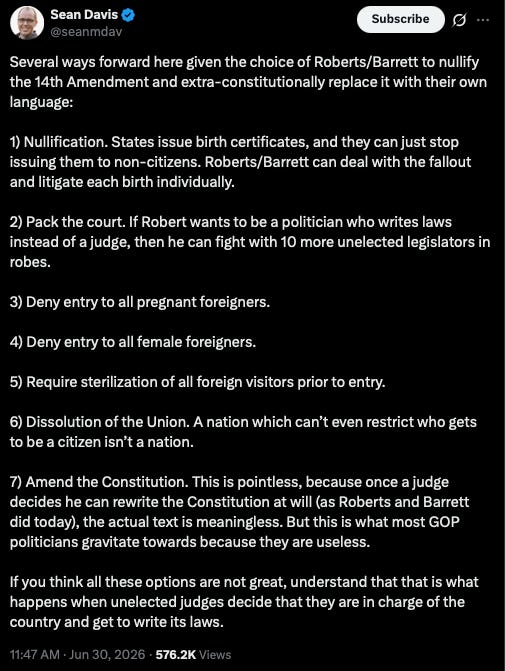
Remarkably, this may have been the first time in his political career that Trump was among the least unhinged voices in his own coalition. “The Supreme Court upheld Birthright Citizenship, which is too bad for our Country, but we can easily make it up in Congress through Legislation, with the support of the President,” he wrote. “No long and unwieldy Constitutional Amendment is necessary!” He’s wrong—there’s a five-justice majority at least that such a law would be unconstitutional—but at least he isn’t gibbering and spraying flecks of spittle.
SCOTUS SUNDRIES: The birthright citizenship case wasn’t the only big case out of SCOTUS yesterday. In West Virginia v. B.P.J., the Court ruled6 that states could forbid biological males from participating in girls’ school sports. And in NRSC v. FEC, the Court struck down some federal restrictions on political parties coordinating spending with candidates—a smaller-scale ruling that is likely to benefit Republicans in the immediate term, given the national GOP has more than $100 million in the bank while the national Democratic party is a few million in the red.
All of these cases were partially overshadowed by a bizarre media circus. Shortly after the birthright case came down, NPR published a bombshell story: Justice Alito, they said, was retiring. Just five minutes later, however, they deleted the story, then issued a retraction: No such retirement announcement had been made. Veteran court reporter Nina Totenberg, it transpired, had simply misheard a mention of “retirement announcements,” assumed that meant Alito, and fired off to NPR that they should publish a pre-written story. Totenberg later said she had sent an apology note to Alito, calling it “the worst professional mistake of my more than 50 years in journalism.”
Cheap Shots

The test established in 1987’s United States v. Salerno is that a facial challenge succeeds only if “no set of circumstances exists under which the [order] would be valid”—a remarkably high bar.
Clarence Thomas, Samuel Alito, and Neil Gorsuch all dissented separately, with Gorsuch also concurring in Thomas’s dissent. I here leave aside Justice Kavanaugh’s milquetoastish foot-in-both-camps partial concurrence, except to remark that, ugh, he would.
Here’s Thomas: “I would reserve for another day the question of whether children of illegal immigrants can be domiciled here. The Government and several scholars have suggested some reasons why, they believe, illegal aliens can never be domiciled here. . . . That said, many others understandably have suggested that long-term resident illegal aliens satisfy the elements of domicile because they reside here with the intent to permanently remain. As Justice Gorsuch explains, the children of such aliens may be domiciled here because they are ‘born here to parents who have long chosen to make this Nation their permanent home.’”
Here’s Gorsuch: “If those parents are not domiciled here, then where are they domiciled? And if the answer is nowhere, how can we reconcile that conclusion with this Court’s longstanding recognition that every person is domiciled somewhere?”
Going by his dissent, which focused more on matters of allegiance than domiciling, Alito likely would have remained unpersuaded.
The decision was 6–3 or 9–0, depending how you slice it: The three liberal justices concurred in part and dissented in part.
Wonderful newsletter as always. Thank you Andrew for taking the time to walk through the text of the dissents in the birthright citizenship case--it was incredibly helpful and informative.
I think it was Greg Sargent who posited that Birthright Citizenship is being set up by the far right to be the next Roe vs Wade, Roe V Wade having lost some of its oomph after Dobbs. I take that to mean that it is the giant wedge issue they will use to motivate their voters, encouraging them to ignore all other issues. It will be a reason to rally them to vote to secure extremely conservative justices on the Supreme Court. And I believe we have only begun to see the most vile, open racism from elected politicians and their mouthpieces, not to mention their followers, that we have seen for many decades.