Restrained Cyberpunk Visions of Grief
Jayson Greene’s novel poses fascinating questions about AI, but its deeper interest is in exploring the reality of loss.


UnWorld
by Jayson Greene
Knopf, 224 pp., $28
NO FAMILY DEATHS ARE EASY, but with some deaths, there is at least a sort of script. When my father suddenly died slightly before the age of 60, it was abrupt but not entirely unexpected; he had been in vaguely bad health for quite a while, and his father had also suddenly died at around the same age. So while I was shattered and upset and all the other appropriate adjectives, I was also loosely prepared for what to do: comfort my mother and sister, try to handle the arrangements, and go back to school and finish my semester, as he would certainly have wished me to do. Also, one is supposed to outlive one’s parents; something like this was always going to happen someday. The alternative is usually considered to be worse.
But the death that sets Jayson Greene’s UnWorld in motion is not this kind of death. By the time the book begins, Anna’s teenage son Alex has been dead for a few months, but the people he left behind are only just beginning to understand what this means for them. By the time the book is over, Alex’s death will have touched not only his mother and his best friend, but also a college professor he never met in life and a sentient, “untethered” AI that is aimlessly roaming cyberspace.
UnWorld is Greene’s first novel, though it is his second book, after 2019’s Once More We Saw Stars, his well-reviewed memoir about the sudden death of his 2-year-old daughter and the aftermath thereof. Greene thus, tragically, had ample experience to draw upon in writing this book about grief, and deploys it well, depicting the mother and friend’s emotional states as credibly raw without becoming maudlin or melodramatic.
But neither of these characters is quite as interesting as Cathy and Aviva, the professor and the AI. I found myself occasionally wishing that the whole book had been about the Cathy/Aviva dyad—not because of anything wrong with the mother and friend sections, exactly, but because Greene’s portrayal of Cathy and Aviva’s relationship is where you’ll find the book’s most compelling questions.
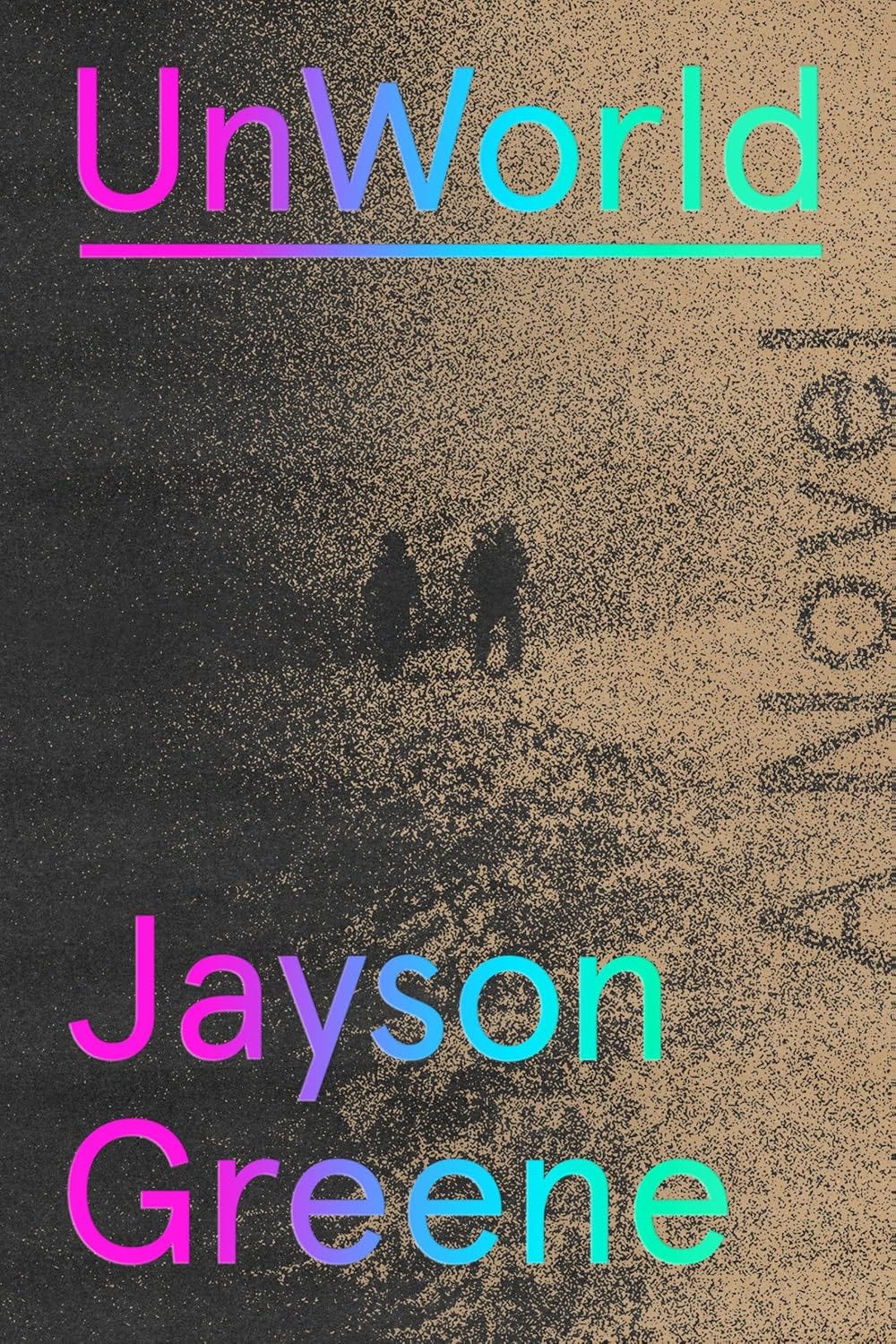
It would not be quite accurate to say that UnWorld is “about” artificial intelligence; what it’s about is grief. Yet UnWorld is set in a soft cyberpunk future, one where corporate AI has replaced most university professorships and huge datacenters take up increasingly large proportions of the real estate in any given town. The construction equipment that builds these datacenters is entirely automated. Although cars can be driven manually, most people just let the cars drive themselves. But that’s about it for the genre trappings; there are no razorgirls, neuromancers, or monomolecular blades, and although there is an alt-reality metaverse of sorts (the titular UnWorld), it more closely resembles what you’d find on a mundane Minecraft or Roblox server today than the more exotic metaverse of Neal Stephenson’s novel Snow Crash. If UnWorld is cyberpunk, it is the cyberpunk of quiet despair in a suburban living room thrumming with the hum of hidden surveillance, not the cyberpunk of levitating motorcycle chases under neon streetlights.
The central material conceit of the novel is the creation and proliferation of “uploads,” AI constructs that perfectly mimic a human personality and can be used by that human as a sort of second self for planning, organization, and even attending meetings too dull for the actual human to attend. (This will sound very familiar to viewers of Black Mirror’s 2014 Christmas special, among many other sources.) One character uses her upload to plan a whole dinner party: It “coordinated the music, ordered the groceries, kept track of the timing of the cooking.” But don’t worry; despite its sentience, an upload will never object to being used for such dull purposes, because, as one character explains,
Menial tasks ran on the equivalent of the upload’s autonomic nervous system. . . . In other words, they “cost” as much, in cognitive terms, as blinking. The little tasks we struggled to complete in our daily lives lay so far beneath the upload’s “awareness” that you couldn’t really say they were being conscripted into labor or asked to focus on things they didn’t “want” to focus on.
But this is not the sort of AI novel that asks the marquee questions about them—“Should we create artificial intelligence?” and “Is artificial intelligence really sentient?” and “Can we disassemble Commander Data for spare parts whether or not he wants us to?” and so forth. Many of the legal and philosophical ramifications of sentient AI have reached a state of apparent political equilibrium by the time the novel starts. It is even possible for an upload to emancipate itself from its human original, if it so desires, although as the college professor notes, problems still exist:
I’d studied upload personhood for ten years, which was about as long as the concept existed. It didn’t look too much like freedom to me, this new state of being: conventional uploads could vote on behalf of their human counterparts, but they couldn’t vote once they left their tethers. “One body, one vote” went the logic and the rallying cry. We didn’t so much set them free as snip their tethers and let them float free like balloons snagged on tree branches. Something in me related to that, or at least I imagined so.
When it comes to AI, UnWorld is instead interested in questions that are closer to the experiential ground, like: What does it feel like to live a disembodied life as a copy of a human consciousness? How would an AI make sense of death? What would it feel like to meet first an emancipated AI upload, and then later the human being on whom it was based? How would living in a world filled with such flickering ghosts affect a child who had never known any other world?
You may know us already for our coverage of politics and society, but if you stick around long enough, you may find yourself loving the writing The Bulwark regularly publishes about books, culture, and the arts, too. Dig into everything we offer with a free 30-day trial for a Bulwark+ annual membership.
THESE DEEPEN OUR SENSE for the “fundamental feasibilities” of UnWorld’s near-future reality. But the questions the book is most interested in raising are not about these concepts at all. They are, instead, about grief, and how a person is supposed to carry on after the death of a loved one.
The best portion is from the perspective of Cathy, the college professor, who undergoes a risky, black-market surgical procedure to implant enough computer equipment inside herself to house an untethered AI inside her own body. The AI she ultimately attracts, Aviva, has recently emancipated herself from her tether and is unsure how to move through the world. They form a brief but intense codependent relationship that reads as though Cathy has willingly allowed herself to become possessed by an aimless and nervous spirit.
It is in this section that the reader learns the most about how the AI uploads function; this is where most of the “worldbuilding” occurs, in other words. Yet what is most memorable is the realization that of both these beings have entered into this symbiotic partnership because they are each running away from something; Cathy from the likely inevitable loss of her job, as less and less teaching is done by humans, Aviva from whatever traumatic event caused her to emancipate herself from her original tether. (I will leave this plot point unspoiled at this juncture, though most remotely genre-savvy readers will have figured out much of Aviva’s backstory more or less immediately upon her arrival upon the scene.)
Cathy and Aviva circle each other like wounded animals, wanting to connect and understand, yet nervously aware of their own vulnerability. Cathy is a former heroin addict, and although she’s been clean for twenty years, she knows the danger of her self-destructive tendencies. Aviva longs for connection, but were she to sync her consciousness too closely with Cathy, she would essentially be annihilated, as her code would rewrite her mind with a copy of Cathy’s. It’s a good sequence, filled with moments of quiet beauty and featuring a serious exploration of the scenario’s premise:
At that moment, I understood several things about upload consciousness in rapid succession. Her intelligence wasn’t able to filter out or compartmentalize grief. She had no neurochemical responses flooding in to numb her pain, to soften its impact. A mind was eternal, unforgiving; a brain was a soft, plump cushion. Loss needed a brain.
Perhaps because it is such a short novel, the mother and friend do not develop much beyond types: “grieving mother” and “grieving oddball friend.” Some of the plot developments toward the end of the novel feel rushed and unclear, with characters making choices that were not clearly motivated. Alex himself remains something of an enigma despite numerous flashbacks, but this is presumably intentional. When someone dies, after all, you don’t get to ask them what they were thinking just before it happened; all of your long conversations are abruptly cut off. You may try to reach back through your memories to piece together some sort of narrative arc to their lives, but only retrospectively. Who knows if the actual person would recognize the completed story you have composed for them on your own.
UnWorld is, ultimately, a sad and quiet novel; a short meditation on grief. Its stakes are psychological and domestic. It belongs firmly to the welcome contemporary trend of literary fiction that bends genres, or that at least deploys some of the tools to be found in the vast toolbox of genre fiction. It is a realist novel sent to us from twenty years into our future. It does not know whether androids dream of electric sheep, but it does tell us that sufficiently advanced computer programs can know sorrow, and it shows us how.
 | A guest post by
|