RFK Jr.’s Junk Science Diet
His MAHA ideas about food are built on some of the same lies as his antivax campaign.

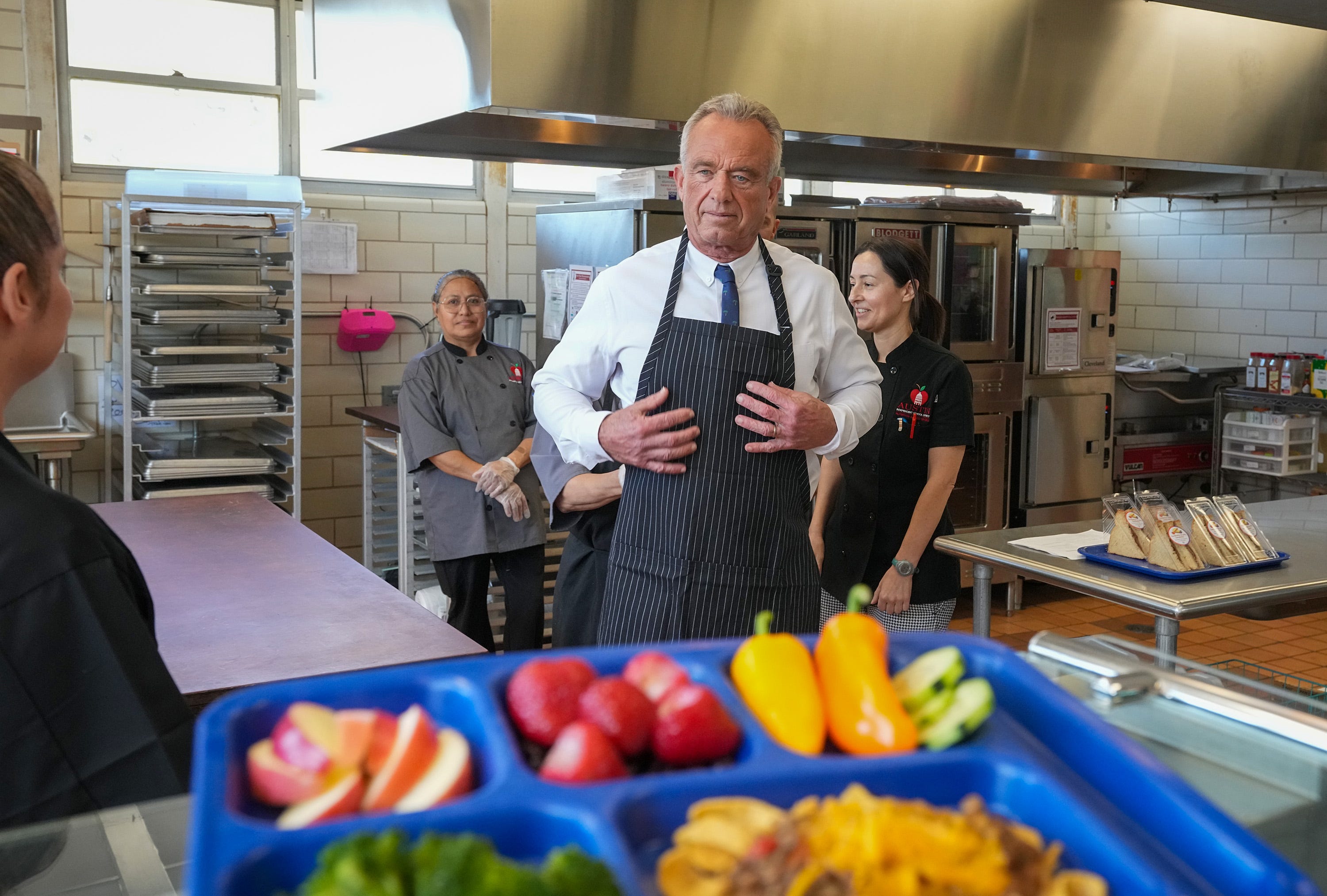
THE STANDARD NON-MAGA TAKE take on Robert F. Kennedy Jr. is that it’s too bad he’s such a brain-wormed lunatic about vaccines, because he’s a surprisingly thoughtful visionary about food and farming. After Donald Trump chose him to be health secretary, an Atlantic essay headlined “RFK Jr. Is in the Wrong Agency” captured this conventional wisdom, with a memorable subhed emphasizing the problem was the job, not the man: “He could be a great agriculture secretary.”
But it was always strange to assume that a brain worm would pick and choose which judgments to infect. While Kennedy’s progressive-sounding ideas about unhealthy food and industrial agriculture are more popular than his retrograde theories about lifesaving vaccines, many of them are just as pseudoscientific, conspiratorial, and wrong. In fact, they’re grounded in the same strain of sloppy and simplistic thinking popular with biohackers and yogis on the right and left, the naturalistic fallacy that anything “unnatural”—including genetically modified crops, pasteurized milk, fake meat, and chemical pesticides as well as mRNA jabs—must be bad for our health and our planet.
It’s woo-woo nonsense—the kind that results in the nation’s top health official urging Americans to binge on fries (as long as they’re made with beef tallow rather than seed oils) and Coke (as long as it’s made with cane sugar rather than high-fructose corn syrup). The inconvenient truth is that you shouldn’t worry about seed oils or GMOs; that “natural” cane sugar is just as unhealthy as processed corn syrup; that plant-based meat isn’t health food but is already healthier than cow-based meat; and that while some agrichemicals are genuinely dangerous, the weed killer glyphosate, Public Enemy Number One for Kennedy’s Make America Healthy Again movement, is unusually benign.
Like the proverbial broken clock that’s right twice a day, Kennedy has a few non-bonkers food beliefs. Yes, ultraprocessed junk like Twinkies is bad for you. No, we don’t need artificial food dyes in our cereal. Yes, “real food” like fruits, vegetables, and whole grains is as nutritious as it was when Michelle Obama was pushing it. But Twinkies aren’t unhealthy because of their processing or even their long ingredient list full of GMO crops grown in monoculture fields; they’re unhealthy because they’re sugary, high-calorie, low-nutrient junk that everyone knows is junk. They’d still be junk if their corn syrup and starch came from organic non-GMO corn grown in diverse rotations.
Support our journalism and commentary, and join our growing pro-democracy community—become a Bulwark+ member today:
It’s telling that Kennedy is also an outspoken advocate for red meat, which is associated with increased risk of cancer and heart disease. The steaks atop the Trump administration’s new food pyramid come from industrially bred cattle stuffed with GMO grain in unnaturally crowded feedlots and then “processed” in assembly-line slaughterhouses, but they’re vibes-aligned with caveman-diet meatfluencers like Joe Rogan, as well as Republican livestock-industry donors. Red meat also happens to be an environmental disaster; in the United States, we use more than half our agricultural land to produce beef, which provides only 3 percent of our calories.
In other words, Kennedy’s food fights have as little to do with science as his antivax fights. There’s no better example than the recent Trump world brawl over glyphosate, the active ingredient in the herbicide Roundup. Jonathan Cohn recently wrote about this chemical warfare here in The Breakdown, explaining how MAHA moms who consider glyphosate a toxic menace are furious about Trump’s new executive order in support of glyphosate production. They’re particularly mad that Kennedy, who has condemned Roundup as a poison fueling a national disease epidemic, was forced to defend the order on ludicrous national security grounds, when Trump was obviously just pandering to the agricultural and chemical lobbies.
It’s an important political story, and it was fun to watch Kennedy—who, as an environmental lawyer, often sued Monsanto over glyphosate—endure one of the ritual humiliations Trump loves to inflict on his underlings. But in his public statement, Kennedy continued to insist that glyphosate was “toxic by design,” and that American farms were just too dependent on it to ban it immediately; he assured his MAHA fans that the Trump administration is still gradually “accelerating the transition to regenerative agriculture” that can “increase biodiversity” and “reduce reliance on synthetic chemicals.” When Trump’s nominee for surgeon general, Casey Means, historically another ferocious glyphosate basher—“For the love of God never buy Roundup,” she once tweeted—bent the knee in her Senate testimony, she also declared it too entrenched to abandon right away: “We cannot overturn the entire agriculture system overnight.”
That’s true enough. In 2021, Sri Lanka’s president thrilled regenerative advocates by banning all agrichemicals, and it was an overnight disaster: Farm yields crashed, creating food shortages, food riots, and a government collapse. So it’s nice Kennedy is publicly rejecting that model, even if it’s only because his boss wants to pander to donors. But the MAHA notion that all agrichemicals are evil, even if sometimes a necessary evil, is as childish as the Trumpian notion that they’re inherently good, at least as long as the campaign donations keep flowing.
Glyphosate is relatively good. It’s less toxic than caffeine, and way less toxic than the herbicides that would replace it if it were banned. Some studies have suggested rodents that ingest massive amounts of it might face higher disease risks, but only tiny traces of it are in our food. Florida’s quack surgeon general, the antivax crusader Joseph Ladapo, is trying to stir up a new MAHA panic over glyphosate, but it isn’t what’s making Americans sick. Another inconvenient truth: The way food is grown has very little to do with how healthy it is. The cows on organic dairies don’t get antibiotics (organic farmers usually sell them to conventional dairies when they get sick) and the crops on organic farms don’t get sprayed with chemical pesticides (organic pesticides are often even nastier) but none of that makes much of a difference to the nutrition that reaches the consumer.
What effective weed killers and other agrichemicals can do is help farmers grow lots of food per acre, so they need fewer acres to grow the same amount of food. That’s a big deal for the environment, because farms and pastures have already overrun 40 percent of the Earth’s habitable land—and they’re on track to overrun another dozen California’s worth of forest to feed a growing global population by 2050. The world doesn’t have another dozen California’s worth of forest to spare. And when regenerative and organic farms produce lower yields than conventional farms, as they usually do, they drive more deforestation as well as malnutrition. They’re also driving habitat destruction, so they’re destroying biodiversity.
The RFK conviction that agriculture should return to its kinder and gentler and more natural roots appeals to our romantic notions of small pastoral red-barn farms where soil is treated with love and animals have names instead of numbers. But there’s plenty of evidence that those farms tend to be worse for the environment, and no evidence that they produce healthier food. Most rational people reject the dopey nostalgia of the antivax movement, the Luddite delusion that things were better before science and innovation started messing with natural processes. We don’t need to let nature take its course with our food, either. We can pasteurize our milk so that it’s safe, fertilize our crops so that they’re abundant, and ignore the charlatans who want to banish modern technology from what goes into our bodies.
Michael Grunwald is the author, most recently, of We Are Eating the Earth: The Race to Fix Our Food System and Save Our Climate (Simon & Schuster, 2025).