Rod Dreher Thought JD Vance Would Save Conservatism. Oops.
The writer thought his friend would stand up to the antisemitic right. His criticism of the vice president is too little, too late.

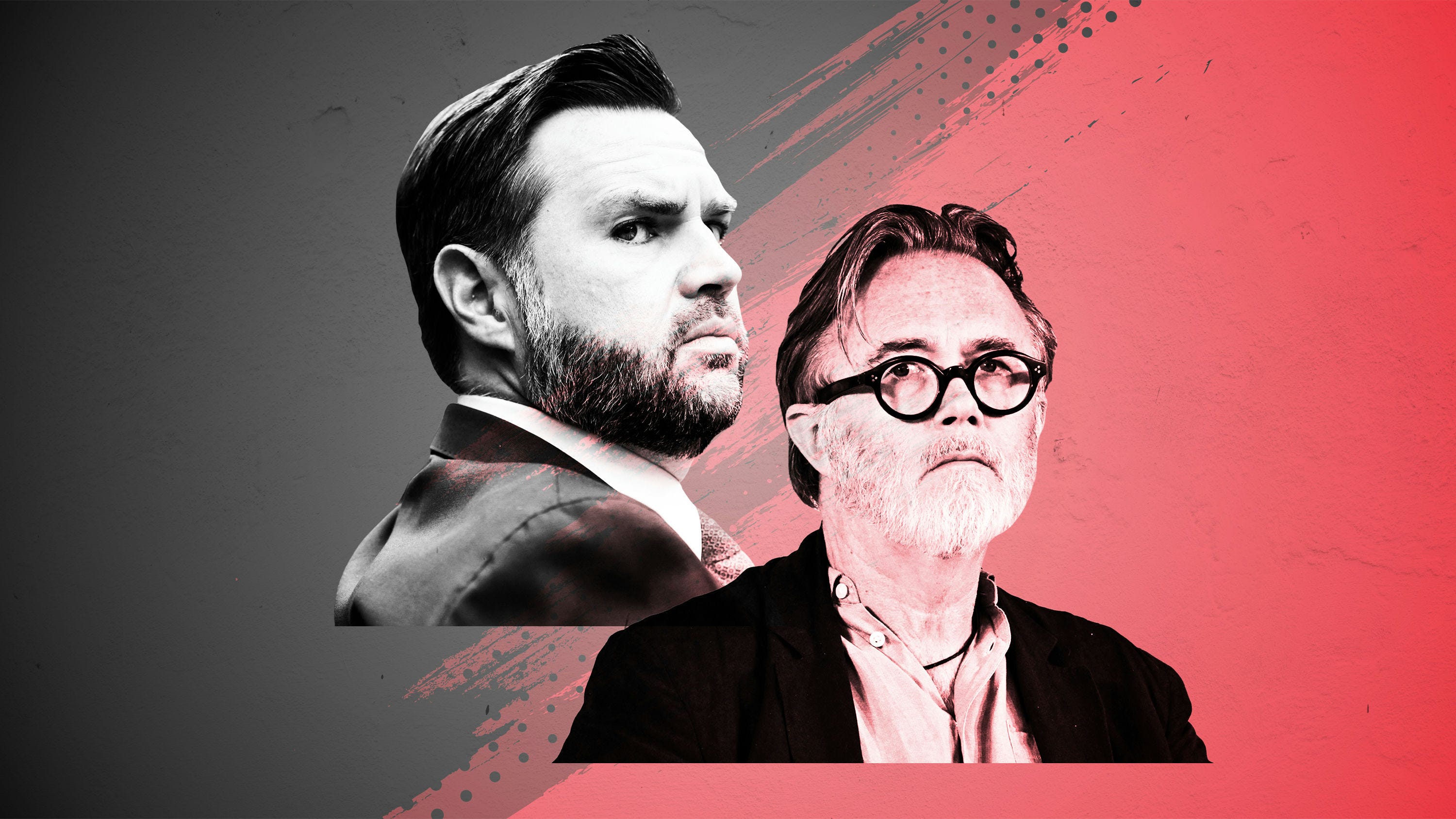
THE PROMINENT CONSERVATIVE INTELLECTUAL Rod Dreher, back from his sojourn in Hungary, has set about destroying his most influential friendship: with Vice President JD Vance. It’s a strange turn of events. In his recent memoir, Vance credited an interview with the longtime blogger for truly launching his public and political career. Without Dreher, Vance might have remained a center-right venture capitalist, perhaps even a Never Trumper. Instead, as their relative stars changed places, Dreher became the supplicant, enjoying a kind of gossipy intimacy with the vice president and always alluding to conversations about which he couldn’t possibly divulge the details. In April, the two met in Hungary after Vance campaigned there for the embattled (and ultimately defeated) prime minister Viktor Orbán.
Since then, though, their friendship seems to have crumbled. In some corners of the right, it’s even become something of a political football. “I don’t know that we’re friends anymore; he cut me off after I went to visit late last fall,” Dreher said on the Jeremy Boreing Show.1 The cause of their split, in Dreher’s telling, was his alarm at the apparent rise of antisemitism on the right and Vance’s unwillingness to openly oppose it.
Their breakup has been a long time coming. Last November, Dreher wrote an article for the Free Press titled “J.D. Vance Versus the Groypers?” The piece took aim at fans of the neo-Nazi streamer Nick Fuentes, whose friendly conversation with Tucker Carlson the month prior had ignited fierce infighting on the American right.
Among “Gen Z congressional and administration staffers,” Dreher wrote, the popularity of Fuentes was astronomically high: “One older insider put the number of Fuentes fans and fellow travelers . . . at ‘30 to 40 percent.’” Dreher concluded, “It’s worse than I thought. And nobody knows what to do about it.”
Nobody, that is, except one man: “Who’s left to save the right, and America, from this rising extremism? For me, the answer can only be J.D. Vance.”
Dreher believed our terminally online vice president would “get in touch with his inner hillbilly and bitch-slap that geeky little Goebbels, hard,” referring to Fuentes. He thought the man who admitted to spreading bigoted lies about an immigrant community in Springfield, Ohio to score a few cheap political points—and then embraced the memeification of these lies—would stand up to white supremacy on the online right. Dreher even presented Vance as an ideal representative of American diversity: “a white man married to a brown woman who does not share his religious faith.” For Dreher, this means “Vance embodies the actual diversity of America even if the right’s self-described ‘heritage Americans’ don’t like it.”
But these hopes were only ever wishful thinking. Vance was never going to be the man Dreher wanted him to be.
Vance hasn’t explicitly used the term “heritage American,” but he’s nonetheless enamored with the concept. In a July 2025 speech, he declared that it’s time to “redefine the meaning of American citizenship in the twenty-first century.” To do so would mean rejecting diversity and American pluralism. “America is not just an idea,” he said. “We’re a particular place with a particular people and a particular set of beliefs and way of life.” MAGA nationalists like Vance constantly denigrate the universal principles that have historically been at the core of American national identity. “People will not fight for abstractions,” he claimed when accepting the Republican nomination, “but they will fight for their home.” This would be news to some of the greatest heroes in American history, such as the Marquis de Lafayette, who left France to take part in the fight for independence because he was inspired by American ideals.
Contra Vance, Americans are not a “particular people” with a “particular set of beliefs.” The United States is vast, fractious, and diverse, and the Founders understood that pluralism would always be at the heart of civic life in a free country. “You cannot swap 10 million people from anywhere else in the world and expect America to remain unchanged,” Vance warned. But 52 million immigrants already live in the United States, and millions more became Americans at birth thanks to the Fourteenth Amendment. When the Supreme Court struck down the Trump administration’s effort to overturn birthright citizenship, Vance described the decision as a “major mistake” and a “preposterous ruling.” The message this sends to the millions of birthright citizens is that they are unwelcome and un-American.
In his piece, Dreher noted that the ascendance of antisemitism and white nationalism on the right requires “uncompromising moral and political leadership.” He claimed Vance could and must take up this mantle. But when given opportunities to demonstrate this leadership, the vice president has repeatedly chosen the morally and politically expedient action instead.
When Trump described Somali Americans as “garbage” who should “go back to where they came from,” Vance banged the table to express his approval. When Trump said immigrants in Springfield were eating people’s pets, Vance repeated the lie, refused to apologize when it was debunked, joked about it, and promised to keep lying. “If I have to create stories so that the American media actually pays attention to the suffering of the American people,” Vance admitted, “then that’s what I’m going to do.”
After the Trump administration sent thousands of federal immigration agents to Minneapolis, two American citizens, Renée Good and Alex Pretti, were shot and killed. The administration immediately smeared both in attempts to justify their deaths. Trump claimed that Good “violently, willfully, and viciously ran over the ICE Officer,” an accusation contradicted by footage of the incident. Vance doubled down on the calumny, saying Good “aimed her car at a law enforcement officer and pressed on the accelerator.” He blamed Good for her own death, accusing her of “classic terrorism.” He then echoed Stephen Miller’s vile claim that Pretti, who had been shot multiple times in the back while face-down on the ground, was an “assassin.”
As Minneapolis reeled from the deaths of two citizens at the hands of masked federal agents, a responsible leader would have acted differently—urging calm, ensuring that law enforcement operations were strictly adhering to the rule of law, even apologizing to the families of the citizens gunned down in the street. Not Vance. He refused to apologize for lying about Good and Pretti and made no mention of accountability for the agents who killed American citizens. Inside the White House, Vance pushed to invoke the Insurrection Act, showing a willingness to risk more violence by siccing troops on cities.
Vance took these revealing steps only months after Dreher declared him “our country’s best hope.” While Dreher couldn’t have known just how completely Vance would abrogate any sense of moral and political leadership, there was no reason for him to place his faith in Vance in the first place.
Support our coverage of the right, the far right, and the far-out right—sign up for a Bulwark+ membership today.
DREHER HAS BECOME RIGHTLY ALARMED at the Groyperization of the American right. When Carlson hosted Fuentes last October, he listened politely as his guest warned against “Zionist Jews” who controlled “the media apparatus,” “unassimilable” Jews, and the power of “organized Jewry in America.” The conversation created a split on the right in which some condemned Carlson and others refused to do so. Vance was in the latter camp. His strategic silences at key moments scandalized his old friend Dreher.
Around two weeks before Carlson hosted Fuentes, Politico published leaked chats between leaders of Young Republican groups across the country. The conversations revealed an avalanche of antisemitic and racist comments. Young Republican leaders described black people as monkeys and “watermelon people.” They joked about sending their political opponents to the gas chambers. The chats were saturated in white supremacist jokes and memes, as well as anti-gay bigotry. One leader expressed his approval of a young Republican group like this: “They support slavery and all that shit. Mega based.” The same leader described one of his opponents as a “fat stinky Jew.” Another said it was a mistake to expect “the Jew to be honest.”
When pressed, Vance responded that “Kids do stupid things, especially young boys,” despite the fact that the participants in the chats were adults, some of them in their thirties. He dismissed the messages as “edgy, offensive jokes” and described the outrage as “pearl clutching.” It took some nerve—or naïveté—for Dreher to champion Vance later that fall as the only politician with enough backbone and hillbilly gumption to stand up to Groypers when he had already miserably failed this very test.
The problems continued. At Turning Point USA’s AmericaFest conference shortly after the Fuentes interview, Ben Shapiro attacked Carlson for embracing a “Hitler apologist, Nazi-loving, anti-American piece of refuse.” Just two days later on the same stage, Vance warned against “endless self-defeating purity tests.”2 He claimed he had no “list of conservatives to denounce or to deplatform.”
The Fuentes interview continued to roil the far right for weeks, and all the while, Vance never changed his position. He seemed to have made a simple calculation: Carlson is among the most powerful voices in MAGA; attacking him was always out of the question. A profile in courage, Vance is not.
THE BLOGGER’S FRIENDSHIP with Vance evidently made it difficult for him to see the vice president clearly. By November 2025, the vice president’s track record should have made it obvious that Vance simply could never be Dreher’s man to restore a principled American conservatism.
Although Dreher’s level of alarm about antisemitism had surged—he dropped pointed references to Hannah Arendt and the Weimar Republic in his column about Vance leading the charge against the Groypers—he still said, “I suspect patience will be needed when it comes to Vance’s approach to Carlson.” Why? For reasons he could appreciate better than most: “Tucker was an early supporter of Vance and they developed a close friendship.”
This is worth unpacking. In one breath, Dreher claimed antisemitism on the right required urgent and uncompromising moral leadership. In the next, he counseled patience with the vice president while he decided whether to condemn his friend’s amplification of the nation’s most notorious neo-Nazi.
The vice president presents himself as a bridge between the online right and mainstream MAGA. But it’s now evident that Groyper-curious young Republicans intend to remake the MAGA establishment in their image rather than adopting the mores and concerns of their elders. Vance clearly thinks he needs to accommodate and not oppose this dynamic.
The Groyperfication process became visible in the recent turmoil at the Heritage Foundation, the major conservative think tank in Washington. Once again, the proximate cause was the Carlson/Fuentes interview. Heritage’s president, Kevin Roberts, responded to the furor by unequivocally taking Carlson’s side on the basis that the conservative institution does not police “the consciences of Christians,” especially when attacked by “bad actors.” Roberts’s faux-principled commitment to free speech and opposition to cancel culture excused his spinelessness in the face of the nihilistic right. He, like Vance, is scared of Carlson’s influence.
In a recent report on the Heritage “crackup,” Elisabeth Zerofsky in the New York Times describes the episode as a watershed moment for the think tank. Heritage lost supporters, partners, and staffers, but Roberts’s remarks also reflected a cultural shift at the institution:
Discussions among new hires frequently echoed arguments promoted by Fuentes, Carlson and the podcaster Candace Owens that shed doubt on the historical consensus around the Holocaust or the origin of the state of Israel. . . . A sizable number of newer staff members were fans of Pat Buchanan, who wrote a book about how Churchill, not Hitler, was the instigator of World War II. A number of them, several former staff members told me, seemed to share this view.
Heritage expects Vance to be the Republican nominee in 2028 and, according to the Times, “is investing heavily in its relationship” with the man who shares Roberts’s broad outlook—and unwillingness to challenge the far right.
In one sense, Dreher was right: As its putative figurehead, Vance is in a stronger position than ever to condemn the radical and bigoted elements on the New Right and bring the conservative movement back toward sanity. But that’s where the credit to Dreher’s argument ends: The idea that Vance would rise to this responsibility was wishful speculation.
But finally, Dreher sees it. Last month, he wrote “Against Vance’s Von Papen Conservatism” for his Substack newsletter. In it, he acknowledged:
Vance has in the past condemned anti-Semitism—good!—but he has also refused to call out the particular haters on the Right who are pushing this narrative. I repeat my conviction that Vance is no anti-Semite or racist. But he lacks the moral courage to take a stance that could alienate this faction (many of whom hate his guts, and say so). He seems to be following a No Enemies To The Right strategy.
Dreher was “really bothered” by Vance’s efforts to blame the Trump administration’s catastrophic Iran policy on Israel, which he described as a “version of the ‘stab in the back legend’ promulgated by Germany’s World War I generals, to scapegoat Jews and socialists for their poor wartime leadership.” Vance’s alleged carelessness is what led Dreher to call him a “Von Papen Conservative,” a reference to the conservative Catholic German politician who convinced Reich President Paul von Hindenburg that Hitler could be restrained if he was allowed into a governing coalition.
This is all a bit much: A simpler reading of Vance’s decision to blame Israel for his boss’s foolish war is that Vance is just serving his own political interests, operating from the same sort of cowardice that inclined him to keep mum about Carlson. But even if we don’t accept Dreher’s interpretation of Vance’s Israel criticisms, the overall trend remains the same: Vance is abetting the further antisemitic corruption of the GOP while Dreher scribbles impotently.
Perhaps Dreher deserves credit for finally recognizing the truth about his former friend. But his criticism now, on this single issue, is both belated and insufficient. Vance has spent two years nurturing a viral bigotry in his party with the power of the bully pulpit. Had Dreher been capable of recognizing Vance’s flaws earlier, he may have been in a position to gather critical GOP opposition to the vice president’s political and moral recklessness, and help rein in the right’s lunatic fringe. Instead, the party’s best hope is that if Dreher can finally see who Vance was all along, maybe others will, too.
Another factor here may be Vance breaking faith with Dreher by dishing barely anonymized secrets about Dreher’s divorce in his conversion memoir.
Trump would later attack Carlson for refusing to support his disastrous war in Iran. He has only one purity test: you must be completely loyal to him.
 | A guest post by
|
Vance and Dreher deserve each other. Each uniquely odious and pathetic in separately and complimentary ways, although sharing a shameless ability to lie and grift.