Roy Cooper’s Radical Strategy: Act Normal
His message is simple, his persona is unglamorous, and his old-school North Carolina Senate bid is working.

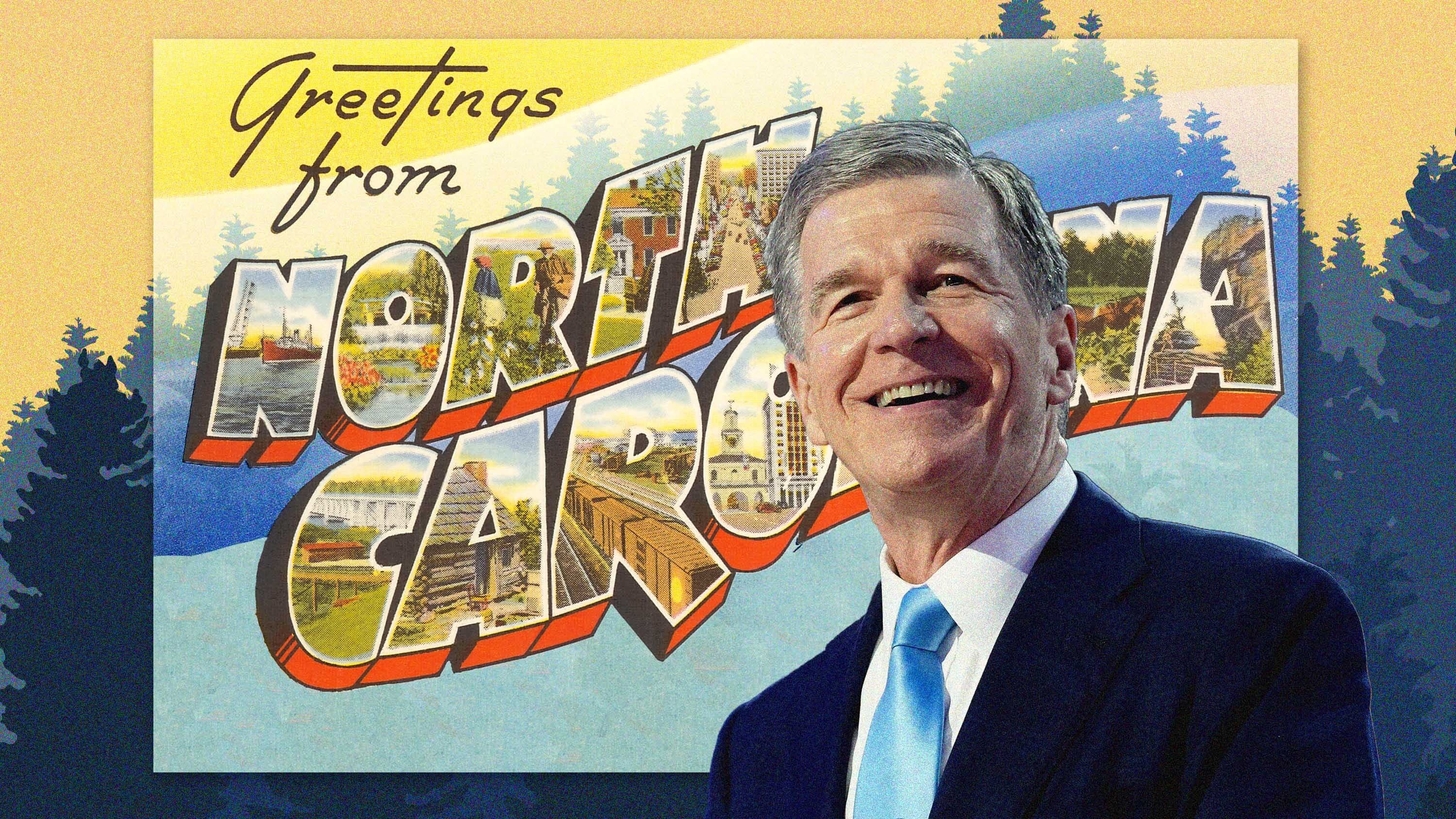
Hendersonville, North Carolina
THERE’S BEEN NO SHORTAGE OF MEDIA ATTENTION for dynamic Democratic Senate candidates, especially as the party casts around for new faces to lead it into the future—or at least, with luck, win control of the Senate. Texas’s James Talarico has been the subject of a 9,000-word New Yorker profile; reporters have followed around Michigan’s Abdul El-Sayed, treating him like a mini-celebrity; and, before his crashout earlier this summer, seemingly every national outlet sent a photographer to Maine to document Graham Platner’s tattooed biceps.
Far less attention has been paid to Roy Cooper, the former North Carolina governor and current Democratic nominee for Senate. Even as poll after poll shows Cooper leading Trump-backed Republican Michael Whatley, making North Carolina increasingly look like it could be the Democratic party’s best pickup opportunity this year, his campaign seems to be flying under the national radar. There’s a case to be made that he likes it that way.
Part of the reason for the Cooper campaign’s low profile is obvious: He’s neither a showman nor a social media star.
I can’t wax poetic about Cooper’s biceps because, unlike those of Platner and El-Sayed, I do not know what the 69-year-old’s upper arms look like. He almost always wears a suit jacket and a button-up shirt. I can’t offer you a buzzy piece about Cooper’s savvy social media strategy, because it doesn’t exist.1 And I can’t give you a colorful story about his career as something unexpected, like an oyster farmer or seminarian, because Cooper has been an elected official since 1987.
In a political age where success is increasingly determined by a candidate’s ability to get attention and go viral, Cooper campaigns like the internet still runs on dial-up. His first TV ad was so basic and gimmick-free it felt like it was from a different era. His campaign slogan is aggressively simple: “Make Stuff Cost Less.” For the past few weeks, he’s been traveling the state on his “Make Stuff Cost Less Tour,” often repeating one of his favorite lines: “For too many North Carolina families, there’s just too much month at the end of the money.”
He talks about high utility costs, rising grocery prices, his record as governor addressing crime, and the federal government’s failure to take care of Hurricane Helene victims. And he hasn’t leaned into Resistance-style rhetoric. Cooper refers to Donald Trump as “this president” or “this administration,” but rarely by name.
Can such a simple—if not downright old-fashioned—approach to politics really be what flips a North Carolina Senate seat blue for the first time since 2008, particularly in an election cycle largely defined by voter frustration with the status quo?
Careful reporting.
Savvy commentary.
And a growing pro-democracy community.
Stick with us this campaign season. Join Bulwark+.
“It doesn’t have to be all glitterati and clicks,” said John Anzalone, a top Democratic pollster who has worked with Cooper since 1996. “Sometimes meatloaf and potatoes is just the most comfortable food that you can have on a certain day. And Roy Cooper is a super comfortable candidate to North Carolina voters.”
When I asked Anzalone if Cooper was, dare I say it, “boring,” he argued the question missed the point.
“He’s anything but boring. I think he’s authentic. And what is boring to the ivory tower, the media class, or the political activists, is really important to real people. So that’s where I just think that they’re off,” said Anzalone. “This guy connects at a different level.”
That may be true. When I arrived at the Oklawaha Brewing Company in western North Carolina last week for Cooper’s roughly twentieth stop on his tour, more than a hundred people were crammed into the bar. As supporters fanned themselves with “Make Stuff Cost Less” posters and ordered pints of frothy beer to keep cool in the August heat, I asked attendees what it was about Cooper that had him up nine points, according to a recent Fox News poll.
Martha Oldham Huggins, an independent, told me it was his “folksy” demeanor. Wanda Hembree, a lifelong Democrat from Morganton, highlighted Cooper’s “sincerity, his fairness.” And after watching her congressman, Republican Chuck Edwards, abruptly end his re-election bid earlier this month amid reports of inappropriate conduct toward female staffers, Shannon Davis Zaragoza said she was just looking for someone who “wasn’t shaking things up or causing anything to be ashamed of.”
As Morgan Jackson, Cooper’s longtime political adviser, explained it to me: “Voters are so frustrated with the status quo, they feel like D.C. is broken. . . . And what people are looking for when they want change is people who will get stuff done.”
BUT JACKSON IS THE FIRST to admit that, while Cooper’s regular-guy appeal helped him get elected four times as attorney general and twice as governor, federal races are a different beast.
The North Carolina Democratic Party’s recent success winning governorships, lieutenant governorships, attorney general races, and Supreme Court seats hasn’t transferred into presidential or Senate victories. The last Democrat to win a Senate seat in the state was Kay Hagan, who defeated GOP Sen. Elizabeth Dole in 2008 before losing her re-election bid to Thom Tillis in 2014.2 Barack Obama was the last Democratic candidate to carry the state at the presidential level, winning by less than half a percentage point in 2008.
Even so, Dems remain competitive. Unlike states such as Florida—which has gotten far Trumpier over the three elections that the owner of Mar-a-Lago has appeared on the ballot—the GOP’s presidential margin of victory in North Carolina has remained slim. Mitt Romney won the state in 2012 by 2.0 points while Trump has carried the state by 1.3 to 3.7 points. Those shouldn’t be insurmountable numbers for Democrats. And yet, even as North Carolina has been one of the fastest-growing states in the country, Democrats have fallen short in federal races.3
Jackson likes to describe North Carolina as “one part Northern Virginia and one part rural Alabama.” It has plenty of blue urban dots packed with college-educated voters, like Charlotte and Raleigh, but it’s also home to the second-largest rural population in the country. Cooper’s challenge will be capturing “unaffiliated” voters—the term North Carolinians use for independents—and winning over a small percentage of rural Trump voters.
He’s done it before. Cooper was first elected governor in 2016, defeating Republican incumbent Gov. Pat McCrory by less than one percentage point while Trump carried the state.
“[Cooper] skimmed a little bit of my vote away by acting as conservative as he could,” McCrory said on a recent episode of the Long Play streaming political show, reflecting on the 2016 race. “That’s one of his great strengths: He says little, does even less, and stays on message.”
Replicating that success for a federal race will require Cooper to talk about more than just affordability or his two-term fight as governor to expand Medicaid (although that has earned him significant goodwill with voters across the ideological spectrum). Rather, he will need to discuss immigration and crime in red parts of the state, issues that have made Democrats uncomfortable in the past.
“He talks to voters often about crime, which is something Democrats don’t talk about,” Jackson told me. “When you talk about keeping communities safe, you’re sending a signal to voters in rural North Carolina, in red North Carolina, in exurban North Carolina, saying: ‘Hey, this guy’s a different kind of Democrat, and so I’m willing to take a look at him.’”
Cooper also appears keenly aware that just because he’s a popular former governor does not mean that he’s got the race locked up. “It’s been really tough to elect Democrats to the U.S. Senate from North Carolina,” he told the crowd at Oklawaha Brewing Company.
After his speech, I asked him why he thought Dems hadn’t been able to win a Senate race in North Carolina in nearly twenty years. He said it was “hard to know” the reason.
“But I think now is a time where people are going to look past the party and look to people who are really going to address issues facing people right now,” he told me, before pivoting back to the Trump administration’s failure to lower costs—as well as reminding me that he was spending the day in a very red county.
THE COOPER CAMPAIGN has given Whatley little room to nationalize the race. On the stump, Whatley has argued that throughout his career Cooper has “fought harder for criminals than he did for their victims. . . . Fought harder for illegal immigrants. . . . Fought harder for men who want to play in girls’ sports and go in women’s locker rooms.” And he’s attacked Cooper’s decision, while governor, to release 3,500 state prisoners early as part of a settlement in a lawsuit brought by the ACLU and NAACP challenging prison conditions during the COVID-19 pandemic. For his part, Cooper and Senate Majority PAC have hit back, highlighting Whatley’s appointment of Harvey West, a convicted child sex offender, to leadership positions in the North Carolina Republican Party.
Cooper’s local affordability emphasis is a sharp contrast to Whatley’s effort to tie him to hot-button culture-war issues.
“Democrats that win in North Carolina typically have built a North Carolina Democratic brand, and that brand is not a national Democratic brand,” said Steve Schale, a Democratic strategist and North Carolina resident. “You have to guard against people nationalizing your race with your life.”
Perhaps, then, the little national media attention that Cooper has received is by design.
“This is the forgotten race,” added Schale. “And I guarantee you one thing: Roy Cooper likes that.”
Despite the polls showing Cooper pulling away, his advisers insist that the election will come down to just a few points. They stress that undecided voters are mostly people who have voted for Trump in past elections and that while Whatley may seem milquetoast, those types of Republicans tend to do well here (see: Ted Budd, Richard Burr, Thom Tillis).
There’s also the question of money. Although Cooper is raising a substantial war chest, there are real fears within his campaign that it won’t be enough. North Carolina’s media markets make it an expensive state to compete in and there’s an expectation that the Republican National Committee will provide Whatley, a former RNC chair, with considerable funds—an offer that the cash-strapped Democratic National Committee cannot extend to Cooper.
“This is a really purple state with a small universe of persuadable voters, and you gotta lock everything down that you can lock down,” said Anzalone. “Even in a good Democratic environment, you gotta run the perfect campaign to win as a Democrat for federal office in North Carolina.”
My open tabs:
— Website behind widely shared fake election polls run by 21-year-old
— Alan Dershowitz Won’t Forget What Larry David Did to Him
— In college sports’ NIL era, ‘there’s no real rules’ for agents. And some like it that way
Even Cooper’s social media presence in general is relatively small. He has just 24,000 TikTok followers and his posts usually get only a few thousand views. (For comparison, Talarico has nearly 2 million TikTok followers and El-Sayed has 784,000.)
Democrat Cal Cunningham came close to recapturing the seat in 2020, but lost by 1.8 points (perhaps that race could have been winnable for Dems, but news that Cunningham had an extramarital affair broke in the final weeks of the campaign).
North Carolina Democrats also now likely face reduced representation in the state’s U.S. House delegation, as the new map of congressional districts enacted last year by the state legislature cut the number of expected Democratic seats from four to three.
That is exactly how he leads with uncompromised integrity. No flash. No chaos. Just intuitive leadership. Imagine what he could have done in NC if we had a better legislature that worked together to solve problems!
My take is that NC voters know him. No amount of ads can change that fact. He was a popular governor who got things done. His record speaks for itself. No icing is needed on this cake; voters know that cake and many of them like it.