


Sarah and I did a giant-sized Secret show that’s mostly about our feelings. If you like that sort of thing, this one’s for you. It’ll be out in a bit.
Before we start I want to give you a quick sense of where my head is at.

1. All Hands
This week was The Bulwark’s annual all-hands meeting. Years ago when we started, I touched every word The Bulwark published. Today I’m pretty far removed from day-to-day operations. When we started, our team was so small and tight-knit that we knew what the person next to us had for dinner the night before. Today the company is so big I just met several colleagues for the first time.
So, lots of change.
But the change is structural, not foundational. At the heart of every single discussion we had—every one—were two things:
How can we help save democracy?
How can we serve and add value for our community?
That’s it. Those are the questions behind all our considerations. Every structural change we make—bringing in new voices, starting new products, even how we manage the company internally—is about those twin objectives.
What I’m trying to convey to you is that everyone at The Bulwark has a reverence for this thing we’ve built together. This community. Being part of it is, for us, an honor, a privilege, and a responsibility.
The responsibility is that we’re not here to stroke or flatter you. Being in community with you does not mean looking to tell you what you want to hear, or infantilizing you.
It means treating you with the respect and candor of a friend.
Let me tell give you a look behind the curtain of how most media companies view their audiences.
At the largest scale of general-interest publications, publishers think about their audience as a commodity. They segment it into tranches and then treat each of these groups as a blob to be grown and managed. A newspaper wants to grow, say, women aged 22 to 50, so they start a cooking newsletter. They see erosion in men aged 50 to 65, so they publish more pieces on military history.
At the next level down are mass-scale partisan operations that view their audience as a mob of rats. They want to be pied pipers so they try to play whatever tune they think will attract the most rats. If they play a note that drives some of the rats away, they quickly correct course.
And then there are niche outfits where the audience is honored but infantilized. The company understands where the lines are and tries to stay inside them. They can name all of the sacred cows. They treat audience members like delicate flowers who must be flattered and cajoled into staying with them.
Here is what I told the team yesterday:
What we owe our audience is compassion, good faith, and candor. When we engage with our community, we don’t walk on eggshells or soothe. We call people to be their best selves. Sometimes that means redirecting a conversation. Sometimes it means telling the community to do better.1
Sometimes it means telling a member who doesn’t understand our ethos, and is looking for something different, that they’d be happier someplace else—we’ll refund their membership, no hard feelings.
But most of the time it means telling people who understands the ethos and want to be part of the community, but can’t afford it, that we have room for them, too.
If there’s another media company that runs like this, I’m not aware of it.
Back in the late ’90s or early ’00s Google had an internal company motto: “Don’t be evil.” People used to clown on them for it. Not me. I like institutional guideposts.
When I worry about our growth changing us, the guidepost I use for myself is: Be real.
My biggest fear is someday turning into this:
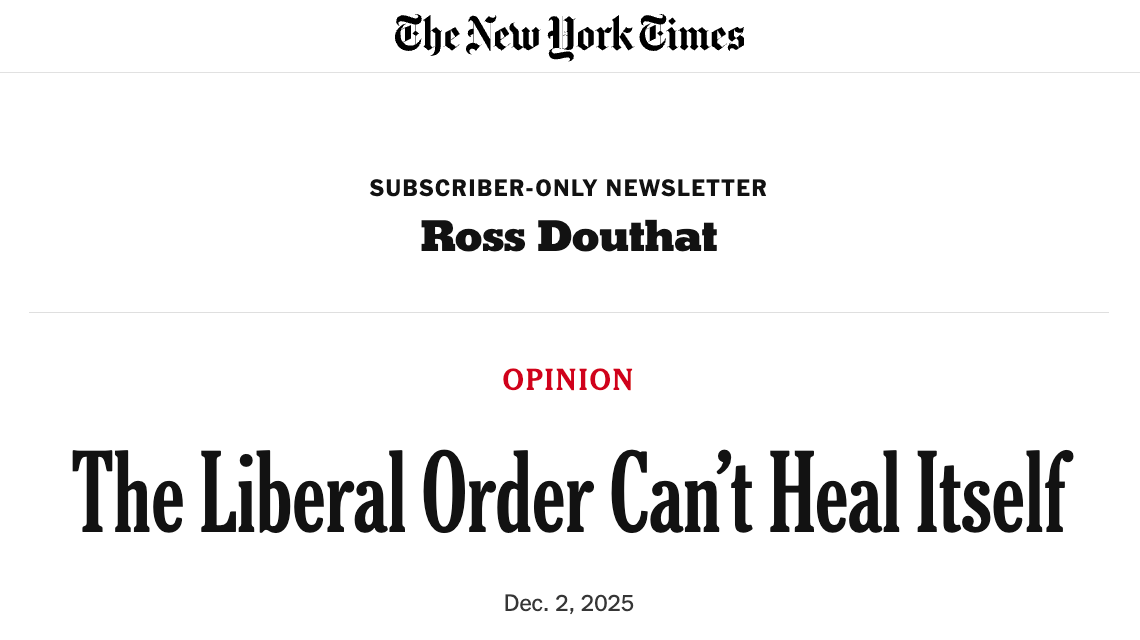
“The Liberal Order Can’t Heal Itself,” complains the man who has spent most of his career trying to strangle the liberal order.
What a fucking joke.2
If you want to be part of this community and build a better media with us, come join up. Right now. Today.
We do this together.
2. Liberal Masochism
One of the best things about our community is how deeply we engage with one another intellectually. In response to my newsletter about liberal masochism, u/PTS_Dreaming wrote an entire essay over on the Bulwark subreddit:
TL;DR: The MAGA movement isn’t driven by economic loss but by a perceived loss of cultural dominance. You cannot counter this with economic policy. The response has to be moral.
JVL has consistently argued that the “Forgotten Man” or the economically “left-behind” are not the driving force behind MAGA. I agree. But I think liberals, including JVL, often hesitate to name what really motivates MAGA because doing so feels both too easy and too validating of MAGA’s own grievance narrative.
At its core, MAGA is not an economic project. It is a cultural one. It uses political power to try to reclaim cultural dominance from what it sees as “liberalism.”
Consider the typical MAGA grievance list:
Hollywood is too liberal
The MSM has a liberal bias
“Wokeness”
“Me Too”
DEI
Socialism/Communism
Only one of these is even superficially economic and even the “socialist/communist” accusation functions more as a cultural attack than an economic one. To explain this, some historical context helps.
A Very Brief History of the GOP’s Cultural Roots
Racism in the U.S. is long, complicated, and foundational. Even the Republicans of the 1860s were not anti-racist; they were anti-slavery on moral grounds. After the Civil War, Union war heroes perpetrated brutal violence against Native Americans. From the beginning, the tension between European Christian “whiteness” and other cultures has shaped American identity.
JVL argues that Reaganism consolidated the neoliberal consensus. But that consensus predated Reagan. For much of the 20th century, the Republican Party’s liberal wing kept its illiberal wing contained. World War II was a turning point. Isolationists and proto-fascists were sidelined because the threat of European fascism was too severe. Afterward, anti-communism served as the unifying cause. But once the USSR collapsed and China ceased to function as a true communist state, that common enemy disappeared and the party began to fracture. When there is no enemy abroad, movements tend to invent one at home.
Though the John Birch Society1 was kept at arm’s length (in large part thanks to William F. Buckley Jr.), the Republican “center” moved rightward as the influence of New Deal liberalism faded. Figures like Goldwater and Buchanan gained traction, and the GOP absorbed a large bloc of Southern voters angered by the Civil Rights Movement and the federal dismantling of legalized segregation.
Several core conservative concepts today trace directly back to that cultural shift. For example:
Education: The rise of private schools and homeschooling in the South was a response to desegregation.
Elite impunity: The treatment of wealthy individuals as above accountability echoes the plantation-era social hierarchy.
Hostility toward federal courts: Conservative attacks on federal authority today mirror resentment toward the federal role in ending segregation.
Enter MAGA: A Cultural Counter-Revolution
With that background in mind MAGA’s motivation becomes clearer. For decades the Right has resented the liberal tilt of American culture. Women gaining autonomy over reproduction challenged conservative Christian patriarchy. Civil rights and affirmative action challenged the belief in a “natural social hierarchy.” Declining church attendance and demographic change signaled a shrinking white Christian majority.
Obama’s election was a cultural watershed for white America. Suddenly, it became undeniable that American culture might not be synonymous with white Christian culture. Complaints about rap, fashion, or halftime shows aren’t really about music or pants, they’re reactions to a cultural no longer centered around “whiteness”. Obama’s re-election cemented the fear: this wasn’t a fluke; the culture was changing.
Trump and MAGA emerged directly from the Tea Party backlash against America’s first Black president. Trump tapped into long-standing grievances and elevated the voices of Charlie Kirk, Chris Rufo, Ben Shapiro, and others, who weaponized those grievances into something sharper and more explicitly reactionary. With their help, Trump dragged racism and misogyny back to the cultural center.
Activists like Rufo reframed bigotry as “anti-woke” and “anti-DEI.” It’s marketing. Anti-woke sounds better than anti-Black, anti-trans, or anti-gay. But it is fundamentally about reversing cultural liberalization, not about economics.
Why Liberals Hesitate to Call MAGA What It Is
This brings us back to George Packer. Many on the left hesitate to say plainly that MAGA is built on racism, misogyny, and cultural dominance because:
They don’t want to believe their fellow citizens are genuinely bigoted.
Calling someone “racist” triggers defensiveness; almost no one sees themselves that way.
It risks strengthening the “us vs. them” mentality MAGA thrives on.
It can provoke the “Fine, call me a racist? Then I’ll act like one” reaction.
So the challenge becomes: How do we separate voters with cultural grievances from the political actors exploiting those grievances for authoritarian ends?
Packer’s economic approach has already been tested. Biden delivered bipartisan legislation that disproportionately benefited red states, yet Trump improved his performance in many of those same places in 2024.
Two Strategies to Break MAGA
I think we need a dual approach:
1. Hammer Corruption and Incompetence
Democrats must relentlessly expose the corruption inherent in Trumpism and connect it to tangible harm. The gutting of critical government services to enrich figures like Elon Musk, Peter Thiel, and Marc Andreessen should be front and center. Promise reform. Publish a Project 2028 detailing immediate actions to reverse this degradation.
2. Make Anti-MAGA a Moral Imperative
We have to frame the fight against anti-woke and anti-DEI politics as a moral struggle, much like abolitionists did. The distortion of Christianity into something fundamentally opposed to Christ’s teachings should be openly condemned. This cannot simply be about policy preferences; it has to be about right and wrong.
This is how you confront a cultural movement: with moral clarity.
I’d be interested in your thoughts on all of this, too. Please discuss.
3. NATO Is Over
I’ve written that NATO is finished a number of times and it keeps being true. News from yesterday:

The story goes on to say that Pentagon officials told NATO counterparts this week that Europe needed to lead NATO in conventional forces and intelligence. If European NATO partners do not meet this deadline, then “the U.S. may stop participating in some NATO defense coordination mechanisms.”
Here are some things not mentioned in the story:
How will this ultimatum be measured?
Did this ultimatum issue from the White House or the Pentagon?
Is this the policy of the United States, or is it just SecWAR Pete and VPJD tugging it together in the corner?
And here is what I want you to understand:
It doesn’t matter what those answers are.
It’s entirely possible that this Reuters story was leaked by Rubio in an attempt to block a Vance/Hegseth initiative.
But from the European perspective, that’s immaterial. Once your alliance partner signals that they might be unreliable, then you have to assume that they are unreliable.
NATO is over and it doesn’t matter what the next American president does. The Europeans cannot make security plans dependent on the United States.
But that’s the long term. In the short term, a story like this makes it less likely that any peace plan for Ukraine can be accepted by Europe. We are in an irrevocable process of abandoning Europe. Which means that Europe will require a strong Ukraine as a buffer between it and Russia.
As I said yesterday: Even if America woke up in 2028 and came entirely to its senses, the damage that has already been done cannot be undone except over the course of decades.
Maybe next week we’ll spend some time thinking about what comes next now that the American-led order is finished.
[Dad voice] Don’t make me turn this car around!
Long before most of you were reading this newsletter, I wrote a piece about Douthat’s fatuous brand of dishonesty: Ross Douthat and the Match Throwing Club. Treat yourself to it, right now. I promise you won’t be disappointed.
I've been glued to politics since I was a tween, and I can say confidently that there is no media company that provides what the Bulwark does. This is a community, full stop. It reminds me of my very best experiences in college - meaningful, respectful debate, with intelligent people, who have good intentions and a sense of humor. It's been a true lifeline through the Trump era - forever grateful for y'all ❤️
Top tier JVL moment in this piece. “My biggest fear is someday turning into this:”
*Crash cut to Ross Douthat*
Chefs kiss 😂