Nuking the Filibuster Is Still on the Menu
A deal to reopen government isn’t enough for Trump’s most loyal Senate Republicans.

Filibuster specter
The deal to reopen the government after nearly seven weeks of stasis may have calmed Donald Trump’s thirst to eliminate the legislative filibuster. But don’t expect for the issue to go away entirely. Nuking the filibuster, either partially (e.g., just for appropriations and continuing resolutions) or for all legislation, remains a compelling GOP interest. And it could very well be a party pursuit going forward—for a few reasons.
First, Republicans blame Democrats for the soon-to-be-concluded shutdown, which could have been prevented if there weren’t a filibuster. Second, Republicans are now convinced that Democrats will eliminate the filibuster the second they regain power. And third, and perhaps most importantly, Trump still wants the filibuster gone, and what he demands of the GOP, he most often gets.
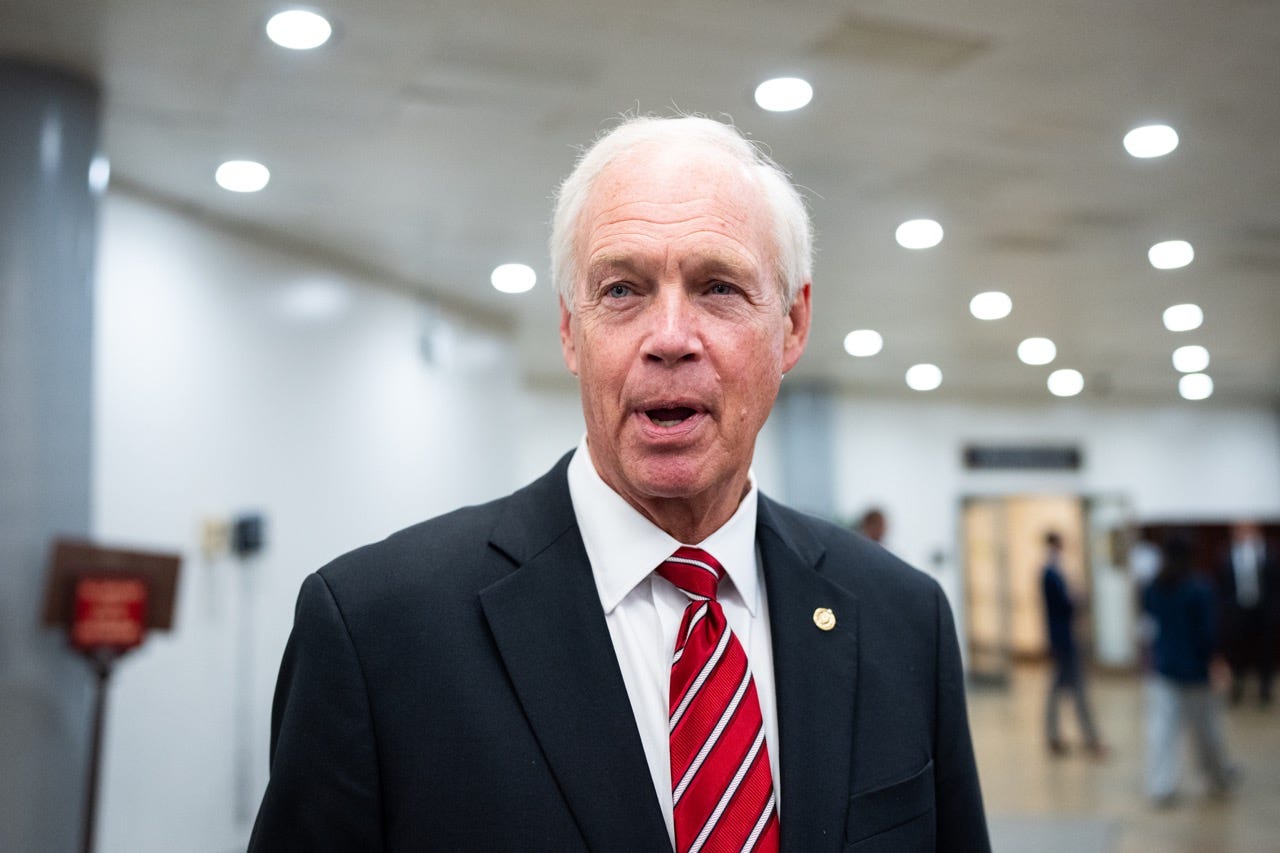
When I asked Sen. Ron Johnson (R-Wis.), one of the leading proponents of nixing the filibuster, whether the deal to reopen the government had effectively put the debate to rest for the foreseeable future, he said, “I don’t think so, because we’ve seen what the Democrats did here.”
“The only reason they kept the government shut down is they don’t want to have this president have success.” Johnson added, indicating that he will consider Democrats responsible for any change to the filibuster, even if Trump is openly pining for it. “It’s that cynical.”
“Moving forward, are they going to actually try and help us solve these problems? Pass [a] good piece of legislation for the best American public? I would guess: probably not,” Johnson concluded. “So they’ve pretty well telegraphed what their game plan is here. It’s going to be obstruction all along.”
“I don’t know,” said Sen. Ted Cruz (R-Texas) of whether Trump would continue to push for the elimination of the filibuster. Cruz has been a longtime supporter of the filibuster, both using it in his own politically motivated shutdowns and hailing it as a backstop preventing “absolute devastation.”
“There’s a natural give and take to politics,” Cruz added. “So the more obstructionist the Democrats are, the more the pushback is going to go the other direction. . . . I feel confident this is not the last time we’ve had that conversation.”
Ideologically minded Republicans like Cruz have long held the filibuster in high regard, believing it can be used to prevent the codification of more liberal or progressive policies and even prompt genuine compromise. On the flip side (although with a few exceptions), Democrats have historically hated it for how it’s been used to obstruct their legislative priorities. They believe it doesn’t compel compromise so much as force majority parties to stuff everything they can into big bills that can pass through reconciliation rules (i.e., a simple majority vote).
If populist Republicans like Johnson and Trump get their way, Democrats might be able to get the filibuster eliminated without having to actually hit the nuclear option button.
Concepts of a plan
When eight Senate Democrats negotiated a surrender in the government-shutdown fight this weekend, they secured a floor vote on extending the Affordable Care Act’s extended tax credits for a to-be-determined date in December.1 Unfortunately for them, the promised vote appears dead on arrival.
“Yeah, why would I renew something that is badly done? Why would I continue to give tens of billions of dollars to insurance companies with an inferior product?” said Sen. Lindsey Graham (R-S.C.) when asked if the promised vote is already doomed to fail. “That’s insane.”
“Everything they promised you under Obamacare has been a lie. There’s a better way of doing it,” Graham added. “I look forward to working with the president and Democrats to find that better way.”
Asked if that means a GOP-led health care plan is on the horizon—as it purportedly has been for a decade and a half—Graham said, “Yeah, you’ll expect a better deal than this.”
Great. So what better deal should we expect? No one knows. Fifteen years after the landmark Obama-era health care bill was signed into law, the details on potential replacements are still being worked out. When another reporter asked Graham to clarify whether that meant a full-fledged health plan or just an alternate proposal relating to the tax credits, the senator quickly reined it in.
“On the subsidies? That’s what we’re talking about,” Graham said. “Yeah, my belief is we should have block-granted the thing back a long time ago.”
During Trump’s first go-around as president, Graham, alongside Sens. Bill Cassidy (R-La.) and Ron Johnson (as well as former Sen. Dean Heller [R-Nev.]), introduced one of the Republican party’s last attempts to repeal and replace the Affordable Care Act. But GOP leadership ultimately pulled the proposal without bringing it up for a vote. After that, Republicans gave up on health care until some future prophecy could be fulfilled—no details allowed!
The Republicans in Congress who lived through the nightmare of repeated failures to develop and propose workable health care plans have learned their lesson. Repealing and replacing Obamacare is no longer feasible, according to Sen. Chuck Grassley (R-Iowa), the Senate’s longest-serving Republican. But younger Republicans who’ve arrived in Washington in recent years have not lived in D.C. long enough to understand the death of their dreams of ACA repeal. As a result, they still have longshot hopes to make fundamental changes to our health system, provided they can get the conditions just right.
In October, freshman Sen. Bernie Moreno (R-Ohio) told me that he thinks it might become possible to develop a Republican health care agenda, but only if they successfully strengthen or maintain their Senate majority in the upcoming midterms.
“My personal preference would be ‘Let’s do it holistically,’ but it’s probably gonna happen after the midterms, because right now Democrats just want to obstruct everything,” Moreno said. “So if we can beat them pretty soundly in the midterms, we break the fever—meaning they reject the extremists in their base and they come to their senses—where you have Democrats like Joe Manchin that are here.2 Then you can actually make a deal with the Democrats. And I think we can make that happen. We need to. It’s a big problem.”
Despite the ACA’s many troubles, health care reform is still one of the Democrats’ best polling issues—and one of Republicans’ worst. While the deal to reopen the government did not substantively address the primary health policy question in play (the coming expiration of expanded Obamacare subsidies), it could be viewed as a political victory for Democrats for how it has brought health care onto center stage a year out from the midterm elections.
Fallen angel investor
Silicon Valley gazillionaire Marc Andreessen decided to mock Pope Leo XIV’s posts about integrating ethics into technology. I have a feeling he wishes he hadn’t.
Andreessen, a venture capitalist and longtime power player in the world of tech startups and investment, dropped a meme of an insufferably smug-looking person interviewing Sydney Sweeney in his quote-tweet of a statement from the pontiff calling on workers in the artificial intelligence industry “to cultivate moral discernment as a fundamental part of their work—to develop systems that reflect justice, solidarity, and a genuine reverence for life.” Later in the evening, Andreessen deleted the post.
Writer Christopher Hale captured screenshots of the posts and analyzed the broader divide between the Catholic Church and Silicon Valley. Hale writes:
The pope had framed technological innovation as “participation in the divine act of creation,” carrying real ethical weight.
To Andreessen, however, these words smacked of “woke” moralizing. He responded with a mocking meme (invoking a trope of a hectoring left-wing interviewer) and a sarcastic swipe at Leo’s ethical and spiritual tone.
It didn’t go well for Andreessen: after a wave of criticism — including from tech folks of faith — he deleted his post in retreat. Yet the damage was done. In one impulsive tweet, Andreessen revealed Silicon Valley’s deep disdain for Pope Leo’s gospel of tech responsibility. . . .
This conflict runs deeper than a Twitter tiff; it exposes an ancient moral fault line. The tech elite’s aversion to limits hints at a familiar temptation: to “be like God.”
Read the whole thing on Substack.
An amendment from Sen. Tammy Baldwin (D-Wis.) provided a test vote for the enhanced ACA subsidies extension last night. It failed 53–47.
Manchin is no longer in the Senate; his term ended in January.
"Moving forward, are they going to actually try and help us solve these problems? Pass [a] good piece of legislation for the best American public? I would guess: probably not,” Johnson concluded. “So they’ve pretty well telegraphed what their game plan is here. It’s going to be obstruction all along.”
This may be the single most ridiculous statement any republican has made in 15 years. When was the lat time republicans "helped" pass any legislation that was good for America. Since 2011 the filibuster has been the sole governing tool of the republican party.
Ron is a disgrace to Wisconsin and the nation, says this Wisconsin voter. Get him out!