SpaceX, Late-Stage Capitalism, and the Trillionaire’s Race War
Everything, everywhere, all at once.

Warning: Today’s Triad is unlocked and free for everyone. It’s also supersized. And it’s about stuff most people don’t care about.
But it’s important because it’s the other half of our authoritarian moment. Authoritarian politics goes hand-in-hand with wealth consolidation and the perversion of markets.
So today’s newsletter is mostly spinach and not a lot of candy—but I hope you get some value out of it.
1. Das Kapital
The SpaceX IPO is tomorrow. It will be a significant moment in both American history and the history of economics. Perhaps it will be a high-water mark, or a turning point. Or maybe it will be a milepost on the path we’re on toward . . . well, we’ll get to that in a minute.
Let’s start with the trivialities.
After tomorrow, Elon Musk will be humanity’s first trillionaire. He is openly racist and responsible for the deaths of many thousands of poor, brown people.1 He is currently attempting to use a division of SpaceX to incite pogroms in Europe.
I want to be very clear about this fact. Here is Elon Musk two days ago replying to an account called DuxVul:

Who is DuxVul and what does he mean by “Reconquista”? Allow him to explain:


So that’s what Elon Musk is saying “same” to. And here he is offering another retweet, just in case no one got the message:
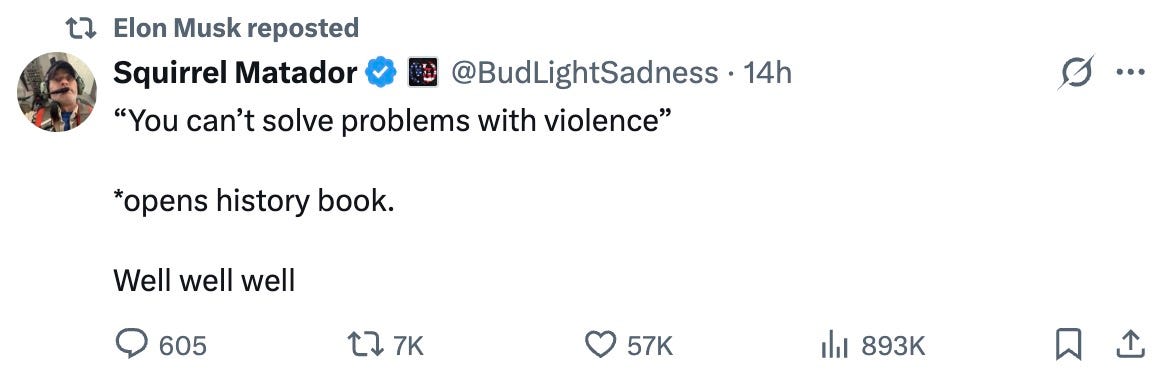
Say what you will about Mark Zuckerberg, but at least when Facebook sparked a round of ethnic cleansing, it was an accident.
Anyway: That’s the trivial stuff. To get at the systemic problem, you have to go down two levels to talk about how Musk and SpaceX turned a system designed to efficiently allocate capital into a rentier’s buffet.
2. Private Markets and Index Funds
I linked to this Garrett Baldwin piece on Tuesday and I want to put it in front of you again. It’s important.
Baldwin proposes that the public stock market has been completely transformed. Let me walk you through his thinking.
There are two forms of capital ownership: private and public.
Privately owned capital tends to be closely held. There is a business, Acme Widgets, and it is owned by a person or group of persons. And they can do (more or less) whatever they want with the business.
However, if the owners of Acme choose, they can offer to sell shares of the business to the general public. Why would they do this? Because selling shares to the public is a way to raise a lot of money. The pool of available investment dollars held by the general public is enormous. If you owned Acme and wanted to raise a bunch of money in order to expand, then taking the business public is the fastest way to get access to capital.
The catch is that publicly owned businesses have a lot of restrictions. Outside entities—such as the government and the exchange on which your company will be traded—have a host of requirements you have to fulfill in order to assure investors that they have all the relevant information and are not being defrauded.
Also: When the owners of Acme sold shares of the company to the public, they gave up some power for the governance of the company. Investors gained a say in how Acme operated. Here’s Baldwin summing up the deal:
In exchange for access to the deepest, most liquid investor base on earth, the founders accepted a set of conditions.
They diluted their ownership.
Shareholders received voting rights in relation to their financial stake.
Courts remained accessible for disputes between shareholders and directors.
Activist investors could challenge management and buy shares with voting rights, and press for changes that benefit all shareholders.
Boards answered to the people whose money they were managing.
Price discovery happened because buyers used math to decide whether the company was worth the ask, and sometimes the answer was… “No.”
This was the trade… the bargain… the exchange.
It behaved this way for centuries. There was a transfer of capital in exchange for accountability, transparency, and public governance.
That old trade no longer really exists because three things changed.
First, we saw the emergence of private markets—which are like a ghost version of public markets. For example: You have not been allowed to buy shares of SpaceX before tomorrow’s IPO, but there is a world of private individuals and entities who have already bought shares in the company. They did so through a private market.
The private market is smaller than the public market, but it’s still enormous. And it is encumbered with relatively few rules and regulations. The emergence of this enormous, parallel, lawless market meant that rapidly expanding companies (like SpaceX) could incubate themselves for a long time, growing in size and power, before finally moving to the public market.
This might sound like a good thing. But there are tradeoffs. In the era of the private market, companies can become immensely powerful before going public—which means that when they do go public, they can exert leverage over both exchanges and investors.
The second change, as Baldwin notes, began with Google’s IPO in 2004. These private market, incubated mega-companies began demanding exotic ownership structures in which stock was offered in dual-classes so that the company’s founders retained control of the business while the investors forfeited governance rights.2
In 2004, this was a big deal. Today, it’s de rigueur for IPOs over a certain size. Facebook, Snap, Lyft, Pinterest, Zoom, Palantir.
SpaceX.
You can see the deal Baldwin described unraveling: The owners still get access to enormous pools of capital—but they don’t dilute their ownership. They don’t give up control over governance. They get the best of both worlds: All the control of private ownership; all the capital of being a publicly traded company.
I can’t believe you made it this far into today’s newsletter. And there’s still more to come. If this is the kind of deep dive you get value from, consider signing up for a Bulwark+ membership. We do this every day.
Which brings us to the third change: the supremacy of index funds.
Once upon a time, normal investors—people like you and me—bought stocks in two ways. We bought shares in individual companies; or we bought funds made up of shares of many different companies.
In the old days, these funds were assembled by managers and you would pick them based on a number of factors. You’d want a fund made of small-cap businesses; one made of mid-cap businesses; one made of large-cap stocks. You’d want a fund that was built on companies from emerging markets and a fund based on stocks from developed countries.
The idea was that you’d try to balance risk and your retirement horizon. And so your fund managers would shift the contents of these baskets looking to get the best returns.
Those days are basically gone.3
Most people now invest in gigantic index funds, the theory of which is: It is impossible to efficiently pick the right stocks for a fund. It’s better to buy the entire market.
So you have the NASDAQ 100 fund, which is made up of the hundred biggest companies on the NASDAQ exchange. Or the S&P 500 fund, which is made up of the top 500 public companies.
The logic of index funds was: Don’t try to outsmart the market. Get exposure to everything. It’ll all work out in the end.
And it did. Until Elon Musk realized that he could treat index funds like a network of zombie ATMs.
The SpaceX IPO is notable for two things. First, Musk is only offering a small percentage of the company’s stock for sale. (This is known as the float.) Second, when he was shopping the IPO to various exchanges, he had them bidding against one another to give him specific terms. He was most interested in getting the exchange to change its preexisting rules in order to get SpaceX rapidly added to index funds.
Why?
Again, here’s Baldwin:
Three firms… BlackRock, Vanguard, and State Street collectively manage roughly $25 trillion in assets and control the voting power associated with an enormous share of American corporate equity.
Passive index funds now account for more than half of all U.S. equity fund assets.
The majority of 401(k) contributions flow into target-date funds that automatically allocate to index products. . . .
Money enters the retirement system through payroll deduction, flows into target-date funds selected by plan administrators, gets allocated to index products managed by a handful of firms, and lands in whatever companies the index committee has decided belong in the basket.
The ordinary investor chose none of this. . . .
This creates a buyer that is 100% different from anything that existed in classical capital markets.
A passive index fund does not ask, “Is this company worth the current price?”
Instead, it asks, “Is this company in the index?”
Elon Musk saw this and realized that the key to the SpaceX IPO wasn’t having the company be worth the price. The key was engineering a situation in which index funds were forced to bid against one another over an artificially limited supply of SpaceX stock.
Kind of like a mirror-image of the GameStop short squeeze. Baldwin:
Old-school, discretionary investors would look at fundamentals, consider valuation, weigh risk, and sometimes walk away.
A passive fund buys when the index says to buy, at whatever price the market is offering, and in whatever quantity the weighting demands.
It is a price-insensitive, mechanically obligated buyer.
And when tens of trillions of dollars operate on that basis, the market begins to reward index eligibility over fundamental quality.
SpaceX will IPO with a thin float—reportedly just 5 percent of the company’s shares will be available for purchase. After the IPO there will be a two-week period before SpaceX is fast-tracked into major index funds.4 At which point the demand will go into overdrive. Because these funds will have to buy SpaceX, no matter what the price is.
Where will funds get the money to make these purchases? They’ll have to “rebalance”—meaning that there will be a sell-off of other equities in order to finance the purchase of SpaceX. Some other index-included stocks will have to go down so that SpaceX can go up.
And those price fluctuations will have fuck-all to do with value, revenue, expected future performance, of anything we traditionally associate with capital allocation.
What SpaceX is doing is the market equivalent of gold farming, with Elon treating normal people’s indexed retirement accounts as NPC loot drops. (Read our Catherine Rampell on this from last week: “Congrats. You’re About to Unwittingly Make Elon Musk a Trillionaire.”)
This is what passes for “capitalism” in 2026.
I don’t know where we go from here, but we’re a long way from Milton Friedman. The stock market used to be a machine. Then it became a casino. Now it’s a farm that oligarchs use to socialize their risks while retaining private control of their capital.
As Baldwin says, markets have always depended on:
Friction… skepticism… and consequences.
When markets don’t have these?
What are they?
The grand irony is that Americans were told that passive investing would remove emotion, speculation, and Wall Street games from the system.
That it would democratize ownership and give ordinary people a fair shot at building wealth without being taken advantage of by those with better information and faster connections.
What happened instead is that the system automated the games.
The speculation didn’t disappear.
It moved into index construction, float engineering, governance design, and inclusion eligibility.
The ordinary people still provide the capital.
They just no longer have any mechanism to influence how it gets allocated, who it benefits, or what happens when the structure breaks.
What could possibly go wrong?
If you’ve made it this far, I’d love your thoughts on how to fix this system. Because on the one hand, it doesn’t seem impossible. This is what regulation is for.
On the other hand, I find it hard to believe that a trillionaire will ever be regulated. His chip stack is too big. He’s too powerful.
Tell me what you see around this corner.
3. Joy #2
Regular Car Reviews is a YouTube channel for gearheads who are also interested in critical literary studies. This week Brian discussed the 1998 second generation Dodge Viper within the context of object-oriented ontology.
Also, there are jokes. The best line in this essay comes while discussing the Viper’s total lack of driver-assist features. (Forget traction control; this beast doesn’t even have ABS.) Here’s Brian:
When you hear its exhaust screaming through a gated community . . . who complain anytime someone mows a lawn earlier than noon, you’ll know that only one of two things has happened.
Either your neighbor’s son Kyle got an early parole or one of the neighborhood dads has had a new self-care ritual that involves edging the grim reaper.
Glorious. Here’s the full video.
On causing deaths, you can read about it here. If you are looking for Musk’s “openly racist” stuff, here are some of his tweets from just the last couple of days.


The story of the Google IPO is even more bizarre and fascinating than that. At the time of the IPO in 2004, Google offered two classes of stock—one with ten times the voting power of the other (Class B vs. the weaker Class A). Then, a decade later, as the company continued to grow, Google’s founders got nervous that future stock issuances would further dilute their control, so they added a third class that had no voting rights (Class C).
For normie investors, like you and me. At the high-end of the wealth scale, rich people invest with boutique hedge funds that seek alpha in the old way. But you have to be high net-worth to buy into these funds.
SpaceX is being rushed into the Nasdaq 100 and Russell 1000 indices. The S&P 500 is holding out for a while.
When Elon Musk made a Nazi salute to the crowd, there were two categories of people responding to any news article that noticed that: one group of people who resolutely insisted that you were crazy, that he was just an autistic small bean doing something that no one has ever done before or since, miming throwing his heart out to the crowd, and that you would have to be crazy to interpret it as a Nazi salute. The other category of people were people who insisted that it was a Nazi salute, and that was based and awesome and you’d better get ready for the gas chambers and crematoriums because we Nazis are in charge now.
The first group of people are perfectly aware that the second group of people exist. The first group of people are aware that the surest way to get that second group of people to kill them is to stand in the way of that second group of people, and that the surest way for the first group of people to get elected is to get the votes of that second group of people.
This will hardly be the first time the stock market has looked at an ethnic category and decided that them being murdered in pogroms is a perfectly acceptable hobby for an executive to have, and certainly not anything that would obligate them to do something other than serve their own financial interests. I don’t particularly expect it to be the last.
I’m currently reading Gabriel Sherman’s “Bonfire of the Murdochs,” and I had no idea Rupert was close many times to losing control of his company.
Which again brings up the old adage, Owe the bank $100 and the bank owns you. Owe the bank $100 million and you own the bank.
Elon will own whole treasuries.
I don’t know what the answer is besides waiting for him to break everything and then start all over.