Street Vendors Hit Hard by Trump’s Assault on L.A.
“I want to live the American dream. . . . Just because I’m not a citizen doesn’t mean I don’t deserve a good life.”

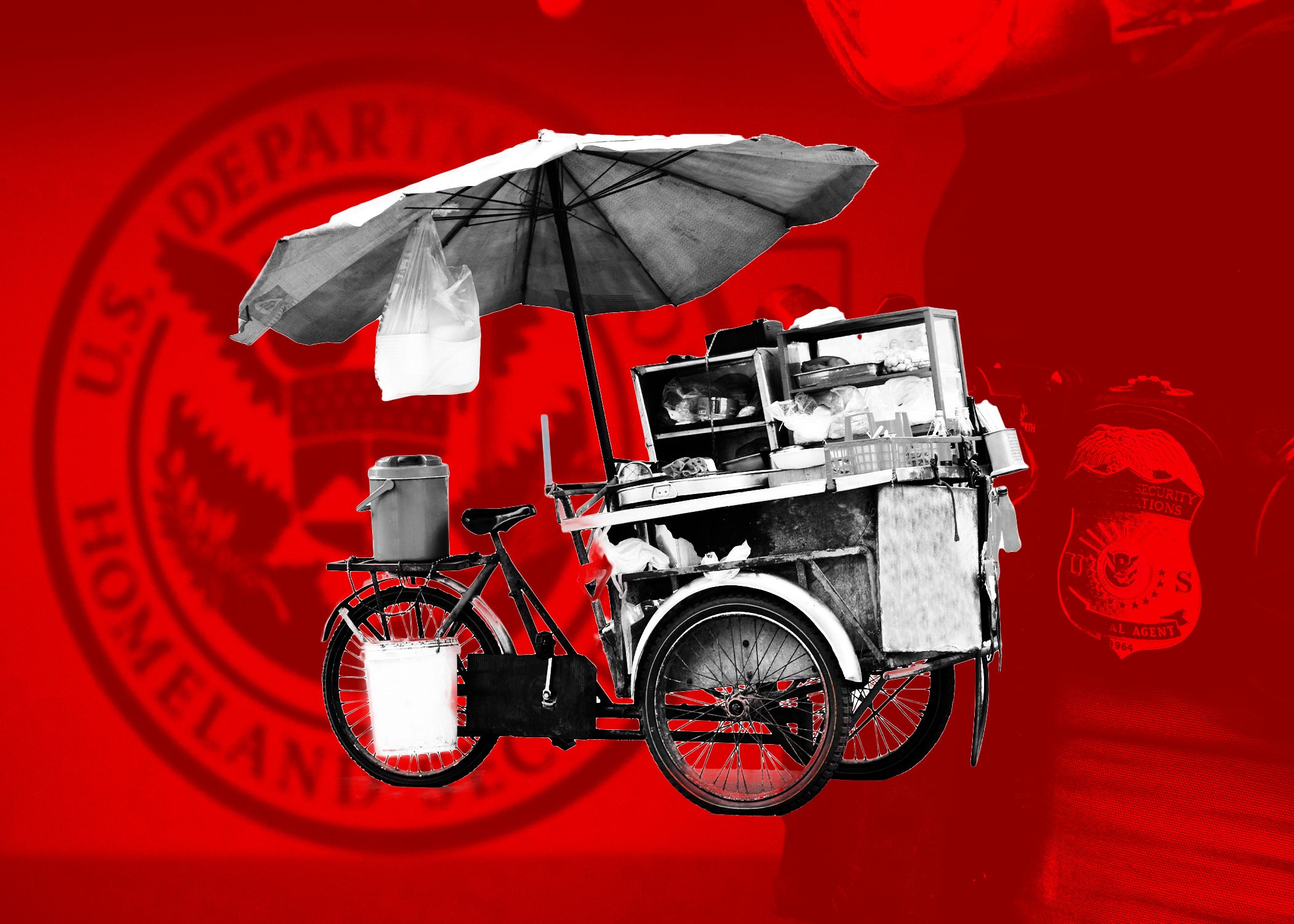
AFTER DONALD TRUMP DEPLOYED THE NATIONAL GUARD to Los Angeles last month, we saw images of ambushes outside Home Depot, rubber bullets flying, and tear gas deployed to put down anti-ICE protests.
But an attack on working immigrants is also an attack on the local economy, and while the economic effects of such actions might be less photo-ready than the scenes of violence, ICE’s abduction of street vendors (and intimidation of others) threatened their livelihoods. The consequences are now cascading outward into a community scrambling to help them.
Rudy Espinoza is one of the helpers, and boy, is he helping.
He is the executive director of Inclusive Action for the City, an economic-justice advocacy organization that is also a certified Community Development Financial Institution. That means they lend money to street vendors and small business owners to get them off the ground when they’re just starting out, or to keep them afloat during difficult times. And these are difficult times.
In light of ICE’s actions, the organization started an L.A. Street Vendor Solidarity Fund to get cash assistance to these small business owners.1 So far, they have raised $159,000 on GoFundMe and $100,000 from philanthropic sources, with the money being distributed to a network of street vendors throughout the county in the form of $500 cash cards.
The L.A. community has stepped up in a major way, too.
BLVD MRKT food hall created a “NO ICE” shirt featuring a cartoon image of an angry L.A. logo stomping on a sad, melting ice cube, with the $7,000 in shirt revenue going to the street vendor fund. Big Bar in Los Feliz created Tropic Cart Crush, a guava Mezcal–infused cocktail with watermelon, cantaloupe, pineapple, lime, jicama, agave, and tajin. (Frankly, it looks and sounds delicious.) They are similarly donating a portion of the proceeds to the street vendor fund.


“We’re thirty days into the siege here,” Espinoza told me. “Some of these vendors, if they miss one day of work, they can’t pay their rent.”
While it may seem like the group is raising a lot of money for street vendors, Espinoza is a bit frustrated by the tally so far because their similar fundraising efforts for workers affected by the Southern California wildfires earlier this year raised much more: $2.5 million.
He said the slower uptake likely owes to organizations being “worried about the political nature of what’s happening, and they don’t want to be seen supporting immigrants.”
The immigrants their donations would be supporting are people like a 27-year-old Los Angeles street vendor I’ll call Maribel, who works with her mother. (Some details are being withheld to protect her.)
Maribel is a Mexican-American woman who came to the United States at the age of 6. She was eligible for the deferred action program known as DACA when it was created, but her family didn’t have money to pay for the application, so it doesn’t cover her. In 2005, shortly after her family arrived, her mother began selling used clothes at the local flea markets, known as swap meets. Eventually, she was selling pallets full of returned clothes from stores like Walmart, Target, and Costco. Now, she and Maribel sell toys.
In May, Maribel’s father went to his court date. He never returned. The family learned he had been deported only when he called them from Mexico.
And when masked ICE officers descended on Los Angeles, raiding everything from garment districts to swap meets while grabbing workers—including U.S. citizens—and beating up landscapers, Maribel, her mother, and her U.S. citizen brother nearly became victims, too. The three of them ran and hid until the immediate danger had passed.
I asked her if she’s scared for her future, given the chaos and trauma of the last two months. Her answer stunned me.
“We’re living our normal lives. We’re not afraid,” she said. “Everybody calls us, but my mom tells them not to worry, that when you worry too much, bad things happen.”
But the state of their business is concerning. I asked her about it, and she was frank about their difficult situation.
“I would say it’s down 80 percent,” she said. “We’re lucky if we get to $100. But nothing is impossible, so we try to hustle. If we’re not selling at the store, we go to Facebook marketplace, or sell at other swap meets. But say you only make $20? If you stay at home, that’s $20 you won’t have, at least you have $20 for gas.”
Sindy Benavides, the executive director of Aquí: The Accountability Movement, which is working to make the plight—and humanity—of street vendors more visible in the media, told me she sees the impact of the Trump administration in her daily life when she goes to her doctor’s office and speaks to Señora Karen, who sells mangoes and coconut water. She used to go out nearly every day of the week, but now she sells just three days a week, parking far enough away to make sure there is no ICE activity nearby. She has been making only a fifth of what she used to make.
“Speaking to other vendors and business owners, the specific phrase in Spanish is, ‘It’s going from bad to worse,’” Benavides told me. “They don’t know if they’re going to make it to stay alive as a business.”
THERE’S A MENTAL HEALTH COMPONENT as well, Espinoza said.
He brings up the common story of children of immigrants taking phone calls in English or signing medical or legal documents for their parents who didn’t speak the language well enough. Now, some U.S. citizen children of vendors have had to take over their parents’ precarious businesses to shield them from possible ICE actions. And when it comes to the $500 cash card the organization is providing to street vendors in need, many vendors are fearful about showing up to pick it up themselves. The group has responded by organizing safe ways for vendors to receive the money, including by dropping the cards off at their homes.
“They say, ‘I’m worried of driving, can my kid go?’” Espinoza said. “I dropped off a card for a vendor two weeks ago, and they didn’t even want to come out to the sidewalk.”
“There’s a serious mental health issue here,” he said. “It’s something that’s going to be a generational thing—we will never forget what is going on now. Kids and people impacted are going to remember this forever.”
Maribel, as I mentioned, has been here since she was 6 years old. She is as American as anyone else, save for a piece of paper making it official. She told me she wants people in positions of power to understand how much she shares with everyone else in this country.
“I want to live the American dream as well,” she said. “Just because I’m not a citizen doesn’t mean I don’t deserve a good life. We just want to work, we just want to make money. We don’t want to hurt anybody. We just want to live a stress-free life, not in struggle.”
If you want to help, consider donating to the L.A. Street Vendor Solidarity Fund. Los Angeles residents or visitors: Please go pick up a Tropic Cart Crush, since I can’t, and let me know how it is—they’re selling them all through July. Espinoza tells me that on August 2, the Halo Halo Boyz, a DJ crew, are throwing a party to raise money for the L.A. Street Vendor Solidarity Fund, as well. If you go to this party, please let us know and send some pics!
There are four organizations jointly administering the fund: Inclusive Action, Community Power Collective, Public Counsel, and East LA Community Corporation.
Hey everyone, I wanted to share the GoFundMe for Maribel and her family. They’re currently dealing with an eviction and this will help her and her mom and brother get on their feet as they deal with this difficult situation. I wanted to share it here since The Bulwark family keeps reminding us how they’re looking for ways to help people. I think it’s a really beautiful and honorable thing.
https://www.gofundme.com/f/support-maribel-and-her-family?attribution_id=sl:7c9e80fb-d0f6-4a65-99d6-5585f3710c52&lang=en_US&ts=1752942914&utm_campaign=man_sharesheet_dash&utm_content=amp13_t1-amp14_t2&utm_medium=customer&utm_source=copy_link&v=amp14_t2
It doesn’t look the same here. It DEFINITELY doesn’t taste the same. I was overjoyed to see that the family who sets up their amazing Oaxacan style pop up on my corner was back the other night. My Lyft driver today was upset because the construction on his ADU was halted completely. The contractor had no labor. I have had it with this. This ‘Proud Boys, ICE Edition’ needs to end. The officers seem untrained, they are hiding, and many don’t have badges. I doubt any of them are actually law enforcement officers.