That Political Video You Just Liked Is Probably an Ad
Candidates are paying influencers to back their campaigns without proper disclosure.

Monsters, Inc.
Paid partnerships are a ubiquitous feature of video and photo–forward social media like Instagram and TikTok. Some of the posts are obvious, and they may even include tags like #ad or #sponcon (“sponsored content”) to make clear that the creator is being remunerated for their breathlessly enthusiastic opinion. But sometimes the commercial backing is not so obvious, and this sort of gray-zone #sponcon goes beyond dog food, jeans, and unnecessary supplements. It’s also getting made for political candidates.
Campaigns are starting to more heavily rely on partnerships with social media influencers to generate interest in their candidates and causes through paid endorsements and custom-ordered content—and the material is very often being served up with no disclosure informing the viewer that what they’re viewing is actually an advertisement.
In the California gubernatorial race, billionaire Democratic donor Tom Steyer has reportedly paid influencers $10 per post in support of his campaign; his failure to explain to his ad-hoc social media brigade that they need to disclose the payments in the sponsored posts likely resulted in numerous violations of a state law requiring such disclosures. (Team Steyer’s offer has since changed to a $1,000/month partnership, with the disclaimer requirement included in the new listing.) In addition, a California elections watchdog is probing his campaign for an “interview” conducted by a TikTok influencer that came with an undisclosed $10,000 honorarium.
Beyond the ethical concerns about proper disclosure, enlisting influencers carries the risk that they might turn on the campaign that recruited them, switching allegiances to rivals offering more money or even attempting to extort candidates to pony up more cash. As Kamala Harris’s 2024 digital director Rob Flaherty wrote in The Bulwark last week in his personal postmortem for the former VP’s failed presidential campaign:
There are a number of tactics that have become standard practice on the right that are probably going to move over to the left—such as paying creators under the table through LLCs for consulting contracts or otherwise. Each campaign in a 2028 primary is going to need a plan for this sort of thing. Does the money flow? If so, where from? You will encounter (as we did in 2024) creators who say something like ‘Pay me $5,000 or I’ll endorse your opponent’—what’s your plan for that?
I asked some senators of both parties whether they would try out this new approach to political advertising, if they believe it’s ethical to do so, and whether they would entertain the idea of contracting with a potentially mercurial and vengeful content creator.
“I’m very familiar with that. That’s a very common thing,” Sen. Brian Schatz (D-Hawaii) told me when I mentioned Flaherty’s claim that influencers often seemed willing to extort campaigns for higher fees. “I would also say that used to happen offline, too.”
“There’s definitely a whole world there [in which] you can interact with them, and if you choose not to form a business relationship, you can have the political equivalent of a review bomb,” Schatz added.
Schatz said that, like many policy areas, the United States’ impotent enforcement mechanisms are to blame.
“I think if we had a good Federal Election Commission—or even a functioning one—then we could do something about that,” he said.
When I asked Sen. Rick Scott (R-Fla.) about all this, he at first expressed confusion about whether these influencer payments would need to be disclosed.1 When I noted there are loopholes to legal requirements for #sponcon diclosure—for instance, paying social media partners through consultancies or LLCs, as Flaherty alluded to—Scott said dryly, “I think there’s always a risk in any check you write.”
Members of a free society make important decisions about money, political participation, and more on the basis of their best judgment of information they get through the news, and most of us nowadays consume news through our phones. Knowing whether a piece of content you’re consuming is an ad or not is crucially important for assessing its trustworthiness, which is why it helps none of us for sponsored content to go undisclosed. Unfortunately, the key decisionmaking factors are different for the candidates themselves: They can afford to add another risk to their campaigns if doing so will mean they can pull in a bit more attention during a high-stakes campaign, especially if lax enforcement nullifies the risk.
Toy Story
Artificial intelligence is the hottest new tool in the world of political campaigns. In federal and local elections, campaigns are using it to give voters the impression of things hitherto unseen—and in some cases, things that are simply unreal.
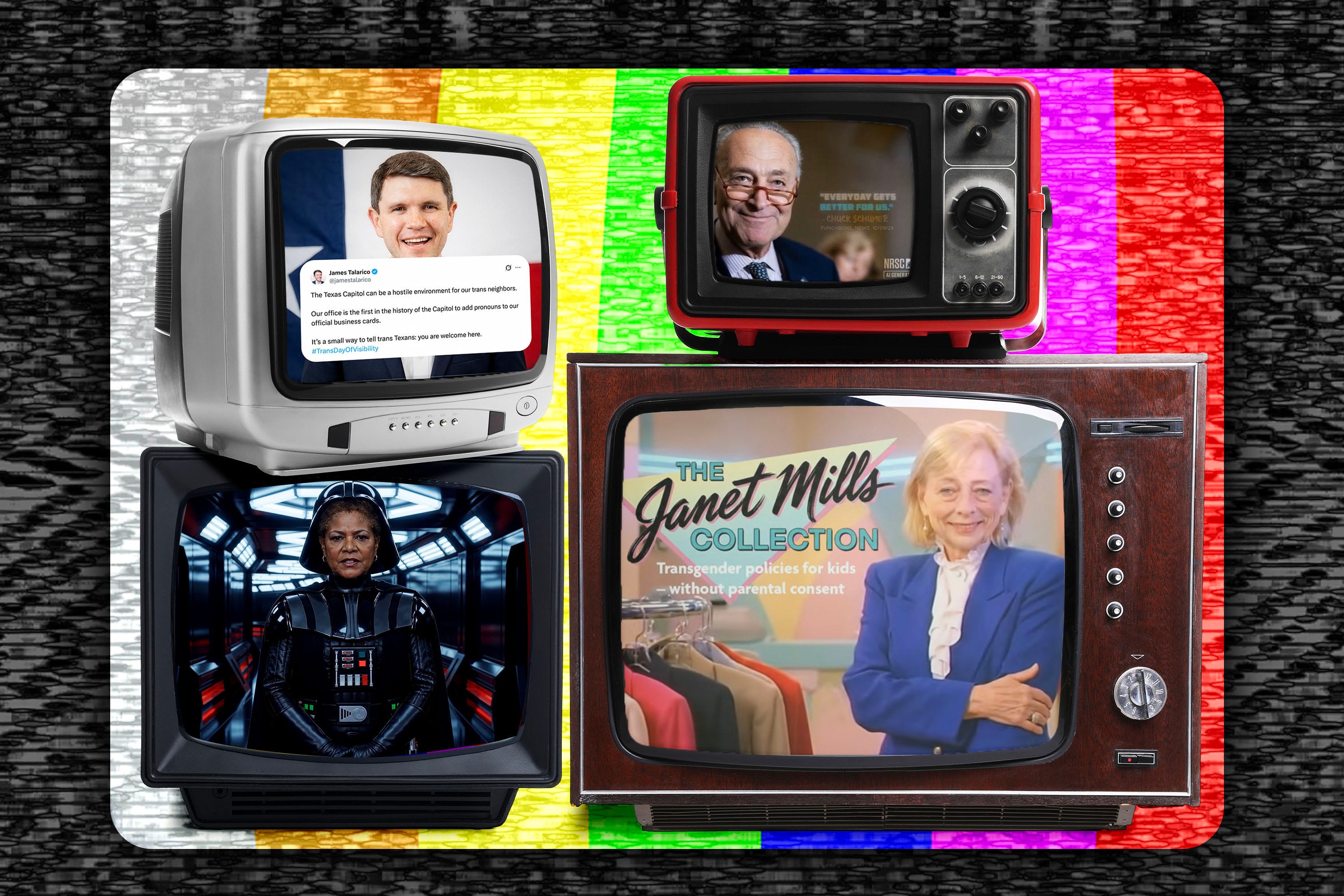
Chief among AI’s political power users is the National Republican Senatorial Committee, the campaign arm of Senate Republicans. In the past year, the NRSC has used AI to reconstruct reported quotes from Senate Minority Leader Chuck Schumer to give the misimpression he said them at a press conference, created fake direct-to-camera testimonials from Texas Senate candidate James Talarico using a mix of his tweets and totally made-up self-congratulations, and depicted Maine Governor Janet Mills in a bizarre 1980s QVC–esque commercial where she sells gender-transitioning treatments to minors, or something.
In the Los Angeles mayoral race, the officially nonpartisan but conservative-leaning Spencer Pratt has leaned heavily on AI in his campaign ads. Pratt’s fans have generated completely bonkers cinematic ads depicting his opponent, incumbent Mayor Karen Bass, as the Joker presiding over a burning city, and spun up videos of him fighting her with a lightsaber against the backdrop of (again) a burning city.
To my surprise, when I asked about this issue around the halls of the U.S. Senate Monday evening, I found quite a bit of bipartisan enthusiasm for restricting the use of AI in campaign ads, whether through required watermarking on videos and images or by banning it from political advertising altogether.
“We should have broader restrictions on AI-produced content,” Sen. Chris Murphy (D-Conn.). “I mean, watermark and identify all of it, and ban it in politics.”
“Oh heavens yes,” Sen. Cynthia Lummis (R-Wyo.) told me in response to a question about enforcing AI use in campaign materials. “Because now they’ve got to where the voice is synced up so perfectly with the AI image that you can’t tell that it’s not an AI image. You cannot tell. It should have to be disclosed.”
In the case of Pratt’s mayoral bid, in which he relies on fan-made videos he then promotes on his official channels, Lummis was less sure-footed.
“Well, I’ve never even thought about that,” she said. “I think if it’s campaign-related, it all needs to be disclosed.”
At the moment, there is one bill in the Senate to restrict AI use in campaigns, authored by Sen. Amy Klobuchar (D-Minn.). The Protect Elections from Deceptive AI Act aims to prohibit “materially deceptive audio or visual media that is generated by artificial intelligence” from being used in federal races.2
The bill has just four additional cosponsors, two Republicans and two Democrats. Unfortunately, as in most cases involving election enforcement or emerging technologies (both of which feature here), bipartisan support doesn’t necessarily translate into political will.
The Aristocats
When I can, I like to stop by estate sales. Sometimes my goal is to get a glimpse into the life of a corrupt former congresswoman; other times, I’m just after interesting and well-loved clothing items, jewelry, and knick-knacks, which can be had at estate sales for much cheaper prices than you’d ever find shopping new.
Then, too, the things left behind by those who’ve lived a full life are often of much greater value—materially and otherwise—than some fresh find from a department store. While sorting through a recently departed relative’s possessions to help organize a sale can be emotionally trying, there can be solace in knowing that someone will care for the items the way they did.
In the case of legendary fashion designer Karl Lagerfeld, that someone might be his pet cat, Choupette.
As Chris Heath writes in the Atlantic:
Karl Lagerfeld, the great German fashion designer, lived in a surreal kind of grandeur. The creative director of both Chanel and Fendi, he owned apartments in Paris, Rome, and the Côte d’Azur, as well as villas in Biarritz and his native Hamburg; enormous collections of Art Deco furniture, antique jewelry, and couture garments; a personal library of some 300,000 books, by his own estimation; paintings and sculptures by Jeff Koons, Takashi Murakami, and John Baldessari; three Rolls-Royces; a curious assemblage of 509 iPods; and hundreds of pairs of his trademark wraparound sunglasses and fingerless biker gloves. According to a conversation that his biographer, William Middleton, had with the Parisian florist Lachaume, his annual flower budget appears to have been about 1.5 million euros. Lagerfeld never married or had children, and when he died of cancer, in 2019, the press quickly began to speculate about the immense fortune he’d supposedly left behind, which a number of outlets, including Bloomberg, Forbes, and The Guardian, ballparked at more than $200 million. Speculation also swirled about where these riches would end up.
More than seven years later, here is what is known for certain about the details of Lagerfeld’s will and estate: nothing. (Under French law, such matters are not made public.) But plenty has been rumored. Various figures close to Lagerfeld have been suggested as beneficiaries, including several male models and fashion executives, his bodyguard, his housekeeper, and the princess of Monaco. Even so, from the start, one improbable name has stood out: Choupette, Lagerfeld’s blue-cream Birman cat. . . .
The swirl of scuttlebutt about other beneficiaries, totals, tax liabilities, and relative shares has continued ever since, and there are consistent reports that, even now, no one has received any money. Nonetheless, it has been printed as established fact that, separate from his will, Lagerfeld had arranged a sizable sum, generally said to be about $1.5 million (though sometimes as much as $4 million), to ensure that Choupette would live on in the style to which she had become accustomed. She was, it was sometimes claimed, the richest cat in the world.
I understand wanting someone to care for your pets after you’ve departed this world. But there’s also only so much that a cat needs. Then again, I’m not Karl Lagerfeld.
Disclosure laws vary by state. But in many cases, campaigns can create loopholes by hiring consultants who do the contracting and payments to content creators.
There are also state-level laws that can be quite detailed on the subject of allowable and disallowable use cases for AI in political ads.
Funny you should mention the pleasures of sipping cocktails while reading The Bulwark. At this very moment I am enjoying a Campari soda. I find the bitterness perfectly complements today's topic. Ciao, Joe!
What are campaigns to do? Potential voters are too lazy to do any research into the candidates. they won't read a news story. They just watch videos all day, fake or not fake. How to reach them without the influencers? (of all the horrible job titles) And influencers want to get paid. It should be revealed of course. But we are in the enshittification stage of our democracy.