‘The Fantastic Four: First Steps’ Review
It’s fine, though there’s a spikier, more interesting movie below the surface.

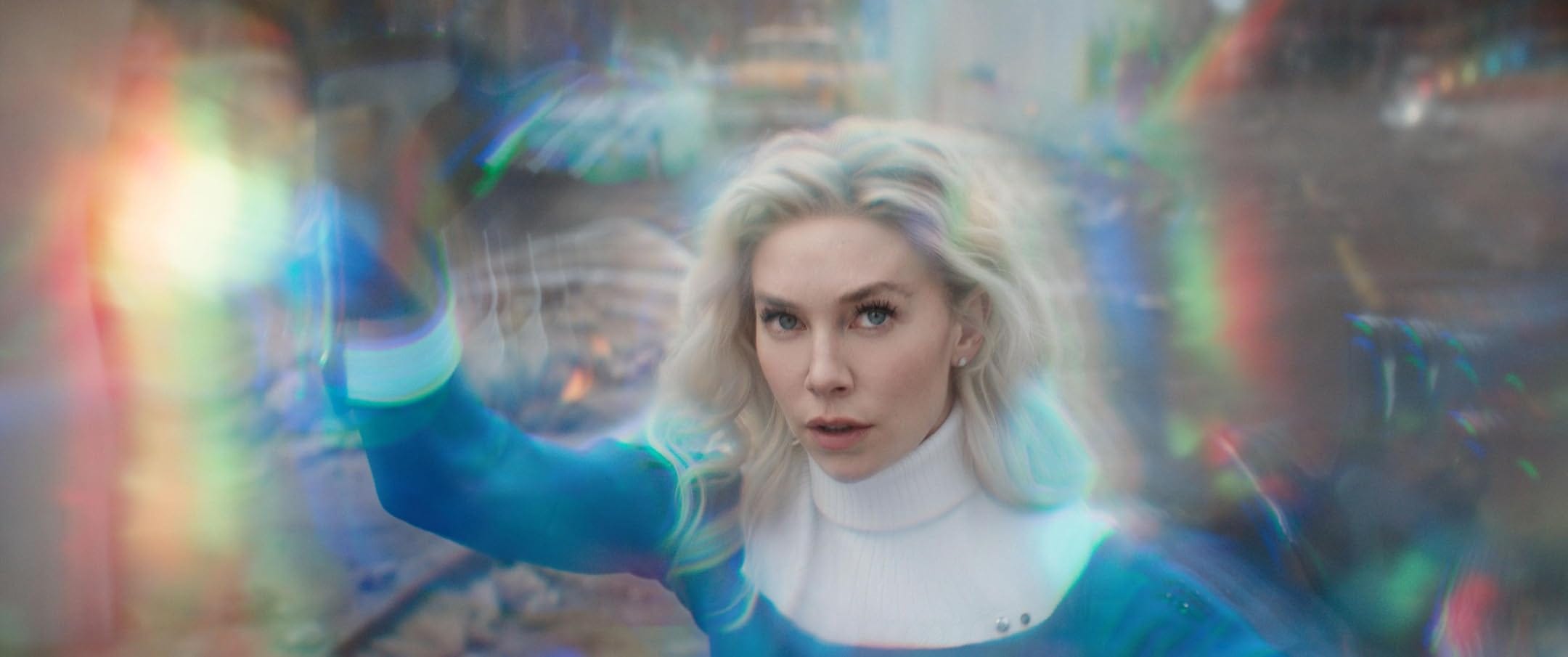
THE FANTASTIC FOUR: FIRST STEPS CALLS TO MIND the early days of the Marvel Cinematic Universe, that first run of (largely) standalone films that introduced us to Iron Man, Captain America, and Thor. It’s competent and charming, well-acted with some fun set pieces, and relatively succinct at just under two hours. Like Superman, released two weekends ago, it’s not quite an origin story—just as with the caped Kryptonian, we’ve seen the FF origin on film several times already—but it is a story that gets to the essence of the characters and introduces us to them and their world with skill and ease.
We pick up a couple of years after Reed Richards (Pedro Pascal), his wife Sue Storm (Vanessa Kirby), her brother Johnny (Joseph Quinn), and family friend Ben Grimm (Ebon Moss-Bachrach) went to space and returned to Earth with powers provided by dangerous cosmic rays. As we learn in the pre-roll package for a Dick Cavett-style interview with Reed and Sue, they are not only beloved by the planet for their heroism on a ground-level, villain-stopping basis. They are also revered as diplomats and world leaders. The Future Foundation1 seems to serve as a sort of alternate United Nations, with Reed promising to share his technology with all the world in exchange for them giving up their armies. (Doctor Doom’s Latveria, pointedly, is absent from these proceedings.)
The quartet is called upon to save the world when Shalla-Bal (Julia Garner), the argentine herald of the planet-consuming Galactus (Ralph Ineson), shows up, warning them that death approaches and nothing can be done to stop its arrival. Except, perhaps, by giving up Reed and Sue’s unborn son, Franklin, who the giant world eater believes can relieve him of his insatiable hunger.
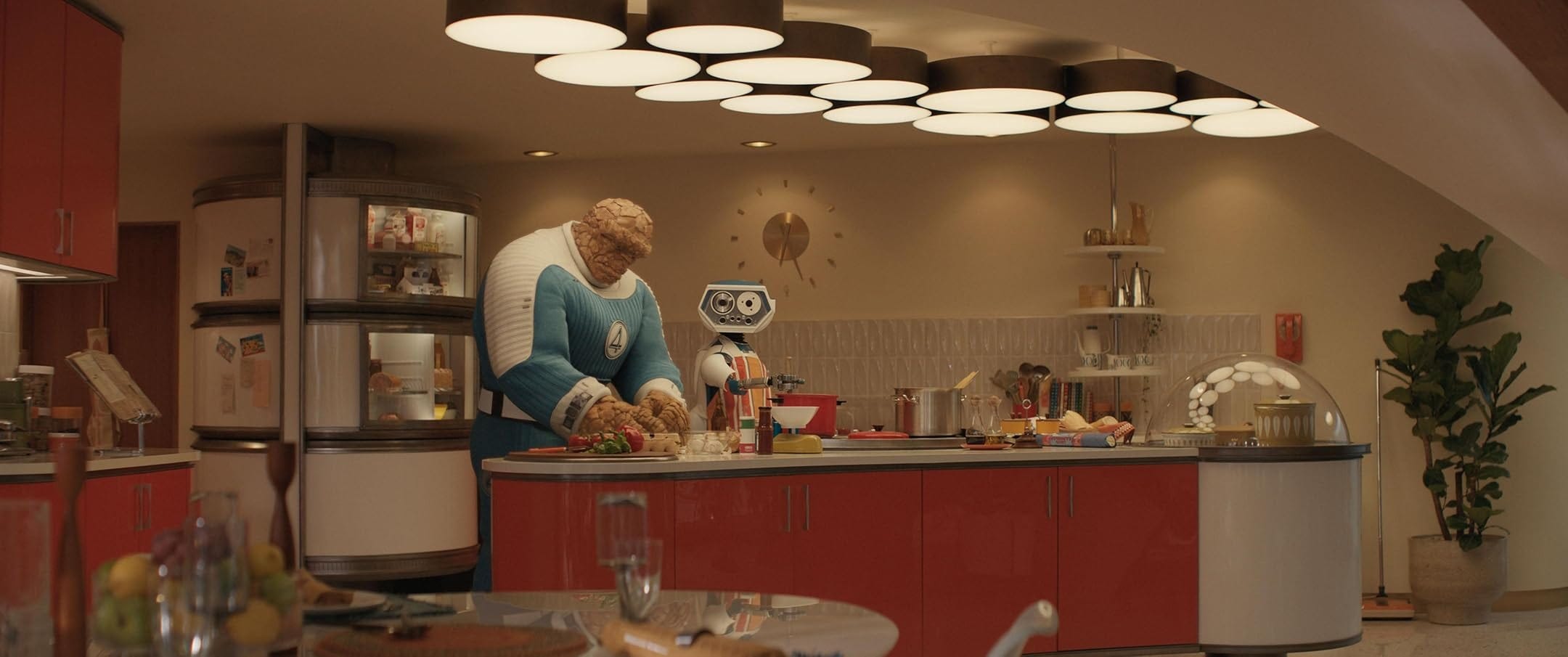
Again, this is all really well done: Director Matt Shakman has a good handle on the Fantastic Four’s family dynamics, the hotshot Johnny and the semi-morose Grimm bouncing nicely off the goofy H.E.R.B.I.E. robot that does most of the scut work around the house, like a well-trained iteration of Krypto. Three cheers for production designer Kasra Farahani, set decorator Jille Azis, and supervising art director Nick Gottschalk, who do a wonderful job of bringing the sort of Art Deco, mid-century modern look to life without making anything feel kitschy.
That said, the film doesn’t wrestle with any of its ideas about techno-optimism and world’s fair-style futurism, the promise and the peril of a post-conflict society. As solid as The Fantastic Four: First Steps is, one can’t help but feel as if there’s a spikier, more complicated movie just under the surface, one that got sanded down by the Marvel factory to make it palatable to as many people as possible by a studio that’s desperately in need of a big hit.
First off, there’s the fact that this takes place on an alternate Earth: number 828. Audiences are, understandably, weary of the whole multiverse thing that Marvel has been doing—who can keep track of which plane of existence any of this stuff has been happening on—but it’s necessary if you want this film set in the 1960s, as they clearly did. Doing so gives you flexibility to really muck with the state and the fate of the planet, and there are hints that Shakman and credited writers Josh Friedman, Eric Pearson, Jeff Kaplan, Ian Springer, and Kat Wood were leading up to something more cataclysmic than where the movie eventually settles.
Consider, for instance, the look of worry that the rest of the team shares when Reed reveals he has unleashed a roving force of drone police to automatically stop all crime in New York City. When added to the idea that the world’s nations would simply disband their armies because Richards’s magical technologies are too good to pass up—and maybe they are; this is a guy who casually solves the problems of faster-than-light travel and teleportation of living matter offscreen—you get an inkling of, well, authoritarian megalomania perpetrated by a guy who thinks he knows what’s best for everyone given that he knows everything already.
And that sort of ego-driven authoritarianism creates a solid conflict with the people of Earth. Here are folks who have given up so much autonomy to partake in a glorious future, and when the Fantastic Four is asked to make a single sacrifice for the greater good, albeit a large one—giving their son to Galactus so the insatiable, mauve-clad space giant will both spare the planet and stop consuming planets all over the galaxy—they refuse.2 And while the people of Earth do meekly protest what they see as the selfishness of Reed and Sue in the film, it is brief and treated as little more than a tantrum by scared folks. One can imagine the team’s refusal resulting in Earth making the ultimate sacrifice while Reed and company flee to another iteration of Earth more familiar with complicated superheroics—say, the Earth-616 where the MCU movies are mostly set—and Reed being presented with a new, even worse, Earth to mold in his image yet again.
These are conflicting ideals that often surface in the books on which the series is based, but they have no place here. The Fantastic Four: First Steps is too busy offering up a fine time at the movies to deal with such heady concerns. It’s a pity, but an understandable one.
Correction: This review initially referred to The Future Foundation as “The Fantastic Forum.” While this is a better name due to the pun, it is, unfortunately, inaccurate. Sonny apologizes for the confusion.
To be absolutely clear, this refusal is understandable and possibly even morally correct; it is, at best, unclear what Galactus wants to do with or to the unborn child, who is imbued with the power cosmic. But it is a choice that goes largely unexamined by both our heroes and the public at large, and the film is weaker for it.