The Influencer Infestation of Our Politics
Democrats scramble to catch up with the GOP in deploying content creators.

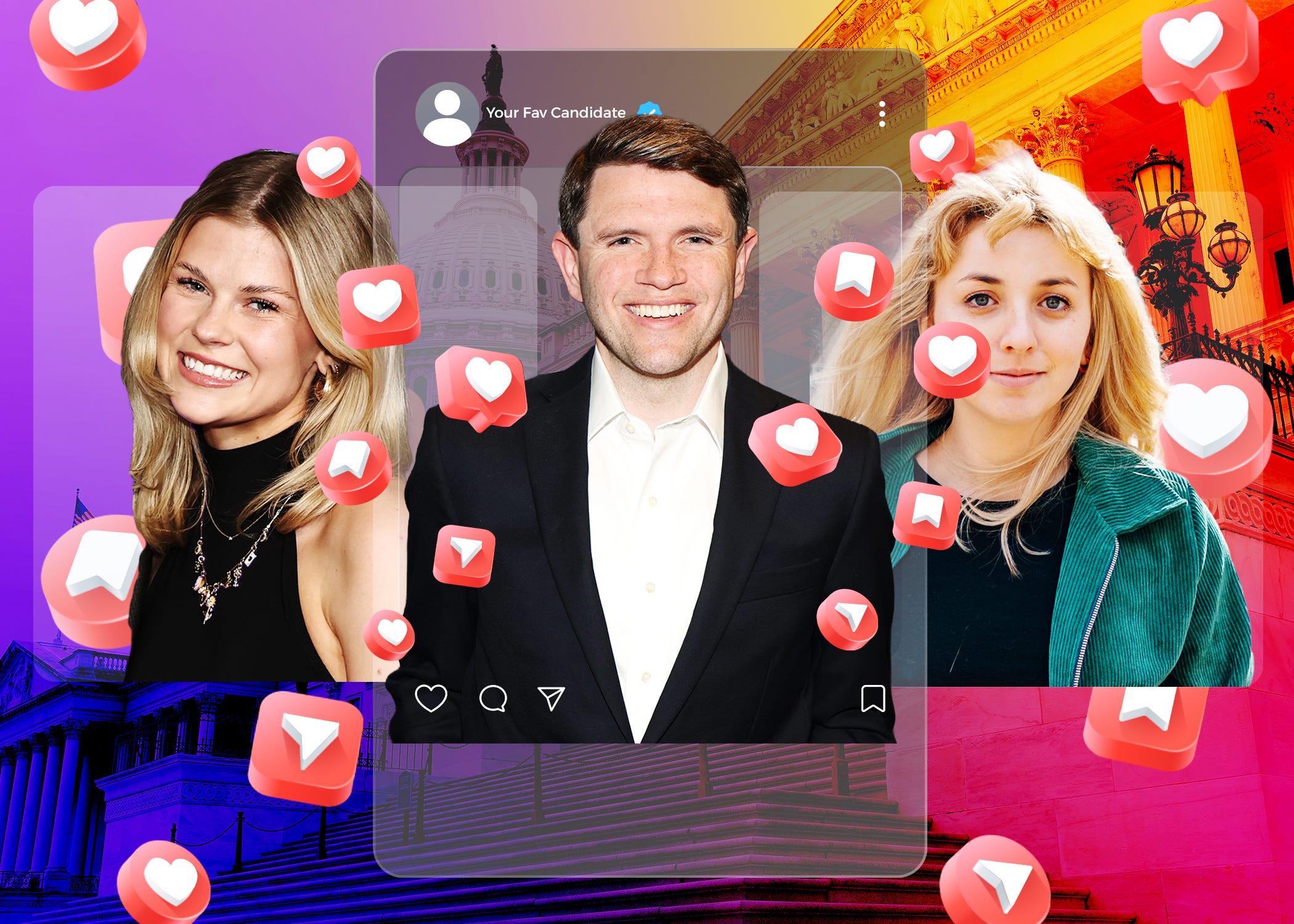
PICTURE THIS. It’s early January 2028. It’s cold, dark, and gloomy—but Democrats aren’t succumbing to seasonal depression or a post-holiday-season hangover. They’re eagerly, anxiously anticipating the first presidential primary contest, which is just a few weeks away.
The half-dozen candidates who are still in the race had imagined that the final days before voting started would be defined by debates over AI policy, health care, or housing. Instead, the race has been roiled by rumors spread by mid-tier content creators that one candidate was talking trash about another behind closed doors. During campaign stops at New Hampshire’s Red Arrow Diner and Iowa City’s Hamburg Inn, the roiling online drama is all that the actual press corps is asking the candidates about.
If that scenario sounds familiar—if not depressing—it’s because we just lived it the Texas Senate Democratic primary. The last few weeks of the race were consumed by heated debates about racism and identity politics—not because the candidates themselves had sparked them but because Morgan Thompson, a Dallas-based content creator, posted a TikTok to her nearly 200,000 followers claiming that James Talarico called his former primary opponent Colin Allred a “mediocre black man” in a private conversation. Talarico said his comments had been mischaracterized. But supporters of Allred and Talarico’s primary opponent, Jasmine Crockett, amplified Thompson. The back-and-forth became the predominant lens through which much of the national media covered the race.
For many Democratic officials, the Texas episode was a startling example of the new challenges that campaigns face. Social media influencers who are posting about and even covering their races are playing by a looser set of rules and ethics than conventional journalists. And their impact is often many magnitudes greater as voters increasingly turn to social media and short-form videos for their news. The situation in Texas underscored just how tricky the relationship can be between campaigns and those influencers who are often incentivized to start drama that gains them clout, followers, and money.
When I asked Democratic campaign operatives about the role of influencers in politics, almost every one let out an audible groan. While some well-known influencers like Carlos Eduardo Espina—who has 22 million followers across TikTok, Instagram, and Facebook—tend to be less catty and more professional, the operatives I talked to say the majority don’t exhibit those traits. And they emphasized that the internet is teeming with thousands of micro- and nano-influencers looking to make a name for themselves.
These smaller influencers still have very engaged and loyal followers—making them important communication tools for campaigns. But they often lack an understanding of how politics works—or, more specifically, an appreciation for the tradeoffs that often must be made—and tend to spread content that revolves around conflict and misinformation.
“Wild West,” “tinderbox,” and “chaos ecosystem” were just a few of the phrases that Democratic campaign staffers used to describe this era of political influencers.
“The 2028 primary, the whole discourse, all the news cycles: There’s a world in which they’re all rooted in things—true or untrue—that start from influencers,” said Democratic strategist Andrew Mamo.
As the midterms get nearer, campaigns are scrambling to figure out how to navigate these relationships. There are basic organizational questions that have to be sorted out, such as who on the campaign should manage creators. Is it the responsibility of the digital team, which typically oversees online content? Or should it be the press secretary, who deals with reporters? “It’s a weird in-between zone,” said Parker Butler, former director of digital rapid response on Kamala Harris’s presidential campaign.
Aside from the issue of editorial standards, there are also questions about money and transparency. The Federal Election Commission does not require influencers to disclose when they are paid to promote political candidates or causes, which has allowed a network of dark money groups to buy online influence almost unnoticed. Some Democratic staffers said creators have demanded campaigns pay them thousands of dollars to post a positive video and threatened to go negative on those campaigns if they don’t agree to the fee.
The lack of transparency about who is paying for what content has also fueled bitter speculation among staffers about whether rival campaigns are behind negative TikToks. Days before the March 17 Illinois primary, MS Now reported that a secretive political organization called Democracy Unmuted was offering content creators $1,500 to make negative videos about Kat Abughazaleh, a candidate for the 9th Congressional District.1
“It’s going to be a disaster,” said Democratic strategist Caitlin Legacki when I asked how influencers could, um, influence the 2028 primary. “Part of what’s hard about it is some of these things are organic and reflect the individual opinions of the creators. And some of them aren’t. And because there’s less transparency around this, it’s really hard for viewers to make those distinctions.”
Last year, the journalist Taylor Lorenz published an investigation in Wired about the dark underbelly of paying political influencers for content. According to her reporting, the Chorus Creator Incubator Program—which was originally sponsored by a liberal dark money group called the Sixteen Thirty Fund—offered dozens of high-profile progressive, pro-Democratic influencers thousands of dollars a month to support their work. Lorenz wrote that they did so under the condition that they not acknowledge the existence of the program or that their content was being paid for, though a person familiar with the operation stressed that there were no such demands—either for secrecy or around the type of content created. After the report came out, some creators denied taking the money.
Maria Comstock, an influencer who posts videos satirizing D.C. stereotypes (such as Capitol Hill staffers) as well as Q&As with former spies,2 told me that every creator has a different standard for transparency with their followers. “I’ve had funders ask me not to [disclose that I was being paid] before,” she said, “and I’m like, ‘Absolutely not.’ It’s just rude to my audience.” Comstock also emphasized that content creators are ultimately small business owners who rely on their accounts to generate money.
The opaqueness of the political influencer market incentivizes everyone to get in on the game. No candidate can know for sure that their primary opponents aren’t using social media pay-to-play against them. So the safe bet is to quietly hire some social media champions of their own.
The incentives get even stronger when it comes to the general election, as Republicans are known to be far more aggressive at paying off social media influencers than Democrats. Pay-for-post schemes have been rampant throughout the conservative commentariat during the Trump years (as studiously documented by my colleague Will Sommer). One reason being that there is just a lot more money at play.
In a recent LinkedIn post about the economics of political content creation, Comstock wrote that she was offered $2,000 in 2024 by a left-leaning group to create political content—and $36,000 by a right-leaning group.
“Because of my values, I worked with organizations on the left and declined the offers on the right. But let’s be honest: For many creators, that delta makes the decision for you,” she wrote in the post. “And if you’re a lifestyle, sports, or comedy creator who doesn’t deeply care about politics? The incentive structure nudges you in one direction.”
Between the prisoner’s dilemma of buying social clout and the amount of money that right-leaning groups are apparently spending on online influence, Democrats have plenty of reason to believe that they have to figure out how to work with content creators, however painful (or expensive) that process might be.
“The MAGA movement has been freaking stellar in this space, where they’ve been building these comms hubs for decades,” said Linh Nguyen, a Democratic digital strategist, arguing that her side of the aisle was still playing catch up. “They’ve known the role of influencers for years.”
🫏 Donkey Business:
— Speaking of influencers, the Democratic party is at odds over how friendly it should be with the streamer Hasan Piker. A self-described socialist, Piker has around 4.5 million followers across YouTube and Twitch and is often talked about as the Joe Rogan of the left. But he’s faced accusations of being antisemitic and defending terrorist groups and has raised eyebrows for recent trips he’s taken to Cuba and China. In a recent Wall Street Journal opinion piece, Jonathan Cowan and Lily Cohen of the center-left think tank Third Way argued: “Piker is anti-American, antiwomen, anti-Western and antisemitic. No Democrat should engage with him. All should seek to push him to the fringe, where he belongs.”
So when Abdul El-Sayed, who is running in Michigan’s competitive Democratic primary for Senate, announced that he’d be campaigning with Piker next month, it set off another round of questions among party leaders about how to engage with influencers who hold some controversial views but have a loyal and engaged follower base.
My open tabs:
— The 2026 Midterms Are Critical. But 2032 Could Be Existential.
— Sorry, Mom. You’re Chatting With an A.I. Agent, Not Your Son.
— The Real March Madness Is the Corporate Race to Ink Viral Stars
This story has been updated with additional reporting.
Abughazaleh lost the race, coming in second to Evanston Mayor Daniel Biss.
What a job!
>>> " Instead, the race has been roiled by rumors spread by mid-tier content creators that one candidate was talking trash about another behind closed doors. During campaign stops at New Hampshire’s Red Arrow Diner and Iowa City’s Hamburg Inn, the roiling online drama is all that the actual press corps is asking the candidates about."
I think there's a good bit of difference between what very online people see or think about the sorts of news that gains traction on social media, versus reality.
It's not that what people post on social media isn't at all important, it obviously has some impacts (or you might say -influence-?) on things in the real world.
It's just that social media is not real, it's all astro-turfed, it's all algorithmically curated to enflame people's passions and bypass the cerebrum/cerebellum and go straight into their amygdalas. People will say they're sooooo mad about something online and then once they put their phone down they actually don't care at all about it. I don't think the Talrico / Crockett / Alred race comments actually had much impact in Texas from what I've seen of the polling, results, exit polling, etc.
I think the real-world stuff is what really matters to voters, and substantive stuff is actually what people are thinking about in polling booths.
Now that said -- traditional mainstream media is decrepit and dying, so I will not be surprised if the media can't help but talk about fake social media stuff in January 2028. But that is a story about the institutional decay of the "actual press corps."
My comment is only tangentially related to this article, but I am very worried about the Democrats messaging in general. Republicans were able to tar Biden with issues about his son’s laptop very effectively. I heard about it all the time from my MAGA friends. Yet I hear only brief and incomplete snippets about Trump’s crypto scandals and the grift associated with ‘prediction’ markets. For some reason, Democrats are not very effective at hammering these things home to the public.